
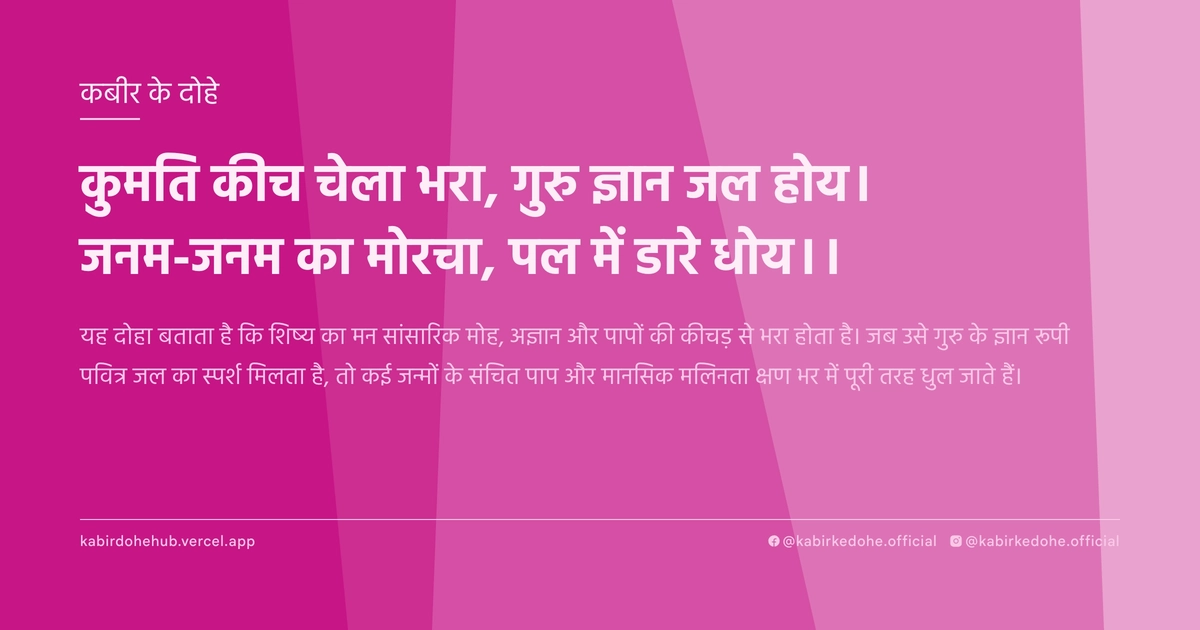
कुमति कीच चेला भरा, गुरु ज्ञान जल होय।
जनम-जनम का मोरचा, पल में डारे धोय।।
Kumati keech chela bhara, guru gyan jal hoye. Janam-janam ka morcha, pal mein daare dhoye.
इस पृष्ठ पर इस कबीर दोहे का अर्थ (meaning), हिंदी व्याख्या और अंग्रेज़ी अनुवाद, दार्शनिक विश्लेषण और व्यावहारिक जीवन सीख दी गई है। यह दोहा गुरु महत्व (The Guru's Importance) विषय से जुड़ा है — Kabir doha meaning and explanation in Hindi and English.
अर्थ (Meaning):
यह दोहा बताता है कि शिष्य का मन सांसारिक मोह, अज्ञान और पापों की कीचड़ से भरा होता है। जब उसे गुरु के ज्ञान रूपी पवित्र जल का स्पर्श मिलता है, तो कई जन्मों के संचित पाप और मानसिक मलिनता क्षण भर में पूरी तरह धुल जाते हैं।
This couplet illustrates that the disciple's mind is saturated with the mire of worldly attachments, ignorance, and accumulated sins. When the purifying waters of the Guru's spiritual knowledge touch the soul, the grime of countless lifetimes is washed away in a single instant of awakening.
व्याख्या (Interpretation):
यहाँ 'कीच' केवल बाहरी गंदगी नहीं, बल्कि अहंकार, वासना और अविद्या का प्रतीक है जो आत्मा को ढके रहती है। गुरु का ज्ञान 'जल' के समान है, जो न केवल साफ करता है बल्कि जीवन देता है। यह निरगुण भक्ति का सार है, जहाँ ईश्वर किसी मूर्ति में नहीं बल्कि ज्ञान के प्रकाश में मिलता है। अद्वैत वेदांत के अनुसार, आत्मा शुद्ध है, लेकिन माया की परतें उसे मैला दिखाती हैं। गुरु वह उत्प्रेरक है जो इस भ्रम को तोड़ता है। यह विरोधाभास है कि जिसे हम जन्मों का संचय मानते हैं, वह एक सच्चे बोध के क्षण में विलीन हो जाता है। अंततः, यह जीव और ब्रह्म के मिलन की प्रक्रिया है जहाँ द्वैत समाप्त हो जाता है।
Here, 'mire' (keech) does not signify physical dirt but symbolizes the ego, lust, and avidya (ignorance) that shroud the soul. The Guru's knowledge is likened to 'water,' which not only cleanses but sustains life. This embodies the essence of Nirgun Bhakti, where the Divine is found not in idols but in the light of consciousness. According to Advaita Vedanta, the Atman is inherently pure, yet the layers of Maya create the illusion of impurity. The Guru acts as the catalyst that shatters this delusion. It is a profound paradox that the karmic baggage of lifetimes can be annihilated in a single moment of genuine realization. Ultimately, this represents the dissolution of duality and the merging of the individual self into the universal Brahman.
दार्शनिक विश्लेषण (Philosophical Analysis):
कबीर के समय का समाज कर्मकांडों और बाहरी दिखावे में जकड़ा हुआ था। लोग गंगा स्नान या तीर्थयात्रा को मोक्ष का साधन मानते थे, लेकिन कबीर ने इसे 'बाहरी कीचड़' कहा। उन्होंने तर्क दिया कि जब तक मन का मैल नहीं जाता, तब तक जल का स्नान व्यर्थ है। यह दृष्टिकोण सूफी मत के 'इश्क-ए-हकीकी' (ईश्वरीय प्रेम) से मिलता-जुलता है, जहाँ आंतरिक शुद्धि ही एकमात्र मार्ग है।
दार्शनिक रूप से, यह दोहा 'चित्त शुद्धि' की प्रक्रिया को दर्शाता है। अद्वैत वेदांत में, अज्ञान (Avidya) ही वह पर्दा है जो हमें अपनी वास्तविक प्रकृति से दूर रखता है। गुरु का ज्ञान इस पर्दे को फाड़ देता है। कबीर यहाँ जाति और धर्म के भेदों को नकारते हुए केवल 'ज्ञान' को सर्वोच्च मानते हैं, जो किसी भी सामाजिक बंधन से ऊपर है।
मनोवैज्ञानिक स्तर पर, 'जन्म-जन्म का मोरचा' हमारे अवचेतन में दबे पुराने संस्कारों और मानसिक प्रवृत्तियों (Samskaras) को दर्शाता है। ये संस्कार हमें बार-बार उन्हीं गलतियों को दोहराने पर मजबूर करते हैं। ज्ञान का जल इन गहरे पैटर्न्स को तोड़ता है, जिससे व्यक्ति अपनी पुरानी पहचान से मुक्त होकर एक नई चेतना में प्रवेश करता है।
कबीर का प्रहार उन पाखंडियों पर है जो केवल मंत्रोच्चार या माला फेरने से शुद्धि चाहते हैं। उनके लिए वास्तविक शुद्धि वह है जो अहंकार का पूर्ण विनाश (annihilation of ego) करे। जब 'मैं' मिटता है, तभी 'वह' (परमात्मा) प्रकट होता है। यह शून्य की अवस्था है जहाँ कोई द्वंद्व नहीं बचता।
अंततः, यह शिक्षण हमें बताता है कि आध्यात्मिक प्रगति रैखिक नहीं है, बल्कि यह एक 'क्वांटम जंप' की तरह है। एक क्षण का सही बोध वर्षों की तपस्या से अधिक शक्तिशाली हो सकता है, बशर्ते शिष्य पूरी तरह समर्पित और ग्रहणशील हो।
During Kabir's era, society was shackled by rigid rituals and external displays of piety. People viewed river baths or pilgrimages as the primary means of salvation, but Kabir termed this 'external mire.' He argued that until the filth of the mind is removed, physical bathing is futile. This perspective aligns with the Sufi concept of 'Ishq-e-Haqiqi' (Divine Love), where internal purification is the only authentic path.
Philosophically, this couplet depicts the process of 'Chitta Shuddhi' (purification of the consciousness). In Advaita Vedanta, Avidya (ignorance) is the veil that separates us from our true nature. The Guru's knowledge acts as the blade that cuts through this veil. Kabir rejects caste and religious divisions, elevating 'Gyan' (knowledge) as the supreme authority, transcending all social constructs.
On a psychological level, the 'grime of lifetimes' represents the deep-seated Samskaras—latent impressions and mental tendencies stored in the subconscious. These patterns compel us to repeat the same errors. The water of knowledge disrupts these deep patterns, allowing the individual to shed their old identity and enter a state of heightened consciousness.
Kabir attacks the hypocrites who seek purity through mere chanting or the mechanical use of prayer beads. For him, true purification is that which achieves the total annihilation of the ego. When the 'I' vanishes, the 'Divine' manifests. This is the state of Shunya (void), where all duality ceases to exist.
Ultimately, this teaching suggests that spiritual progress is not always linear but can occur as a 'quantum leap.' A single moment of genuine realization can be more powerful than years of asceticism, provided the disciple is completely surrendered and receptive.
मूल संदेश (Core Message):
- अज्ञानता की परतें आत्मा की चमक को ढक लेती हैं।
- बाहरी शुद्धि व्यर्थ है यदि आंतरिक मैल बना रहे।
- सच्चा गुरु वह है जो अहंकार का विसर्जन करे।
- एक क्षण का बोध जन्मों के कर्मों को मिटा सकता है।
- शुद्धता का अर्थ है स्वयं के वास्तविक स्वरूप में लौटना।
- Layers of ignorance obscure the radiance of the soul.
- External purity is futile if internal grime persists.
- A true Guru is one who facilitates the dissolution of ego.
- A single moment of awakening can erase lifetimes of karma.
- Purity means returning to one's original, primordial nature.
व्यावहारिक उदाहरण (Practical Example):
वाराणसी के एक पुराने घाट पर माधव नाम का एक वृद्ध नाविक रहता था। वह स्वभाव से अत्यंत क्रोधी और लालची था, और अक्सर अन्य नाविकों के साथ झगड़ा करता था। वह मानता था कि उसकी कड़वाहट उसके भाग्य में लिखी है और वह इसे बदल नहीं सकता।
एक दिन उसकी नाव में एक शांत, फकीर स्वभाव का संत सवार हुआ। माधव ने अपनी आदत के अनुसार संत से बदतमीजी की, लेकिन संत ने बिना विचलित हुए केवल एक मुस्कान दी और माधव की आँखों में गहराई से देखा।
संत ने माधव से कहा, 'तू नाव की गंदगी तो रोज साफ करता है, पर उस मन की कीचड़ का क्या जो तुझे खुद से दूर कर रही है?' माधव को पहली बार महसूस हुआ कि उसकी क्रोध की आदत वास्तव में एक मानसिक कैद है।
उस संत के शब्दों ने माधव के भीतर एक बिजली जैसी कौंध पैदा की। उसे समझ आया कि वह अब तक केवल बाहरी दुनिया से लड़ रहा था, जबकि असली युद्ध उसके भीतर था।
उस क्षण, माधव का अहंकार टूट गया। उसने महसूस किया कि उसकी सारी कड़वाहट वास्तव में एक गहरे डर और अकेलेपन का परिणाम थी।
उसने संत के चरणों में गिरकर क्षमा मांगी। यह केवल एक माफी नहीं थी, बल्कि उसके पुराने व्यक्तित्व का अंत था।
अगले कुछ महीनों में, माधव पूरी तरह बदल गया। वह अब घाट का सबसे दयालु व्यक्ति बन गया, जो दूसरों की मदद के लिए हमेशा तैयार रहता था।
उसने अपनी नाव को केवल सवारी ढोने का साधन नहीं, बल्कि सेवा का माध्यम बना लिया।
गाँव वाले हैरान थे कि जो व्यक्ति कभी गाली देता था, वह अब शांत और सौम्य कैसे हो गया।
माधव की यह रूपांतरण यात्रा दिखाती है कि कैसे एक सही शब्द और सही गुरु का मार्गदर्शन वर्षों के संचित क्रोध को एक पल में धो सकता है।
On an ancient ghat in Varanasi lived an elderly boatman named Madhav. He was naturally irritable and greedy, often clashing with other boatmen. He believed his bitterness was written in his destiny and could never be changed.
One day, a serene, dervish-like saint boarded his boat. Madhav, true to his nature, spoke rudely to the saint, but the saint remained unperturbed, offering only a smile and a deep, piercing gaze into Madhav's eyes.
The saint asked, 'You clean the grime of your boat every day, but what about the mire of the mind that keeps you distant from yourself?' For the first time, Madhav realized that his habit of anger was actually a mental prison.
The saint's words triggered a bolt of lightning within Madhav. He understood that he had been fighting the external world, while the real battle was raging inside him.
In that instant, Madhav's ego collapsed. He realized that all his bitterness was merely a byproduct of deep-seated fear and loneliness.
He fell at the saint's feet in total surrender. This was not just an apology, but the death of his old persona.
Over the following months, Madhav transformed completely. He became the most compassionate man on the ghat, always ready to help others.
He turned his boat from a mere tool for earning money into a vehicle for selfless service.
The villagers were astonished that the man who once shouted insults was now the embodiment of peace and gentleness.
Madhav's journey of transformation demonstrates how a single right word and the guidance of a true master can wash away lifetimes of accumulated anger in a moment.
अभ्यास मार्गदर्शन (Practice Guidance):
- प्रतिदिन 20 मिनट मौन रहकर यह विचार करें कि आपकी कौन सी आदतें 'मानसिक कीचड़' (क्रोध, ईर्ष्या, अहंकार) हैं।
- एक डायरी लिखें जिसमें आप अपने उन व्यवहारों को दर्ज करें जो आपके वास्तविक स्वरूप के विपरीत हैं, और फिर उन्हें 'ज्ञान के जल' से मिटाने का संकल्प लें।
- जब भी क्रोध आए, रुककर खुद से पूछें: 'क्या यह मैं बोल रहा हूँ, या मेरा पुराना संस्कार?'
- निदान चेकलिस्ट: यदि आप दूसरों की गलतियों पर तुरंत प्रतिक्रिया देते हैं, तो कीचड़ अभी मौजूद है; यदि आप साक्षी भाव से देख पाते हैं, तो शुद्धि शुरू हो चुकी है।
- Spend 20 minutes daily in silence, contemplating which habits constitute your 'mental mire' (anger, jealousy, ego).
- Maintain a journal recording behaviors that contradict your true nature, then consciously resolve to dissolve them with the 'water of knowledge.'
- Whenever anger arises, pause and ask: 'Is this the True Self speaking, or is it an old conditioned pattern?'
- Diagnostic Checklist: If you react instantly to others' mistakes, the mire remains; if you can observe with detachment (Sakshi Bhava), the purification has begun.
चिंतन प्रश्न (Reflection Questions):
- वह कौन सा 'मुखौटा' है जिसे आप दुनिया के सामने पहनते हैं, लेकिन वह आपके आंतरिक सत्य को दबा रहा है?
- क्या आप वास्तव में ज्ञान चाहते हैं, या केवल अपनी वर्तमान मान्यताओं की पुष्टि करने वाला कोई गुरु?
- आपके जीवन का वह कौन सा 'पुराना मोरचा' (संस्कार) है जिसे आप बार-बार दोहराते हैं?
- यदि आपका अहंकार आज पूरी तरह मिट जाए, तो आपके व्यक्तित्व का क्या बचेगा?
- क्या आपकी आध्यात्मिक खोज केवल एक मानसिक व्यायाम है या यह आपके व्यवहार में बदलाव ला रही है?
- What is the 'mask' you wear for the world that actively suppresses your internal truth?
- Do you truly seek knowledge, or are you merely looking for a Guru who validates your existing beliefs?
- What is that 'ancient grime' (Samskara) in your life that you find yourself repeating incessantly?
- If your ego were to vanish completely today, what would remain of your personality?
- Is your spiritual pursuit merely a mental exercise, or is it manifesting as a tangible change in your behavior?