
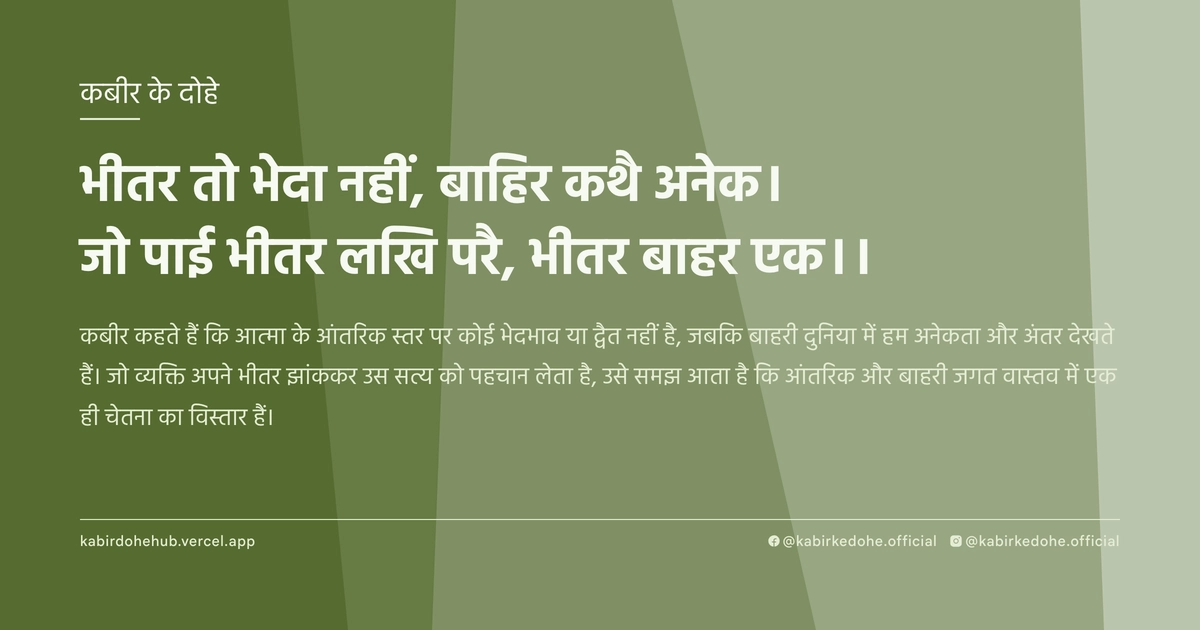
भीतर तो भेदा नहीं, बाहिर कथै अनेक।
जो पाई भीतर लखि परै, भीतर बाहर एक।।
Bhitar to bheda nahi, bahir kathai anek. Jo paai bhitar lakhi parai, bhitar bahar ek.
इस पृष्ठ पर इस कबीर दोहे का अर्थ (meaning), हिंदी व्याख्या और अंग्रेज़ी अनुवाद, दार्शनिक विश्लेषण और व्यावहारिक जीवन सीख दी गई है। यह दोहा निर्गुण ब्रह्म (Nirguna Brahman) विषय से जुड़ा है — Kabir doha meaning and explanation in Hindi and English.
अर्थ (Meaning):
कबीर कहते हैं कि आत्मा के आंतरिक स्तर पर कोई भेदभाव या द्वैत नहीं है, जबकि बाहरी दुनिया में हम अनेकता और अंतर देखते हैं। जो व्यक्ति अपने भीतर झांककर उस सत्य को पहचान लेता है, उसे समझ आता है कि आंतरिक और बाहरी जगत वास्तव में एक ही चेतना का विस्तार हैं।
Kabir asserts that within the core of the soul, there is no division or duality, although the external world presents a facade of endless multiplicity. He suggests that once a seeker realizes the truth within, the perceived boundary between the inner self and the outer universe dissolves into a singular, unified existence.
व्याख्या (Interpretation):
इस दोहे का शाब्दिक अर्थ है कि आंतरिक जगत में कोई भेद नहीं है। रूपक के स्तर पर, 'भीतर' वह शून्य या साक्षी भाव है जहाँ अहंकार विलीन हो जाता है। 'बाहिर' माया का वह पर्दा है जो हमें अलग-अलग धर्मों, जातियों और शरीरों में बाँटता है। यह निर्गुण भक्ति का सार है, जहाँ ईश्वर किसी मूर्ति में नहीं बल्कि सर्वव्यापी चेतना में है। अद्वैत वेदांत के अनुसार, यह 'अहं ब्रह्मास्मि' की स्थिति है। जब साधक इस एकता को अनुभव करता है, तो द्वैत का भ्रम समाप्त हो जाता है। यह विरोधाभास है कि हम जिसे खोजने बाहर जाते हैं, वह वास्तव में हमारे भीतर ही स्थित है।
Literally, the verse claims there is no division within. Metaphorically, 'within' refers to the state of the Witness or the Void where the ego ceases to exist. 'Outside' represents the veil of Maya, which fragments reality into disparate religions, castes, and physical forms. This is the essence of Nirgun Bhakti, where the Divine is not a localized idol but an omnipresent consciousness. In the light of Advaita Vedanta, this mirrors the realization of 'Aham Brahmasmi' (I am Brahman). When the seeker experiences this unity, the illusion of duality vanishes. It presents the central paradox of human existence: the truth we seek in the external world is already anchored within our own being.
दार्शनिक विश्लेषण (Philosophical Analysis):
कबीर का यह विचार उनके युग के कट्टरपंथी धार्मिक विभाजन के विरुद्ध एक सशक्त प्रहार था। उस समय समाज कर्मकांडों और बाहरी पहचानों में उलझा था, जिसे कबीर ने 'बाहिर' की अनेकता कहा है। वे तर्क देते हैं कि मंदिर, मस्जिद और तीर्थयात्राएं केवल बाहरी आडंबर हैं जो आत्मा को सत्य से दूर ले जाते हैं।
दार्शनिक रूप से, यह दोहा अद्वैत वेदांत के 'एकमेवादितीयम्' (एक ही है, दूसरा कोई नहीं) के सिद्धांत से मेल खाता है। कबीर यहाँ यह समझा रहे हैं कि विविधता केवल एक आभास है। जैसे समुद्र की हज़ारों लहरें अलग दिखती हैं लेकिन अंततः वे केवल पानी हैं, वैसे ही मनुष्य की विविधता केवल ऊपरी आवरण है।
सूफीवाद के 'वहदत-अल-वुजूद' (अस्तित्व की एकता) के साथ इसका गहरा संबंध है। सूफी संत भी मानते हैं कि ईश्वर और सृष्टि अलग नहीं हैं। कबीर इस विचार को सरल भाषा में प्रस्तुत कर यह बताते हैं कि जब तक हम 'मैं' और 'तू' के भेद में रहेंगे, हम सत्य को नहीं पा सकते।
मनोवैज्ञानिक स्तर पर, यह अहंकार के विसर्जन की प्रक्रिया है। अहंकार वह दीवार है जो 'भीतर' और 'बाहिर' को अलग करती है। जब यह दीवार गिरती है, तो व्यक्ति केवल एक शरीर नहीं रहता, बल्कि संपूर्ण ब्रह्मांड के साथ एकाकार हो जाता है।
अतः, कबीर का संदेश केवल धार्मिक नहीं, बल्कि एक आध्यात्मिक क्रांति है। वे हमें बाहरी पहचानों को त्यागकर उस आंतरिक मौन में उतरने के लिए प्रेरित करते हैं जहाँ कोई भेद नहीं बचता। यह सत्य की वह स्थिति है जहाँ प्रेमी और प्रियतम, या भक्त और भगवान, एक हो जाते हैं।
Kabir’s insight serves as a potent critique of the rigid religious divisions of his era. During his time, society was entangled in ritualism and external identities, which Kabir categorizes as the 'multiplicity of the outside.' He argues that temples, mosques, and pilgrimages are mere external ornaments that distance the soul from the ultimate truth.
Philosophically, this verse aligns with the Advaita Vedanta principle of 'Ekamevadvitiyam' (One without a second). Kabir explains that diversity is merely an appearance. Just as thousands of waves in an ocean appear distinct yet are fundamentally just water, human diversity is but a superficial covering.
There is a profound connection here to the Sufi concept of 'Wahdat-al-Wujud' (Unity of Existence). Sufi mystics similarly believe that the Creator and the creation are not separate. Kabir translates this complex metaphysical idea into simple language, suggesting that as long as we maintain the distinction between 'I' and 'Thou,' truth remains elusive.
On a psychological level, this describes the process of ego dissolution. The ego is the wall that separates the 'inner' from the 'outer.' When this wall collapses, the individual ceases to be a mere body and merges with the cosmic consciousness.
Thus, Kabir’s message is not merely religious but an invitation to a spiritual revolution. He urges us to shed external labels and descend into that inner silence where no division remains. This is the state of truth where the lover and the beloved, or the devotee and the Divine, become one.
मूल संदेश (Core Message):
- बाहरी विविधता केवल एक पर्दा है, सत्य एक ही है।
- अहंकार ही वह दीवार है जो हमें अलग करती है।
- भीतर की शांति ही बाहरी दुनिया का वास्तविक रूपांतरण है।
- जब 'मैं' मिटता है, तब केवल 'एक' शेष रहता है।
- सच्ची भक्ति कर्मकांडों में नहीं, बल्कि अद्वैत के अनुभव में है।
- External diversity is but a veil; the Truth is one.
- The ego is the only wall that creates separation.
- Inner peace is the only true transformation of the outer world.
- When the 'I' vanishes, only the 'One' remains.
- True devotion lies not in rituals, but in the experience of non-duality.
व्यावहारिक उदाहरण (Practical Example):
वाराणसी के घाटों पर रहने वाली एक वृद्ध विधवा, जानकी, का जीवन केवल दूसरों की सेवा और कठोर नियमों में बीता था। वह मानती थी कि मोक्ष केवल कठिन तपस्या और बाहरी शुद्धता से मिलता है। वह अक्सर उन लोगों को तिरस्कार से देखती थी जो उनके अनुसार 'अशुद्ध' थे या अलग धर्म के थे।
एक दिन, जानकी ने एक युवा साधु को देखा जो घाट की सीढ़ियों पर बैठकर चुपचाप मुस्कुरा रहा था। जब जानकी ने उससे उसकी साधना के बारे में पूछा, तो साधु ने केवल इतना कहा, 'माँ, आप जिसे बाहर ढूंढ रही हैं, वह आपके भीतर ही शांत बैठा है। बाहर की भीड़ तो केवल एक शोर है, असली संगीत तो भीतर है।'
जानकी को यह बात पहले तो अजीब लगी, लेकिन उसने प्रयोग करने का निर्णय लिया। उसने अपनी बाहरी रस्मों को कम किया और प्रतिदिन एक घंटा मौन रहकर अपने भीतर के विचारों को देखना शुरू किया।
शुरुआत में, उसे अपने भीतर क्रोध, ईर्ष्या और पुराने दुखों का अंबार दिखा। उसने महसूस किया कि जिसे वह 'बाहरी अशुद्धि' कहती थी, वह वास्तव में उसके अपने मन की गंदगी थी।
धीरे-धीरे, मौन की गहराई में उसे एक ऐसा बिंदु मिला जहाँ न कोई जाति थी, न कोई धर्म, और न ही कोई दुख। उसे अनुभव हुआ कि वह जिसे 'दूसरा' मानकर घृणा करती थी, वह वास्तव में उसी चेतना का हिस्सा था जो उसके अपने भीतर धड़क रही थी।
एक शाम, जब उसने एक गरीब, अछूत कहे जाने वाले व्यक्ति को भूख से तड़पते देखा, तो उसे उसमें कोई 'पराया' नहीं दिखा। उसे लगा जैसे वह स्वयं भूखा है।
उसने बिना किसी संकोच के अपना भोजन उस व्यक्ति को दे दिया। उस क्षण, जानकी के चेहरे पर एक ऐसी शांति थी जो उसने दशकों की तपस्या में नहीं पाई थी।
उसने महसूस किया कि जब भीतर का भेद मिट गया, तो बाहर की दुनिया की अनेकता अब उसे डराती नहीं थी, बल्कि वह उसे एक सुंदर विविधता के रूप में दिखने लगी।
जानकी अब केवल एक विधवा या एक भक्त नहीं थी; वह एक ऐसी आत्मा बन गई थी जिसने भीतर और बाहर के एकत्व को पा लिया था। उसकी पूरी जीवनशैली बदल गई और वह सबके लिए प्रेम का स्रोत बन गई।
Janaki, an elderly widow living on the ghats of Varanasi, had spent her life adhering to strict rituals and the belief that salvation came only through rigorous penance and external purity. She often looked with disdain upon those she deemed 'impure' or belonging to different faiths.
One day, Janaki noticed a young monk sitting on the steps of the ghat, smiling serenely. When she asked about his practice, the monk simply replied, 'Mother, that which you seek outside is sitting silently within you. The crowd outside is merely noise; the real music is within.'
Janaki initially found this perplexing, but she decided to experiment. She reduced her external rituals and began spending an hour each day in absolute silence, observing the currents of her own mind.
At first, she encountered a mountain of anger, jealousy, and old griefs. She realized that what she had labeled as 'external impurity' was actually the residue of her own mental turmoil.
Gradually, in the depths of that silence, she found a point where there was no caste, no religion, and no suffering. She experienced that the person she had hated as 'the other' was actually a part of the same consciousness pulsing within her.
One evening, seeing a poor man, branded as untouchable, suffering from hunger, she no longer saw a stranger. She felt as if she herself were the one starving.
Without a moment's hesitation, she gave her meal to him. In that instant, a peace settled upon Janaki's face that she had not found in decades of formal penance.
She realized that once the internal division vanished, the multiplicity of the external world no longer frightened her; instead, it appeared as a beautiful diversity.
Janaki was no longer just a widow or a devotee; she became a soul that had realized the oneness of the inner and outer realms. Her entire way of being transformed, and she became a source of unconditional love for all.
अभ्यास मार्गदर्शन (Practice Guidance):
- प्रतिदिन 20 मिनट 'साक्षी भाव' का अभ्यास करें: अपने विचारों को बिना किसी निर्णय के देखें, जैसे आप किसी और के विचार देख रहे हों।
- आत्म-पूछताछ जर्नल: प्रतिदिन एक ऐसी स्थिति लिखें जहाँ आपने किसी को 'अलग' या 'पराया' महसूस किया, और फिर सोचें कि उस व्यक्ति में आपका अपना कौन सा गुण मौजूद है।
- व्यवहार परिवर्तन: दिन में कम से कम एक बार किसी ऐसे व्यक्ति की मदद करें जिससे आपकी वैचारिक या सामाजिक असहमति हो, यह महसूस करते हुए कि आप स्वयं की ही सेवा कर रहे हैं।
- निदान चेकलिस्ट: क्या मैं अभी भी लोगों को उनके लेबल (धर्म, पद, जाति) से पहचान रहा हूँ? क्या मैं अपनी शांति के लिए बाहरी परिस्थितियों पर निर्भर हूँ? यदि हाँ, तो मैं अभी भी 'बाहिर' के भ्रम में हूँ।
- Practice 20 minutes of 'Witness Consciousness' daily: Observe your thoughts without judgment, as if you are watching someone else's mind.
- Self-Inquiry Journaling: Record one instance daily where you felt someone was 'different' or 'other,' then identify a quality in them that also exists within you.
- Behavioral Shift: At least once a day, help someone with whom you have a conceptual or social disagreement, consciously feeling that you are serving yourself.
- Diagnostic Checklist: Am I still identifying people by their labels (religion, status, caste)? Am I dependent on external conditions for my peace? If yes, I am still trapped in the illusion of the 'outside'.
चिंतन प्रश्न (Reflection Questions):
- मेरा वह कौन सा 'लेबल' है जिसे मैं सबसे अधिक महत्व देता हूँ, और यदि वह छिन जाए तो मेरी पहचान क्या होगी?
- मैं दूसरों में जिन कमियों को देखता हूँ, क्या वे वास्तव में मेरे अपने भीतर के अनसुलझे द्वंद्व हैं?
- क्या मेरी करुणा केवल उन लोगों के लिए है जो मेरे जैसे हैं, या वह वास्तव में सार्वभौमिक है?
- डिजिटल युग में, मेरा 'ऑनलाइन व्यक्तित्व' मेरे 'आंतरिक सत्य' से कितना अलग है और यह विभाजन मुझे कैसे प्रभावित करता है?
- यदि दुनिया का हर व्यक्ति मेरे जैसा सोचने लगे, तो क्या यह दुनिया अधिक शांतिपूर्ण होगी या अधिक अराजक?
- Which 'label' do I value most in myself, and if it were stripped away, what would remain of my identity?
- Are the flaws I perceive in others actually reflections of my own unresolved internal conflicts?
- Is my compassion reserved only for those like me, or is it truly universal?
- In the digital age, how different is my 'online persona' from my 'internal truth,' and how does this divide affect me?
- If every person in the world thought exactly as I do, would the world be more peaceful or more chaotic?