
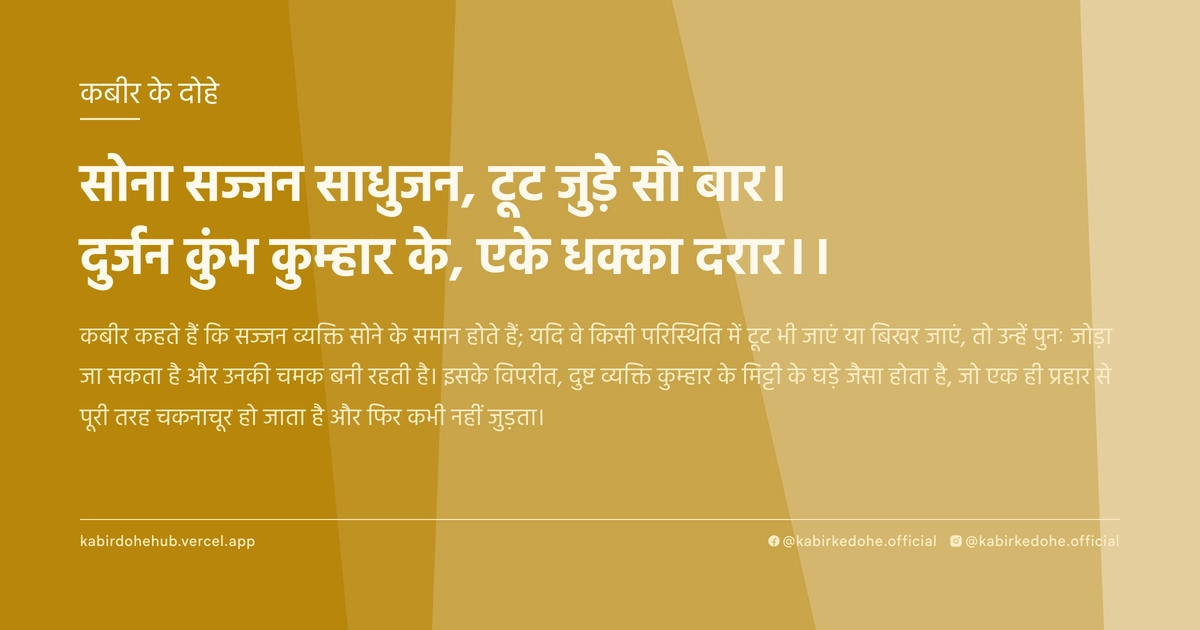
सोना सज्जन साधुजन, टूट जुड़े सौ बार।
दुर्जन कुंभ कुम्हार के, एके धक्का दरार।।
Sona sajjan sadhujan, toot jude sau baar. Durjan kumbh kumhar ke, eke dhakka darar.
इस पृष्ठ पर इस कबीर दोहे का अर्थ (meaning), हिंदी व्याख्या और अंग्रेज़ी अनुवाद, दार्शनिक विश्लेषण और व्यावहारिक जीवन सीख दी गई है। यह दोहा विनम्रता (Humility) विषय से जुड़ा है — Kabir doha meaning and explanation in Hindi and English.
अर्थ (Meaning):
कबीर कहते हैं कि सज्जन व्यक्ति सोने के समान होते हैं; यदि वे किसी परिस्थिति में टूट भी जाएं या बिखर जाएं, तो उन्हें पुनः जोड़ा जा सकता है और उनकी चमक बनी रहती है। इसके विपरीत, दुष्ट व्यक्ति कुम्हार के मिट्टी के घड़े जैसा होता है, जो एक ही प्रहार से पूरी तरह चकनाचूर हो जाता है और फिर कभी नहीं जुड़ता।
Kabir asserts that virtuous people are like gold; even if they are broken or fragmented by circumstances, they can be fused back together a hundred times without losing their intrinsic value. Conversely, a wicked person is like a clay pot made by a potter; a single blow is enough to shatter them completely, leaving them beyond repair.
व्याख्या (Interpretation):
यह दोहा मानवीय स्वभाव की आंतरिक संरचना और लचीलेपन का विश्लेषण करता है। 'सोना' यहाँ केवल धातु नहीं, बल्कि शुद्ध चेतना और अहंकार-रहित आत्मा का प्रतीक है। जब एक साधु या सज्जन व्यक्ति जीवन के संघर्षों से टूटता है, तो वह अपनी विनम्रता और सत्य के प्रति निष्ठा के कारण पुनः एकीकृत हो जाता है, क्योंकि उसका आधार 'निर्गुण' सत्य है। इसके विपरीत, 'कुंभ' या मिट्टी का घड़ा उस व्यक्ति का प्रतीक है जो केवल बाहरी पहचान, अहंकार और माया के खोल में लिपटा है। मिट्टी का घड़ा कठोर दिखता है लेकिन वह भंगुर (brittle) होता है। जब अहंकार का टकराव सत्य से होता है, तो वह व्यक्ति पूरी तरह बिखर जाता है क्योंकि उसके पास कोई आंतरिक आध्यात्मिक आधार नहीं होता। यह अद्वैत वेदांत के उस सिद्धांत को दर्शाता है जहाँ शुद्ध आत्मा (सोना) अविनाशी है, जबकि मायावी अहंकार (मिट्टी) क्षणभंगुर है।
This couplet analyzes the internal structure and resilience of human nature. 'Gold' here is not merely a metal, but a symbol of pure consciousness and an ego-less soul. When a virtuous person is broken by life's struggles, they reintegrate through humility and devotion to truth, as their foundation is the 'Nirgun' (formless) reality. In contrast, the 'Kumbh' or clay pot symbolizes the individual wrapped only in external identity, ego, and Maya. A clay pot appears solid but is inherently brittle. When the ego clashes with ultimate truth, the person shatters completely because they lack an internal spiritual anchor. This reflects the Advaita Vedanta principle where the pure Atman (gold) is indestructible, while the illusory ego (clay) is ephemeral and fragile.
दार्शनिक विश्लेषण (Philosophical Analysis):
ऐतिहासिक रूप से, कबीर का समय सामाजिक और धार्मिक कट्टरता का था। इस दोहे के माध्यम से वे बाहरी कर्मकांडों के बजाय आंतरिक गुणों की श्रेष्ठता स्थापित करते हैं। वे यह स्पष्ट करते हैं कि व्यक्ति की पहचान उसके कुल या जाति से नहीं, बल्कि उसके चरित्र की 'शुद्धता' से होती है। सोना आग में तपकर और अधिक शुद्ध होता है, ठीक उसी तरह जैसे एक साधक दुखों की अग्नि में तपकर अपनी आत्मा को निखारता है।
दार्शनिक स्तर पर, यह सूफी मत के 'फना' (अहंकार का विनाश) और 'बका' (शाश्वत अस्तित्व) के विचार से मेल खाता है। सज्जन व्यक्ति वह है जिसने अपने छोटे 'मैं' को मिटाकर सार्वभौमिक 'मैं' को पा लिया है। जब वह टूटता है, तो वह वास्तव में अपनी सीमाओं को तोड़ता है ताकि वह अनंत से जुड़ सके।
यहाँ 'कुम्हार' का संदर्भ माया के उस सृजन से है जो हमें यह विश्वास दिलाता है कि हम अलग-अलग इकाइयाँ हैं। मिट्टी का घड़ा एक सीमित आकार है। जो व्यक्ति अपनी पहचान केवल इस सीमित आकार (शरीर, पद, प्रतिष्ठा) से जोड़ता है, वह जीवन के एक छोटे से झटके से भी मानसिक रूप से ध्वस्त हो जाता है।
कबीर यहाँ यह चेतावनी देते हैं कि अहंकार का कठोरता (rigidity) वास्तव में कमजोरी है। लचीलापन, जो सोने की तरह है, वास्तव में सर्वोच्च शक्ति है। यह शक्ति केवल तभी आती है जब व्यक्ति 'अहंकार' का त्याग कर 'विनम्रता' को अपनाता है।
अंततः, यह विश्लेषण हमें यह समझने के लिए प्रेरित करता है कि आध्यात्मिक विकास का अर्थ केवल ज्ञान प्राप्त करना नहीं, बल्कि अपने स्वभाव को 'मिट्टी' से 'सोने' में बदलना है—अर्थात, नश्वरता से अमरता की ओर और अहंकार से आत्म-बोध की ओर बढ़ना।
Historically, Kabir's era was marked by social and religious rigidity. Through this doha, he establishes the superiority of internal virtues over external rituals. He clarifies that a person's identity is defined not by lineage or caste, but by the 'purity' of their character. Just as gold becomes purer after being heated in fire, a seeker refines their soul through the fires of suffering.
Philosophically, this aligns with the Sufi concepts of 'Fana' (annihilation of the ego) and 'Baqa' (eternal subsistence). The virtuous person is one who has dissolved the small 'I' to realize the universal 'I'. When such a person 'breaks,' they are actually breaking their limitations to merge with the Infinite.
The reference to the 'potter' pertains to the creation of Maya, which leads us to believe we are separate entities. The clay pot represents a limited form. One who identifies solely with this limited form (body, status, prestige) is mentally devastated by a single blow of fate.
Kabir warns that the rigidity of the ego is actually a profound weakness. Flexibility, akin to gold, is the supreme strength. This strength emerges only when one discards 'ego' in favor of 'humility.'
Ultimately, this analysis urges us to understand that spiritual growth is not merely about acquiring knowledge, but about transforming one's nature from 'clay' to 'gold'—moving from transience to eternity and from ego to self-realization.
मूल संदेश (Core Message):
- अहंकार की कठोरता वास्तव में सबसे बड़ी कमजोरी है।
- आंतरिक शुद्धता ही वह एकमात्र संपत्ति है जो अविनाशी है।
- विपत्तियाँ सोने को चमकाती हैं और मिट्टी को तोड़ देती हैं।
- विनम्रता वह गोंद है जो टूटी हुई आत्माओं को पुनः जोड़ती है।
- सत्य के साथ जुड़ाव ही व्यक्ति को अभेद्य बनाता है।
- The rigidity of ego is actually the greatest weakness.
- Inner purity is the only asset that remains indestructible.
- Adversities polish the gold but shatter the clay.
- Humility is the glue that reintegrates broken souls.
- Alignment with Truth makes an individual impenetrable.
व्यावहारिक उदाहरण (Practical Example):
वाराणसी के एक पुराने घाट पर माधव नाम का एक वृद्ध बुनकर रहता था। वह अपनी ईमानदारी और शांत स्वभाव के लिए जाना जाता था। माधव का जीवन सरल था, लेकिन उसके पास एक अटूट आंतरिक शांति थी। एक समय ऐसा आया जब शहर में भीषण आग लगी और माधव की पूरी कार्यशाला, उसके करघे और जीवन भर की जमा पूँजी जलकर राख हो गई। उसके पड़ोसी उसे सांत्वना देने आए, यह सोचकर कि वह टूट चुका होगा।
लेकिन माधव विचलित नहीं हुआ। उसने राख के ढेर को देखा और मुस्कुराते हुए कहा, 'ईश्वर ने केवल पुराने कपड़ों को जलाया है, मेरी कला और मेरी आत्मा को नहीं।' उसने शून्य से शुरुआत की। उसने छोटे-छोटे टुकड़ों को जोड़कर नए वस्त्र बुनने शुरू किए। उसकी विनम्रता और धैर्य ने उसे और अधिक लोकप्रिय बना दिया। वह 'सोने' की तरह था; जीवन के प्रहार ने उसे तोड़ा नहीं, बल्कि उसकी आंतरिक चमक को और निखार दिया।
उसी घाट पर एक अन्य व्यक्ति था, धनपत, जो एक बड़ा व्यापारी था और अपनी संपत्ति के अहंकार में चूर रहता था। वह खुद को बहुत शक्तिशाली समझता था, लेकिन उसका पूरा व्यक्तित्व उसकी सामाजिक प्रतिष्ठा और धन के इर्द-गिर्द बुना गया था। वह 'मिट्टी के घड़े' जैसा था—बाहर से सख्त, अंदर से खोखला।
एक दिन, एक व्यापारिक सौदे में धनपत को भारी नुकसान हुआ और उसके कुछ करीबी सहयोगियों ने उसे धोखा दिया। यह प्रहार इतना गहरा था कि धनपत पूरी तरह टूट गया। वह अवसाद में चला गया और अपनी मानसिक शांति खो बैठा। वह न तो अपने रिश्तों को सुधार पाया और न ही अपने व्यवसाय को।
धनपत की समस्या यह नहीं थी कि उसने पैसा खोया था, बल्कि यह थी कि उसकी पहचान केवल उस पैसे से जुड़ी थी। जब वह बाहरी पहचान टूटी, तो उसके पास अंदर कोई 'सोना' नहीं था जो उसे संभाल सके।
माधव और धनपत का अंतर यह था कि माधव ने अपनी खुशी को बाहरी परिस्थितियों से अलग रखा था। उसकी पहचान उसके कर्म और उसकी आंतरिक शांति में थी, न कि उसकी संपत्ति में।
जब धनपत ने माधव को देखा, तो उसे समझ आया कि असली मजबूती अहंकार में नहीं, बल्कि समर्पण में है। माधव की स्थिरता ने धनपत को यह एहसास दिलाया कि वह अब तक केवल एक मिट्टी का बर्तन था जिसे दुनिया का एक छोटा सा धक्का भी तोड़ सकता था।
अंततः, धनपत ने अपनी शेष संपत्ति का त्याग कर माधव के साथ सादगी से रहना सीखा। उसने सीखा कि जब हम खुद को 'शून्य' कर लेते हैं, तब हम वास्तव में अविनाशी हो जाते हैं। यह 'कबीर ट्विस्ट' था—जहाँ एक व्यक्ति का टूटना उसे उसकी वास्तविक पहचान से मिला गया।
On an ancient ghat in Varanasi lived an elderly weaver named Madhav. He was known for his honesty and serene nature. Madhav's life was simple, but he possessed an unbreakable inner peace. A time came when a devastating fire swept through the city, and Madhav's entire workshop, his looms, and his life savings were reduced to ashes. Neighbors came to console him, assuming he would be shattered.
However, Madhav remained undisturbed. Looking at the pile of ash, he smiled and said, 'The Divine has only burnt the old clothes, not my art or my soul.' He started from zero. He began weaving new fabrics by joining small remnants. His humility and patience made him even more beloved. He was like 'gold'; the blow of life did not break him but polished his inner radiance.
On the same ghat lived another man, Dhanpat, a wealthy merchant consumed by the ego of his riches. He considered himself powerful, but his entire personality was woven around social prestige and wealth. He was like the 'clay pot'—hard on the outside, hollow within.
One day, Dhanpat suffered a massive loss in a business deal and was betrayed by close associates. This blow was so deep that Dhanpat completely collapsed. He spiraled into depression and lost his mental equilibrium. He could neither mend his relationships nor recover his business.
Dhanpat's problem was not the loss of money, but that his identity was solely tied to that money. When the external identity shattered, there was no 'gold' within to sustain him.
The difference between Madhav and Dhanpat was that Madhav had detached his happiness from external circumstances. His identity lay in his work and inner peace, not in his possessions.
When Dhanpat observed Madhav, he realized that true strength lies not in ego, but in surrender. Madhav's stability made Dhanpat realize he had been merely a clay vessel that a single push from the world could destroy.
Eventually, Dhanpat renounced his remaining wealth and learned to live simply with Madhav. He learned that when we make ourselves 'zero,' we truly become indestructible.
This was the 'Kabir Twist'—where the breaking of a man finally introduced him to his authentic self.
अभ्यास मार्गदर्शन (Practice Guidance):
- प्रतिदिन 15 मिनट मौन ध्यान करें और विचार करें कि आपकी कौन सी पहचान (पद, नाम, संपत्ति) 'मिट्टी के घड़े' जैसी है जिसे खोने का डर आपको सताता है।
- एक 'अहंकार डायरी' बनाएँ। जब भी आपको किसी की बात पर गुस्सा आए या आप खुद को श्रेष्ठ महसूस करें, लिखें कि वह कौन सा 'मिट्टी का हिस्सा' है जो चोटिल हुआ है।
- व्यवहार परिवर्तन: दिन में कम से कम एक बार किसी ऐसे व्यक्ति की मदद करें जिससे आप सामाजिक या वैचारिक रूप से असहमत हों, ताकि आपके भीतर का 'कठोर घड़ा' पिघलकर 'लचीले सोने' में बदल सके।
- निदान चेकलिस्ट: क्या आप आलोचना सुनकर विचलित होते हैं? क्या आपकी खुशी दूसरों की प्रशंसा पर निर्भर है? यदि हाँ, तो आप वर्तमान में 'मिट्टी के घड़े' की स्थिति में हैं।
- Practice 15 minutes of silent meditation daily, contemplating which of your identities (status, name, wealth) is like the 'clay pot' that you fear losing.
- Maintain an 'Ego Diary.' Whenever you feel anger at someone's words or a sense of superiority, record which part of your 'clay shell' was triggered.
- Behavioral Change: At least once a day, help someone with whom you are socially or ideologically disagreed, allowing your 'rigid pot' to melt into 'flexible gold.'
- Diagnostic Checklist: Do you become distressed by criticism? Is your happiness dependent on others' praise? If yes, you are currently in the state of the 'clay pot'.
चिंतन प्रश्न (Reflection Questions):
- यदि आज आपकी सारी सामाजिक प्रतिष्ठा और डिजिटल पहचान छीन ली जाए, तो आपके भीतर क्या बचेगा?
- आपकी कौन सी मान्यताएँ इतनी कठोर हैं कि वे आपको दूसरों के प्रति असंवेदनशील बना रही हैं?
- क्या आप अपनी गलतियों को स्वीकार कर उन्हें सुधारने की क्षमता रखते हैं, या आप उन्हें अपनी पहचान का हिस्सा मानकर उनसे चिपक जाते हैं?
- जब आप दूसरों को 'नीचा' देखते हैं, तो क्या आप वास्तव में अपनी श्रेष्ठता देख रहे होते हैं या अपने डर को छिपा रहे होते हैं?
- आपके जीवन का वह कौन सा 'धक्का' था जिसने आपको तोड़ा, और क्या उस टूटन ने आपको सोने की तरह निखारा या मिट्टी की तरह बिखेर दिया?
- If all your social prestige and digital identity were stripped away today, what would remain within you?
- Which of your beliefs are so rigid that they are making you insensitive to others?
- Do you have the capacity to accept and correct your mistakes, or do you cling to them as part of your identity?
- When you look down upon others, are you seeing your own superiority or merely hiding your own fear?
- What was the 'blow' in your life that broke you, and did that breaking refine you like gold or scatter you like clay?