
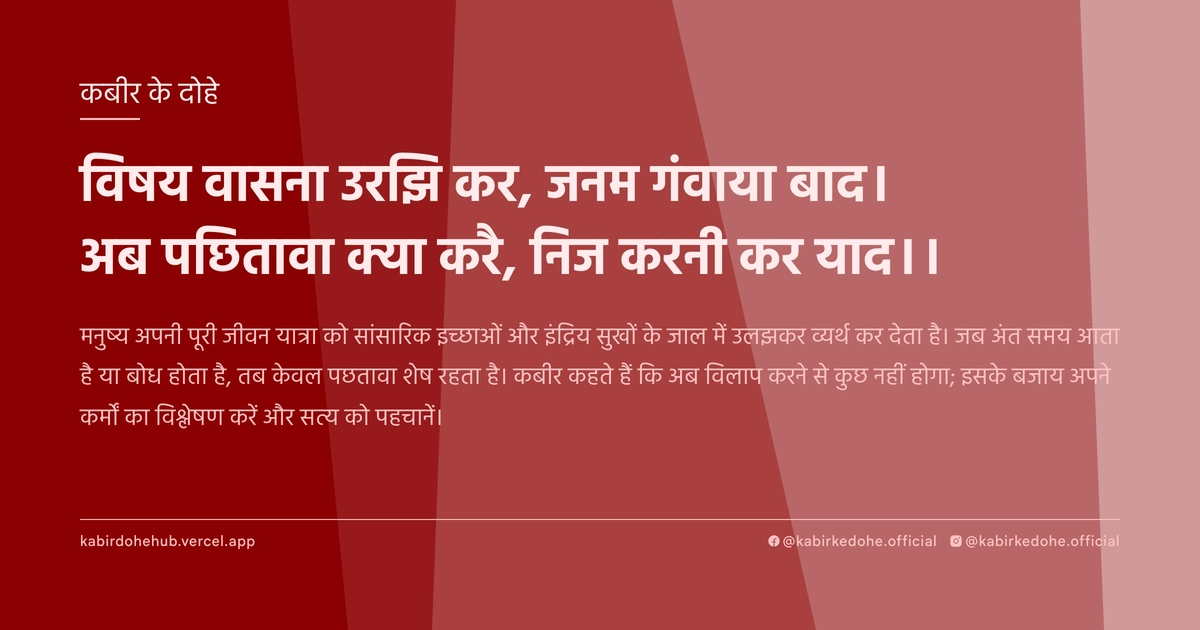
विषय वासना उरझि कर, जनम गंवाया बाद।
अब पछितावा क्या करै, निज करनी कर याद।।
Vishay vaasna urjhi kar, janam ganvaya baad. Ab pachitava kya karai, nij karani kar yaad.
इस पृष्ठ पर इस कबीर दोहे का अर्थ (meaning), हिंदी व्याख्या और अंग्रेज़ी अनुवाद, दार्शनिक विश्लेषण और व्यावहारिक जीवन सीख दी गई है। यह दोहा कर्म (Karma) विषय से जुड़ा है — Kabir doha meaning and explanation in Hindi and English.
अर्थ (Meaning):
मनुष्य अपनी पूरी जीवन यात्रा को सांसारिक इच्छाओं और इंद्रिय सुखों के जाल में उलझकर व्यर्थ कर देता है। जब अंत समय आता है या बोध होता है, तब केवल पछतावा शेष रहता है। कबीर कहते हैं कि अब विलाप करने से कुछ नहीं होगा; इसके बजाय अपने कर्मों का विश्लेषण करें और सत्य को पहचानें।
A human spends their entire existence entangled in the web of sensory desires and worldly cravings, effectively wasting the precious gift of birth. When the realization of mortality or spiritual void arrives, only regret remains. Kabir asserts that repentance is futile now; instead, one must reflect upon their own actions and the nature of their deeds.
व्याख्या (Interpretation):
यह दोहा भौतिक आसक्ति और आध्यात्मिक विस्मृति के बीच के द्वंद्व को दर्शाता है। 'विषय वासना' केवल कामुकता नहीं, बल्कि वह हर मानसिक लगाव है जो आत्मा को परमात्मा से अलग करता है। यह निरगुण भक्ति का सार है जहाँ माया को एक भ्रम माना गया है जो जीव को जन्म-मरण के चक्र में बांधे रखता है। यहाँ 'उरझि' शब्द एक जटिल जाल का संकेत देता है, जो अद्वैत वेदांत के उस विचार से मेल खाता है जहाँ अज्ञान (Avidya) के कारण हम स्वयं को शरीर और मन समझ लेते हैं। अंततः, यह दोहा चेतावनी देता है कि समय की रेत फिसल रही है और केवल आत्म-साक्षात्कार ही एकमात्र मुक्ति का मार्ग है।
This couplet illustrates the conflict between material attachment and spiritual oblivion. 'Vishay Vaasna' refers not merely to lust, but to every mental clinging that separates the Soul from the Divine. This is the essence of Nirgun Bhakti, where Maya is viewed as an illusion that binds the entity to the cycle of birth and death. The word 'urjhi' suggests a complex entanglement, mirroring the Advaita Vedanta concept where ignorance (Avidya) causes us to mistake the temporary body and mind for the eternal Self. Ultimately, the verse warns that the sands of time are slipping away, and only self-realization offers a path to liberation.
दार्शनिक विश्लेषण (Philosophical Analysis):
कबीर का यह संदेश उस युग की प्रतिक्रिया है जहाँ धर्म केवल बाहरी कर्मकांडों और दिखावे तक सीमित हो गया था। उन्होंने स्पष्ट किया कि मोक्ष किसी तीर्थ या मंदिर में नहीं, बल्कि वासनाओं के त्याग और आंतरिक शुद्धि में है। यह सूफी मत के 'नफ्स' (अहंकार/इच्छा) के दमन के विचार से गहराई से जुड़ा है, जहाँ साधक को अपनी निम्न प्रवृत्तियों को जीतकर उच्च सत्य तक पहुँचना होता है।
दार्शनिक स्तर पर, यह दोहा 'कर्म' के सिद्धांत की व्याख्या करता है। कबीर यह नहीं कह रहे कि कर्म छोड़ दो, बल्कि वे 'फल' की आसक्ति और इंद्रिय सुखों के पीछे भागने की प्रवृत्ति पर प्रहार कर रहे हैं। जब व्यक्ति केवल बाहरी दुनिया की तृप्ति खोजता है, तो वह अपनी वास्तविक प्रकृति (Atman) को भूल जाता है।
अद्वैत वेदांत के परिप्रेक्ष्य में, वासनाएँ वह पर्दा हैं जो ब्रह्म और जीव के बीच खड़े हैं। जब तक यह पर्दा नहीं हटता, मनुष्य स्वयं को खंडित महसूस करता है। कबीर का 'निज करनी कर याद' का आह्वान वास्तव में एक आत्म-निरीक्षण (Self-Inquiry) की प्रक्रिया है, जो व्यक्ति को उसके झूठे अहंकार से मुक्त कर उसे शून्य की स्थिति में ले जाती है।
यह दोहा मनोवैज्ञानिक रूप से 'संज्ञानात्मक विसंगति' (Cognitive Dissonance) को संबोधित करता है। मनुष्य जानता है कि भौतिक सुख क्षणभंगुर हैं, फिर भी वह उनमें लिप्त रहता है। यह आंतरिक संघर्ष अंततः गहरे अवसाद और पछतावे में बदल जाता है। कबीर इस पछतावे को एक उत्प्रेरक (Catalyst) के रूप में उपयोग करने का सुझाव देते हैं ताकि व्यक्ति जागृति की ओर बढ़े।
अंततः, कबीर का दृष्टिकोण क्रांतिकारी है क्योंकि वह किसी बाहरी ईश्वर की शरण में जाने के बजाय व्यक्ति को उसकी अपनी जिम्मेदारी (Accountability) का अहसास कराते हैं। वे सिखाते हैं कि मुक्ति का मार्ग बाहरी अनुष्ठानों से नहीं, बल्कि अपनी वासनाओं के प्रति सजगता और उनके विसर्जन से प्रशस्त होता है।
Kabir's message is a reaction to an era where religion had become confined to external rituals and superficial displays. He clarified that liberation is found not in pilgrimages or temples, but in the renunciation of cravings and internal purification. This aligns deeply with the Sufi concept of conquering the 'Nafs' (ego/desire), where the seeker must overcome lower instincts to reach the Higher Truth.
On a philosophical level, this couplet explains the law of Karma. Kabir is not suggesting the abandonment of action, but is attacking the attachment to results and the tendency to chase sensory pleasures. When a person seeks satisfaction only in the external world, they forget their true nature (Atman).
From the perspective of Advaita Vedanta, desires are the veil that stands between Brahman and the individual soul. Until this veil is lifted, the human feels fragmented. Kabir's call to 'remember your own deeds' is actually a process of Self-Inquiry, which frees the individual from their false ego and leads them toward the state of Emptiness (Shunya).
Psychologically, this verse addresses 'cognitive dissonance.' Humans know that material pleasures are ephemeral, yet they remain immersed in them. This internal conflict eventually transforms into deep depression and regret. Kabir suggests using this regret as a catalyst to trigger spiritual awakening.
Ultimately, Kabir's approach is revolutionary because instead of urging the individual to seek refuge in an external deity, he makes them realize their own accountability. He teaches that the path to liberation is paved not by external rites, but by awareness and the dissolution of one's own cravings.
मूल संदेश (Core Message):
- इंद्रिय सुख क्षणभंगुर हैं, आत्मा की शांति शाश्वत है।
- अहंकार और इच्छाएं ही जन्म-मरण के चक्र का मूल कारण हैं।
- पछतावा केवल तभी सार्थक है जब वह आत्म-सुधार की प्रेरणा बने।
- बाहरी उपलब्धियां आंतरिक रिक्तता को कभी नहीं भर सकतीं।
- सच्ची मुक्ति वासनाओं के त्याग और स्वयं के बोध में निहित है।
- Sensory pleasures are ephemeral; the peace of the soul is eternal.
- Ego and cravings are the root causes of the cycle of birth and death.
- Regret is meaningful only when it becomes a catalyst for self-transformation.
- External achievements can never fill an internal void.
- True liberation lies in the renunciation of desires and the realization of the Self.
व्यावहारिक उदाहरण (Practical Example):
एक समय की बात है, वाराणसी के घाटों पर रहने वाला एक वृद्ध बुनकर था जिसका नाम माधव था। माधव अपने रेशमी वस्त्रों की बारीकी के लिए पूरे शहर में प्रसिद्ध था। उसकी कला अद्भुत थी, लेकिन उसका मन हमेशा और अधिक धन, प्रसिद्धि और विलासिता की चाहत में रहता था।
वह दिन-रात केवल इस चिंता में रहता था कि कैसे वह और महंगे धागे खरीदे और कैसे अपने व्यापार को बढ़ाकर शहर के सबसे अमीर व्यक्ति बन सके। इस दौड़ में उसने अपने परिवार की खुशियों, अपने स्वास्थ्य और अपनी आत्मा की शांति को पूरी तरह भुला दिया।
उसका बेटा बड़ा हुआ, लेकिन माधव ने उसे समय देने के बजाय उसे केवल धन कमाने की शिक्षा दी। माधव की वासना केवल धन की नहीं थी, बल्कि उस 'प्रतिष्ठा' की थी जो धन से आती है। वह दूसरों को नीचा दिखाने और खुद को श्रेष्ठ साबित करने की होड़ में लगा रहा।
वर्षों बाद, जब माधव अत्यंत वृद्ध और बीमार हो गया, तो उसने देखा कि उसके पास सोने की मोहरें तो बहुत थीं, लेकिन उसके पास बैठने वाला कोई प्रियजन नहीं था। उसका बेटा उससे दूर जा चुका था और उसके मित्र केवल उसके धन के कारण उसके साथ थे।
एक रात, जब वह अपनी अंतिम सांसों के करीब था, उसे कबीर का यह दोहा याद आया। उसे महसूस हुआ कि उसने अपना पूरा जीवन एक ऐसे जाल में बिता दिया जिसका कोई अंत नहीं था। उसने रेशम के धागों से कपड़े तो बुने, लेकिन अपने जीवन के धागों को उलझा दिया।
उसे याद आया कि कैसे उसने एक गरीब साथी बुनकर की मदद करने से मना कर दिया था क्योंकि वह उसे अपना प्रतिस्पर्धी मानता था। उसे याद आया कि कैसे उसने अपनी पत्नी की अंतिम इच्छाओं को धन के लालच में अनदेखा कर दिया था।
अब वह रो रहा था, लेकिन कबीर की वाणी उसके कानों में गूँजी—'अब पछतावा क्या करै'। माधव को समझ आया कि रोने से बीता समय वापस नहीं आएगा, लेकिन वह अपनी बची हुई चेतना के साथ सत्य को स्वीकार कर सकता है।
उसने अपनी सारी संपत्ति उन अनाथ बच्चों और गरीब बुनकरों के लिए दान कर दी जिन्हें उसने जीवन भर अनदेखा किया था। यह कोई बाहरी दान नहीं था, बल्कि उसके अहंकार का विसर्जन था।
उसने महसूस किया कि असली शांति उस रेशमी कपड़े में नहीं थी जिसे वह बेचता था, बल्कि उस सादगी में थी जिसे उसने वर्षों पहले त्याग दिया था। उसने अपनी आँखें बंद कीं, लेकिन इस बार उसके चेहरे पर पछतावा नहीं, बल्कि एक गहरी स्वीकृति और शांति थी।
माधव की यह कहानी हमें सिखाती है कि वासना का जाल हमें तब तक नहीं दिखता जब तक हम उसमें पूरी तरह उलझ नहीं जाते, और जागृति का क्षण चाहे देर से आए, वह हमें अपनी वास्तविकता से मिलाता है।
Once, in the ghats of Varanasi, there lived an elderly weaver named Madhav. Madhav was renowned throughout the city for the intricacy of his silk garments. His art was sublime, but his mind was always consumed by the desire for more wealth, fame, and luxury.
Day and night, he worried only about how to acquire more expensive threads and how to expand his business to become the wealthiest man in the city. In this race, he completely forgot the happiness of his family, his own health, and the peace of his soul.
His son grew up, but instead of spending time with him, Madhav only taught him the art of accumulating wealth. Madhav's craving was not just for money, but for the 'prestige' that came with it. He spent his years trying to belittle others and prove his own superiority.
Years later, when Madhav became frail and bedridden, he realized that while he possessed countless gold coins, he had no loved ones to sit by his side. His son had drifted away, and his friends were with him only for his money.
One night, as he neared his final breaths, this couplet of Kabir echoed in his mind. He realized he had spent his entire life entangled in a web that had no end. He had woven exquisite silk fabrics, but in doing so, he had tangled the threads of his own existence.
He remembered how he had refused to help a fellow poor weaver because he viewed him as a competitor. He recalled how he had ignored his wife's final wishes in his greed for more gold.
He began to weep, but Kabir's words resonated: 'Why repent now?' Madhav understood that crying would not bring back the lost years, but he could accept the truth with his remaining consciousness.
He donated all his wealth to the orphaned children and poor weavers he had ignored for a lifetime. This was not a mere act of charity, but a dissolution of his ego.
He realized that true peace did not lie in the silk fabric he sold, but in the simplicity he had discarded years ago. He closed his eyes, but this time, his face held not regret, but a deep acceptance and serenity.
Madhav's story teaches us that the web of desire remains invisible until we are completely entangled in it, and the moment of awakening, however late, reconnects us with our true reality.
अभ्यास मार्गदर्शन (Practice Guidance):
- दैनिक आत्म-निरीक्षण: प्रतिदिन 15 मिनट मौन बैठें और विचार करें कि आज आपने किन इच्छाओं के पीछे अपना समय और मानसिक ऊर्जा व्यर्थ की।
- इच्छा-विश्लेषण जर्नल: एक डायरी लिखें जिसमें उन चीजों की सूची हो जिन्हें आप 'अनिवार्य' मानते हैं, और फिर विश्लेषण करें कि क्या वे वास्तव में आपकी आत्मा की आवश्यकता हैं या केवल सामाजिक अहंकार (Digital/Social Ego) की संतुष्टि।
- सजग उपभोग: जब भी कुछ नया खरीदने या किसी सांसारिक उपलब्धि की तीव्र इच्छा हो, तो रुककर स्वयं से पूछें—'क्या यह मुझे मेरी वास्तविकता से दूर ले जा रहा है?'
- निदान चेकलिस्ट: यदि आप छोटी-छोटी बातों पर अत्यधिक क्रोधित होते हैं, दूसरों की सफलता से ईर्ष्या करते हैं, या भविष्य की चिंता में वर्तमान को खो रहे हैं, तो समझें कि आप 'विषय वासना' के जाल में उलझे हुए हैं।
- Daily Self-Inquiry: Sit in silence for 15 minutes every day and reflect on which desires consumed your time and mental energy today.
- Desire-Analysis Journal: Maintain a diary listing things you consider 'essential,' then analyze whether they are genuine needs of the soul or merely satisfactions for the social/digital ego.
- Conscious Consumption: Whenever you feel an intense urge to buy something new or achieve a worldly milestone, pause and ask—'Is this leading me away from my true reality?'
- Diagnostic Checklist: If you find yourself excessively angry over trivialities, envious of others' success, or losing the present to future anxieties, recognize that you are entangled in the web of 'Vishay Vaasna'.
चिंतन प्रश्न (Reflection Questions):
- यदि आज आपका अंतिम दिन हो, तो आपकी कौन सी 'उपलब्धियां' वास्तव में अर्थपूर्ण लगेंगी और कौन सी व्यर्थ?
- आपकी कौन सी ऐसी गुप्त इच्छाएं हैं जिन्हें आप दुनिया से छिपाते हैं, लेकिन वे अंदर ही अंदर आपको नियंत्रित कर रही हैं?
- क्या आपकी डिजिटल पहचान (Social Media Image) आपके वास्तविक अस्तित्व को निगल रही है?
- आप दूसरों की मदद करते हैं या केवल अपनी छवि को 'परोपकारी' दिखाने के लिए दान देते हैं?
- वह कौन सा एक मोह है जिसे छोड़ने पर आपको लगता है कि आपका अस्तित्व समाप्त हो जाएगा?
- If today were your final day, which of your 'achievements' would feel truly meaningful and which would seem futile?
- What are the secret desires you hide from the world, yet they control you from within?
- Is your digital identity (social media image) consuming your actual existence?
- Do you help others out of genuine compassion, or do you give only to project a 'philanthropic' image?
- What is the one attachment that you feel would annihilate your existence if you let it go?