
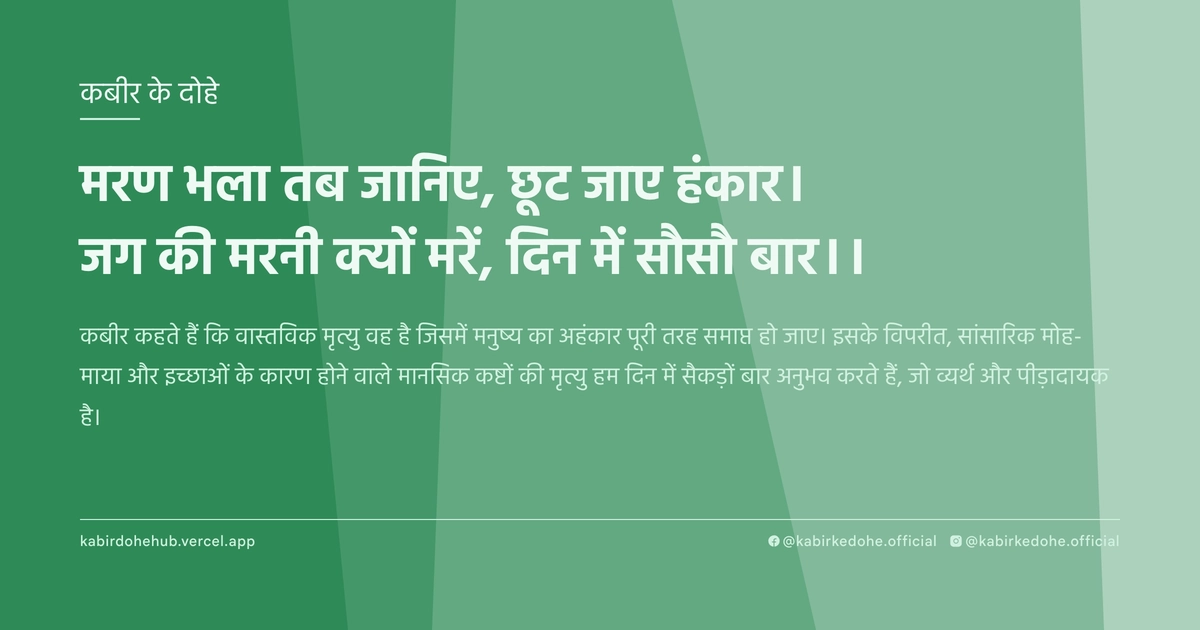
मरण भला तब जानिए, छूट जाए हंकार।
जग की मरनी क्यों मरें, दिन में सौसौ बार।।
Maran bhala tab jaaniye, choot jaaye hankaar. Jag ki marni kyon marein, din mein sausau baar.
इस पृष्ठ पर इस कबीर दोहे का अर्थ (meaning), हिंदी व्याख्या और अंग्रेज़ी अनुवाद, दार्शनिक विश्लेषण और व्यावहारिक जीवन सीख दी गई है। यह दोहा अहंकार (The Ego) विषय से जुड़ा है — Kabir doha meaning and explanation in Hindi and English.
अर्थ (Meaning):
कबीर कहते हैं कि वास्तविक मृत्यु वह है जिसमें मनुष्य का अहंकार पूरी तरह समाप्त हो जाए। इसके विपरीत, सांसारिक मोह-माया और इच्छाओं के कारण होने वाले मानसिक कष्टों की मृत्यु हम दिन में सैकड़ों बार अनुभव करते हैं, जो व्यर्थ और पीड़ादायक है।
Kabir asserts that true death is the dissolution of the ego. In contrast, he questions why we choose to suffer the 'death' of worldly anxieties and emotional turmoil hundreds of times a day, which is a futile cycle of mental agony.
व्याख्या (Interpretation):
इस दोहे में 'मरण' शब्द के दो अर्थ हैं: शारीरिक मृत्यु और अहंकार का विसर्जन। कबीर भौतिक मृत्यु से नहीं, बल्कि 'हंकार' (अहंकार) की मृत्यु की वकालत करते हैं। जब तक 'मैं' का भाव जीवित है, मनुष्य माया के जाल में फंसा रहता है। यह द्वैतवाद ही दुख का मूल है। निर्गुण भक्ति के अनुसार, जब साधक अपनी व्यक्तिगत पहचान को ब्रह्म में विलीन कर देता है, वही वास्तविक मोक्ष है। सांसारिक मृत्यु केवल शरीर का अंत है, लेकिन अहंकार की मृत्यु आत्मा की मुक्ति है। यह विरोधाभास हमें सिखाता है कि जीवित रहते हुए मरना (अहंकार त्यागना) ही वास्तव में जीना है।
In this couplet, 'death' carries a dual meaning: physical cessation and the dissolution of the ego. Kabir advocates not for the end of the body, but for the death of 'Hankaar' (the ego). As long as the sense of 'I' persists, the soul remains trapped in the illusions of Maya. This duality is the root of all suffering. According to Nirgun Bhakti, true liberation occurs when the seeker merges their individual identity into the formless Brahman. While physical death is merely the end of the biological frame, the death of the ego is the liberation of the spirit. This paradox teaches that 'dying while living'—surrendering the ego—is the only way to truly exist.
दार्शनिक विश्लेषण (Philosophical Analysis):
कबीर का यह दर्शन अद्वैत वेदांत और सूफी मत के 'फना' (annihilation) के सिद्धांत से गहराई से जुड़ा है। उनके समय में धर्म केवल कर्मकांडों और बाहरी दिखावे तक सीमित था, जहाँ लोग अपनी जाति और पद के अहंकार में डूबे थे। कबीर ने इस सामाजिक और मानसिक ढांचे पर प्रहार किया। वे कहते हैं कि बाहरी अनुष्ठान आत्मा को शुद्ध नहीं कर सकते; केवल अहंकार का विसर्जन ही सत्य का मार्ग प्रशस्त करता है।
मनोवैज्ञानिक स्तर पर, 'जग की मरनी' हमारे मानसिक तनाव, ईर्ष्या और तुलनात्मक दुख को दर्शाती है। जब हम दूसरों से अपनी तुलना करते हैं या अपनी छवि को बचाने की कोशिश करते हैं, तो हम हर पल एक सूक्ष्म मृत्यु का अनुभव करते हैं। यह मानसिक मृत्यु हमें वर्तमान क्षण से काट देती है और एक अंतहीन चिंता के चक्र में धकेल देती है।
सूफीवाद में इसे 'नफ्स' (lower self) पर विजय पाना कहा गया है। जब तक मनुष्य अपनी इच्छाओं और अहंकार का दास है, वह ईश्वर (परमात्मा) से दूर है। कबीर का तर्क है कि यदि हमें एक बार मरना ही है, तो वह मृत्यु ऐसी हो जो हमें बंधनमुक्त कर दे, न कि ऐसी जो हमें बार-बार मोह के दुखों में मारती रहे।
यह शिक्षण जातिवाद और वर्ग-भेद के विरुद्ध एक सशक्त हथियार है। अहंकार ही वह दीवार है जो मनुष्य को मनुष्य से और आत्मा को परमात्मा से अलग करती है। जब यह दीवार गिरती है, तो केवल शुद्ध चेतना शेष रहती है, जहाँ न कोई छोटा है और न कोई बड़ा।
अंततः, कबीर हमें यह समझाने का प्रयास कर रहे हैं कि आध्यात्मिक प्रगति का अर्थ नई उपलब्धियाँ प्राप्त करना नहीं, बल्कि उन परतों को हटाना है जो सत्य को ढके हुए हैं। अहंकार वह अंतिम पर्दा है जिसे हटाते ही अद्वैत (non-duality) का अनुभव होता है।
Kabir's philosophy is deeply intertwined with the Advaita Vedanta concept of non-duality and the Sufi principle of 'Fana' (annihilation of the self). During his era, religion had devolved into mere ritualism and external displays of piety, where individuals were consumed by the ego of caste and social hierarchy. Kabir attacked this structure, asserting that external rituals cannot purify the soul; only the dissolution of the ego clears the path to Truth.
On a psychological level, 'Jag ki marni' (worldly death) represents our chronic mental stress, jealousy, and the agony of comparison. Whenever we strive to protect a false image or compete with others, we experience a subtle, fragmented death. This mental attrition disconnects us from the present moment and thrusts us into an endless cycle of anxiety.
In Sufism, this is described as conquering the 'Nafs' (the lower self). As long as a person is a slave to their desires and ego, they remain estranged from the Divine. Kabir argues that if death is inevitable, it should be a death that liberates—the death of the ego—rather than the repetitive, agonizing deaths caused by worldly attachments.
This teaching serves as a powerful weapon against casteism and class division. The ego is the primary wall separating human from human and soul from the Absolute. When this wall collapses, only pure consciousness remains, where distinctions of high and low vanish entirely.
Ultimately, Kabir suggests that spiritual progress is not about acquiring new attributes, but about shedding the layers that obscure the Truth. The ego is the final veil; once lifted, the realization of Oneness (Advaita) emerges spontaneously.
मूल संदेश (Core Message):
- अहंकार ही आत्मा और परमात्मा के बीच की सबसे बड़ी बाधा है।
- मानसिक तनाव वास्तव में हमारे झूठे अहंकार की सूक्ष्म मृत्यु है।
- सच्ची मुक्ति बाहरी दुनिया को जीतने में नहीं, बल्कि स्वयं को मिटाने में है।
- जब 'मैं' समाप्त होता है, तब केवल अनंत सत्य शेष रहता है।
- अहंकार का त्याग ही वास्तविक जीवन का प्रारंभ है।
- The ego is the primary obstacle between the soul and the Divine.
- Mental stress is essentially the subtle death of our false identity.
- True liberation lies not in conquering the world, but in erasing the self.
- When the 'I' vanishes, only the infinite Truth remains.
- The surrender of ego is the actual beginning of living.
व्यावहारिक उदाहरण (Practical Example):
वाराणसी के घाटों पर रहने वाले एक वृद्ध बुनकर, माधव, का जीवन केवल रेशमी साड़ियों के धागों में उलझा था। माधव को अपनी बुनाई की कला पर अत्यधिक गर्व था और वह शहर के अन्य बुनकरों को तुच्छ समझता था। उसका अहंकार इतना बड़ा था कि वह किसी की सलाह नहीं सुनता था और स्वयं को 'सर्वश्रेष्ठ' मानता था।
एक दिन, माधव ने एक अत्यंत जटिल डिजाइन की साड़ी बनाई, जिसे वह अपनी सबसे बड़ी उपलब्धि मान रहा था। लेकिन एक छोटी सी गलती के कारण, अंतिम क्षण में साड़ी का एक हिस्सा फट गया। माधव क्रोध और हताशा से भर गया। उसे लगा कि उसकी प्रतिष्ठा मिट्टी में मिल गई। वह उस रात सो नहीं सका, उसे लगा जैसे उसकी पहचान मर गई हो।
अगली सुबह, उसने देखा कि एक छोटा बच्चा उसी फटी हुई साड़ी के टुकड़ों से एक सुंदर खिलौना बना रहा था। बच्चे के चेहरे पर जो संतोष और खुशी थी, वह माधव ने अपने वर्षों के गर्व में कभी महसूस नहीं की थी। माधव को अचानक कबीर का वह दोहा याद आया कि वह अपनी श्रेष्ठता के अहंकार में दिन में सौ बार मरता है—कभी किसी की आलोचना से, कभी अपनी गलती से।
उसे अहसास हुआ कि उसकी 'कला' उसके लिए एक बंधन बन गई थी। वह अपनी कला का स्वामी नहीं, बल्कि उसका गुलाम था। उसने महसूस किया कि जिस 'प्रतिष्ठा' को वह बचा रहा था, वह वास्तव में एक बोझ था जो उसे मानसिक शांति से दूर रख रहा था।
माधव ने उस दिन एक निर्णय लिया। उसने अपनी श्रेष्ठता का दावा छोड़ दिया और अन्य बुनकरों के साथ मिलकर काम करना शुरू किया। उसने अपनी कला को 'अहंकार' से हटाकर 'सेवा' और 'साझाकरण' में बदल दिया।
अब वह दूसरों की गलतियों पर हंसता नहीं था, बल्कि उन्हें सुधारने में मदद करता था। उसका मन अब उस तनाव से मुक्त था जो उसे हर छोटी गलती पर 'मार' देता था।
उसने पाया कि जब उसने अपनी 'सर्वश्रेष्ठ' होने की छवि को मार दिया, तो वह वास्तव में पहली बार जीवित महसूस करने लगा। उसकी नींद गहरी हो गई और उसके काम में एक नई पवित्रता आ गई।
माधव अब केवल एक बुनकर नहीं था, वह एक मुक्त आत्मा था। उसने समझ लिया था कि अहंकार की मृत्यु ही जीवन का वास्तविक उत्सव है।
Madhav, an elderly weaver living on the ghats of Varanasi, spent his life entangled in the threads of silk sarees. Madhav possessed an immense pride in his craft, viewing other weavers in the city as inferior. His ego was so towering that he refused all advice, believing himself to be the 'absolute master'.
One day, Madhav created a saree with an incredibly complex design, viewing it as his magnum opus. However, due to a minor oversight, a section of the fabric tore during the final moments. Madhav was consumed by rage and despair. He felt his reputation had been obliterated; that night, he could not sleep, feeling as though his identity had died.
The next morning, he noticed a small child using the torn scraps of that very saree to create a beautiful toy. The joy and contentment on the child's face were things Madhav had never experienced in all his years of pride. Suddenly, Kabir's words resonated: he had been 'dying' a hundred times a day—once through a critic's word, once through a mistake, always protecting a fragile image.
He realized that his 'art' had become a shackle. He was not the master of his craft, but its slave. The 'prestige' he fought to protect was actually a burden keeping him away from inner peace.
Madhav made a conscious decision. He abandoned his claim to superiority and began collaborating with other weavers. He shifted his focus from 'ego-driven excellence' to 'service and sharing'.
He stopped mocking the mistakes of others and instead offered help. His mind was finally freed from the tension that used to 'kill' him with every minor imperfection.
He discovered that by killing the image of being the 'best', he finally began to truly live. His sleep became deep, and a new sanctity entered his work.
Madhav was no longer just a weaver; he was a liberated soul. He understood that the death of the ego is the only true celebration of life.
अभ्यास मार्गदर्शन (Practice Guidance):
- प्रतिदिन 20 मिनट मौन ध्यान करें, जहाँ आप अपने विचारों को केवल एक साक्षी (observer) के रूप में देखें, बिना उनसे जुड़े।
- एक 'अहंकार डायरी' लिखें: दिन भर में उन क्षणों को नोट करें जब आपको गुस्सा आया या आप छोटा महसूस किया। विश्लेषण करें कि वहाँ कौन सा 'मैं' आहत हुआ था।
- सचेत व्यवहार परिवर्तन: दिन में कम से कम एक बार किसी ऐसे व्यक्ति की मदद करें जिससे आप असहज महसूस करते हैं, बिना किसी प्रशंसा की अपेक्षा के।
- निदान चेकलिस्ट: क्या मैं दूसरों की सफलता से जलता हूँ? क्या मैं अपनी गलती स्वीकार करने में डरता हूँ? क्या मेरी शांति दूसरों की राय पर निर्भर है? यदि हाँ, तो अहंकार अभी जीवित है।
- Practice 20 minutes of silent meditation daily, observing your thoughts as a witness without identifying with them.
- Maintain an 'Ego Journal': Note moments during the day when you felt anger or inadequacy. Analyze which specific 'I' (image) was wounded in that moment.
- Conscious Behavioral Shift: At least once a day, help someone you feel uncomfortable with, without expecting any recognition or praise.
- Diagnostic Checklist: Do I feel envy at others' success? Am I afraid to admit a mistake? Is my peace dependent on others' opinions? If yes, the ego is still active.
चिंतन प्रश्न (Reflection Questions):
- मेरी वह कौन सी छवि है जिसे मैं दुनिया के सामने बनाए रखने के लिए सबसे अधिक संघर्ष करता हूँ?
- यदि मेरी सारी उपलब्धियाँ और पद छीन लिए जाएँ, तो मेरे भीतर क्या बचेगा?
- मैं अपनी डिजिटल पहचान (सोशल मीडिया) को अपनी वास्तविक पहचान से अधिक महत्व क्यों देता हूँ?
- क्या मेरा धर्म और आध्यात्मिकता वास्तव में मुझे विनम्र बना रहे हैं, या वे मेरे अहंकार को एक नया 'धार्मिक' रूप दे रहे हैं?
- मेरे जीवन का वह कौन सा डर है जो वास्तव में मेरे अहंकार के खोने का डर है?
- Which specific image of myself do I struggle most to maintain in the eyes of the world?
- If all my achievements and titles were stripped away, what would truly remain within me?
- Why do I often prioritize my digital identity over my authentic, internal existence?
- Is my spirituality making me humble, or is it merely giving my ego a 'religious' mask to wear?
- Which fear in my life is actually just the fear of the ego being extinguished?