
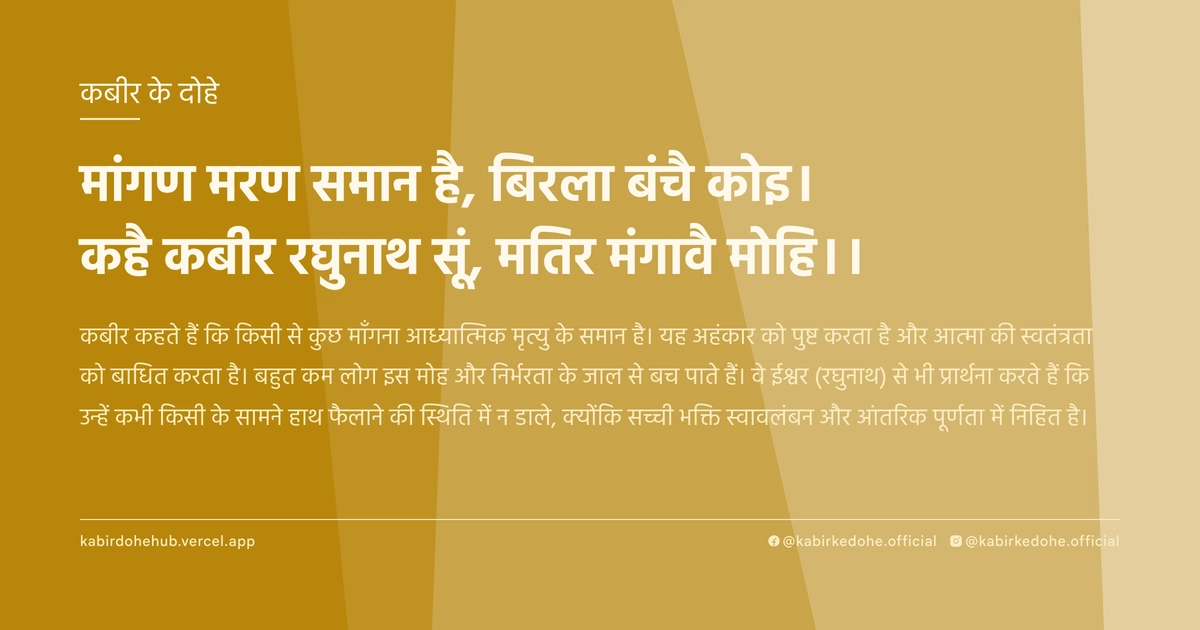
मांगण मरण समान है, बिरला बंचै कोइ।
कहै कबीर रघुनाथ सूं, मतिर मंगावै मोहि।।
Maangan maran saman hai, birla banchai koi. Kahe kabir raghunath soon, matir mangavai mohi.
इस पृष्ठ पर इस कबीर दोहे का अर्थ (meaning), हिंदी व्याख्या और अंग्रेज़ी अनुवाद, दार्शनिक विश्लेषण और व्यावहारिक जीवन सीख दी गई है। यह दोहा विनम्रता (Humility) विषय से जुड़ा है — Kabir doha meaning and explanation in Hindi and English.
अर्थ (Meaning):
कबीर कहते हैं कि किसी से कुछ माँगना आध्यात्मिक मृत्यु के समान है। यह अहंकार को पुष्ट करता है और आत्मा की स्वतंत्रता को बाधित करता है। बहुत कम लोग इस मोह और निर्भरता के जाल से बच पाते हैं। वे ईश्वर (रघुनाथ) से भी प्रार्थना करते हैं कि उन्हें कभी किसी के सामने हाथ फैलाने की स्थिति में न डाले, क्योंकि सच्ची भक्ति स्वावलंबन और आंतरिक पूर्णता में निहित है।
Kabir asserts that the act of begging or pleading for external sustenance—whether material or spiritual—is akin to spiritual death. It reinforces the ego's sense of lack and binds the soul to dependency. Very few are able to escape this cycle of craving. He prays to the Divine (Raghunath) not to let him fall into the trap of asking, for true devotion resides in self-reliance and the realization of inner wholeness.
व्याख्या (Interpretation):
इस दोहे का शाब्दिक अर्थ है कि माँगना मृत्यु के समान है। लेकिन रूपकात्मक स्तर पर, 'माँगना' केवल भौतिक वस्तुओं तक सीमित नहीं है, बल्कि इसमें दूसरों से मान्यता, प्रेम या मोक्ष की याचना करना भी शामिल है। यह निर्गुण भक्ति का सार है जहाँ साधक बाहरी सहारे को त्यागकर अपने भीतर के 'अविनाशी' तत्व को खोजता है। जब हम माँगते हैं, तो हम यह स्वीकार करते हैं कि हम अपूर्ण हैं, जो कि माया का सबसे बड़ा भ्रम है। अद्वैत वेदांत के अनुसार, आत्मा स्वयं पूर्ण (पूर्णता) है; अतः माँगना उस पूर्णता का अपमान है। यह विरोधाभास है कि हम उस ईश्वर से कुछ माँगते हैं जो वास्तव में हमारे अपने स्वरूप का ही विस्तार है। कबीर यहाँ 'अहं' के विसर्जन और आत्म-निर्भरता की बात कर रहे हैं।
Literally, the verse equates begging with death. Metaphorically, 'begging' extends beyond material needs to include the craving for validation, love, or salvation from external sources. This aligns with Nirgun Bhakti, where the seeker discards external crutches to discover the 'Indestructible' within. When we ask, we validate the illusion of incompleteness, which is the core of Maya. According to Advaita Vedanta, the Atman is inherently whole (Purnam); thus, begging is a denial of this innate perfection. The paradox lies in asking the Divine for something, when the Divine is actually the very essence of our own being. Kabir advocates for the annihilation of the dependent ego in favor of spiritual autonomy.
दार्शनिक विश्लेषण (Philosophical Analysis):
कबीर का यह दृष्टिकोण उनके समय के सामाजिक और धार्मिक पाखंडों पर एक कड़ा प्रहार था। उस युग में, लोग धर्म के नाम पर भिक्षा माँगने और बाहरी अनुष्ठानों के माध्यम से कृपा पाने के आदी थे। कबीर ने इस 'याचक मानसिकता' को खारिज किया क्योंकि यह व्यक्ति को मानसिक रूप से गुलाम बनाती है। वे सूफी मत के 'फना' (अहंकार का विनाश) और वेदांत के 'अहं ब्रह्मास्मि' के बीच एक सेतु बनाते हैं। उनके लिए, माँगना इस बात का प्रमाण है कि आप अभी भी द्वैत (Duality) में जी रहे हैं—एक माँगने वाला और एक देने वाला।
दार्शनिक रूप से, यह दोहा मनोवैज्ञानिक निर्भरता के विरुद्ध एक चेतावनी है। जब हम किसी से कुछ माँगते हैं, तो हम अपनी शक्ति को दूसरे को सौंप देते हैं। यह क्रिया सूक्ष्म रूप से अहंकार को बढ़ाती है क्योंकि यह 'कमी' की भावना पर आधारित होती है। कबीर का तर्क है कि यदि आप वास्तव में परमात्मा से जुड़ना चाहते हैं, तो आपको उस स्थिति में आना होगा जहाँ आपकी कोई इच्छा न बचे।
यह शिक्षण हमें सिखाता है कि मोक्ष कोई ऐसी वस्तु नहीं है जिसे बाहर से माँगा जा सके; यह एक आंतरिक खोज है। ritualism या कर्मकांडों के माध्यम से ईश्वर को प्रसन्न करने की कोशिश करना भी एक प्रकार का 'माँगना' ही है। कबीर इस लेन-देन वाले धर्म का विरोध करते हैं।
यहाँ 'मरण' शब्द का प्रयोग शारीरिक मृत्यु के लिए नहीं, बल्कि चेतना की सुस्ती और आध्यात्मिक पतन के लिए किया गया है। जो व्यक्ति माँगने की आदत में पड़ जाता है, उसकी रचनात्मकता और आत्म-शक्ति मर जाती है।
अंततः, यह दोहा हमें शून्य की स्थिति की ओर ले जाता है। जब माँगने वाला 'मैं' समाप्त हो जाता है, तब केवल वह शेष रहता जो देने वाला भी है और पाने वाला भी। यही वह बिंदु है जहाँ भक्त और भगवान एक हो जाते हैं।
Kabir's perspective was a sharp critique of the social and religious hypocrisies of his era. During his time, many relied on ritualistic begging and external ceremonies to seek divine grace. Kabir rejected this 'supplicant mindset' because it fosters mental slavery. He bridges the Sufi concept of 'Fana' (annihilation of the ego) with the Vedantic 'Aham Brahmasmi' (I am Brahman). To him, the act of asking is evidence of living in Duality—the perceived separation between the asker and the giver.
Philosophically, this verse serves as a warning against psychological dependency. By asking, one surrenders their innate power to another. This act subtly feeds the ego by grounding it in a sense of 'lack' or 'deficiency.' Kabir argues that to truly unite with the Divine, one must reach a state where no desire for external acquisition remains.
This teaching emphasizes that liberation (Moksha) is not a commodity to be requested; it is an internal realization. Attempting to appease God through rituals is merely another form of 'begging.' Kabir opposes this transactional approach to spirituality.
The term 'death' here does not refer to biological cessation but to the stagnation of consciousness and spiritual decay. A person habituated to begging loses their creative agency and spiritual potency.
Ultimately, the verse leads us toward the state of 'Shunya' (Void). When the 'I' who asks is annihilated, only that remains which is simultaneously the giver and the receiver. This is the point of non-duality where the devotee and the Divine merge.
मूल संदेश (Core Message):
- बाहरी निर्भरता आत्मा की स्वतंत्रता का सबसे बड़ा अवरोध है।
- माँगना केवल वस्तु की कमी नहीं, बल्कि आत्मविश्वास का अभाव है।
- सच्ची प्रार्थना कुछ पाने के लिए नहीं, बल्कि अहंकार को मिटाने के लिए होती है।
- आंतरिक पूर्णता का अनुभव ही वास्तविक मोक्ष और समृद्धि है।
- जब आप माँगना छोड़ देते हैं, तब आप ब्रह्मांड की प्रचुरता से जुड़ जाते हैं।
- External dependency is the greatest obstacle to the soul's freedom.
- Begging is not just a lack of resources, but a lack of self-confidence.
- True prayer is not for acquisition, but for the annihilation of the ego.
- Experiencing inner wholeness is the only real liberation and prosperity.
- When you stop asking, you align with the natural abundance of the universe.
व्यावहारिक उदाहरण (Practical Example):
वाराणसी के घाटों पर रहने वाला एक वृद्ध विधवा, जानकी, अपना जीवन दूसरों की दया और दान पर निर्भर रहकर बिता रही थी। वह हर दिन मंदिर के बाहर बैठती और आने-जाने वाले श्रद्धालुओं से कुछ सिक्कों या भोजन की उम्मीद करती। उसकी आँखों में हमेशा एक शिकायत रहती थी कि दुनिया कितनी कठोर है और भगवान ने उसे अकेला छोड़ दिया। वह अपनी गरीबी को अपनी नियति मान चुकी थी और हर किसी से मदद की गुहार लगाती थी।
एक दिन उसकी मुलाकात एक घुमंतू फकीर से हुई, जिसने कबीर का यह दोहा सुनाया। फकीर ने उससे कहा, "माई, जब तक तू माँगती रहेगी, तू अपनी उस शक्ति को कभी नहीं पहचान पाएगी जो तेरे भीतर है। माँगना तुझे मानसिक रूप से मृत बना रहा है।"
जानकी को पहले तो यह बात कड़वी लगी, लेकिन उसने प्रयोग करने का निर्णय लिया। उसने तय किया कि वह अब किसी से कुछ नहीं माँगेगी। उसने घाट के किनारे पड़े पुराने सूती कपड़ों के टुकड़ों को इकट्ठा करना शुरू किया और अपनी पुरानी सिलाई की कला का उपयोग करके छोटे-छोटे थैले बनाने लगी।
शुरुआत में उसे बहुत कठिनाई हुई। भूख लगी, और पुराने संस्कार उसे फिर से हाथ फैलाने के लिए उकसाने लगे। लेकिन उसने अपने भीतर के उस 'अभाव' को चुनौती दी। उसने महसूस किया कि जब वह माँगती थी, तो वह खुद को छोटा और लाचार महसूस करती थी, लेकिन जब वह काम करती थी, तो उसे अपने अस्तित्व का बोध होता था।
धीरे-धीरे, उसके बनाए थैले पर्यटकों को पसंद आने लगे। अब वह केवल अपनी जरूरतें ही पूरी नहीं कर रही थी, बल्कि अन्य जरूरतमंद महिलाओं को सिलाई सिखाने लगी। उसने पाया कि उसकी आंतरिक शांति अब इस बात पर निर्भर नहीं थी कि कोई उसे दान दे रहा है या नहीं।
उसकी आँखों की शिकायत गायब हो गई और उसकी जगह एक गहरा संतोष आ गया। उसने महसूस किया कि 'माँगना' वास्तव में उसकी आत्मा की मृत्यु थी, और 'स्वावलंबन' उसका पुनर्जन्म।
उसने समझा कि ईश्वर से भी यह नहीं माँगना चाहिए कि "मुझे कुछ दो", बल्कि यह माँगना चाहिए कि "मुझे इतना सक्षम बनाओ कि मैं किसी के सामने न झुकूँ।"
जानकी अब केवल एक विधवा नहीं थी जो दया की पात्र थी, बल्कि वह एक ऐसी स्त्री बन गई थी जिसने अपनी आंतरिक पूर्णता को खोज लिया था। उसका जीवन अब एक जीवित उदाहरण था कि कैसे निर्भरता का त्याग व्यक्ति को गरिमा और स्वतंत्रता प्रदान करता है।
Janaki, an elderly widow living on the ghats of Varanasi, spent her life depending on the charity and mercy of others. Every day, she sat outside the temple, hoping for a few coins or food from passing pilgrims. Her eyes were always filled with a grievance that the world was cruel and God had abandoned her. She had accepted her poverty as fate and constantly pleaded for help.
One day, she met a wandering fakir who recited this Doha of Kabir. The fakir told her, "Mother, as long as you keep begging, you will never recognize the power that resides within you. Begging is making you spiritually dead."
At first, Janaki found these words harsh, but she decided to experiment. She vowed that she would no longer ask anyone for anything. She began collecting discarded pieces of cotton cloth from the riverbanks and used her old sewing skills to make small pouches.
Initially, it was grueling. Hunger struck, and her old habits urged her to stretch out her hand again. However, she challenged that inner sense of 'lack.' She realized that when she begged, she felt small and helpless, but when she worked, she felt the presence of her own existence.
Gradually, tourists began to admire her handmade pouches. She was no longer just meeting her own needs; she started teaching other needy women how to sew. She discovered that her inner peace no longer depended on whether someone gave her alms or not.
The grievance in her eyes vanished, replaced by a profound contentment. She realized that 'begging' had indeed been the death of her soul, and 'self-reliance' was her rebirth.
She understood that one should not even ask God for "things," but rather ask for the strength to never have to bow before another in desperation.
Janaki was no longer just a widow deserving of pity; she became a woman who had discovered her inner wholeness. Her life became a living testament to how renouncing dependency grants a person dignity and freedom.
अभ्यास मार्गदर्शन (Practice Guidance):
- प्रतिदिन 15 मिनट मौन ध्यान करें, जहाँ आप अपनी हर इच्छा और 'कमी' के भाव को केवल देखें, उसे पूरा करने की कोशिश न करें।
- एक 'निर्भरता डायरी' लिखें: उन क्षणों को नोट करें जब आपने मानसिक या भावनात्मक रूप से किसी से मान्यता या मदद माँगी, और फिर विचार करें कि उस समय आपके भीतर कौन सा डर था।
- व्यवहार परिवर्तन: अगले 30 दिनों तक किसी भी ऐसी चीज़ की शिकायत न करें जो आपके पास नहीं है। इसके बजाय, अपनी वर्तमान क्षमताओं का उपयोग करके समाधान खोजें।
- निदान चेकलिस्ट: क्या आप दूसरों की प्रशंसा के बिना अधूरा महसूस करते हैं? क्या आप अपनी समस्याओं के लिए बाहरी परिस्थितियों को दोष देते हैं? यदि हाँ, तो आप 'माँगने' की मानसिक अवस्था में हैं।
- Practice 15 minutes of silent meditation daily, observing every desire and sense of 'lack' without attempting to fulfill it.
- Maintain a 'Dependency Journal': Note moments when you mentally or emotionally sought validation or help, and analyze the underlying fear present at that time.
- Behavioral Shift: For the next 30 days, refrain from complaining about anything you lack. Instead, use your current capabilities to find a solution.
- Diagnostic Checklist: Do you feel incomplete without the praise of others? Do you blame external circumstances for your problems? If yes, you are operating in the 'beggar's mindset'.
चिंतन प्रश्न (Reflection Questions):
- आप अपनी सामाजिक छवि (Social Image) को बनाए रखने के लिए दूसरों से किस तरह की 'मान्यता' माँग रहे हैं?
- क्या आपकी आध्यात्मिक साधना वास्तव में ईश्वर से जुड़ने के लिए है, या आप केवल सुख-सुविधाओं की याचना कर रहे हैं?
- वह कौन सा डर है जो आपको स्वावलंबी होने से रोकता है और आपको दूसरों के सहारे की ओर धकेलता है?
- यदि आपके जीवन से सभी बाहरी सहारे (वित्तीय, भावनात्मक, सामाजिक) हटा दिए जाएँ, तो आपके भीतर क्या बचेगा?
- क्या आप अपनी 'कमी' को अपनी पहचान बना चुके हैं? क्या आप खुद को एक 'पीड़ित' के रूप में देखना पसंद करते हैं?
- What kind of 'validation' are you begging for from others to maintain your social image?
- Is your spiritual practice truly about uniting with the Divine, or are you merely petitioning for comforts?
- What is the specific fear that prevents you from being self-reliant and pushes you toward dependency?
- If all external supports (financial, emotional, social) were removed from your life, what would remain within you?
- Have you made your 'lack' your identity? Do you subconsciously enjoy the role of the victim?