
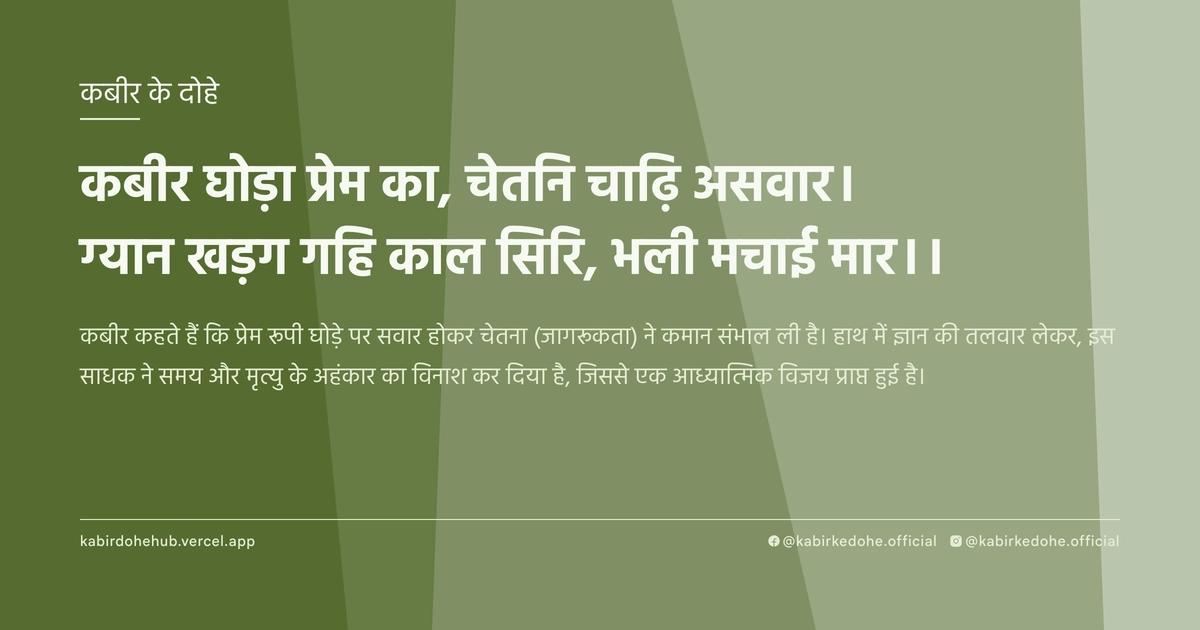
कबीर घोड़ा प्रेम का, चेतनि चाढ़ि असवार।
ग्यान खड़ग गहि काल सिरि, भली मचाई मार।।
Kabir ghoda prem ka, chetani chadhi asvaar. Gyaan khadag gahi kaal siri, bhali machai maar.
इस पृष्ठ पर इस कबीर दोहे का अर्थ (meaning), हिंदी व्याख्या और अंग्रेज़ी अनुवाद, दार्शनिक विश्लेषण और व्यावहारिक जीवन सीख दी गई है। यह दोहा ध्यान (Meditation) विषय से जुड़ा है — Kabir doha meaning and explanation in Hindi and English.
अर्थ (Meaning):
कबीर कहते हैं कि प्रेम रूपी घोड़े पर सवार होकर चेतना (जागरूकता) ने कमान संभाल ली है। हाथ में ज्ञान की तलवार लेकर, इस साधक ने समय और मृत्यु के अहंकार का विनाश कर दिया है, जिससे एक आध्यात्मिक विजय प्राप्त हुई है।
Kabir proclaims that the seeker has mounted the horse of Divine Love, with conscious awareness acting as the rider. Wielding the sword of transcendental knowledge, the seeker has decisively struck down the head of 'Kaal' (time/death/ego), achieving a profound spiritual victory over the temporal world.
व्याख्या (Interpretation):
यहाँ 'घोड़ा' प्रेम की तीव्र गति और शक्ति का प्रतीक है, जो साधक को भौतिकता से ऊपर ले जाता है। 'चेतनि' या चेतना वह सजगता है जो बिना दिशा के प्रेम को केवल भावना बना देती है, लेकिन यहाँ वह मार्गदर्शक है। 'ज्ञान की खड़ग' वह विवेक है जो सत्य और असत्य के बीच भेद करती है। 'काल' का सिर काटना वास्तव में मृत्यु के भय और समय की सीमितता से मुक्ति पाना है। यह निरगुण भक्ति का सार है जहाँ प्रेम और ज्ञान का मिलन होता है। यह अद्वैत वेदांत की उस स्थिति को दर्शाता है जहाँ आत्मा यह जान लेती है कि वह अविनाशी ब्रह्म है। माया का पर्दा तब हटता है जब प्रेम की तीव्रता और ज्ञान की धार एक साथ काम करती हैं। अंततः, यह द्वैत के विनाश और पूर्ण एकता की घोषणा है।
The 'horse' symbolizes the ferocious velocity and power of Divine Love, which propels the seeker beyond the mundane. 'Chetani' (consciousness) represents the alert awareness that prevents love from becoming mere sentimentality, acting instead as the skilled rider. The 'sword of knowledge' is the razor-sharp discernment (Viveka) that severs the ties of illusion. To 'strike the head of Kaal' is not a literal act of violence but a metaphorical annihilation of the fear of death and the constraints of linear time. This reflects the essence of Nirgun Bhakti, where love is not directed toward an idol but toward the Formless Absolute. It aligns with Advaita Vedanta, where the realization of the Atman-Brahman non-duality dissolves the ego. The paradox lies in using the 'weapon' of knowledge to achieve the 'peace' of love. Ultimately, it is the destruction of the fragmented self to reveal the eternal, undivided Truth.
दार्शनिक विश्लेषण (Philosophical Analysis):
कबीर का यह दोहा उनके युग के धार्मिक पाखंड और केवल किताबी ज्ञान के प्रति एक कड़ा प्रहार है। उस समय समाज कर्मकांडों और बाहरी दिखावे में उलझा था, जिसे कबीर ने 'मृत्यु' के समान जड़ता माना। उन्होंने तर्क दिया कि केवल शास्त्र पढ़ने से मुक्ति नहीं मिलती; ज्ञान तब तक व्यर्थ है जब तक वह प्रेम की ऊर्जा से संचालित न हो। यह दृष्टिकोण सूफी मत के 'इश्क-ए-हकीकी' (ईश्वरीय प्रेम) और वेदांत के 'ज्ञान मार्ग' का एक अद्भुत संश्लेषण है।
दार्शनिक स्तर पर, कबीर यहाँ 'अहंकार' को ही 'काल' कह रहे हैं। अहंकार वह शक्ति है जो हमें समय और स्थान की सीमाओं में बांधती है और हमें यह विश्वास दिलाती है कि हम शरीर हैं। जब प्रेम (भक्ति) और ज्ञान (विवेक) एक साथ मिलते हैं, तो यह अहंकार नष्ट हो जाता है। यह 'अहं ब्रह्मास्मि' की अनुभूति है, जहाँ व्यक्ति स्वयं को ब्रह्मांडीय चेतना के रूप में देखता है।
कबीर ने जाति और धर्म की सीमाओं को तोड़ते हुए यह स्पष्ट किया कि आध्यात्मिक युद्ध बाहरी नहीं, बल्कि आंतरिक है। 'मार' शब्द यहाँ हिंसा नहीं, बल्कि रूपांतरण का प्रतीक है। यह पुराने व्यक्तित्व की मृत्यु और नए, जागृत स्वरूप के जन्म की प्रक्रिया है। यह मनोवैज्ञानिक परिवर्तन है जहाँ भय का स्थान साहस ले लेता है।
निरगुण परंपरा में, ईश्वर किसी मंदिर या मस्जिद में नहीं, बल्कि हृदय के भीतर 'शून्य' या 'अनहद' में निवास करता है। इस शून्य तक पहुँचने के लिए प्रेम का वेग आवश्यक है ताकि दुनिया के मोह बंधन टूट सकें। ज्ञान वह दिशा देता है ताकि साधक भटककर केवल भावनात्मक उद्वेग में न खो जाए।
अंततः, यह दोहा यह सिखाता है कि प्रेम और ज्ञान परस्पर विरोधी नहीं, बल्कि पूरक हैं। बिना प्रेम के ज्ञान शुष्क और अहंकारी होता है, और बिना ज्ञान के प्रेम अंधा और दिशाहीन। जब ये दोनों मिलते हैं, तब मनुष्य समय (काल) की सीमाओं को पार कर अमरता या मोक्ष को प्राप्त करता है।
This couplet is a fierce critique of the religious hypocrisy and sterile scholasticism of Kabir's era. During his time, society was entangled in rituals and external displays of piety, which Kabir viewed as a form of spiritual inertia or 'death.' He argued that mere scriptural learning is futile unless it is propelled by the kinetic energy of Divine Love. This perspective is a masterful synthesis of the Sufi concept of 'Ishq-e-Haqiqi' (True Love) and the Vedantic 'Jnana Marga' (Path of Knowledge).
Philosophically, Kabir identifies 'Kaal' (Time/Death) as the Ego. The ego is the force that imprisons the soul within the limitations of time, space, and identity, fostering the illusion that we are merely the physical body. When Love (Bhakti) and Knowledge (Viveka) converge, this egoic structure is shattered. This is the realization of 'Aham Brahmasmi'—the understanding that the individual self is identical to the universal consciousness.
By rejecting caste and creed, Kabir emphasizes that the true battlefield is internal. The term 'maar' (slaughter/strike) does not denote physical violence but a radical spiritual transformation. It represents the death of the conditioned personality and the birth of the awakened being. It is a psychological shift where the paralysis of fear is replaced by the dynamism of liberation.
In the Nirgun tradition, the Divine does not reside in temples or mosques but within the 'Shunya' (Void) or 'Anhad' (Unstruck Sound) of the heart. To reach this center, the velocity of love is required to break the gravitational pull of worldly attachments. Knowledge provides the navigation, ensuring the seeker does not get lost in mere emotional volatility.
Ultimately, the doha teaches that Love and Knowledge are not opposites but complements. Knowledge without love is dry, intellectual, and often arrogant; love without knowledge is blind and prone to delusion. When these two forces unite, the human being transcends the temporal constraints of 'Kaal' to attain Moksha, or eternal liberation.
मूल संदेश (Core Message):
- प्रेम के बिना ज्ञान केवल एक बोझ है।
- अहंकार ही वह काल है जो हमें मुक्त नहीं होने देता।
- सजगता (चेतना) प्रेम को सही दिशा प्रदान करती है।
- विवेक की तलवार से भ्रम के बंधनों को काटें।
- जब प्रेम और ज्ञान मिलते हैं, तब मोक्ष घटित होता है।
- Knowledge without love is merely a burdensome weight.
- The ego is the only 'Time' that prevents our liberation.
- Consciousness provides the necessary direction to love.
- Sever the bonds of illusion with the sword of discernment.
- Moksha occurs at the intersection of Love and Knowledge.
व्यावहारिक उदाहरण (Practical Example):
एक समय की बात है, बनारस के घाटों पर माधव नाम का एक वृद्ध बुनकर रहता था। माधव अपने काम में निपुण था, लेकिन उसका मन हमेशा इस बात से दुखी रहता था कि वह एक साधारण बुनकर है और कभी महान विद्वान नहीं बन पाया। वह घंटों पंडितों को शास्त्र पढ़ते देखता और अपनी 'अज्ञानता' पर रोता। वह ज्ञान की खोज में कई किताबों के पीछे भागा, लेकिन उसका मन अशांत ही रहा।
एक दिन उसने एक फकीर को देखा जो बिना किसी किताब के, केवल प्रेम और करुणा से लोगों के दुखों को हर रहा था। माधव ने उससे पूछा, 'मैं ज्ञान चाहता हूँ, लेकिन मुझे वह मिलता नहीं।' फकीर ने मुस्कुराकर कहा, 'तुम ज्ञान को एक वस्तु की तरह खोज रहे हो, जबकि ज्ञान एक तलवार है जो केवल प्रेम के घोड़े पर सवार होकर ही चलाई जा सकती है।'
माधव को यह बात समझ नहीं आई, लेकिन उसने एक प्रयोग करने का निर्णय लिया। उसने तय किया कि वह अब केवल ज्ञान खोजेगा नहीं, बल्कि अपने हर कपड़े की बुनाई में, हर धागे में प्रेम और सेवा का भाव डालेगा। उसने गरीब बच्चों को मुफ्त में कपड़े देना शुरू किया और अपने पड़ोसियों के झगड़ों को प्रेम से सुलझाने लगा।
धीरे-धीरे, माधव के भीतर एक बदलाव आया। वह अब यह नहीं सोचता था कि वह 'अज्ञानी' है। उसकी करुणा ने उसके भीतर की हीन भावना को खत्म कर दिया। उसने महसूस किया कि जब वह दूसरों की सेवा करता है, तो उसका अहंकार (उसका 'काल') धीरे-धीरे मिट रहा है।
एक दिन एक बड़ा विद्वान उसके पास आया और उसकी बुनाई की बारीकी और उसके चेहरे के तेज को देखकर दंग रह गया। विद्वान ने पूछा, 'आपने कौन से शास्त्र पढ़े हैं?' माधव ने विनम्रता से उत्तर दिया, 'मैंने कोई शास्त्र नहीं पढ़ा, मैंने बस प्रेम को अपना घोड़ा बनाया और सेवा को अपनी तलवार।'
उस क्षण माधव को अहसास हुआ कि जिसे वह जीवन भर 'ज्ञान' समझकर खोज रहा था, वह वास्तव में अहंकार की एक परत थी। असली ज्ञान तो वह था जिसने उसे उसके 'छोटे होने' के भ्रम से मुक्त कर दिया था।
उसका डर खत्म हो गया था। अब उसे मृत्यु या समय का भय नहीं था क्योंकि उसने जान लिया था कि प्रेम ही वह एकमात्र शक्ति है जो समय से परे है।
माधव अब केवल एक बुनकर नहीं था; वह एक जागृत आत्मा बन चुका था। उसने अपनी कला को अपनी प्रार्थना बना लिया था।
Once, on the ghats of Varanasi, lived an elderly weaver named Madhav. Madhav was a master of his craft, yet he lived in a state of perpetual melancholy, believing himself inferior because he was not a scholar. He spent hours watching the pundits recite scriptures, mourning his own perceived 'ignorance.' He chased knowledge through countless books, but his mind remained restless and fragmented.
One day, he encountered a wandering dervish who possessed no books but healed the sorrows of others through sheer love and compassion. Madhav asked, 'I seek knowledge, yet it eludes me.' The dervish smiled and replied, 'You seek knowledge as if it were an object to be acquired, but knowledge is a sword that can only be wielded by one riding the horse of Love.'
Madhav did not fully grasp the metaphor, but he decided to experiment. He resolved that instead of searching for knowledge externally, he would weave love and service into every thread of his cloth. He began gifting clothes to orphaned children and resolving neighborhood disputes with unconditional kindness.
Gradually, a transformation occurred within Madhav. He stopped identifying as 'ignorant.' His compassion eroded the foundation of his inferiority complex. He realized that as he served others, his ego—his internal 'Kaal'—was slowly being dismantled.
One day, a renowned scholar visited him and was stunned by the intricacy of his weaving and the luminous radiance of his face. The scholar asked, 'Which scriptures have you mastered to attain such peace?' Madhav replied humbly, 'I have read no scriptures; I simply made Love my horse and Service my sword.'
In that moment, Madhav realized that the 'knowledge' he had chased for a lifetime was actually a layer of ego. True knowledge was the realization that liberated him from the illusion of being 'small' or 'incomplete.'
His fear vanished. He no longer dreaded death or the passage of time because he had discovered that Love is the only force that exists beyond the temporal realm.
Madhav was no longer just a weaver; he had become an awakened soul. He had turned his craft into his prayer.
अभ्यास मार्गदर्शन (Practice Guidance):
- प्रतिदिन 20 मिनट मौन ध्यान करें, जहाँ आप केवल अपने हृदय की धड़कन और प्रेम की भावना पर ध्यान केंद्रित करें, बिना किसी विचार के।
- एक 'अहंकार डायरी' लिखें: दिन भर में उन क्षणों को नोट करें जब आपने खुद को दूसरों से श्रेष्ठ या हीन महसूस किया, और फिर विचार करें कि वहाँ 'प्रेम' की कमी कहाँ थी।
- व्यवहार परिवर्तन: प्रतिदिन एक ऐसा कार्य करें जिसमें आपका कोई व्यक्तिगत लाभ न हो और जो पूरी तरह से निस्वार्थ प्रेम से प्रेरित हो।
- निदान चेकलिस्ट: क्या मैं अभी भी अपनी पहचान अपनी डिग्री, पद या जाति से जोड़ रहा हूँ? क्या मैं दूसरों की आलोचना करते समय 'ज्ञान' का ढोंग करता हूँ? यदि हाँ, तो 'काल' (अहंकार) अभी जीवित है।
- Practice 20 minutes of silent meditation daily, focusing solely on the heartbeat and the feeling of love, stripping away all conceptual thoughts.
- Maintain an 'Ego Journal': Record moments throughout the day when you felt superior or inferior to others, and analyze where the lack of love created that distortion.
- Behavioral Shift: Perform one act of service daily that offers no personal gain and is driven entirely by selfless compassion.
- Diagnostic Checklist: Am I still anchoring my identity to my degree, title, or social status? Do I use 'knowledge' as a shield to criticize others? If yes, 'Kaal' (the ego) is still dominant.
चिंतन प्रश्न (Reflection Questions):
- मेरा वह कौन सा 'ज्ञान' है जो वास्तव में मुझे दूसरों से अलग करने और श्रेष्ठ महसूस कराने का साधन बन गया है?
- क्या मेरा प्रेम वास्तव में निस्वार्थ है, या यह केवल मेरी अपनी जरूरतों का एक प्रतिबिंब है?
- यदि मेरी सामाजिक पहचान (नाम, पद, प्रतिष्ठा) छीन ली जाए, तो मेरे भीतर क्या बचेगा?
- मैं अपने जीवन में 'काल' (समय और मृत्यु के भय) को कहाँ महसूस करता हूँ, और वह भय मुझे क्या करने से रोकता है?
- क्या मैं सत्य को जानने की कोशिश कर रहा हूँ, या केवल सत्य के बारे में बात करने का नाटक कर रहा हूँ?
- Which part of my 'knowledge' has actually become a tool to separate me from others and make me feel superior?
- Is my love truly selfless, or is it merely a reflection of my own unmet needs?
- If my social identity (name, title, status) were stripped away, what would remain of me?
- Where do I experience 'Kaal' (the fear of time and death) in my life, and what does that fear prevent me from doing?
- Am I striving to realize the Truth, or am I merely performing the act of talking about the Truth?