
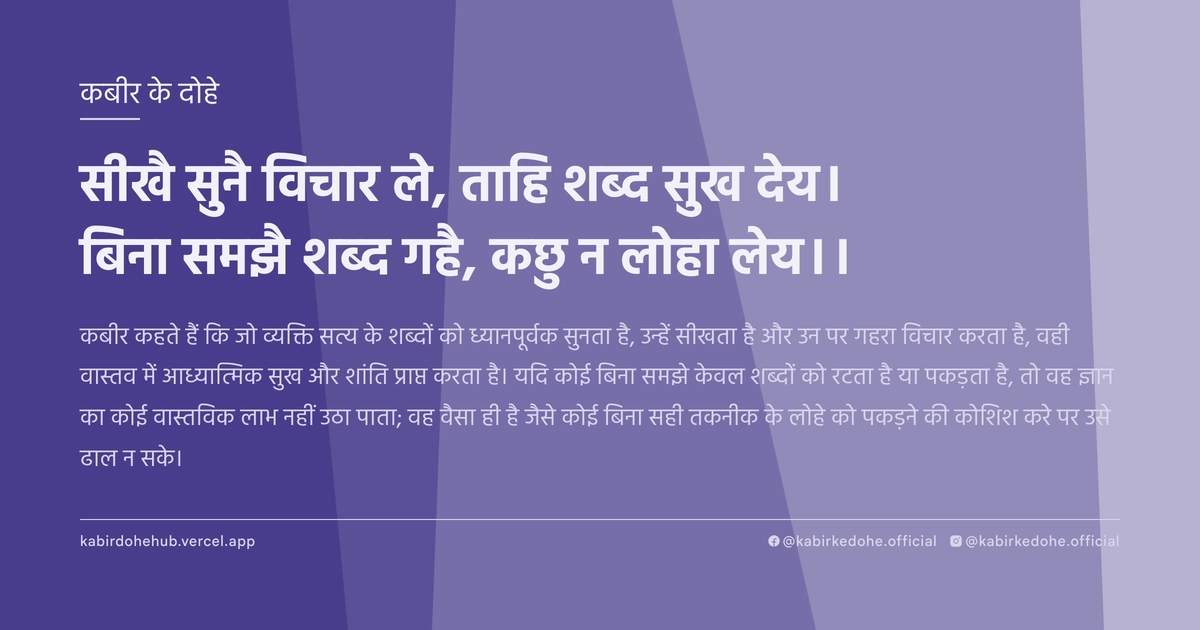
सीखै सुनै विचार ले, ताहि शब्द सुख देय।
बिना समझै शब्द गहै, कछु न लोहा लेय।।
Seekhai sunai vichaar le, taahi shabd sukh dey. Bina samjhai shabd gahai, kachhu na loha ley.
इस पृष्ठ पर इस कबीर दोहे का अर्थ (meaning), हिंदी व्याख्या और अंग्रेज़ी अनुवाद, दार्शनिक विश्लेषण और व्यावहारिक जीवन सीख दी गई है। यह दोहा आत्मनिरीक्षण (Self-introspection) विषय से जुड़ा है — Kabir doha meaning and explanation in Hindi and English.
अर्थ (Meaning):
कबीर कहते हैं कि जो व्यक्ति सत्य के शब्दों को ध्यानपूर्वक सुनता है, उन्हें सीखता है और उन पर गहरा विचार करता है, वही वास्तव में आध्यात्मिक सुख और शांति प्राप्त करता है। यदि कोई बिना समझे केवल शब्दों को रटता है या पकड़ता है, तो वह ज्ञान का कोई वास्तविक लाभ नहीं उठा पाता; वह वैसा ही है जैसे कोई बिना सही तकनीक के लोहे को पकड़ने की कोशिश करे पर उसे ढाल न सके।
Kabir asserts that only the one who listens attentively to the Truth, learns its essence, and contemplates it deeply can experience true spiritual bliss. Those who merely grasp words or recite scriptures without internalizing their meaning derive no real benefit; they are like someone trying to hold iron without understanding its nature, failing to forge it into anything useful.
व्याख्या (Interpretation):
यह दोहा ज्ञान के सतही अर्जन और वास्तविक बोध के बीच के अंतर को स्पष्ट करता है। 'शब्द' यहाँ केवल भाषा नहीं, बल्कि 'नाद' या ईश्वरीय कंपन है। जब साधक इसे केवल बौद्धिक स्तर पर ग्रहण करता है, तो वह माया के जाल में ही रहता है। निर्गुण भक्ति में, शब्द का अर्थ है वह आंतरिक ध्वनि जो आत्मा को परमात्मा से जोड़ती है। बिना 'विचार' (चिंतन) के, शब्द केवल एक बाहरी आवरण है। यह अद्वैत वेदांत के उस सिद्धांत को दर्शाता है जहाँ केवल सूचना नहीं, बल्कि अनुभव (Anubhuti) ही मोक्ष का मार्ग है। यहाँ विरोधाभास यह है कि शब्द ही मार्ग है, लेकिन शब्द का मोह ही सबसे बड़ी बाधा है।
This couplet elucidates the stark contrast between the superficial acquisition of knowledge and actual realization. 'Shabda' here refers not merely to language, but to the 'Naad' or the divine vibration. When a seeker grasps this only at an intellectual level, they remain trapped within the veil of Maya. In Nirgun Bhakti, the Word is the internal resonance that bridges the Atman and Brahman. Without 'Vichaar' (deep contemplation), the word remains a mere external shell. This aligns with Advaita Vedanta, where experience (Anubhuti), rather than information, is the path to liberation. The central paradox is that while the Word is the vehicle, attachment to the literal word is the primary obstacle.
दार्शनिक विश्लेषण (Philosophical Analysis):
कबीर का यह दृष्टिकोण उनके समय के कट्टरपंथी धार्मिक वातावरण के विरुद्ध एक विद्रोह था, जहाँ मंत्रों का जाप बिना अर्थ समझे केवल परंपरा के नाम पर किया जाता था। वे कर्मकांडीय धर्म की आलोचना करते हैं और 'सहज' मार्ग पर जोर देते हैं। उनके लिए, ज्ञान वह नहीं है जो किताबों में है, बल्कि वह है जो जीवन के अनुभव से छनकर आता है।
दार्शनिक रूप से, यह सूफी मत के 'ज़िक्र' और अद्वैत के 'विवेक' का संगम है। सूफीवाद में शब्द का बार-बार दोहराव हृदय को शुद्ध करने के लिए होता है, लेकिन कबीर चेतावनी देते हैं कि यदि यह दोहराव केवल यांत्रिक है, तो यह अहंकार को और पुष्ट करता है। अहंकार (Ego) यह मान लेता है कि वह 'जानता' है, जबकि वह केवल 'रट' रहा है।
यहाँ 'लोहा लेय' का रूपक अत्यंत गहरा है। लोहा कठोर होता है, उसे आकार देने के लिए अग्नि और प्रहार की आवश्यकता होती है। इसी तरह, सत्य कठोर होता है; उसे आत्मसात करने के लिए बौद्धिक अहंकार को जलाना पड़ता है। जो केवल शब्दों को पकड़ता है, वह लोहे की कठोरता से चोट खाता है, उसे ढाल नहीं पाता।
यह विश्लेषण हमें बताता है कि भक्ति केवल भावना नहीं, बल्कि एक सूक्ष्म विज्ञान है। बिना समझ के की गई भक्ति अंधविश्वास में बदल जाती है। कबीर चाहते हैं कि साधक एक 'साक्षी' (Witness) बने, जो शब्दों के पीछे छिपे मौन को सुन सके।
अंततः, यह दोहा मनोवैज्ञानिक रूपांतरण की बात करता है। जब हम किसी सत्य को गहराई से विचार कर स्वीकार करते हैं, तो वह हमारी चेतना का हिस्सा बन जाता है। यह 'सूचना' से 'प्रज्ञा' (Wisdom) की ओर संक्रमण है, जो व्यक्ति को जाति, धर्म और बाहरी पहचानों से ऊपर उठाकर एक सार्वभौमिक चेतना में विलीन कर देता है।
Kabir's perspective is a rebellion against the dogmatic religious environment of his era, where mantras were chanted mechanically in the name of tradition without any understanding of their essence. He critiques ritualistic religion and emphasizes the 'Sahaj' (spontaneous) path. For him, knowledge is not what resides in books, but what is filtered through lived experience.
Philosophically, this is a confluence of the Sufi 'Zikr' and the Advaitic 'Viveka' (discernment). In Sufism, the repetition of a word is meant to purify the heart, but Kabir warns that if this repetition is merely mechanical, it only reinforces the ego. The ego convinces itself that it 'knows,' while it is merely 'parroting.'
The metaphor of 'holding iron' is profoundly deep. Iron is rigid; it requires fire and hammering to be shaped. Similarly, Truth is rigorous; to assimilate it, one must burn away intellectual pride. He who merely grasps words is wounded by the rigidity of the iron; he cannot forge it into a tool.
This analysis reveals that Bhakti is not just emotion, but a subtle science. Devotion without understanding devolves into superstition. Kabir urges the seeker to become a 'Sakshi' (Witness), capable of hearing the silence that resides behind the words.
Ultimately, this couplet speaks of psychological transformation. When we accept a truth after deep contemplation, it becomes part of our consciousness. This is the transition from 'information' to 'Prajna' (Wisdom), which elevates the individual above caste, religion, and external identities, merging them into a universal consciousness.
मूल संदेश (Core Message):
- सूचना ज्ञान नहीं है; अनुभव ही वास्तविक बोध है।
- शब्द केवल उंगली हैं जो चंद्रमा की ओर इशारा करती हैं।
- बिना आत्म-मंथन के रटा हुआ ज्ञान अहंकार का पोषण करता है।
- सत्य को तर्क से नहीं, बल्कि समर्पण और विचार से पाया जाता है।
- जब शब्द आचरण में बदलता है, तब वह ईश्वरीय सुख देता है।
- बौद्धिक पकड़ को छोड़ें और हृदय के अनुभव को अपनाएं।
- Information is not wisdom; experience is the only true realization.
- Words are merely fingers pointing toward the moon.
- Knowledge memorized without introspection feeds the ego.
- Truth is found not through logic, but through surrender and contemplation.
- When a word transforms into conduct, it grants divine bliss.
- Release the intellectual grip and embrace the experience of the heart.
व्यावहारिक उदाहरण (Practical Example):
एक समय की बात है, वाराणसी के घाटों पर माधव नाम का एक वृद्ध बुनकर रहता था। माधव अपनी पूरी ज़िंदगी केवल शास्त्रों को रटने और दूसरों को सुनाने में बिता चुका था। वह शहर भर में प्रसिद्ध था क्योंकि उसकी याददाश्त अद्भुत थी। वह घंटों तक जटिल श्लोकों का पाठ करता, लेकिन उसके स्वभाव में चिड़चिड़ापन और अहंकार भरा रहता था। वह मानता था कि क्योंकि वह 'शब्दों' का स्वामी है, इसलिए वह ईश्वर के सबसे करीब है।
एक दिन उसकी मुलाकात एक मौन साधु से हुई, जो केवल एक छोटी सी कुटिया में रहता था। साधु ने माधव को एक सरल वाक्य कहा: 'सत्य वह नहीं जो सुनाया जाए, बल्कि वह है जिसे जिया जाए।' माधव ने तुरंत उस वाक्य का शास्त्रोक्त विश्लेषण करना शुरू कर दिया। उसने तर्क दिया कि शास्त्रों में लिखा है कि ज्ञान का मार्ग ही सर्वोच्च है।
साधु मुस्कुराया और उसने माधव को एक जलता हुआ कोयला दिखाया। साधु ने कहा, 'इस कोयले के बारे में किताबें पढ़ो, इसके तापमान का वर्णन सुनो, और इसके गुणों को रटो। क्या इससे तुम्हारी उंगली जलने से बचेगी?' माधव चुप रहा। साधु ने आगे कहा, 'जब तुम कोयले को छूओगे, तब तुम्हें उसकी तपिश का पता चलेगा। शब्द केवल संकेत हैं, अनुभव ही सत्य है।'
माधव को पहली बार महसूस हुआ कि उसने जीवन भर केवल 'कोयले की किताब' पढ़ी थी, लेकिन कभी उसकी तपिश को महसूस नहीं किया था। उसने महसूस किया कि उसका ज्ञान केवल एक मुखौटा था, जिसने उसके अहंकार को पाला था।
अगले कुछ महीनों तक, माधव ने बोलना कम कर दिया। उसने उन शब्दों पर विचार करना शुरू किया जिन्हें वह सालों से रट रहा था। उसने देखा कि वह दूसरों को उपदेश देते समय वास्तव में उन्हें नीचा दिखा रहा था।
उसने अपनी बुनाई के काम में ध्यान लगाना शुरू किया। वह हर धागे को एक प्रार्थना की तरह देखने लगा। उसने पाया कि जब वह बिना किसी अहंकार के केवल वर्तमान क्षण में होता है, तो उसे वह शांति मिलती है जो हज़ारों श्लोकों में नहीं मिली थी।
एक दिन, एक गरीब व्यक्ति उसके पास आया और उससे मदद मांगी। पुराने माधव ने उसे शास्त्रों का हवाला देकर उपदेश दिया होता, लेकिन नए माधव ने चुपचाप अपनी चादर उसे ओढ़ा दी।
उस क्षण माधव को 'शब्द' का वास्तविक सुख मिला। उसने समझा कि जब शब्द व्यवहार में बदल जाता है, तभी वह सार्थक होता है। उसका अहंकार गल चुका था, और वह वास्तव में एक साधक बन गया था।
Once, on the ghats of Varanasi, lived an elderly weaver named Madhav. Madhav had spent his entire life memorizing scriptures and reciting them to others. He was famous throughout the city for his extraordinary memory. He would chant complex shlokas for hours, yet his nature remained irritable and arrogant. He believed that because he was a master of 'words,' he was closest to the Divine.
One day, he met a silent monk who lived in a tiny hut. The monk told Madhav a simple sentence: 'Truth is not that which is told, but that which is lived.' Madhav immediately began a scriptural analysis of that sentence. He argued that the texts stated the path of knowledge was supreme.
The monk smiled and showed Madhav a glowing piece of coal. The monk said, 'Read books about this coal, listen to descriptions of its temperature, and memorize its properties. Will that prevent your finger from burning?' Madhav remained silent. The monk continued, 'When you touch the coal, you will know its heat. Words are merely pointers; experience is the Truth.'
For the first time, Madhav realized he had spent his life reading the 'book of coal' without ever feeling its heat. He saw that his knowledge was merely a mask that had fed his ego.
Over the next few months, Madhav spoke less. He began to contemplate the words he had spent years reciting. He noticed that while preaching to others, he was actually belittling them.
He began to bring mindfulness into his weaving. He started viewing every thread as a prayer. He discovered that when he existed in the present moment without ego, he found a peace that thousands of shlokas had never provided.
One day, a poor man approached him seeking help. The old Madhav would have lectured him using scriptural references, but the new Madhav silently wrapped his own shawl around the man.
In that moment, Madhav experienced the true bliss of the 'Word.' He understood that a word only becomes meaningful when it transforms into action. His ego had melted, and he had finally become a true seeker.
अभ्यास मार्गदर्शन (Practice Guidance):
- दैनिक चिंतन: प्रतिदिन एक आध्यात्मिक विचार या श्लोक चुनें। उसे केवल पढ़ें नहीं, बल्कि पूरे दिन यह सोचें कि वह आपके वर्तमान व्यवहार में कैसे लागू होता है।
- आत्म-पूछताछ जर्नल: लिखें कि आज आपने किस बात पर केवल 'बौद्धिक सहमति' जताई लेकिन उसे वास्तव में महसूस नहीं किया।
- मौन अभ्यास: दिन में 30 मिनट पूर्ण मौन रहें। शब्दों के शोर को शांत करें ताकि आप आंतरिक 'नाद' या अंतर्ध्वनि को सुन सकें।
- निदान चेकलिस्ट: क्या आप दूसरों को उपदेश देते समय श्रेष्ठता महसूस करते हैं? क्या आप सत्य को तर्क से सिद्ध करने की कोशिश करते हैं? यदि हाँ, तो आप अभी भी 'शब्दों' को पकड़ रहे हैं, सत्य को नहीं।
- Daily Contemplation: Choose one spiritual thought or verse daily. Do not just read it; spend the day reflecting on how it applies to your actual behavior.
- Self-Inquiry Journal: Record instances where you gave 'intellectual agreement' to a truth but did not actually feel or embody it.
- Silence Practice: Maintain complete silence for 30 minutes a day. Quiet the noise of words to hear the internal 'Naad' or inner resonance.
- Diagnostic Checklist: Do you feel a sense of superiority while advising others? Do you try to prove the Truth through logic? If yes, you are still grasping 'words,' not the Truth.
चिंतन प्रश्न (Reflection Questions):
- क्या मेरी आध्यात्मिक पहचान वास्तव में मेरे व्यवहार में दिखती है, या यह केवल मेरी शब्दावली में सीमित है?
- मैं कितनी बार सत्य को 'जानने' का दावा करता हूँ ताकि मैं दूसरों से श्रेष्ठ दिख सकूँ?
- मेरे जीवन का वह कौन सा 'रटा हुआ' विश्वास है जो वास्तव में मेरे आंतरिक सत्य के विपरीत है?
- यदि मुझसे मेरे सभी धार्मिक और आध्यात्मिक शब्द छीन लिए जाएं, तो क्या मेरे भीतर कोई शांति शेष रहेगी?
- क्या मैं सत्य की खोज कर रहा हूँ, या मैं केवल अपनी पूर्व-धारणाओं की पुष्टि करने वाले शब्द खोज रहा हूँ?
- मेरे डिजिटल व्यक्तित्व (Social Media) में मैं जिस ज्ञान का प्रदर्शन करता हूँ, क्या उसका एक प्रतिशत भी मेरे एकांत के आचरण में है?
- Does my spiritual identity actually manifest in my behavior, or is it confined to my vocabulary?
- How often do I claim to 'know' the Truth simply to appear superior to others?
- Which 'memorized' belief in my life is actually in contradiction to my internal truth?
- If all my religious and spiritual words were stripped away, would any peace remain within me?
- Am I searching for the Truth, or am I merely searching for words that confirm my preconceptions?
- Of the wisdom I project in my digital persona, does even one percent exist in my conduct during solitude?