
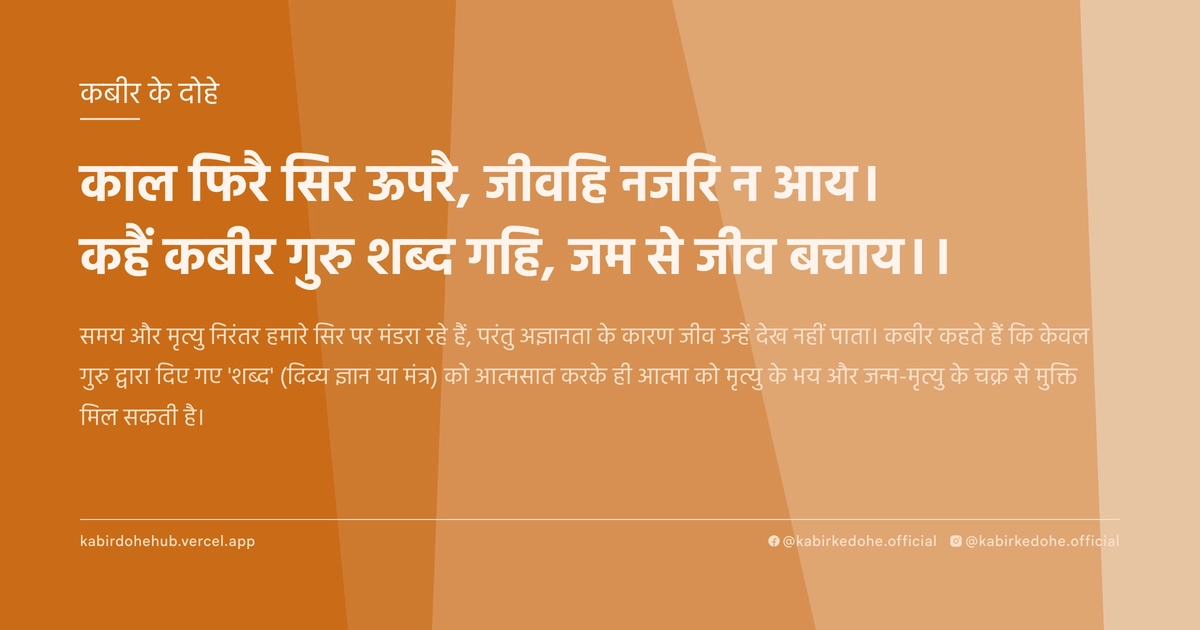
काल फिरै सिर ऊपरै, जीवहि नजरि न आय।
कहैं कबीर गुरु शब्द गहि, जम से जीव बचाय।।
Kaal phirai sir uparai, jeevahi najari na aay. Kahain Kabir guru shabd gahi, jam se jeev bachay.
इस पृष्ठ पर इस कबीर दोहे का अर्थ (meaning), हिंदी व्याख्या और अंग्रेज़ी अनुवाद, दार्शनिक विश्लेषण और व्यावहारिक जीवन सीख दी गई है। यह दोहा गुरु महत्व (The Guru's Importance) विषय से जुड़ा है — Kabir doha meaning and explanation in Hindi and English.
अर्थ (Meaning):
समय और मृत्यु निरंतर हमारे सिर पर मंडरा रहे हैं, परंतु अज्ञानता के कारण जीव उन्हें देख नहीं पाता। कबीर कहते हैं कि केवल गुरु द्वारा दिए गए 'शब्द' (दिव्य ज्ञान या मंत्र) को आत्मसात करके ही आत्मा को मृत्यु के भय और जन्म-मृत्यु के चक्र से मुक्ति मिल सकती है।
Time and death hover incessantly above our heads, yet the soul remains oblivious due to deep-seated ignorance. Kabir asserts that only by grasping the 'Shabad' (the divine word or spiritual vibration) transmitted by a true Guru can the soul be liberated from the terror of death and the endless cycle of rebirth.
व्याख्या (Interpretation):
यहाँ 'काल' केवल समय नहीं, बल्कि वह विनाशकारी शक्ति है जो नश्वरता का प्रतीक है। जीव अपनी इंद्रियों और माया के मोह में इतना लीन है कि वह अपनी आसन्न मृत्यु को नहीं देख पाता। यह स्थिति अद्वैत वेदांत के 'अविद्या' (अज्ञान) के समान है, जहाँ आत्मा स्वयं को शरीर मान लेती है। 'शब्द' यहाँ केवल ध्वनि नहीं, बल्कि वह नाद या ब्रह्मांडीय कंपन है जो जीव को उसके वास्तविक स्वरूप (ब्रह्म) से जोड़ता है। जब साधक इस शब्द को पकड़ता है, तो वह द्वैत से ऊपर उठकर निर्गुण भक्ति में लीन हो जाता है। इस प्रकार, गुरु का ज्ञान वह सेतु है जो जीव को 'यम' (मृत्यु के देवता/भय) के बंधन से मुक्त कर मोक्ष की ओर ले जाता है।
In this context, 'Kaal' represents not just chronological time, but the destructive force of impermanence. The soul, blinded by the illusions of Maya and sensory attachments, fails to perceive its own inevitable end. This mirrors the concept of 'Avidya' in Advaita Vedanta, where the Atman mistakenly identifies with the physical body. The 'Shabad' is not a mere word but the primordial cosmic vibration (Anahad Naad) that aligns the individual consciousness with the Universal Consciousness. By grasping this vibration, the seeker transcends duality and merges into Nirgun Bhakti. Thus, the Guru's wisdom serves as the bridge, liberating the soul from the clutches of 'Yam' (the deity of death/fear) and guiding it toward ultimate liberation.
दार्शनिक विश्लेषण (Philosophical Analysis):
कबीर का यह दोहा मध्यकालीन भारत के उस सामाजिक-धार्मिक परिवेश में रचा गया था जहाँ कर्मकांड और बाहरी आडंबरों का बोलबाला था। कबीर ने स्पष्ट किया कि न तो तीर्थयात्रा और न ही कठिन व्रत मृत्यु के भय को मिटा सकते हैं। उनका दर्शन सूफीवाद के 'फना' (अहंकार का विनाश) और वेदांत के 'अहं ब्रह्मास्मि' का एक अनूठा संगम है।
यहाँ 'काल' का अर्थ मनोवैज्ञानिक स्तर पर 'भय' और 'अहंकार' से है। जब तक मनुष्य अपनी पहचान शरीर और सामाजिक पद से जोड़ता है, वह मृत्यु के भय से ग्रस्त रहता है। कबीर का प्रहार उन लोगों पर है जो मृत्यु को एक बाहरी घटना मानते हैं, जबकि वह वास्तव में चेतना के स्तर पर एक निरंतर प्रक्रिया है।
निर्गुण भक्ति के परिप्रेक्ष्य में, ईश्वर किसी मूर्ति या मंदिर में नहीं, बल्कि 'शब्द' या आंतरिक ध्वनि में निवास करता है। यह शब्द ही वह कुंजी है जो माया के पर्दे को हटाती है। कबीर यहाँ यह समझा रहे हैं कि मुक्ति बाहरी अनुष्ठानों से नहीं, बल्कि आंतरिक रूपांतरण से संभव है।
सूफी मत के 'जिक्र' की तरह, कबीर का 'शब्द' भी एक निरंतर स्मरण है जो साधक को वर्तमान क्षण में स्थिर करता है। जब जीव वर्तमान में पूरी तरह उपस्थित होता है, तो भविष्य का भय (मृत्यु) समाप्त हो जाता है।
अंततः, यह दोहा अहंकार के विसर्जन की बात करता है। जब 'मैं' (ego) मिट जाता है, तो यमराज का कोई अस्तित्व नहीं रहता, क्योंकि यम केवल उस 'मैं' को पकड़ता है जो शरीर से चिपका है। जो स्वयं को ब्रह्म जान लेता है, वह काल के प्रभाव से परे हो जाता है।
This couplet was composed during a medieval Indian era dominated by rigid ritualism and external piety. Kabir explicitly argues that neither pilgrimages nor austere fasts can erase the primal fear of death. His philosophy represents a unique synthesis of the Sufi concept of 'Fana' (annihilation of the ego) and the Vedantic realization of 'Aham Brahmasmi' (I am Brahman).
On a psychological level, 'Kaal' refers to the pervasive anxiety and the grip of the ego. As long as a human identifies themselves with the physical body or social status, they remain prisoners of the fear of cessation. Kabir critiques those who view death as a distant external event, whereas it is actually a continuous process of dissolution at the level of consciousness.
From the perspective of Nirgun Bhakti, the Divine does not reside in idols or temples but within the 'Shabad' or the internal sonic vibration. This word is the key that peels away the layers of Maya. Kabir emphasizes that liberation is achieved not through external rites, but through a profound internal transmutation.
Similar to the Sufi practice of 'Zikr', Kabir's 'Shabad' is a continuous remembrance that anchors the seeker in the absolute present. When the soul is fully present, the fear of the future—symbolized by death—evaporates.
Ultimately, this teaching focuses on the dissolution of the ego. Death (Yam) only claims the 'I' that is attached to the physical form. One who realizes their identity as the formless Brahman transcends the influence of time and decay, achieving a state of timelessness.
मूल संदेश (Core Message):
- मृत्यु का भय केवल अज्ञानता की उपज है।
- शरीर नश्वर है, परंतु चेतना शाश्वत और अविनाशी है।
- गुरु का ज्ञान ही माया के अंधकार को मिटाने वाला दीपक है।
- आंतरिक ध्वनि (शब्द) से जुड़ना ही वास्तविक सुरक्षा है।
- अहंकार का विसर्जन ही मृत्यु पर अंतिम विजय है।
- The fear of death is merely a byproduct of spiritual ignorance.
- The body is transient, but consciousness is eternal and indestructible.
- The Guru's wisdom is the only lamp capable of dispelling the darkness of Maya.
- Aligning with the inner vibration (Shabad) is the only true sanctuary.
- The dissolution of the ego is the ultimate victory over death.
व्यावहारिक उदाहरण (Practical Example):
एक समय की बात है, वाराणसी के घाटों पर माधव नाम का एक वृद्ध बुनकर रहता था। माधव अपनी कला में निपुण था, लेकिन उसका मन हमेशा इस बात से व्याकुल रहता था कि वह बूढ़ा हो रहा है और एक दिन सब कुछ समाप्त हो जाएगा। वह अपनी मृत्यु के भय से इतना डरा हुआ था कि उसने अपनी सारी जमा पूँजी बड़े-बड़े पंडितों को दान कर दी ताकि उसे मोक्ष मिल सके, फिर भी उसके मन की बेचैनी कम नहीं हुई।
एक दिन उसकी मुलाकात एक फकीर से हुई जो घाट की सीढ़ियों पर चुपचाप बैठा था। माधव ने अपनी व्यथा सुनाई कि वह मृत्यु के डर से कांप रहा है। फकीर ने मुस्कुराते हुए उससे कहा, 'तू उस वस्त्र की चिंता कर रहा है जो पुराना होकर फट जाएगा, लेकिन तूने उस बुनकर को नहीं देखा जो इस वस्त्र को बुन रहा है और जो कभी नहीं मरता।'
माधव उलझन में पड़ गया। फकीर ने उसे समझाया कि उसका डर केवल इसलिए है क्योंकि वह खुद को केवल यह शरीर मान रहा है। उसने माधव को 'शब्द' का अभ्यास कराया—अर्थात अपनी सांसों के भीतर छिपी उस मौन ध्वनि को सुनना जो जन्म और मृत्यु से परे है।
शुरुआत में माधव को यह कठिन लगा। वह बार-बार अपने पुराने डर में लौट आता। लेकिन फकीर ने उसे सिखाया कि जब भी भय आए, वह बाहरी दुनिया से ध्यान हटाकर अपने भीतर के उस 'अविनाशी शब्द' पर ध्यान केंद्रित करे।
धीरे-धीरे माधव के जीवन में बदलाव आने लगा। उसने देखा कि वह अब भी बूढ़ा हो रहा है, लेकिन अब वह इस प्रक्रिया से डरता नहीं, बल्कि इसे एक उत्सव की तरह देखता है।
उसने अपनी कला को भी बदल दिया। अब वह केवल कपड़े नहीं बुनता था, बल्कि हर धागे में उस अनंत सत्य को महसूस करता था। उसका काम अब केवल जीविका नहीं, बल्कि एक ध्यान बन गया था।
एक दिन जब माधव बहुत बीमार पड़ा और उसकी अंतिम घड़ियाँ आईं, उसके चेहरे पर भय के बजाय एक असीम शांति थी। उसके परिवार वाले रो रहे थे, लेकिन माधव मुस्कुरा रहा था।
उसने महसूस किया कि 'काल' उसके सिर पर नहीं था, बल्कि वह स्वयं उस काल का हिस्सा था। उसने उस 'शब्द' को पकड़ लिया था जिसने उसे यम के भय से मुक्त कर दिया था।
माधव की मृत्यु एक शरीर का अंत थी, लेकिन उसकी चेतना उस अनंत संगीत में विलीन हो गई जिसे उसने गुरु के मार्गदर्शन में पाया था।
गाँव के लोग अब माधव को एक ऐसे व्यक्ति के रूप में याद करते हैं जिसने मृत्यु को जीत लिया था, न कि किसी चमत्कार से, बल्कि स्वयं के वास्तविक स्वरूप को पहचान कर।
Once, in the sacred ghats of Varanasi, lived an elderly weaver named Madhav. Madhav was a master of his craft, yet his mind was perpetually plagued by the realization that he was aging and everything would eventually vanish. He was so consumed by the fear of death that he donated all his savings to high priests in hopes of securing salvation, yet his inner turmoil persisted.
One day, he encountered a wandering dervish sitting silently on the stone steps of the river. Madhav poured out his grief, admitting that he trembled at the thought of the end. The dervish smiled and said, 'You are worrying about the garment that will fray and tear, but you have ignored the Weaver who creates the garment and who never dies.'
Madhav was perplexed. The dervish explained that his fear stemmed from the delusion of identifying solely with the physical body. He initiated Madhav into the practice of the 'Shabad'—the art of listening to the silent, primordial vibration within the breath that exists beyond birth and death.
Initially, Madhav struggled. He frequently lapsed back into his old anxieties. However, the dervish taught him that whenever fear surfaced, he must withdraw his attention from the external world and anchor himself in that 'indestructible word' within.
Gradually, a transformation occurred. Madhav noticed that while he was still aging, he no longer feared the process; instead, he viewed it as a natural transition.
His art evolved as well. He no longer wove mere fabric; he began to feel the infinite truth in every thread. His weaving ceased to be a means of livelihood and became a form of meditation.
One day, when Madhav fell gravely ill and his final moments approached, there was no terror on his face, only an immeasurable peace. While his family wept, Madhav smiled.
He realized that 'Kaal' (Time/Death) was not hovering over him as an enemy, but that he himself was a part of that eternal flow. He had grasped the 'Shabad' that liberated him from the grip of Yam.
Madhav's death was the end of a body, but his consciousness merged into the infinite music he had discovered through the Guru's guidance.
The villagers remembered Madhav not as a man who died, but as one who conquered death—not through a miracle, but by recognizing his own true nature.
अभ्यास मार्गदर्शन (Practice Guidance):
- प्रतिदिन 20 मिनट 'अनाहत नाद' (आंतरिक मौन ध्वनि) का श्रवण करें। बाहरी शोर को शांत कर अपने भीतर की सूक्ष्म गूँज को सुनने का प्रयास करें।
- आत्म-पूछताछ जर्नल: प्रतिदिन लिखें—'आज मैंने किन चीजों के खोने का डर महसूस किया? क्या वह डर मेरे शरीर से जुड़ा है या मेरी आत्मा से?'
- व्यवहारिक परिवर्तन: जब भी मृत्यु, बीमारी या नुकसान का विचार आए, तो उसे रोकने के बजाय उसे एक साक्षी (Witness) की तरह देखें और मन में दोहराएं: 'मैं यह शरीर नहीं, मैं वह अविनाशी शब्द हूँ।'
- निदान चेकलिस्ट: यदि आप छोटी-छोटी असफलताओं पर अत्यधिक तनाव लेते हैं या भविष्य की चिंता में वर्तमान को खो देते हैं, तो यह संकेत है कि आप अभी भी 'काल' के भय में हैं और 'शब्द' से दूर हैं।
- Dedicate 20 minutes daily to listening to the 'Anahad Naad' (the unstruck inner sound). Silence the external noise and attempt to perceive the subtle vibration within.
- Self-Inquiry Journaling: Daily record—'What did I fear losing today? Is this fear attached to my physical identity or my eternal essence?'
- Behavioral Shift: Whenever thoughts of death, illness, or loss arise, do not resist them. Instead, observe them as a Witness and mentally affirm: 'I am not this body; I am the indestructible Word.'
- Diagnostic Checklist: If you experience extreme stress over minor failures or lose the present moment to future anxieties, it is a sign that you are still gripped by 'Kaal' and disconnected from the 'Shabad'.
चिंतन प्रश्न (Reflection Questions):
- यदि आज आपका सामाजिक पद, संपत्ति और शरीर छीन लिया जाए, तो आपके भीतर क्या बचेगा?
- आप अपनी डिजिटल पहचान (Social Media Ego) को संवारने में कितना समय व्यतीत करते हैं, जबकि वह पहचान स्वयं एक 'नश्वर मुखौटा' है?
- क्या आपका धर्म और आध्यात्मिकता वास्तव में आपको मृत्यु के भय से मुक्त कर रहे हैं, या वे केवल एक मानसिक सुरक्षा कवच (Comfort Zone) बन गए हैं?
- वह कौन सा 'शब्द' या सत्य है जिसे आप अपने जीवन के शोर में सुनने से डरते हैं?
- क्या आप वास्तव में स्वतंत्र हैं, या आप केवल उन आदतों और पूर्वाग्रहों के गुलाम हैं जो आपको समय की सीमाओं में बांधे हुए हैं?
- If your social status, wealth, and physical body were stripped away today, what would remain within you?
- How much time do you spend polishing your digital identity (Social Media Ego), knowing it is merely a 'transient mask'?
- Is your practice of religion and spirituality actually liberating you from the fear of death, or has it become a psychological comfort zone?
- What is the 'Word' or truth that you are afraid to hear amidst the noise of your daily life?
- Are you truly free, or are you a slave to the habits and biases that bind you to the limitations of time?