
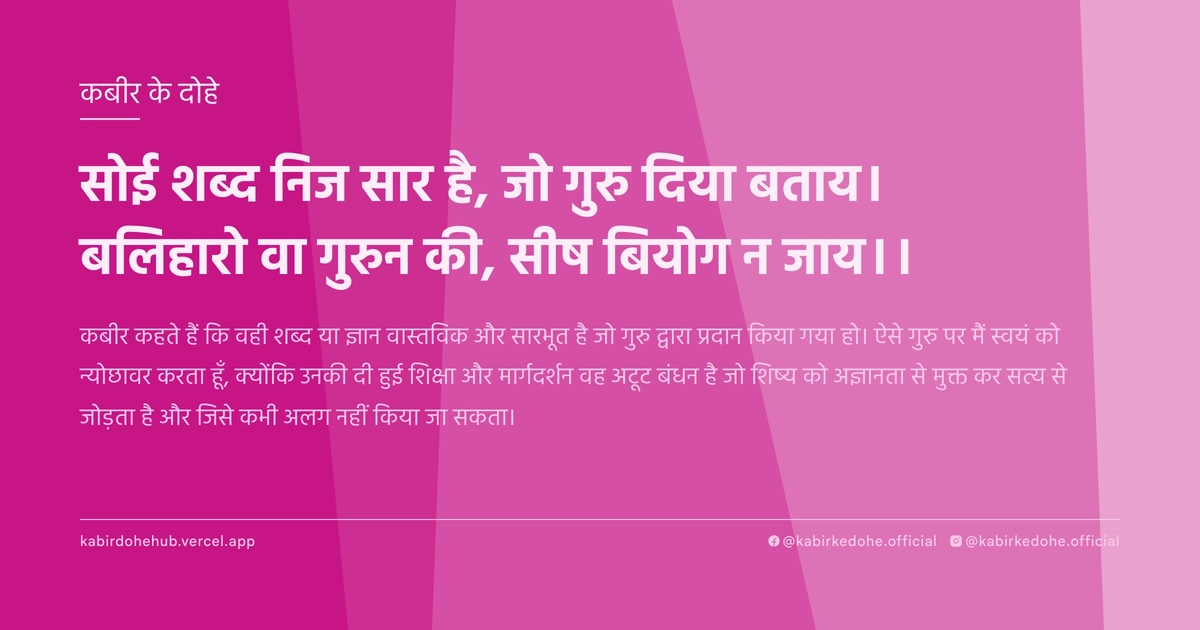
सोई शब्द निज सार है, जो गुरु दिया बताय।
बलिहारो वा गुरुन की, सीष बियोग न जाय।।
Soi shabd nij saar hai, jo guru diya batay. Baliharo va gurun ki, seesh biyog na jaaye.
इस पृष्ठ पर इस कबीर दोहे का अर्थ (meaning), हिंदी व्याख्या और अंग्रेज़ी अनुवाद, दार्शनिक विश्लेषण और व्यावहारिक जीवन सीख दी गई है। यह दोहा गुरु महत्व (The Guru's Importance) विषय से जुड़ा है — Kabir doha meaning and explanation in Hindi and English.
अर्थ (Meaning):
कबीर कहते हैं कि वही शब्द या ज्ञान वास्तविक और सारभूत है जो गुरु द्वारा प्रदान किया गया हो। ऐसे गुरु पर मैं स्वयं को न्योछावर करता हूँ, क्योंकि उनकी दी हुई शिक्षा और मार्गदर्शन वह अटूट बंधन है जो शिष्य को अज्ञानता से मुक्त कर सत्य से जोड़ता है और जिसे कभी अलग नहीं किया जा सकता।
Kabir asserts that the only true essence or spiritual word is that which is imparted by a realized Guru. He expresses total surrender to such a teacher, for the wisdom received is an eternal bond that liberates the disciple from ignorance and anchors them in the ultimate truth, remaining inseparable even beyond the physical plane.
व्याख्या (Interpretation):
शाब्दिक अर्थ में यह दोहा गुरु की महत्ता को दर्शाता है, परंतु गहरा अर्थ 'शब्द' की रहस्यमय प्रकृति में है। यहाँ 'शब्द' केवल वाणी नहीं, बल्कि वह 'अनहद नाद' या ब्रह्मांडीय कंपन है जो आत्मा को परमात्मा से जोड़ता है। यह निरगुण भक्ति का मार्ग है जहाँ गुरु बाहरी व्यक्ति न होकर वह प्रकाश है जो माया के पर्दे को हटाता है। अद्वैत वेदांत के अनुसार, गुरु वह माध्यम है जो यह बोध कराता है कि आत्मा और ब्रह्म एक ही हैं। 'बियोग न जाय' का अर्थ है कि एक बार जब सत्य का साक्षात्कार हो जाता है, तो वह ज्ञान आत्मा का हिस्सा बन जाता है, जिसे मृत्यु या समय भी नहीं मिटा सकता। यह शिष्य के अहंकार के पूर्ण विसर्जन और गुरु के प्रति पूर्ण समर्पण की पराकाष्ठा है।
Literally, the verse praises the Guru, but metaphorically, 'Shabad' refers not to spoken words, but to the 'Anhad Naad'—the unstruck sound or cosmic vibration that bridges the gap between the self and the Absolute. In the context of Nirgun Bhakti, the Guru is not merely a physical instructor but the illuminating force that pierces the veil of Maya. Drawing from Advaita Vedanta, the Guru acts as the catalyst for the realization of Atman-Brahman non-duality. The phrase 'beeyog na jaay' implies that once the spiritual spark is ignited, the realization becomes an ontological part of the seeker, rendering it indestructible. It signifies the total annihilation of the ego, where the disciple's identity merges into the timeless wisdom of the master.
दार्शनिक विश्लेषण (Philosophical Analysis):
कबीर का यह दोहा उस युग की उपज है जब धर्म कर्मकांडों, बाहरी आडंबरों और जातिगत श्रेष्ठता में जकड़ा हुआ था। कबीर ने पुरोहित वर्ग के उस एकाधिकार को चुनौती दी जहाँ ज्ञान केवल शास्त्रों के रटने तक सीमित था। उन्होंने 'शब्द' को आंतरिक अनुभव के रूप में प्रस्तुत किया, जो किसी भी मंदिर, मस्जिद या पोथी से ऊपर है। यह दृष्टिकोण सूफी मत के 'पीर' और 'मुरीद' के संबंध से मेल खाता है, जहाँ बिना आध्यात्मिक मार्गदर्शन के सत्य की प्राप्ति असंभव मानी जाती है।
दार्शनिक स्तर पर, कबीर यहाँ 'ज्ञान' और 'सूचना' के बीच अंतर कर रहे हैं। सूचना किताबों से मिलती है, लेकिन 'सार' (Essence) केवल एक जीवित अनुभव से मिलता है। यह अद्वैत वेदांत के उस सिद्धांत का समर्थन करता है जहाँ गुरु का कार्य केवल निर्देश देना नहीं, बल्कि शिष्य के भीतर पहले से मौजूद दिव्य चिंगारी को जगाना है।
यहाँ 'बलिहारो' शब्द अहंकार के विसर्जन का प्रतीक है। जब तक शिष्य 'मैं' के भाव में रहता है, वह सत्य को ग्रहण नहीं कर सकता। गुरु के प्रति समर्पण वास्तव में स्वयं के अहंकार के प्रति समर्पण है। यह मनोवैज्ञानिक रूपांतरण की प्रक्रिया है जहाँ व्यक्ति अपनी सीमित पहचान को छोड़कर सार्वभौमिक चेतना में प्रवेश करता है।
कबीर का विरोध केवल बाहरी अनुष्ठानों से नहीं था, बल्कि उस मानसिक जड़ता से था जो मनुष्य को सत्य से दूर रखती है। वे सिखाते हैं कि वास्तविक गुरु वह है जो आपको दूसरों पर निर्भर नहीं करता, बल्कि आपको आपके अपने आंतरिक केंद्र (Self) से मिला देता है।
अंततः, यह दोहा इस सत्य को स्थापित करता है कि आध्यात्मिक यात्रा में दिशा का ज्ञान अनिवार्य है। बिना सही मार्गदर्शन के, साधक अक्सर अपनी ही इच्छाओं को आध्यात्मिक उपलब्धि मान बैठता है। गुरु का 'शब्द' वह कसौटी है जिस पर साधक अपने अनुभवों की सत्यता को परखता है।
This Doha emerges from an era where religion was suffocated by rigid rituals, outward displays of piety, and caste hierarchies. Kabir challenged the monopoly of the priestly class, who reduced spirituality to the rote memorization of scriptures. By emphasizing the 'Shabad', Kabir shifted the focus from external dogma to internal experience, asserting that truth transcends temples, mosques, and texts.
Philosophically, Kabir distinguishes between 'information' and 'realization'. While information is found in books, the 'Saar' (Essence) can only be transmitted through a living embodiment of truth. This aligns with the Sufi tradition of the Pir and Murid, where the spiritual guide is indispensable for navigating the treacherous path toward the Divine.
Drawing from Advaita Vedanta, the Guru's role is not to implant knowledge, but to remove the ignorance (Avidya) that obscures the seeker's inherent divinity. The Guru is the mirror reflecting the seeker's own true nature as Brahman.
The term 'Balihaaro' (surrender/sacrifice) is a profound psychological marker. It represents the annihilation of the 'I-consciousness'. Until the ego is dissolved, the truth cannot be absorbed because the ego acts as a filter that distorts reality. Surrender to the Guru is, in essence, the surrender of the false self.
Kabir’s critique extends to the mental inertia that keeps humans tethered to illusion. He posits that the true Guru does not create a new dependency but facilitates the seeker's return to their own internal center. The guidance is a catalyst for self-liberation.
Ultimately, this verse establishes that direction is paramount in the spiritual journey. Without a realized guide, a seeker often mistakes their own psychological projections or desires for spiritual enlightenment. The Guru's 'Shabad' serves as the ultimate litmus test for authentic realization.
मूल संदेश (Core Message):
- बाहरी शोर को शांत करें ताकि आंतरिक शब्द सुनाई दे।
- गुरु केवल मार्गदर्शक है, गंतव्य आपके भीतर ही है।
- अहंकार का विसर्जन ही वास्तविक ज्ञान की पहली शर्त है।
- सत्य कोई सूचना नहीं, बल्कि एक जीवित अनुभव है।
- आत्मा और परमात्मा का मिलन ही जीवन का एकमात्र सार है।
- Silence the external noise to hear the internal Word.
- The Guru is the guide, but the destination is within you.
- The dissolution of ego is the primary prerequisite for true knowledge.
- Truth is not a piece of information, but a living experience.
- The union of the Atman and Brahman is the only true essence of life.
व्यावहारिक उदाहरण (Practical Example):
वाराणसी के एक पुराने घाट पर रहने वाले रामू नाम के एक वृद्ध बुनकर थे। रामू अपनी पूरी जिंदगी रेशमी धागों को बुनने में बिता चुके थे, लेकिन उनका मन हमेशा एक बेचैनी से भरा रहता था। वे सोचते थे कि मोक्ष पाने के लिए उन्हें कठिन व्रत करने होंगे या तीर्थों की लंबी यात्राएं करनी होंगी। वे अक्सर पंडितों के पास जाते और उनसे पूछते कि ईश्वर को पाने का सबसे छोटा रास्ता क्या है, लेकिन उन्हें हमेशा महंगे अनुष्ठानों और लंबी सूचियों वाले नियमों के बारे में बताया जाता।
एक दिन, घाट की सीढ़ियों पर एक फकीर बैठे थे, जिनकी आंखों में एक अजीब सी शांति थी। रामू उनके पास गए और अपनी व्यथा सुनाई। फकीर ने मुस्कुराते हुए रामू से कहा, 'तुम धागों को बुनते हो, लेकिन क्या तुमने कभी उस बुनकर को देखा है जिसने तुम्हें बुना है? बाहर मत ढूंढो, बस अपने भीतर की सांसों के संगीत को सुनो।'
रामू को पहले यह बात समझ नहीं आई। उन्हें लगा कि यह कोई पहेली है। लेकिन फकीर ने उन्हें एक सरल अभ्यास दिया: हर दिन केवल दस मिनट मौन रहकर अपनी सांसों के आने-जाने के साथ 'मैं कौन हूँ' का विचार करना। रामू ने इसे एक प्रयोग की तरह शुरू किया।
शुरुआत में, उनके मन में हजारों विचार आए—घर की चिंता, पुराने झगड़े, और भविष्य का डर। लेकिन फकीर के शब्दों का 'सार' उनके भीतर गहराई तक उतर चुका था। धीरे-धीरे, रामू को महसूस हुआ कि जिस शांति की तलाश में वे तीर्थों पर जाना चाहते थे, वह शांति उनके भीतर ही मौजूद थी।
एक दिन, जब वे करघे पर काम कर रहे थे, उन्हें अचानक अनुभव हुआ कि धागे, करघा, और वे स्वयं—सब एक ही ऊर्जा का हिस्सा हैं। उनके भीतर का 'मैं' गायब हो गया और केवल एक अनंत आनंद शेष रहा।
रामू अब किसी पंडित के पास नहीं जाते थे। उन्होंने महसूस किया कि फकीर द्वारा दिया गया वह एक छोटा सा 'शब्द' (निर्देश) उनके जीवन का सबसे बड़ा सार बन गया था।
उनकी व्यवहारिक जीवन में बदलाव आया। वे अब अधिक धैर्यवान हो गए थे। जब मोहल्ले के लोग आपस में लड़ते, तो रामू उन्हें शांत करने के लिए वही सरलता अपनाते जो उन्होंने फकीर से सीखी थी।
उनकी कला में भी निखार आया। अब वे केवल कपड़े नहीं बुनते थे, बल्कि हर धागे में एक ध्यान जैसा भाव होता था। लोग उनके द्वारा बनाए गए वस्त्रों में एक अजीब सी शांति महसूस करते थे।
रामू ने समझा कि असली गुरु वह नहीं जो आपको रास्ता बताए, बल्कि वह है जो आपको यह एहसास दिला दे कि आप स्वयं ही मंजिल हैं।
अंत में, रामू ने अपना पूरा जीवन उस 'शब्द' के प्रति समर्पित कर दिया, और उनकी मृत्यु के समय उनके चेहरे पर वही शांति थी जो उस फकीर की आंखों में थी।
In the ancient ghats of Varanasi lived an elderly weaver named Ramu. Ramu had spent his entire life weaving intricate silk threads, yet his heart was plagued by a persistent restlessness. He believed that salvation required rigorous fasting or arduous pilgrimages to distant shrines. He frequently consulted priests, asking for the shortest path to God, but was always met with lists of expensive rituals and complex rules.
One day, he encountered a wandering dervish sitting on the stone steps of the ghat, whose eyes radiated an otherworldly peace. Ramu approached him and shared his spiritual agony. The dervish smiled and asked, 'You weave threads, but have you ever seen the Weaver who wove you? Stop searching outside; simply listen to the music of your own breath.'
Initially, Ramu was confused, perceiving this as a mere riddle. However, the dervish gave him a simple practice: spend ten minutes in absolute silence every day, observing the breath and contemplating the question, 'Who am I?'
At first, Ramu's mind was a storm of thoughts—worries about his home, old grudges, and fears of the future. But the 'essence' of the dervish's words had planted a seed deep within him. Slowly, Ramu began to realize that the peace he sought in distant lands was already residing within his own chest.
One afternoon, while working at his loom, a sudden realization struck him: the threads, the loom, and his own self were all manifestations of a single, unified energy. The 'I' vanished, leaving behind only an infinite, shimmering bliss.
Ramu stopped visiting the priests. He understood that the single 'word' or instruction given by the dervish had become the core essence of his existence.
This realization transformed his daily behavior. He became profoundly patient. When neighbors clashed in the narrow lanes, Ramu intervened with the same gentleness he had learned from the dervish, resolving conflicts without judgment.
Even his craft evolved. He no longer just wove fabric; he wove meditation into every thread. People began to feel a strange sense of tranquility when touching the garments he created.
Ramu understood that a true Guru is not one who merely points to a destination, but one who makes you realize that you are the destination itself.
In his final days, Ramu surrendered completely to that inner 'word'. When he passed, his face bore the same serene expression he had first seen in the eyes of the dervish.
अभ्यास मार्गदर्शन (Practice Guidance):
- प्रतिदिन 20 मिनट 'मौन चिंतन' करें, जहाँ आप बाहरी शोर को छोड़कर केवल अपने भीतर की गूँज को सुनने का प्रयास करें।
- एक 'आत्म-पूछताछ जर्नल' बनाएँ: प्रतिदिन एक ऐसी स्थिति लिखें जहाँ आपका अहंकार (Ego) हावी हुआ और विचार करें कि यदि आप 'सार' (सत्य) के साथ होते, तो प्रतिक्रिया क्या होती।
- व्यवहार परिवर्तन: किसी एक व्यक्ति की मदद बिना किसी अपेक्षा या पहचान के करें, यह अनुभव करते हुए कि आप और वह एक ही चेतना के दो रूप हैं।
- डायग्नोस्टिक चेकलिस्ट: क्या आप अभी भी बाहरी प्रमाणों (प्रशंसा, पद, मान्यता) से अपनी शांति तय कर रहे हैं? यदि हाँ, तो आप अभी भी 'माया' के प्रभाव में हैं। क्या आप विपरीत परिस्थितियों में भी आंतरिक स्थिरता महसूस करते हैं? यदि हाँ, तो आप 'शब्द' के सार को जी रहे हैं।
- Practice 20 minutes of 'Silent Contemplation' daily, ignoring external noise to listen to the subtle resonance within your own being.
- Maintain a 'Self-Inquiry Journal': Record daily instances where your ego took control and analyze how you would have responded if you were aligned with the 'Essence' (Truth).
- Behavioral Shift: Perform an act of selfless service for someone without any expectation of reward or recognition, acknowledging that you and the other are manifestations of the same consciousness.
- Diagnostic Checklist: Do you still derive your peace from external validations (praise, status, recognition)? If yes, you are still under the influence of Maya. Do you maintain internal stability amidst chaos? If yes, you are living the essence of the 'Shabad'.
चिंतन प्रश्न (Reflection Questions):
- क्या मेरा 'गुरु' कोई बाहरी व्यक्ति है, या मैंने अपने भीतर के विवेक को गुरु बनाया है?
- मैं अपनी पहचान किन बाहरी लेबलों (डिग्री, पद, धर्म) से जोड़ता हूँ, और यदि ये सब छीन लिए जाएँ, तो मेरा 'सार' क्या बचेगा?
- क्या मैं सत्य को खोजने का दावा करता हूँ, या मैं केवल अपनी पूर्व-धारणाओं की पुष्टि करने वाले 'सत्य' की तलाश कर रहा हूँ?
- मेरे जीवन में 'शब्द' (ज्ञान) और 'आचरण' के बीच कितना अंतराल है?
- क्या मैं वास्तव में समर्पित हूँ, या मेरा समर्पण केवल एक और मानसिक निवेश है जिससे मैं लाभ की उम्मीद करता हूँ?
- Is my 'Guru' merely an external figure, or have I established my inner intuition as the ultimate guide?
- Which external labels (degrees, titles, religion) do I attach to my identity, and if these were stripped away, what 'essence' would remain?
- Do I truly seek the Truth, or am I merely searching for a 'truth' that confirms my existing biases?
- What is the gap between the 'Word' (knowledge) I possess and the 'Action' (conduct) I manifest?
- Am I truly surrendered, or is my surrender just another mental investment from which I expect a spiritual return?