
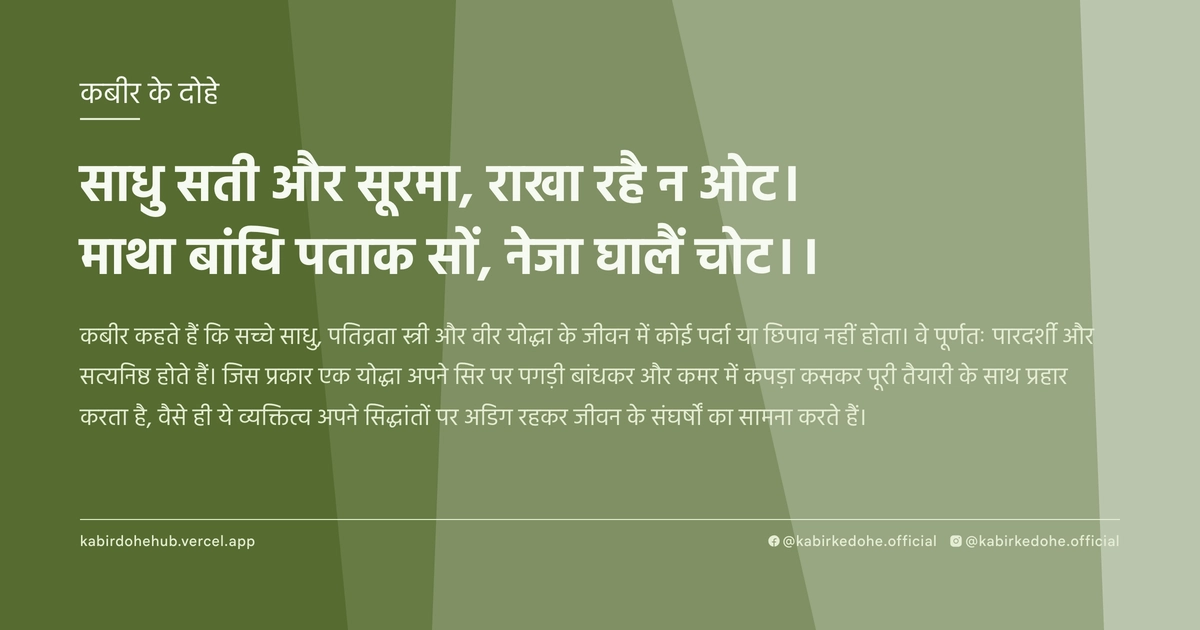
साधु सती और सूरमा, राखा रहै न ओट।
माथा बांधि पताक सों, नेजा घालैं चोट।।
Sadhu sati aur surma, rakha rahai na ot. Matha bandhi patak son, neja ghalain chot.
इस पृष्ठ पर इस कबीर दोहे का अर्थ (meaning), हिंदी व्याख्या और अंग्रेज़ी अनुवाद, दार्शनिक विश्लेषण और व्यावहारिक जीवन सीख दी गई है। यह दोहा निष्ठा (Integrity) विषय से जुड़ा है — Kabir doha meaning and explanation in Hindi and English.
अर्थ (Meaning):
कबीर कहते हैं कि सच्चे साधु, पतिव्रता स्त्री और वीर योद्धा के जीवन में कोई पर्दा या छिपाव नहीं होता। वे पूर्णतः पारदर्शी और सत्यनिष्ठ होते हैं। जिस प्रकार एक योद्धा अपने सिर पर पगड़ी बांधकर और कमर में कपड़ा कसकर पूरी तैयारी के साथ प्रहार करता है, वैसे ही ये व्यक्तित्व अपने सिद्धांतों पर अडिग रहकर जीवन के संघर्षों का सामना करते हैं।
Kabir asserts that for the true seeker, the virtuous soul, and the brave warrior, there is no veil or deception. Their lives are characterized by absolute transparency and integrity. Just as a warrior binds his turban and girds his loins to strike a decisive blow, these individuals confront the illusions of existence with unwavering resolve and total openness.
व्याख्या (Interpretation):
शाब्दिक अर्थ में यह दोहा साहस और ईमानदारी की बात करता है, लेकिन आध्यात्मिक स्तर पर यह 'अहंकार के विसर्जन' का संकेत है। 'ओट' या पर्दा यहाँ माया और पाखंड का प्रतीक है। निर्गुण भक्ति में, ईश्वर तक पहुँचने के लिए बाहरी आडंबरों के पर्दे को हटाना अनिवार्य है। जब साधक अपनी आंतरिक कमजोरियों और बाहरी दिखावे को त्याग देता है, तब वह 'सूरमा' बन जाता है। यह अद्वैत वेदांत के उस सत्य को दर्शाता है जहाँ आत्मा और ब्रह्म के बीच का पर्दा (अविद्या) हट जाता है। यहाँ 'चोट' का अर्थ शारीरिक प्रहार नहीं, बल्कि अज्ञानता पर किया गया प्रहार है।
Literally, the verse speaks of courage and honesty, but spiritually, it signifies the dissolution of the ego. The 'veil' (ot) symbolizes Maya and hypocrisy. In Nirgun Bhakti, reaching the Formless Divine requires removing the curtains of ritualistic pretense. When a seeker discards internal weaknesses and external facades, they become a 'warrior' of the spirit. This aligns with Advaita Vedanta, where the veil of ignorance (Avidya) separating the Atman from Brahman is torn away. The 'strike' (chot) is not physical violence, but a decisive blow dealt to the illusions of the mind.
दार्शनिक विश्लेषण (Philosophical Analysis):
कबीर का यह दोहा उस सामाजिक और धार्मिक परिवेश में लिखा गया था जहाँ धर्म केवल बाहरी कर्मकांडों और जातिगत श्रेष्ठता का खेल बन गया था। कबीर ने 'साधु' और 'सूरमा' जैसे शब्दों का प्रयोग करके यह स्पष्ट किया कि आध्यात्मिकता का अर्थ पलायन नहीं, बल्कि वीरतापूर्ण ईमानदारी है। उन्होंने तत्कालीन समाज में व्याप्त पाखंड को चुनौती दी, जहाँ लोग धर्म का चोला पहनकर भीतर से कपटी थे।
दार्शनिक रूप से, यह सूफी मत के 'फना' (अहंकार का विनाश) और वेदांत के 'ज्ञान' के मिलन बिंदु पर स्थित है। कबीर का मानना था कि सत्य को पाने के लिए व्यक्ति को अपनी सामाजिक पहचान (जाति, पद, प्रतिष्ठा) के पर्दे को हटाना होगा। यदि कोई व्यक्ति अपनी त्रुटियों को छिपाता है, तो वह कभी मुक्त नहीं हो सकता।
यहाँ 'सती' शब्द केवल विवाहित स्त्री के लिए नहीं, बल्कि उस आत्मा के लिए है जो अपने सत्य के प्रति पूर्णतः समर्पित है। यह समर्पण ही वह शक्ति है जो माया के प्रभाव को समाप्त करती है। कबीर यहाँ यह समझा रहे हैं कि भक्ति कोई कोमल प्रक्रिया नहीं है, बल्कि यह एक युद्ध है—अपने ही भीतर के अंधकार के विरुद्ध।
इस विश्लेषण में यह समझना आवश्यक है कि कबीर 'वीरता' को शारीरिक बल से नहीं, बल्कि मानसिक दृढ़ता से जोड़ते हैं। एक सच्चा साधु वह है जो समाज के डर के बिना सत्य बोल सके। यह मनोवैज्ञानिक रूपांतरण है जहाँ व्यक्ति बाहरी अनुमोदन की आवश्यकता को समाप्त कर देता है।
अंततः, यह दोहा हमें सिखाता है कि सत्य की प्राप्ति केवल उन्हीं को होती है जो पारदर्शी होने का साहस रखते हैं। जो अपनी कमियों को स्वीकार करते हैं और उन्हें सुधारने के लिए 'नेजा' (कमरबंद) बांधकर तैयार रहते हैं, वही वास्तविक मोक्ष के अधिकारी हैं।
This couplet was composed in an era where religion had devolved into mere ritualism and caste-based superiority. By invoking the 'Sadhu' and the 'Warrior,' Kabir redefines spirituality not as an escape from the world, but as a courageous commitment to honesty. He challenged the prevailing hypocrisy where individuals wore the cloak of piety while harboring deceit within.
Philosophically, this verse sits at the intersection of the Sufi concept of 'Fana' (annihilation of the ego) and the Vedantic pursuit of 'Jnana' (knowledge). Kabir posits that to realize the Truth, one must strip away the veils of social identity—caste, rank, and reputation. Transparency is the prerequisite for liberation; he who hides his flaws remains shackled by them.
The term 'Sati' here transcends gender or marital status, representing any soul completely devoted to its intrinsic Truth. This devotion is the catalyst that dissolves the influence of Maya. Kabir frames the spiritual journey not as a gentle stroll, but as a battle—a war waged against the internal darkness of the self.
It is crucial to understand that Kabir equates 'bravery' not with physical prowess, but with psychological fortitude. A true seeker is one who can speak the truth without fear of social ostracization. This represents a profound psychological shift where the need for external validation is replaced by internal authenticity.
Ultimately, the verse teaches that the Divine is accessible only to those who dare to be transparent. Those who acknowledge their imperfections and gird themselves with resolve to overcome them are the ones who truly attain liberation.
मूल संदेश (Core Message):
- पाखंड का पर्दा हटाना ही वास्तविक आध्यात्मिकता की शुरुआत है।
- सत्य की राह पर चलने के लिए मानसिक साहस और ईमानदारी अनिवार्य है।
- अहंकार का विनाश ही आत्मा और परमात्मा के मिलन का एकमात्र मार्ग है।
- बाहरी आडंबरों को त्यागकर आंतरिक सत्य को स्वीकार करना ही वीरता है।
- पारदर्शिता ही वह कुंजी है जो माया के बंधनों को काटती है।
- Tearing the veil of hypocrisy is the true beginning of spirituality.
- Mental courage and honesty are indispensable for walking the path of Truth.
- The annihilation of ego is the only bridge between the Soul and the Divine.
- True bravery lies in discarding external facades to embrace internal truth.
- Transparency is the key that severs the shackles of Maya.
व्यावहारिक उदाहरण (Practical Example):
एक समय की बात है, वाराणसी के घाटों पर माधव नाम का एक वृद्ध बुनकर रहता था। माधव अपनी कला में निपुण था, लेकिन वह अपनी एक बड़ी कमजोरी छिपाता था—वह बहुत क्रोधी था और अक्सर अपने सहायकों पर चिल्लाता था। समाज उसे एक 'धर्मनिष्ठ' व्यक्ति मानता था क्योंकि वह नियमित पूजा करता था, लेकिन उसके मन का पर्दा (ओट) उसके क्रोध को छिपाए हुए था।
एक दिन उसकी मुलाकात एक घुमंतू संत से हुई। संत ने माधव की पूजा की प्रशंसा नहीं की, बल्कि उसकी आँखों में छिपे क्रोध को देख लिया। संत ने कहा, 'माधव, तुम्हारी पूजा का पर्दा तुम्हारे क्रोध को ढंक रहा है। जब तक तुम अपनी इस कुरूपता को स्वीकार नहीं करोगे, तुम्हारी भक्ति केवल एक दिखावा है।'
माधव को पहले तो यह बात चुभी, लेकिन फिर उसने महसूस किया कि वह दुनिया के सामने एक 'साधु' बनने का नाटक कर रहा था, जबकि भीतर वह एक अशांत मनुष्य था। उसने तय किया कि वह अब अपनी कमियों को छिपाएगा नहीं।
अगले दिन, जब उसे अपने एक सहायक पर क्रोध आया, तो उसने चिल्लाने के बजाय रुककर खुद से कहा, 'देखो, मेरा क्रोध फिर से जाग रहा है।' उसने यह बात अपने सहायक को भी बता दी कि वह क्रोधित महसूस कर रहा है और इसके लिए क्षमा चाहता है।
यह उसकी पहली 'चोट' थी—अपने अहंकार पर प्रहार। उसने अपनी छवि के पर्दे को हटा दिया। उसने स्वीकार किया कि वह पूर्ण नहीं है।
धीरे-धीरे, माधव ने पाया कि जब उसने अपनी कमियों को छिपाना बंद किया, तो उसका क्रोध कम होने लगा। अब उसे इस बात का डर नहीं था कि लोग उसके बारे में क्या सोचेंगे।
उसने अपनी कमर में 'नेजा' बांध लिया, जिसका अर्थ था कि अब वह अपनी आंतरिक बुराइयों से लड़ने के लिए पूरी तरह तैयार था। उसने अपनी ईमानदारी को ही अपनी सबसे बड़ी शक्ति बना लिया।
अंत में, माधव केवल एक कुशल बुनकर या एक पूजा करने वाला व्यक्ति नहीं रहा, बल्कि वह एक सच्चा 'सूरमा' बन गया। उसकी शांति अब दिखावटी नहीं, बल्कि वास्तविक थी क्योंकि उसने सत्य के साथ जीना सीख लिया था।
Once, on the ghats of Varanasi, lived an elderly weaver named Madhav. Madhav was a master of his craft, but he harbored a hidden flaw—a volatile temper. He often shouted at his assistants, yet the community regarded him as a 'devout' man because of his rigorous ritualistic prayers. The 'veil' of his religious identity masked his internal turbulence.
One day, he encountered a wandering mystic. The mystic did not praise Madhav's prayers but instead looked straight into the anger simmering in his eyes. The mystic remarked, 'Madhav, the veil of your piety is merely hiding your rage. Until you acknowledge this ugliness, your devotion is nothing but a performance.'
Initially, Madhav felt insulted, but he soon realized he was playing the role of a 'saint' for the world while remaining a tormented man inside. He decided he would no longer hide his imperfections.
The next day, when he felt a surge of anger toward an assistant, he stopped and told himself, 'Look, my anger is rising again.' He then openly admitted to his assistant that he was feeling angry and asked for forgiveness for his struggle.
This was his first 'strike'—a blow dealt to his own ego. He tore down the curtain of his curated image and admitted he was flawed.
Gradually, Madhav discovered that once he stopped hiding his shadows, the anger lost its power over him. He was no longer terrified of how others perceived him.
He 'girded his loins,' meaning he became fully prepared to battle his internal demons. He transformed his honesty into his greatest strength.
In the end, Madhav ceased to be just a skilled weaver or a ritualistic devotee; he became a true 'warrior' of the spirit. His peace was no longer a facade, but a reality, for he had learned to live in absolute transparency.
अभ्यास मार्गदर्शन (Practice Guidance):
- दैनिक आत्म-निरीक्षण: प्रतिदिन 15 मिनट मौन बैठें और उन बातों की सूची बनाएं जिन्हें आप दुनिया से छिपाते हैं। पूछें, 'मैं यह पर्दा क्यों बनाए हुए हूँ?'
- सत्य का अभ्यास: दिन में कम से कम एक बार अपनी किसी गलती को बिना किसी बहाने के स्वीकार करें, चाहे वह छोटी ही क्यों न हो।
- अहंकार का विसर्जन: जब भी आप स्वयं को दूसरों से 'बेहतर' या 'अधिक आध्यात्मिक' महसूस करें, तो तुरंत याद करें कि यह केवल माया का एक और पर्दा है।
- निदान चेकलिस्ट: क्या मैं अपनी छवि की रक्षा करने के लिए झूठ बोल रहा हूँ? क्या मैं दूसरों की आलोचना करता हूँ लेकिन अपनी गलतियों को नजरअंदाज करता हूँ? यदि हाँ, तो आप अभी भी 'ओट' के पीछे हैं।
- Daily Self-Inquiry: Sit in silence for 15 minutes daily and list the things you hide from the world. Ask yourself, 'Why am I maintaining this veil?'
- Practice of Truth: At least once a day, admit a mistake without offering any excuses, no matter how trivial it may seem.
- Dissolution of Ego: Whenever you feel 'superior' or 'more spiritual' than others, immediately recognize this as another veil of Maya.
- Diagnostic Checklist: Am I lying to protect my image? Do I criticize others while ignoring my own flaws? If yes, you are still hiding behind the 'veil'.
चिंतन प्रश्न (Reflection Questions):
- वह कौन सा 'पर्दा' है जिसे मैं अपनी सामाजिक प्रतिष्ठा बचाने के लिए सबसे मजबूती से पकड़े हुए हूँ?
- क्या मेरी धार्मिकता वास्तव में मेरी आत्मा की शुद्धि है, या केवल मेरी असुरक्षाओं को छिपाने का एक तरीका?
- यदि दुनिया को मेरी सबसे गहरी कमियां पता चल जाएं, तो क्या मैं अभी भी खुद को 'अच्छा' मान पाऊंगा?
- मेरा 'डिजिटल अहंकार' (सोशल मीडिया इमेज) मेरे वास्तविक स्वरूप से कितना अलग है और यह मुझे सत्य से कैसे दूर कर रहा है?
- क्या मैं वास्तव में सत्य की खोज कर रहा हूँ, या मैं केवल सत्य जैसा दिखने का प्रयास कर रहा हूँ?
- What is the 'veil' I cling to most fiercely to protect my social standing?
- Is my religiosity a genuine purification of the soul, or merely a way to mask my insecurities?
- If the world knew my deepest flaws, would I still be able to perceive myself as a 'good' person?
- How different is my 'digital ego' (social media image) from my true self, and how does this distance alienate me from Truth?
- Am I truly seeking the Truth, or am I merely striving to appear truthful?