
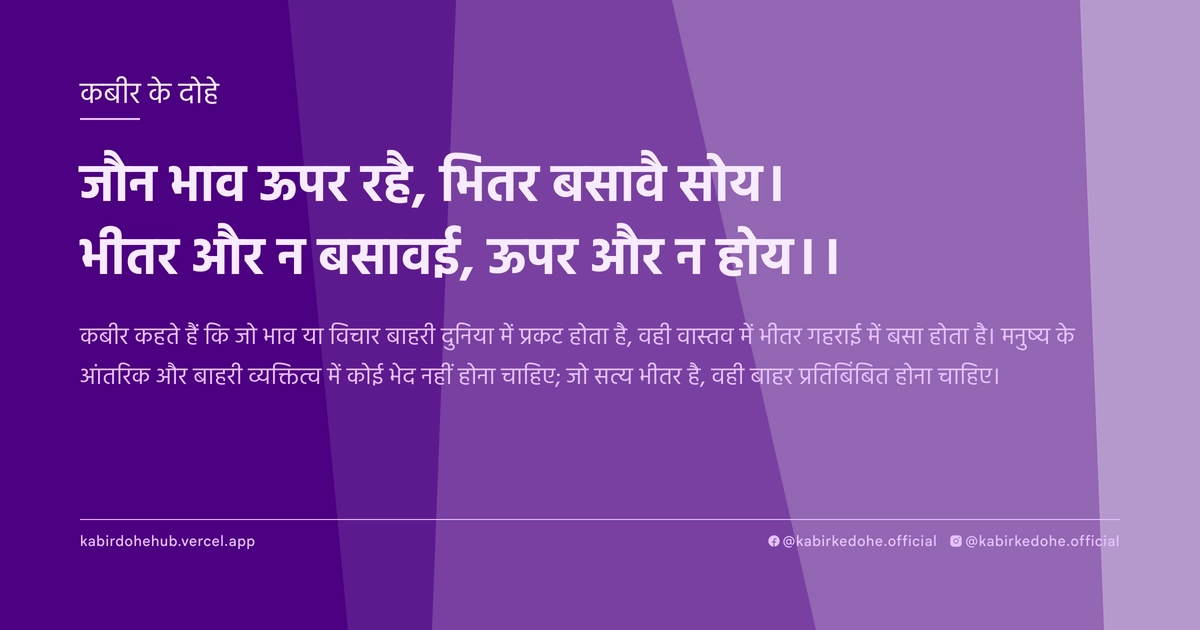
जौन भाव ऊपर रहै, भितर बसावै सोय।
भीतर और न बसावई, ऊपर और न होय।।
Jaun bhav upar rahai, bhitar basavai soy. Bhitar aur na basavai, upar aur na hoye.
इस पृष्ठ पर इस कबीर दोहे का अर्थ (meaning), हिंदी व्याख्या और अंग्रेज़ी अनुवाद, दार्शनिक विश्लेषण और व्यावहारिक जीवन सीख दी गई है। यह दोहा अंतर ज्योति (The Inner Light) विषय से जुड़ा है — Kabir doha meaning and explanation in Hindi and English.
अर्थ (Meaning):
कबीर कहते हैं कि जो भाव या विचार बाहरी दुनिया में प्रकट होता है, वही वास्तव में भीतर गहराई में बसा होता है। मनुष्य के आंतरिक और बाहरी व्यक्तित्व में कोई भेद नहीं होना चाहिए; जो सत्य भीतर है, वही बाहर प्रतिबिंबित होना चाहिए।
Kabir asserts that the disposition or emotion displayed on the surface is merely a reflection of what is deeply embedded within. There should be no duality between the internal state and external expression; whatever resides inside must be the only thing that manifests outside.
व्याख्या (Interpretation):
इसका शाब्दिक अर्थ है कि बाहरी व्यवहार आंतरिक स्थिति का दर्पण है। आध्यात्मिक स्तर पर, यह 'अद्वैत' की स्थिति है जहाँ पाखंड का कोई स्थान नहीं है। कबीर यहाँ माया के उस जाल की बात कर रहे हैं जहाँ मनुष्य बाहर से कुछ और भीतर से कुछ और होने का ढोंग करता है। जब साधक अपनी अंतरात्मा (Atman) को पहचान लेता है, तो वह बाहरी दिखावे और आंतरिक सत्य के बीच के द्वंद्व को समाप्त कर देता है। यह निर्गुण भक्ति का मार्ग है जहाँ ईश्वर किसी मूर्ति में नहीं, बल्कि शुद्ध और एकीकृत चेतना में बसता है। यहाँ 'भाव' का अर्थ केवल भावना नहीं, बल्कि वह मूल अस्तित्व है जो व्यक्ति को संचालित करता है।
Literally, this suggests that external behavior is a mirror of the internal state. Spiritually, it points toward the state of 'Advaita' or non-duality, where hypocrisy cannot exist. Kabir addresses the web of Maya, where humans pretend to be one thing externally while harboring another reality internally. When a seeker realizes the Atman, the conflict between the external facade and internal truth dissolves. This is the path of Nirgun Bhakti, where the Divine is not found in idols but in a pure, integrated consciousness. Here, 'Bhaav' refers not just to emotion, but to the fundamental essence that drives a human being.
दार्शनिक विश्लेषण (Philosophical Analysis):
कबीर का यह दोहा मध्यकालीन भारत के सामाजिक और धार्मिक पाखंड पर एक तीखा प्रहार है। उस समय धर्म केवल बाहरी कर्मकांडों, जैसे तीर्थयात्रा और माला जपने तक सीमित था, जबकि मन ईर्ष्या और अहंकार से भरा रहता था। कबीर ने इस 'दोहरेपन' को आध्यात्मिक पतन का मुख्य कारण माना।
अद्वैत वेदांत के परिप्रेक्ष्य में, यह दोहा आत्मा और परमात्मा की एकता पर जोर देता है। यदि हम स्वयं को ब्रह्म का अंश मानते हैं, तो हमारे भीतर और बाहर कोई अंतर नहीं होना चाहिए। बाहरी दिखावा 'अहंकार' (Ego) की उपज है, जबकि आंतरिक सत्य 'शुद्ध चैतन्य' है।
सूफी मत के 'फना' के सिद्धांत से इसे जोड़कर देखें तो, जब इंसान अपनी व्यक्तिगत पहचान (नफ्स) को मिटा देता है, तब केवल वही सत्य बचता है जो सार्वभौमिक है। जब 'मैं' मिट जाता है, तो भीतर और बाहर का भेद समाप्त हो जाता है।
कबीर जातिवाद और ऊंच-नीच के भेदभाव को भी इसी दोहरेपन का हिस्सा मानते थे। एक व्यक्ति खुद को उच्च जाति का बताकर बाहर से पवित्र दिख सकता है, लेकिन यदि उसके भीतर घृणा है, तो वह पवित्र नहीं है।
मनोवैज्ञानिक स्तर पर, यह 'कॉग्निटिव डिसोनेंस' या मानसिक द्वंद्व की स्थिति को समाप्त करने का आह्वान है। जब हमारे विचार और कार्य एक ही दिशा में होते हैं, तब मानसिक शांति और आध्यात्मिक उत्थान संभव होता है।
This couplet is a sharp critique of the social and religious hypocrisy prevalent in medieval India. During Kabir's era, religion was often reduced to external rituals—pilgrimages and prayer beads—while the mind remained clouded by jealousy and ego.
From the perspective of Advaita Vedanta, this verse emphasizes the unity of the Atman and Brahman. If we perceive ourselves as fragments of the Universal Consciousness, there can be no divergence between our inner and outer selves. External facade is a product of the 'Ahamkara' (Ego), whereas internal truth is 'Pure Consciousness'.
Connecting this to the Sufi concept of 'Fana' (annihilation), when a human dissolves their individual identity (Nafs), only the universal truth remains. Once the 'I' is erased, the boundary between the internal and external vanishes.
Kabir viewed casteism and social hierarchy as extensions of this duality. A person might claim a high caste to appear pure externally, but if hatred resides within, that purity is an illusion.
Psychologically, this is a call to resolve 'cognitive dissonance'. When a person's thoughts and actions align perfectly, mental peace and spiritual evolution become possible, leading to a state of wholeness.
मूल संदेश (Core Message):
- बाहरी दिखावा आंतरिक रिक्तता का प्रमाण है।
- सत्य वह है जहाँ भीतर और बाहर एक हो जाएं।
- पाखंड आत्मा की प्रगति में सबसे बड़ी बाधा है।
- ईश्वर को खोजने से पहले स्वयं के द्वंद्व को समाप्त करें।
- प्रामाणिकता ही वास्तविक आध्यात्मिकता का आधार है।
- External facade is evidence of internal emptiness.
- Truth is where the inner and outer become one.
- Hypocrisy is the greatest obstacle to spiritual progress.
- Resolve your internal conflicts before seeking the Divine.
- Authenticity is the foundation of true spirituality.
व्यावहारिक उदाहरण (Practical Example):
एक समय की बात है, वाराणसी के घाटों पर माधव नाम का एक पुराना बुनकर रहता था। माधव अपनी साड़ियों की बारीकी के लिए प्रसिद्ध था, लेकिन वह स्वभाव से बहुत क्रोधी था।
वह मंदिर में जाकर घंटों प्रार्थना करता और सबको शांति का उपदेश देता, लेकिन घर लौटते ही अपनी पत्नी और बच्चों पर चिल्लाता था।
उसका बाहरी व्यक्तित्व एक 'संत' का था, लेकिन आंतरिक व्यक्तित्व एक 'अशांत' व्यक्ति का। वह इस द्वंद्व से बहुत परेशान रहता था क्योंकि उसकी प्रार्थनाएं उसे शांति नहीं दे रही थीं।
एक दिन उसने कबीर के इस दोहे को सुना: 'जौन भाव ऊपर रहै, भितर बसावै सोय'। उसे समझ आया कि वह बाहर जो शांति दिखा रहा है, वह उसके भीतर मौजूद नहीं है।
माधव ने महसूस किया कि वह केवल 'दिखावा' कर रहा था। उसने तय किया कि वह अब बाहरी पूजा के बजाय अपने क्रोध की जड़ को खोजने का प्रयास करेगा।
उसने अपनी साड़ियों की बुनाई को ही ध्यान बना लिया। जब भी उसे क्रोध आता, वह रुक जाता और सोचता कि यह क्रोध कहाँ से आ रहा है।
धीरे-धीरे उसने पाया कि उसका क्रोध उसकी अपनी असफलताओं और अहंकार से उपजा था। उसने अपने भीतर के उस अंधेरे को स्वीकार करना शुरू किया।
जैसे-जैसे वह आंतरिक रूप से शांत हुआ, उसका बाहरी व्यवहार भी स्वाभाविक रूप से बदल गया। अब उसे मंदिर में घंटों नाटक करने की आवश्यकता नहीं थी।
उसकी शांति अब बनावटी नहीं थी, बल्कि उसके अस्तित्व का हिस्सा बन गई थी। वह अब वास्तव में वही था जो वह दिखता था।
गाँव के लोग अब उसकी साड़ियों की नहीं, बल्कि उसके स्वभाव की सौम्यता की प्रशंसा करने लगे। माधव ने जान लिया कि असली मोक्ष बाहरी आडंबर में नहीं, बल्कि आंतरिक और बाहरी सत्य के मिलन में है।
Once, in the ghats of Varanasi, lived an old weaver named Madhav. Madhav was renowned for the intricacy of his sarees, but he was known for his volatile temper.
He would spend hours in the temple praying and preaching peace to everyone, yet the moment he returned home, he would scream at his wife and children.
His external persona was that of a 'saint', but his internal reality was that of a 'restless man'. He suffered deeply from this conflict, as his prayers brought him no lasting peace.
One day, he heard Kabir's couplet: 'Jaun bhaav upar rahai, bhitar basaavai soy'. He realized that the peace he projected externally did not exist within him.
Madhav understood that he was merely performing a role. He decided to stop focusing on external rituals and instead seek the root of his anger.
He turned the act of weaving his sarees into a meditation. Whenever anger flared, he would stop and observe where the emotion was originating.
Gradually, he discovered that his anger stemmed from his own hidden failures and a fragile ego. He began to acknowledge and embrace that inner darkness.
As he became internally tranquil, his external behavior shifted naturally. He no longer felt the need to perform piety in the temple for hours.
His peace was no longer a mask; it had become a part of his very existence. He finally became who he appeared to be.
The villagers began to admire not just his sarees, but the gentleness of his spirit. Madhav learned that true liberation lies not in outward display, but in the union of internal and external truth.
अभ्यास मार्गदर्शन (Practice Guidance):
- प्रतिदिन 15 मिनट मौन रहकर यह निरीक्षण करें कि आपके बाहरी शब्दों और आंतरिक विचारों में कितना अंतर है।
- एक 'सत्य-डायरी' लिखें: दिन भर में ऐसी घटनाओं को दर्ज करें जहाँ आपने अपनी वास्तविक भावना को छिपाकर कुछ और प्रदर्शित किया।
- व्यवहार परिवर्तन: जब भी आप किसी की प्रशंसा करें, सुनिश्चित करें कि वह प्रशंसा आपके हृदय की गहराई से आ रही है, न कि केवल शिष्टाचार के लिए।
- डायग्नोस्टिक चेकलिस्ट: क्या मैं दूसरों के सामने वह व्यक्ति बनने की कोशिश कर रहा हूँ जो मैं वास्तव में नहीं हूँ? क्या मेरी शांति केवल बाहरी है? क्या मैं अपनी कमियों को स्वीकार करने से डरता हूँ?
- Spend 15 minutes in silence daily observing the gap between your external words and your internal thoughts.
- Maintain a 'Truth Journal': Record instances during the day where you masked your real emotions to project a different image.
- Behavioral Shift: Whenever you praise someone, ensure the appreciation comes from a place of genuine internal feeling, not mere social etiquette.
- Diagnostic Checklist: Am I trying to be someone for others that I am not? Is my peace merely superficial? Am I afraid to acknowledge my internal flaws?
चिंतन प्रश्न (Reflection Questions):
- वह कौन सा मुखौटा है जिसे मैं दुनिया के सामने सबसे अधिक पहनता हूँ?
- यदि मेरे विचार सार्वजनिक हो जाएं, तो मेरी सामाजिक छवि कितनी बदल जाएगी?
- क्या मेरी 'धार्मिकता' केवल दूसरों की नजरों में अच्छा दिखने का एक साधन है?
- मैं अपनी उन भावनाओं से क्यों डरता हूँ जो मेरी सार्वजनिक छवि के विपरीत हैं?
- क्या मैं वास्तव में वह व्यक्ति हूँ जिसे मैं दर्पण में देखता हूँ, या वह जिसे मैं दुनिया को दिखाना चाहता हूँ?
- Which mask do I wear most frequently in front of the world?
- If my internal thoughts were made public, how drastically would my social image change?
- Is my 'religiosity' merely a tool to appear good in the eyes of others?
- Why am I afraid of emotions that contradict my public persona?
- Am I truly the person I see in the mirror, or the person I want the world to see?