
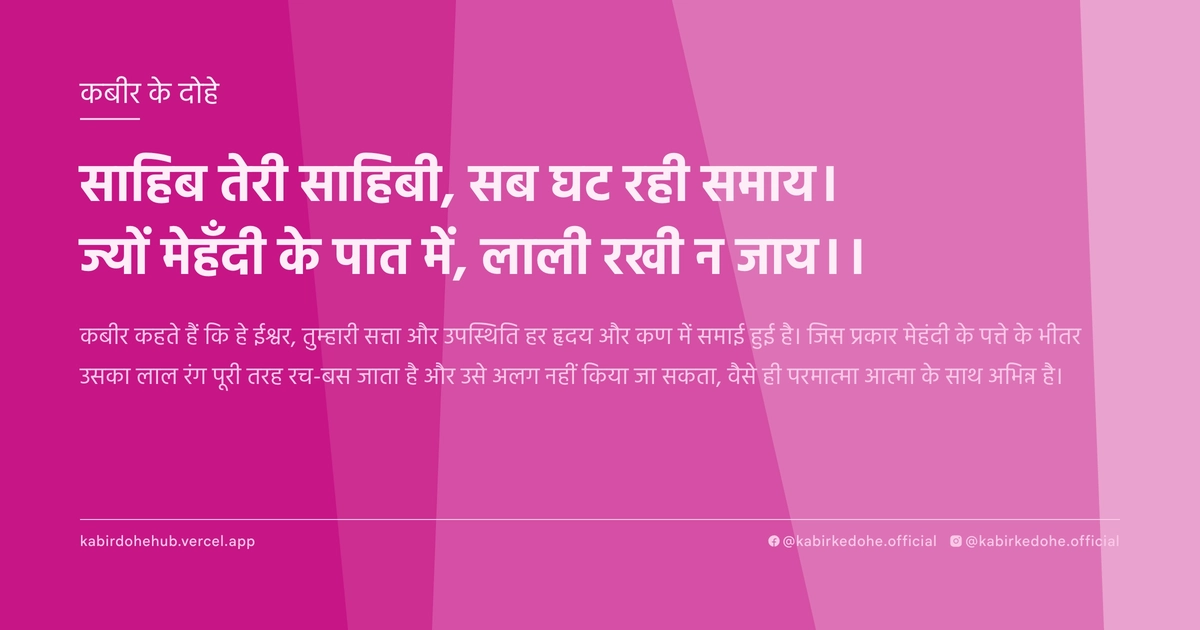
साहिब तेरी साहिबी, सब घट रही समाय।
ज्यों मेहँदी के पात में, लाली रखी न जाय।।
Sahib teri sahibi, sab ghat rahi samaye. Jyon mehndi ke paat mein, laali rakhi na jaaye.
इस पृष्ठ पर इस कबीर दोहे का अर्थ (meaning), हिंदी व्याख्या और अंग्रेज़ी अनुवाद, दार्शनिक विश्लेषण और व्यावहारिक जीवन सीख दी गई है। यह दोहा निर्गुण ब्रह्म (Nirguna Brahman) विषय से जुड़ा है — Kabir doha meaning and explanation in Hindi and English.
अर्थ (Meaning):
कबीर कहते हैं कि हे ईश्वर, तुम्हारी सत्ता और उपस्थिति हर हृदय और कण में समाई हुई है। जिस प्रकार मेहंदी के पत्ते के भीतर उसका लाल रंग पूरी तरह रच-बस जाता है और उसे अलग नहीं किया जा सकता, वैसे ही परमात्मा आत्मा के साथ अभिन्न है।
Kabir proclaims that the Divine Presence permeates every heart and every atom of existence. Just as the crimson hue of henna is inextricably woven into the very fiber of its leaf, the Creator is inseparable from the creation, residing within every soul as an eternal essence.
व्याख्या (Interpretation):
यह दोहा अद्वैत भाव की पराकाष्ठा है। 'साहिब' यहाँ केवल एक बाहरी ईश्वर नहीं, बल्कि वह अंतर्यामी चेतना है जो सर्वव्यापी है। मेहंदी और उसके रंग का उदाहरण यह दर्शाता है कि परमात्मा और जीव का संबंध 'अविभाज्य' है। यह निरगुण भक्ति का मार्ग है जहाँ ईश्वर किसी मंदिर या मस्जिद में नहीं, बल्कि स्वयं के भीतर खोजा जाता है। माया वह पर्दा है जो हमें इस एकता को देखने से रोकता है, जबकि सत्य यह है कि आत्मा और ब्रह्म एक ही हैं। यहाँ विरोधाभास यह है कि हम जिसे बाहर खोज रहे हैं, वह हमारे अस्तित्व का मूल आधार है।
This couplet represents the pinnacle of non-dual consciousness. 'Sahib' here is not a distant deity but the immanent consciousness pervading all existence. The metaphor of henna and its color illustrates that the relationship between the Divine and the individual soul is 'indivisible.' This aligns with Nirgun Bhakti, where the Formless is sought not in external shrines, but within the self. Maya acts as the veil obscuring this unity, while the truth remains that Atman and Brahman are one. The central paradox is that the seeker is simultaneously the sought, and the search itself is the final barrier to realization.
दार्शनिक विश्लेषण (Philosophical Analysis):
कबीर का यह दर्शन मध्यकालीन भारत के उस दौर का है जब धर्म कर्मकांडों और बाहरी आडंबरों में जकड़ा हुआ था। उन्होंने स्पष्ट रूप से जाति, धर्म और मूर्तिपूजा का विरोध किया, क्योंकि उनके लिए सत्य 'अनुभव' का विषय था, 'शास्त्रों' का नहीं। यह विचार सूफी मत के 'वहदत-अल-वुजूद' (अस्तित्व की एकता) और अद्वैत वेदांत के 'अहं ब्रह्मास्मि' से गहराई से मेल खाता है।
यहाँ कबीर यह समझा रहे हैं कि ईश्वर को पाने के लिए कहीं जाने की आवश्यकता नहीं है। ritualism या बाहरी पूजा केवल अहंकार को पुष्ट करती है, जबकि वास्तविक भक्ति अहंकार के विसर्जन में है। जब 'मैं' मिटता है, तब केवल 'वह' बचता है। यह मनोवैज्ञानिक रूपांतरण की प्रक्रिया है जहाँ व्यक्ति अपनी सीमित पहचान को त्यागकर सार्वभौमिक पहचान को अपनाता है।
अक्सर लोग इस दोहे को केवल ईश्वर की सर्वव्यापकता के रूप में देखते हैं, लेकिन इसका गहरा अर्थ 'अभिन्नता' है। जैसे रंग पत्ते से अलग नहीं होता, वैसे ही चेतना पदार्थ से अलग नहीं है। यह भौतिकवाद और आध्यात्मिकता के बीच के द्वैत को समाप्त करता है।
सूफीवाद में जिसे 'इश्क-ए-हकीकी' कहा गया है, कबीर उसे सहज प्रेम कहते हैं। यह प्रेम किसी व्यक्ति से नहीं, बल्कि उस तत्व से है जो हर जीवित इकाई में स्पंदित हो रहा है। यह बोध मनुष्य को संकीर्णताओं से मुक्त कर करुणा और समता की ओर ले जाता है।
अंततः, यह विश्लेषण हमें बताता है कि मुक्ति कहीं बाहर नहीं, बल्कि अपनी ही प्रकृति को पहचानने में है। जब साधक यह जान लेता है कि वह स्वयं उस अनंत का हिस्सा है, तब भय, वासना और द्वेष स्वतः समाप्त हो जाते हैं, क्योंकि वह हर दूसरे व्यक्ति में स्वयं को ही देखता है।
Kabir's philosophy emerged during a medieval Indian era where religion was stifled by rigid rituals and outward displays of piety. He vehemently rejected caste hierarchies and idol worship, asserting that Truth is a matter of direct 'experience' rather than scriptural dogma. This perspective resonates deeply with the Sufi concept of 'Wahdat-al-Wujud' (Unity of Existence) and the Advaita Vedanta realization of 'Aham Brahmasmi' (I am Brahman).
Kabir argues that there is no need to travel far to find the Divine. Ritualism and external worship often serve only to bolster the ego, whereas true devotion lies in the annihilation of the 'I'. When the ego dissolves, only the Universal remains. This is a process of psychological transformation where the individual transcends their limited identity to embrace a cosmic consciousness.
Common literalist interpretations view this only as God's omnipresence, but the deeper meaning is 'non-separability.' Just as the color cannot be peeled away from the leaf, consciousness cannot be detached from existence. This collapses the duality between the material and the spiritual worlds.
What Sufism calls 'Ishq-e-Haqiqi' (Divine Love), Kabir describes as 'Sahaj Prem' (Natural Love). This love is not directed toward a person, but toward the essence vibrating within every living entity. This realization liberates the human spirit from narrow prejudices, leading toward universal compassion and equity.
Ultimately, this analysis reveals that liberation is not a destination but the act of recognizing one's own true nature. Once the seeker realizes they are an integral part of the Infinite, fear, lust, and hatred vanish, for they perceive themselves in every other being they encounter.
मूल संदेश (Core Message):
- ईश्वर कोई बाहरी सत्ता नहीं, बल्कि आंतरिक चेतना है।
- अहंकार वह पर्दा है जो हमें हमारी एकता से अलग करता है।
- सच्ची भक्ति कर्मकांडों में नहीं, बल्कि जीव-मात्र के प्रेम में है।
- आत्मा और परमात्मा के बीच कोई अंतर नहीं है, वे अभिन्न हैं।
- जब 'मैं' मिटता है, तब सार्वभौमिक सत्य प्रकट होता है।
- The Divine is not an external entity but our own inner consciousness.
- The ego is the only veil separating us from our primordial unity.
- True devotion lies not in rituals, but in love for all living beings.
- There is no distinction between the Soul and the Absolute; they are one.
- When the 'I' dissolves, the universal truth manifests effortlessly.
व्यावहारिक उदाहरण (Practical Example):
वाराणसी के एक पुराने मोहल्ले में माधव नाम का एक वृद्ध बुनकर रहता था। माधव अपनी कला में निपुण था, लेकिन उसका मन हमेशा अशांत रहता था। वह घंटों मंदिरों में माथा टेकता और कठिन व्रत रखता, इस उम्मीद में कि एक दिन ईश्वर उसे दर्शन देंगे और उसके जीवन के दुखों का अंत होगा।
माधव का मानना था कि ईश्वर कहीं बहुत दूर, किसी दिव्य लोक में रहते हैं और उन्हें प्रसन्न करने के लिए विशेष अनुष्ठानों की आवश्यकता होती है। वह अपने आस-पास के लोगों को तुच्छ समझता था और खुद को एक 'सच्चा भक्त' मानता था, जिससे उसके भीतर एक सूक्ष्म अहंकार जन्म ले चुका था।
एक दिन उसकी मुलाकात एक घुमंतू फकीर से हुई, जिसने माधव को यह दोहा सुनाया: 'साहिब तेरी साहिबी, सब घट रही समाय।' फकीर ने माधव से पूछा, 'तुम जिस रंग को कपड़े पर चढ़ाते हो, क्या वह रंग कपड़े से अलग होता है?'
माधव ने उत्तर दिया, 'नहीं, रंग तो धागे-धागे में बस जाता है।' फकीर मुस्कुराया और बोला, 'ठीक वैसे ही, तुम्हारा ईश्वर तुम्हारे भीतर और तुम्हारे पड़ोस के उस गरीब भिखारी के भीतर भी उसी गहराई से रचा-बसा है। तुम उसे बाहर खोज रहे हो, जबकि तुम स्वयं उसी का रंग हो।'
यह बात माधव के हृदय में गहरे तक उतर गई। उसने महसूस किया कि उसकी बाहरी पूजा केवल एक ढोंग थी और उसका अहंकार उसे ईश्वर से दूर रख रहा था। उसने अपनी दृष्टि बदली।
अब माधव ने मंदिर जाने के बजाय, अपने काम को ही पूजा बना लिया। उसने देखा कि जब वह किसी अन्य बुनकर की मदद करता है, तो उसे वही शांति मिलती है जो उसे मंदिर की मूर्तियों के सामने मिलती थी।
उसने अपने जीवन के संघर्षों को ईश्वर की इच्छा मानकर स्वीकार किया और क्रोध की जगह करुणा को स्थान दिया। उसने महसूस किया कि हर इंसान एक पवित्र मंदिर है।
माधव का जीवन बदल गया। वह अब केवल एक बुनकर नहीं था, बल्कि एक ऐसा मनुष्य बन गया था जिसने अपने भीतर के ईश्वर को पहचान लिया था। उसकी शांति अब बाहरी परिस्थितियों पर निर्भर नहीं थी।
उसने सीखा कि जब हम दूसरों में उसी 'लाल रंग' या दैवीय अंश को देखते हैं, तो घृणा का कोई स्थान नहीं बचता। यह उसका 'कबीर ट्विस्ट' था—बाहर की खोज का अंत और भीतर के साक्षात्कार की शुरुआत।
अंत में, माधव ने अपनी पूरी संपत्ति और ज्ञान को निःस्वार्थ भाव से दूसरों की सेवा में लगा दिया, क्योंकि वह जान गया था कि सबकी सेवा ही वास्तव में साहिब की सेवा है।
In an old alley of Varanasi lived an elderly weaver named Madhav. Madhav was a master of his craft, yet his mind was perpetually restless. He spent hours bowing before idols and observing rigorous fasts, hoping that one day God would appear and end his earthly sufferings.
Madhav believed that the Divine resided in a distant, celestial realm and required specific rituals to be appeased. He looked down upon those around him, considering himself a 'true devotee,' which had secretly fostered a subtle sense of spiritual superiority within him.
One day, he encountered a wandering fakir who recited the doha: 'Sahib teri sahbi, sab ghat rahi samay.' The fakir asked Madhav, 'The dye you apply to your fabric, is that color separate from the cloth?'
Madhav replied, 'No, the color permeates every single thread.' The fakir smiled and said, 'Exactly so. Your God is woven into you and into that poor beggar in your street with the same intensity. You seek Him outside, while you yourself are the very color of His presence.'
These words pierced Madhav's heart. He realized that his external rituals were merely a facade and his ego was the very wall separating him from the Divine. He decided to shift his gaze.
Instead of chasing God in temples, Madhav turned his daily work into worship. He discovered that helping a struggling fellow weaver brought him the same peace he once sought before stone idols.
He accepted his life's struggles as the Divine's will and replaced anger with compassion. He began to see every human being as a living, breathing temple.
Madhav's life underwent a total transformation. He was no longer just a weaver; he became a man who had recognized the God within. His peace was no longer dependent on external circumstances.
He learned that when we perceive the same 'crimson hue' or divine spark in others, hatred finds no place to dwell. This was his 'Kabir Twist'—the end of the external search and the beginning of internal realization.
Ultimately, Madhav dedicated his wealth and knowledge to the selfless service of others, knowing that serving the creation is the only true way to serve the Creator.
अभ्यास मार्गदर्शन (Practice Guidance):
- प्रतिदिन 20 मिनट मौन ध्यान करें, जहाँ आप यह कल्पना करें कि आपके शरीर का हर कोशिका एक दिव्य प्रकाश से भरी हुई है।
- स्व-अन्वेषण जर्नल: प्रतिदिन एक ऐसी घटना लिखें जहाँ आपने किसी ऐसे व्यक्ति में अच्छाई देखी जिसे आप नापसंद करते हैं।
- व्यवहारिक परिवर्तन: दिन में कम से कम एक बार किसी अजनबी की निस्वार्थ मदद करें, यह महसूस करते हुए कि आप स्वयं की ही सेवा कर रहे हैं।
- डायग्नोस्टिक चेकलिस्ट: क्या मैं अभी भी ईश्वर को केवल मंदिर/मस्जिद में खोज रहा हूँ? क्या मैं दूसरों को खुद से नीचा समझता हूँ? यदि हाँ, तो मैं अभी भी द्वैत में हूँ।
- Practice 20 minutes of silent meditation daily, visualizing every cell of your body filled with a divine, luminous light.
- Self-Inquiry Journaling: Record one daily instance where you recognized the divine spark in someone you typically dislike.
- Behavioral Shift: Perform one act of selfless service for a stranger daily, consciously feeling that you are serving the Divine within them.
- Diagnostic Checklist: Am I still seeking God only in shrines? Do I perceive others as inferior? If yes, I am still operating within the illusion of duality.
चिंतन प्रश्न (Reflection Questions):
- यदि ईश्वर हर किसी में है, तो मैं किन लोगों को अपने जीवन से बाहर रखने की कोशिश कर रहा हूँ और क्यों?
- मेरी 'धार्मिक पहचान' मुझे दूसरों से जोड़ती है या मुझे एक श्रेष्ठता का बोध कराती है?
- क्या मेरा डिजिटल व्यक्तित्व (सोशल मीडिया) मेरी वास्तविक आंतरिक शांति को छुपाने का एक मुखौटा है?
- मैं अपनी कमियों को सुधारने की कोशिश करता हूँ या उन्हें 'ईश्वर की इच्छा' कहकर टाल देता हूँ?
- अगर आज मेरा सारा सामाजिक दर्जा और पद छीन लिया जाए, तो क्या मेरे भीतर का 'साहिब' अभी भी बचेगा?
- If the Divine resides in everyone, who am I trying to exclude from my life, and why?
- Does my 'religious identity' connect me to others, or does it feed a sense of superiority?
- Is my digital persona a mask used to hide the void of my internal unrest?
- Do I strive to evolve my flaws, or do I use 'divine will' as an excuse for stagnation?
- If all my social status and titles were stripped away today, would the 'Sahib' within me still remain?