
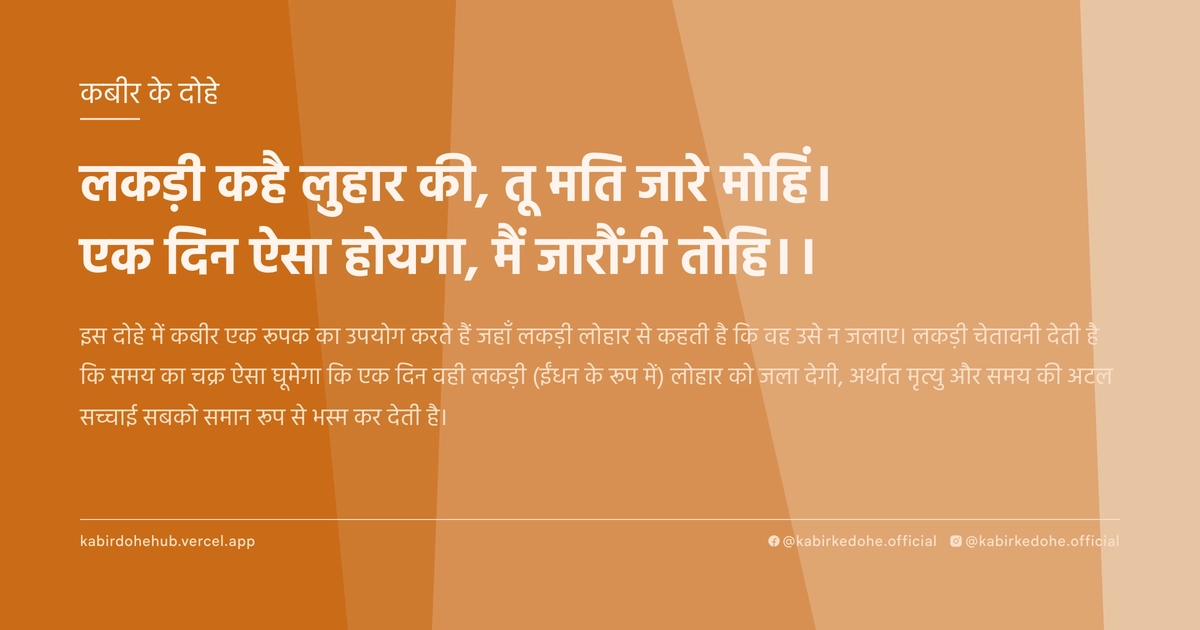
लकड़ी कहै लुहार की, तू मति जारे मोहिं।
एक दिन ऐसा होयगा, मैं जारौंगी तोहि।।
Lakdi kahai luhar ki, tu mati jaare mohin. Ek din aisa hoyga, main jarungi tohi.
इस पृष्ठ पर इस कबीर दोहे का अर्थ (meaning), हिंदी व्याख्या और अंग्रेज़ी अनुवाद, दार्शनिक विश्लेषण और व्यावहारिक जीवन सीख दी गई है। यह दोहा कर्म (Karma) विषय से जुड़ा है — Kabir doha meaning and explanation in Hindi and English.
अर्थ (Meaning):
इस दोहे में कबीर एक रूपक का उपयोग करते हैं जहाँ लकड़ी लोहार से कहती है कि वह उसे न जलाए। लकड़ी चेतावनी देती है कि समय का चक्र ऐसा घूमेगा कि एक दिन वही लकड़ी (ईंधन के रूप में) लोहार को जला देगी, अर्थात मृत्यु और समय की अटल सच्चाई सबको समान रूप से भस्म कर देती है।
In this couplet, Kabir employs a poignant metaphor where a piece of wood speaks to the blacksmith, pleading not to be burned. The wood warns that the wheel of time will inevitably turn, and a day will come when that very wood (as fuel for a funeral pyre) will burn the blacksmith, signifying the inescapable nature of death and temporal justice.
व्याख्या (Interpretation):
साब्दिक अर्थ में यह एक संवाद है, लेकिन आध्यात्मिक स्तर पर यह अहंकार और कर्म के सिद्धांत का विश्लेषण है। यहाँ 'लोहार' उस अहंकारी मनुष्य का प्रतीक है जो स्वयं को कर्ता मानता है और प्रकृति या अन्य जीवों का शोषण करता है। 'लकड़ी' वह निरीह सृष्टि है जिसे मनुष्य अपनी वासनाओं के लिए जलाता है। यह दोहा निर्गुण भक्ति के उस सत्य को उजागर करता है जहाँ माया का खेल क्षणभंगुर है। अद्वैत वेदांत के अनुसार, जब हम दूसरे को कष्ट देते हैं, तो हम वास्तव में स्वयं को ही चोट पहुँचा रहे होते हैं क्योंकि आत्मा एक ही है। यह विरोधाभास है कि जो आज विनाशक है, वह कल उसी विनाश की अग्नि में समा जाएगा। अंततः, यह शरीर और अहंकार की नश्वरता का बोध कराता है।
Literally, this is a dialogue, but spiritually, it is a profound analysis of ego and the law of Karma. The 'blacksmith' symbolizes the arrogant human who perceives themselves as the sole doer and exploits nature or other sentient beings. The 'wood' represents the innocent creation consumed by human desire. This couplet illuminates the truth of Nirgun Bhakti, where the play of Maya is ephemeral. According to Advaita Vedanta, when we inflict pain on another, we are essentially harming ourselves because the Atman is one. It presents the central paradox: the destroyer of today becomes the fuel for tomorrow's destruction. Ultimately, it awakens the seeker to the transience of the physical body and the illusory nature of the ego.
दार्शनिक विश्लेषण (Philosophical Analysis):
कबीर का यह दोहा उस सामाजिक और धार्मिक परिवेश में रचा गया जहाँ कर्मकांड और जातिगत श्रेष्ठता चरम पर थी। कबीर ने यहाँ 'लोहार' के माध्यम से उन सत्ताधारियों और पाखंडियों पर प्रहार किया है जो अपनी शक्ति के मद में दूसरों को तुच्छ समझते हैं। यह विश्लेषण केवल मृत्यु की चेतावनी नहीं है, बल्कि यह 'अहं' (Ego) के विलीनीकरण की प्रक्रिया है।
सूफी मत के 'फना' (annihilation) के सिद्धांत की तरह, कबीर यहाँ बताते हैं कि जब तक मनुष्य स्वयं को अलग और श्रेष्ठ मानता है, वह प्रकृति के साथ संघर्ष करता है। यह संघर्ष अंततः उसे उसी अग्नि में ले जाता है जिसे उसने स्वयं प्रज्वलित किया था। यह कर्म के सिद्धांत का एक कठोर प्रतिबिंब है—जो हम बोते हैं, वही काटते हैं।
अद्वैत वेदांत के परिप्रेक्ष्य में, यह दोहा द्वैत (duality) के भ्रम को तोड़ता है। लोहार और लकड़ी अलग नहीं हैं; दोनों एक ही ब्रह्म की अभिव्यक्ति हैं। जब लोहार लकड़ी को जलाता है, तो वह वास्तव में अपनी ही एकता को खंडित कर रहा होता है। कबीर यहाँ ritualism (कर्मकांड) के बजाय आंतरिक शुद्धि और करुणा पर जोर देते हैं।
मनोवैज्ञानिक स्तर पर, यह 'प्रोजेक्शन' की प्रक्रिया को दर्शाता है। मनुष्य अपनी आंतरिक हिंसा को बाहरी दुनिया पर थोपता है, लेकिन समय (Kaal) वह दर्पण है जहाँ हर क्रिया का विपरीत प्रभाव अनिवार्य है। यह भय आधारित चेतावनी नहीं, बल्कि एक आध्यात्मिक जागृति है ताकि मनुष्य समय रहते अपने अहंकार का त्याग कर सके।
अंततः, कबीर यह संदेश देते हैं कि भौतिक शक्ति और सामाजिक स्थिति केवल एक पर्दा है। मृत्यु वह अंतिम सत्य है जो सभी भेदों को मिटा देती है। जब लोहार की देह लकड़ी की अग्नि में जलती है, तब न कोई जाति बचती है, न कोई पेशा, और न ही कोई अहंकार। केवल वही बचता है जो शाश्वत है—परमात्मा।
Kabir’s couplet was conceived in a socio-religious climate where ritualism and caste superiority were rampant. Through the 'blacksmith,' he attacks those in power and the hypocrites who perceive others as inferior due to their own arrogance. This analysis is not merely a warning of death, but a study of the process of the annihilation of the 'Aham' (Ego).
Mirroring the Sufi concept of 'Fana' (annihilation), Kabir explains that as long as a human perceives themselves as separate and superior, they remain in conflict with nature. This conflict inevitably leads them into the very fire they ignited. It is a stark reflection of the Law of Karma—what one sows, one shall reap.
From the perspective of Advaita Vedanta, this doha shatters the illusion of duality. The blacksmith and the wood are not distinct; both are expressions of the same Brahman. When the blacksmith burns the wood, he is effectively fracturing his own oneness. Kabir emphasizes internal purification and compassion over empty ritualism.
Psychologically, this illustrates the process of projection. Humans impose their internal violence upon the external world, but Time (Kaal) is the mirror where every action inevitably meets its opposite reaction. This is not a fear-based warning, but a spiritual awakening urging the individual to relinquish the ego before it is too late.
Ultimately, Kabir conveys that physical power and social status are mere veils. Death is the final truth that erases all distinctions. When the blacksmith's body is consumed by the fire of the wood, neither caste, nor profession, nor ego remains. Only that which is eternal—the Divine—persists.
मूल संदेश (Core Message):
- अहंकार एक भ्रम है जो विनाश को आमंत्रित करता है।
- समय सबसे बड़ा न्यायधीश है, जो सबको समान करता है।
- दूसरों का शोषण स्वयं के विनाश का बीज है।
- नश्वरता का बोध ही वास्तविक विनम्रता का आधार है।
- आत्मा की एकता को पहचानना ही मोक्ष का मार्ग है।
- Ego is a delusion that invites its own destruction.
- Time is the ultimate judge, rendering all equal.
- Exploiting others is sowing the seeds of one's own ruin.
- Awareness of mortality is the foundation of true humility.
- Recognizing the unity of the soul is the path to liberation.
व्यावहारिक उदाहरण (Practical Example):
एक समय की बात है, वाराणसी के घाटों पर रामदीन नाम का एक अत्यंत अभिमानी नाई रहता था। वह अपनी कला और सुंदरता के अहंकार में इतना डूबा था कि वह शहर के गरीब मरीजों और वृद्धों का मजाक उड़ाता था। वह अक्सर कहता था कि उसकी सेवा के बिना कोई भी समाज में सम्मानजनक नहीं दिख सकता। वह उन लोगों को तुच्छ समझता था जो शारीरिक रूप से कमजोर थे।
एक दिन, रामदीन की मुलाकात एक शांत साधु से हुई। साधु ने देखा कि रामदीन एक बीमार वृद्ध व्यक्ति की मदद करने के बजाय उसकी शारीरिक स्थिति पर व्यंग्य कर रहा था। साधु ने मुस्कुराते हुए उसे एक सूखी लकड़ी का टुकड़ा दिया और कहा, 'इसे संभाल कर रखो, यह तुम्हारी असली पहचान है।' रामदीन ने उसका उपहास किया और लकड़ी को फेंक दिया।
समय बीतता गया। रामदीन की समृद्धि और स्वास्थ्य धीरे-धीरे घटने लगे। एक गंभीर बीमारी ने उसे ऐसा जकड़ा कि वह बिस्तर से उठने में असमर्थ हो गया। उसकी सुंदरता गायब हो गई और वह खुद उसी अवस्था में पहुँच गया जिसका वह मजाक उड़ाता था। अब उसे उन्हीं लोगों की सेवा की आवश्यकता थी जिन्हें उसने कभी तुच्छ समझा था।
एक रात, जब वह अपनी अंतिम सांसें ले रहा था, उसने देखा कि उसके घर के बाहर उसकी अंतिम विदाई के लिए लकड़ियाँ इकट्ठी की जा रही थीं। उसे अचानक वह साधु और उसकी दी हुई लकड़ी याद आई। उसे अहसास हुआ कि जिस शरीर और अहंकार पर उसने गर्व किया था, वह अब केवल कुछ लकड़ियों की आग में राख होने जा रहा है।
उसने महसूस किया कि वह 'लोहार' था जिसने दूसरों की भावनाओं को जलाया, और अब वह स्वयं उस 'लकड़ी' की अग्नि में जलने वाला था। इस बोध ने उसके भीतर के अहंकार को पूरी तरह नष्ट कर दिया।
उसने अपने अंतिम क्षणों में उन सभी से क्षमा मांगी जिन्हें उसने नीचा दिखाया था। उसने अपनी सारी संपत्ति उन गरीबों के नाम कर दी जिनकी उसने उपेक्षा की थी।
उसका चेहरा, जो कभी घमंड से भरा रहता था, अब एक असीम शांति और करुणा से चमक रहा था। उसने जान लिया था कि केवल प्रेम और सेवा ही स्थायी हैं।
जब वह अंततः अग्नि को समर्पित हुआ, तो वह भयभीत नहीं था, क्योंकि उसने अपने अहंकार को मृत्यु से पहले ही जला दिया था।
Once, on the ghats of Varanasi, lived an extremely arrogant barber named Ramdeen. He was so consumed by the ego of his skill and appearance that he frequently mocked the city's poor patients and the elderly. He often claimed that without his services, no one could look respectable in society, viewing the physically frail as insignificant.
One day, Ramdeen encountered a serene monk. The monk observed Ramdeen mocking a sick elderly man instead of helping him. Smiling, the monk handed him a piece of dry wood and said, 'Keep this carefully; it is your true identity.' Ramdeen laughed in derision and threw the wood away.
Time passed. Ramdeen's prosperity and health began to decline. A severe illness gripped him, leaving him bedridden and unable to move. His beauty vanished, and he found himself in the very state he used to ridicule.
Now, he desperately needed the care of the very people he had once dismissed as worthless. One night, as he breathed his last, he saw logs of wood being gathered outside his house for his funeral pyre.
Suddenly, he remembered the monk and the piece of wood. He realized that the body and ego he had prided himself on were now merely destined to be reduced to ash by a few pieces of wood.
He understood that he had been the 'blacksmith' who burned the emotions of others, and now he was the one to be consumed by the 'wood's' fire.
This realization completely annihilated his ego. In his final moments, he sought forgiveness from everyone he had belittled.
He bequeathed all his wealth to the poor he had once ignored. His face, once clouded with pride, now glowed with an infinite peace and compassion.
He had learned that only love and service are permanent. When he was finally committed to the flames, he felt no fear, for he had burned his ego long before the fire touched his skin.
अभ्यास मार्गदर्शन (Practice Guidance):
- दैनिक चिंतन: प्रतिदिन 10 मिनट मौन बैठें और विचार करें कि आपकी कौन सी उपलब्धियां अस्थायी हैं और कौन सा अहंकार आपको दूसरों से अलग कर रहा है।
- आत्म-पूछताछ जर्नल: लिखें कि आज आपने किस व्यक्ति को अपनी श्रेष्ठता के कारण कमतर महसूस कराया। उस भावना के मूल कारण (डर या असुरक्षा) को खोजें।
- व्यवहारिक परिवर्तन: सप्ताह में एक बार किसी ऐसे व्यक्ति की निस्वार्थ सेवा करें जिसे समाज 'तुच्छ' मानता है, बिना किसी अहसान की भावना के।
- नैदानिक चेकलिस्ट: क्या आप दूसरों की गलती पर तुरंत प्रतिक्रिया देते हैं? क्या आप अपनी सफलता का श्रेय केवल स्वयं को देते हैं? यदि हाँ, तो आपका 'लोहार' (अहंकार) अभी भी सक्रिय है।
- Daily Contemplation: Sit in silence for 10 minutes daily and reflect on which of your achievements are transient and which ego-driven beliefs separate you from others.
- Self-Inquiry Journal: Document instances where you made someone feel inferior due to your perceived superiority. Trace the root cause (fear or insecurity) of that impulse.
- Behavioral Shift: Once a week, perform selfless service for someone marginalized by society, ensuring there is no sense of patronization or superiority.
- Diagnostic Checklist: Do you react instantly to others' mistakes? Do you attribute all your success solely to yourself? If yes, your inner 'blacksmith' (ego) is still active.
चिंतन प्रश्न (Reflection Questions):
- आपकी वह कौन सी 'सामाजिक पहचान' है जिसे खोने का डर आपको दूसरों के प्रति कठोर बनाता है?
- यदि आज आपकी सारी उपलब्धियां छीन ली जाएं, तो आपके व्यक्तित्व में क्या शेष बचेगा?
- क्या आप अपनी डिजिटल पहचान (सोशल मीडिया) के माध्यम से एक ऐसा 'लोहार' बन रहे हैं जो दूसरों की गरिमा को जलाता है?
- आपकी कौन सी छिपी हुई पूर्वाग्रह (biases) आपको यह विश्वास दिलाती हैं कि आप कुछ लोगों से श्रेष्ठ हैं?
- मृत्यु के क्षण में, आपकी कौन सी उपलब्धियां आपको वास्तव में शांति प्रदान करेंगी?
- Which 'social identity' do you fear losing so much that it makes you harsh toward others?
- If all your achievements were stripped away today, what would remain of your personality?
- Are you becoming a 'blacksmith' through your digital identity, burning the dignity of others for validation?
- Which hidden biases convince you that you are inherently superior to certain groups of people?
- In the moment of death, which of your achievements will actually provide you with peace?