
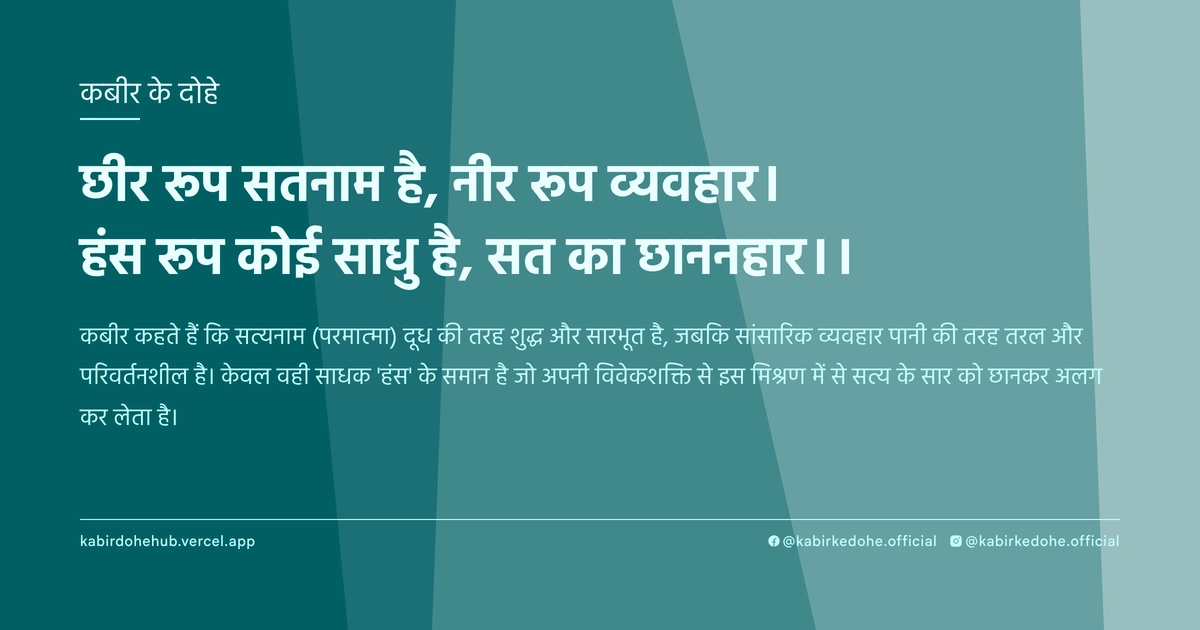
छीर रूप सतनाम है, नीर रूप व्यवहार।
हंस रूप कोई साधु है, सत का छाननहार।।
Chheer rup satnaam hai, neer rup vyavhar. Hans rup koi sadhu hai, sat ka chhaannanhari.
इस पृष्ठ पर इस कबीर दोहे का अर्थ (meaning), हिंदी व्याख्या और अंग्रेज़ी अनुवाद, दार्शनिक विश्लेषण और व्यावहारिक जीवन सीख दी गई है। यह दोहा निर्गुण ब्रह्म (Nirguna Brahman) विषय से जुड़ा है — Kabir doha meaning and explanation in Hindi and English.
अर्थ (Meaning):
कबीर कहते हैं कि सत्यनाम (परमात्मा) दूध की तरह शुद्ध और सारभूत है, जबकि सांसारिक व्यवहार पानी की तरह तरल और परिवर्तनशील है। केवल वही साधक 'हंस' के समान है जो अपनी विवेकशक्ति से इस मिश्रण में से सत्य के सार को छानकर अलग कर लेता है।
Kabir asserts that the True Name (Satnaam) is like the essence of milk—pure and substantial—whereas worldly conduct and social interactions are like water—fluid and transient. Only a true seeker, embodying the qualities of the 'Hans' (divine swan), possesses the discernment to filter the eternal truth from the ephemeral noise of existence.
व्याख्या (Interpretation):
यहाँ 'छीर' (दूध) शुद्धता और पोषण का प्रतीक है, जो आत्मा के वास्तविक स्वरूप को दर्शाता है। 'नीर' (पानी) माया और सांसारिक प्रपंचों का संकेत है जो सत्य को ढक लेते हैं। हंस का रूप विवेक (Discernment) का प्रतीक है, जो पौराणिक कथाओं में दूध और पानी को अलग करने की क्षमता रखता है। यह दोहा निर्गुण भक्ति के उस मार्ग को दर्शाता है जहाँ साधक बाहरी कर्मकांडों के बजाय आंतरिक सत्य की खोज करता है। यह अद्वैत वेदांत के उस सिद्धांत से जुड़ा है जहाँ ब्रह्म (सत्य) सर्वव्यापी है, परंतु माया के कारण वह हमें साधारण जल की तरह प्रतीत होता है। साधक का लक्ष्य इस द्वैत को समाप्त कर केवल शुद्ध चेतना में स्थित होना है।
In this verse, 'Chheer' (milk) symbolizes purity and the nourishing essence of the soul, while 'Neer' (water) represents Maya and the fluid, deceptive nature of worldly attachments. The 'Hans' (swan) is a potent metaphor for Viveka (spiritual discernment), traditionally believed to separate milk from water. This doha aligns with Nirgun Bhakti, emphasizing the pursuit of the formless truth over ritualistic adherence. It echoes Advaita Vedanta, where Brahman is the only reality, yet obscured by the veil of illusion. The paradox lies in the fact that while the Truth is mixed with the mundane, it remains untainted. The seeker's journey is not to create truth, but to filter out the falsehoods that cloud the Atman-Brahman non-duality.
दार्शनिक विश्लेषण (Philosophical Analysis):
कबीर का यह दोहा मध्यकालीन भारत के उस सामाजिक परिवेश में लिखा गया जहाँ धर्म केवल बाहरी प्रतीकों और जातिगत श्रेष्ठता तक सीमित था। कबीर ने 'सतनाम' के माध्यम से यह स्पष्ट किया कि ईश्वर किसी मंदिर या मस्जिद में नहीं, बल्कि शुद्ध चेतना के अनुभव में है। उन्होंने ritualism (कर्मकांड) का खंडन करते हुए यह बताया कि केवल पूजा-पाठ से सत्य प्राप्त नहीं होता, बल्कि उसके लिए 'छानने' यानी गहन आत्म-विश्लेषण की आवश्यकता होती है।
दार्शनिक रूप से, यह सूफी मत के 'फना' और वेदांत के 'विवेक' का संगम है। सूफीवाद में जैसे अहंकार का विलीनीकरण आवश्यक है, वैसे ही यहाँ 'हंस' बनने का अर्थ है अपने अहंकार को मिटाकर केवल सत्य को ग्रहण करना। कबीर यहाँ यह चेतावनी दे रहे हैं कि दुनिया का व्यवहार (नीर) हमें भ्रमित कर सकता है, लेकिन जो साधक तटस्थ रहता है, वही सत्य को पहचान पाता है।
यह विश्लेषण हमें बताता है कि सत्य और असत्य एक ही समय में एक ही स्थान पर मौजूद हो सकते हैं। जैसे दूध और पानी का मिश्रण, वैसे ही हमारा जीवन आध्यात्मिक और भौतिक तत्वों का मिश्रण है। अज्ञानता वह स्थिति है जहाँ हम मिश्रण को ही सत्य मान लेते हैं, जबकि ज्ञान वह प्रक्रिया है जिससे हम सार तत्व को अलग करते हैं।
कबीर की दृष्टि में 'साधु' वह नहीं है जिसने गेरुआ वस्त्र पहना हो, बल्कि वह है जिसने अपने भीतर के विवेक को जाग्रत कर लिया हो। यह मनोवैज्ञानिक रूपांतरण की बात है, जहाँ व्यक्ति बाहरी शोर से हटकर आंतरिक मौन में सत्य की गूँज सुनता है।
अंततः, यह दोहा हमें सिखाता है कि सत्य की प्राप्ति के लिए किसी बाहरी गुरु से अधिक आंतरिक सजगता की आवश्यकता है। यह एक ऐसी प्रक्रिया है जिसमें साधक स्वयं ही छलनी बनता है और स्वयं ही परिष्कृत होता है, जिससे वह माया के बंधन से मुक्त होकर मोक्ष की ओर अग्रसर होता है।
This doha emerged during a period of intense religious rigidity in medieval India, where spirituality was often reduced to caste-based superiority and hollow rituals. Kabir uses 'Satnaam' to pivot the focus from an external deity to an internal, formless consciousness. By rejecting ritualism, he argues that truth is not bestowed through ceremonies but is extracted through rigorous self-analysis and discernment.
Philosophically, this is a synthesis of the Sufi concept of 'Fana' (annihilation of self) and the Vedantic principle of 'Viveka'. Just as Sufism demands the dissolution of the ego to merge with the Divine, Kabir’s 'Hans' represents the ego-less state required to perceive the Absolute. He warns that worldly conduct (Neer) is inherently deceptive, and only those who maintain a state of spiritual detachment can perceive the underlying essence.
The analysis reveals a profound ontological claim: truth and illusion coexist in the same space. Like the mixture of milk and water, human existence is a blend of the eternal and the ephemeral. Ignorance is the inability to distinguish between the two, while enlightenment is the active process of filtration.
For Kabir, a 'Sadhu' is not defined by saffron robes or ascetic titles, but by the awakening of an internal filter. This is a call for psychological transformation, urging the individual to move from the noise of social conditioning to the silence of primordial truth.
Ultimately, the doha suggests that the path to liberation is an internal alchemy. The seeker must become both the filter and the filtered, stripping away the layers of Maya to reveal the shimmering purity of the Atman, thereby realizing the non-dual nature of existence.
मूल संदेश (Core Message):
- बाहरी व्यवहार माया का जल है, आंतरिक सत्य आत्मा का दूध है।
- विवेक वह छलनी है जो भ्रम को सत्य से अलग करती है।
- अहंकार का त्याग ही साधक को 'हंस' बनाता है।
- सत्य को खोजने के लिए बाहरी यात्रा नहीं, आंतरिक छनाई आवश्यक है।
- स्थिरता ही वह कुंजी है जिससे हम शाश्वत को पहचानते हैं।
- External conduct is the water of Maya; internal truth is the milk of the soul.
- Discernment is the filter that separates illusion from reality.
- The annihilation of ego transforms the seeker into the divine swan.
- Truth requires internal filtration, not external pilgrimage.
- Equanimity is the key to recognizing the eternal within the ephemeral.
व्यावहारिक उदाहरण (Practical Example):
एक समय की बात है, वाराणसी के घाटों पर माधव नाम का एक वृद्ध बुनकर रहता था। माधव अपनी कला में निपुण था, लेकिन उसका मन हमेशा इस बात से परेशान रहता था कि लोग उसे केवल एक निम्न जाति के बुनकर के रूप में देखते हैं। वह समाज में सम्मान पाने के लिए कई बार दिखावा करता और दूसरों की चापलूसी करता, जिसे वह अपना 'व्यवहार' कहता था।
एक दिन उसकी मुलाकात एक घुमक्कड़ फकीर से हुई। फकीर ने माधव को एक गिलास में दूध और पानी का मिश्रण दिया और कहा, 'माधव, इसमें से केवल दूध को अलग करो।' माधव हँसा और बोला, 'यह असंभव है, एक बार मिल जाने पर इन्हें अलग नहीं किया जा सकता।'
फकीर ने शांति से उत्तर दिया, 'यही तुम्हारी समस्या है। तुम दुनिया के व्यवहार (पानी) और अपने आत्म-सम्मान (दूध) को एक ही मान रहे हो। तुम दुनिया की नजरों में खुद को ढालने की कोशिश कर रहे हो, जिससे तुम्हारा असली स्वरूप खो गया है।'
माधव को यह बात गहराई से चुभी। उसने महसूस किया कि वह अब तक केवल 'नीर-रूप व्यवहार' में उलझा था—यानी वह वही बन रहा था जो लोग चाहते थे, न कि वह जो वह वास्तव में था।
अगले कुछ महीनों तक, माधव ने एक प्रयोग किया। जब भी कोई उसका अपमान करता या उसे नीचा दिखाता, वह प्रतिक्रिया करने के बजाय अपने भीतर यह पूछता, 'क्या यह अपमान मेरा सत्य है, या यह केवल सामने वाले का व्यवहार है?'
धीरे-धीरे उसने पाया कि बाहरी दुनिया की बातें केवल 'पानी' की तरह हैं, जो आते-जाते रहते हैं। उसका अपना आंतरिक संतोष और उसकी कला के प्रति समर्पण ही उसका 'दूध' यानी सत्य था।
उसने चापलूसी करना छोड़ दिया और केवल अपनी ईमानदारी और कला पर ध्यान केंद्रित किया। अब वह दूसरों की राय से विचलित नहीं होता था।
गाँव के लोग हैरान थे कि माधव अब पहले से अधिक शांत और आत्मविश्वासी दिखता था। उसकी शांति ने लोगों को उसकी ओर आकर्षित किया, और जिस सम्मान के लिए वह तरसता था, वह उसे बिना मांगे ही मिलने लगा।
माधव अब एक 'हंस' बन चुका था। उसने जीवन के शोर से सत्य के सार को छानना सीख लिया था।
उसने समझा कि जब हम बाहरी दुनिया के प्रपंचों को केवल 'पानी' मानकर छोड़ देते हैं, तब हमारे भीतर का 'सतनाम' स्वतः ही चमकने लगता है।
Once, in the ghats of Varanasi, lived an elderly weaver named Madhav. Madhav was a master of his craft, yet he was plagued by the fact that society viewed him only through the lens of his lower caste. To gain respect, he often resorted to social masks and flattery, which he considered his necessary 'worldly conduct'.
One day, he encountered a wandering fakir. The fakir handed Madhav a glass containing a mixture of milk and water and challenged him, 'Madhav, separate the milk from the water.' Madhav laughed, replying, 'This is impossible; once mixed, they cannot be parted.'
The fakir replied calmly, 'This is precisely your struggle. You are treating the world's behavior (water) and your own essence (milk) as one. You are trying to mold yourself into what others expect, and in doing so, you have lost your true self.'
This realization struck a chord deep within Madhav. He understood that he had been trapped in 'Neer-roop vyavhaar'—living a life based on external perceptions rather than internal truth.
Over the next few months, Madhav practiced a mental experiment. Whenever someone insulted him or belittled his status, instead of reacting, he would ask himself, 'Is this insult my truth, or is it merely the other person's behavior?'
Gradually, he discovered that the opinions of the world were like water—fluid, transient, and ultimately superficial. His inner contentment and his devotion to his art were the 'milk'—the enduring truth of his existence.
He ceased all flattery and focused solely on his integrity and his loom. He stopped seeking validation from the crowd and started seeking it from his own conscience.
Villagers were amazed to find that Madhav had become profoundly calm and confident. His stillness became his strength, and the respect he had once craved began to flow toward him naturally, without effort.
Madhav had finally become the 'Hans'. He had learned to filter the essence of truth from the noise of existence.
He realized that when we stop identifying with the transient 'water' of social dynamics, the 'Satnaam' within us begins to shine with its own light.
अभ्यास मार्गदर्शन (Practice Guidance):
- दैनिक चिंतन: प्रतिदिन 20 मिनट मौन बैठें और अपने दिनभर के सामाजिक व्यवहारों का विश्लेषण करें। पूछें कि कौन सा हिस्सा 'सत्य' था और कौन सा केवल 'दिखावा' या 'पानी' था।
- आत्म-पूछताछ जर्नल: एक डायरी लिखें जिसमें उन स्थितियों का वर्णन हो जहाँ आपने अपनी मूल प्रकृति को दूसरों की अपेक्षाओं के लिए बदला। लिखें कि उस समय 'हंस' जैसा विवेक कैसे काम कर सकता था।
- व्यवहारिक परिवर्तन: जब भी आप किसी विवाद में हों, तुरंत प्रतिक्रिया देने के बजाय 5 सेकंड रुकें। यह पहचानें कि सामने वाले का क्रोध 'नीर' (अस्थायी) है, जबकि आपकी शांति 'छीर' (स्थायी) होनी चाहिए।
- नैदानिक चेकलिस्ट: क्या मैं दूसरों की प्रशंसा से अत्यधिक खुश होता हूँ? क्या मैं आलोचना से टूट जाता हूँ? यदि हाँ, तो मैं अभी भी 'पानी' और 'दूध' के मिश्रण में उलझा हुआ हूँ। यदि मैं दोनों के प्रति तटस्थ हूँ, तो मैं 'हंस' की ओर बढ़ रहा हूँ।
- Daily Contemplation: Sit in silence for 20 minutes daily. Analyze your social interactions of the day. Ask yourself: Which parts were 'Truth' (essence) and which were merely 'Performance' (water)?
- Self-Inquiry Journal: Maintain a journal documenting instances where you compromised your authentic self to meet others' expectations. Reflect on how 'Hans-like' discernment could have altered your response.
- Behavioral Shift: During conflicts, implement a 5-second pause before reacting. Recognize that the other person's anger is 'Neer' (transient), while your internal equanimity should be the 'Chheer' (permanent).
- Diagnostic Checklist: Do I feel excessive euphoria from praise? Do I crumble under criticism? If yes, I am still entangled in the mixture. If I remain equanimous toward both, I am evolving into the 'Hans'.
चिंतन प्रश्न (Reflection Questions):
- मेरा वह कौन सा 'मुखौटा' है जिसे मैं समाज में सबसे अधिक पहनता हूँ, और वह मेरे वास्तविक स्वरूप से कितना अलग है?
- क्या मैं अपनी पहचान उन चीजों से बनाता हूँ जो 'पानी' की तरह बदल रही हैं (पद, पैसा, प्रतिष्ठा), या किसी ऐसी चीज से जो स्थायी है?
- जब मैं खुद को 'सही' साबित करने की कोशिश करता हूँ, तो क्या मैं सत्य की खोज कर रहा होता हूँ या केवल अपने अहंकार की रक्षा?
- मेरे जीवन में 'दूध' (शुद्धता) और 'पानी' (मिलावट) का अनुपात क्या है, और मैं इसे बदलने के लिए क्या कर रहा हूँ?
- क्या मैं वास्तव में स्वतंत्र हूँ, या मैं केवल दूसरों की धारणाओं का एक प्रतिबिंब मात्र हूँ?
- Which 'mask' do I wear most frequently in society, and how far does it deviate from my authentic self?
- Do I build my identity on things as transient as water (status, wealth, fame), or on something immutable?
- When I strive to prove myself 'right', am I seeking the Truth or merely defending my ego?
- What is the ratio of 'milk' (purity) to 'water' (impurity) in my daily consciousness, and how am I refining it?
- Am I truly autonomous, or am I merely a reflection of other people's perceptions of me?