
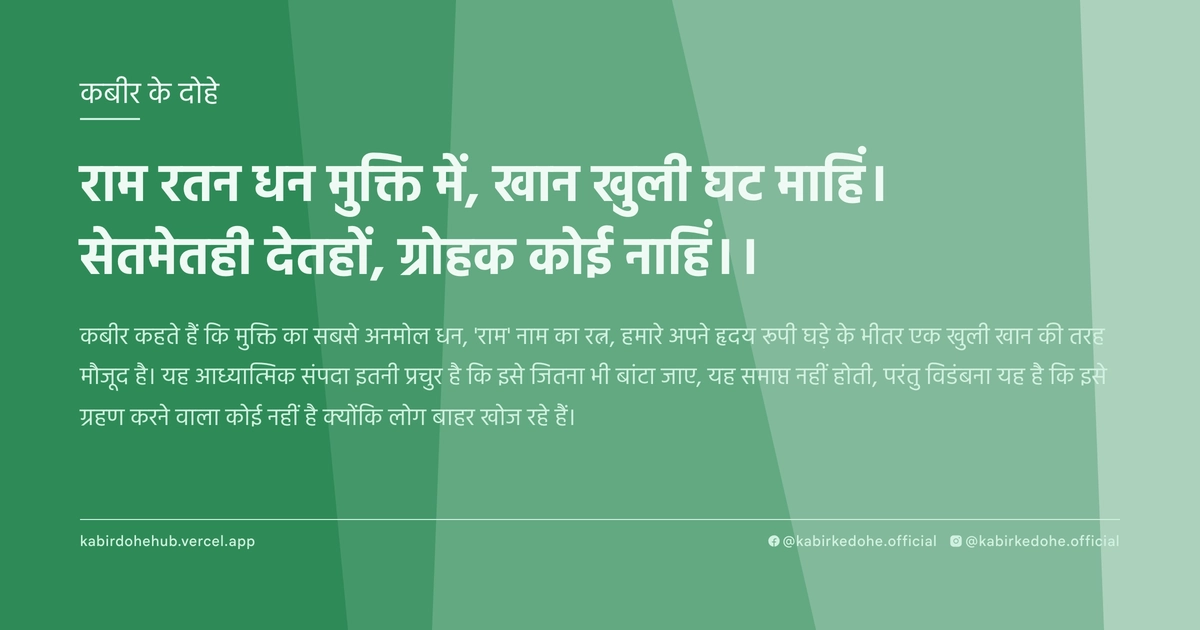
राम रतन धन मुक्ति में, खान खुली घट माहिं।
सेतमेतही देतहों, ग्रोहक कोई नाहिं।।
Ram ratan dhan mukti mein, khan khuli ghat mahin. Setmetahi detahon, grohak koi nahin.
इस पृष्ठ पर इस कबीर दोहे का अर्थ (meaning), हिंदी व्याख्या और अंग्रेज़ी अनुवाद, दार्शनिक विश्लेषण और व्यावहारिक जीवन सीख दी गई है। यह दोहा मुक्ति (Liberation) विषय से जुड़ा है — Kabir doha meaning and explanation in Hindi and English.
अर्थ (Meaning):
कबीर कहते हैं कि मुक्ति का सबसे अनमोल धन, 'राम' नाम का रत्न, हमारे अपने हृदय रूपी घड़े के भीतर एक खुली खान की तरह मौजूद है। यह आध्यात्मिक संपदा इतनी प्रचुर है कि इसे जितना भी बांटा जाए, यह समाप्त नहीं होती, परंतु विडंबना यह है कि इसे ग्रहण करने वाला कोई नहीं है क्योंकि लोग बाहर खोज रहे हैं।
Kabir proclaims that the most precious treasure for liberation, the jewel of 'Ram' (the Divine Name), is an open mine residing within the vessel of one's own heart. This spiritual wealth is infinite and freely available to all, yet the tragedy remains that there is no one to collect or receive it, as humanity continues to seek the divine in external rituals and distant lands.
व्याख्या (Interpretation):
यहाँ 'राम' शब्द किसी व्यक्ति या पौराणिक राजा के लिए नहीं, बल्कि उस निराकार, सर्वव्यापी चेतना (Nirgun Brahman) के लिए प्रयुक्त हुआ है जो हर जीव के भीतर स्पंदित है। 'घट' का अर्थ है मानव शरीर या हृदय, जिसे कबीर एक खजाने की खान मानते हैं। यह दोहा अद्वैत वेदांत के इस सिद्धांत को पुष्ट करता है कि आत्मा और परमात्मा एक ही हैं; पृथकता केवल माया का भ्रम है। 'सेतमेतही' शब्द यह दर्शाता है कि यह ज्ञान बिना किसी शुल्क या शर्त के उपलब्ध है। विरोधाभास यह है कि जिस धन की खोज में मनुष्य पूरी दुनिया छान मारता है, वह उसके अपने भीतर ही स्थित है, फिर भी अहंकार और अज्ञानता के कारण वह 'ग्रोहक' यानी ग्रहण करने वाला नहीं बन पाता। यह आंतरिक शून्यता और बाहरी शोर के बीच के संघर्ष को दर्शाता है।
In this verse, 'Ram' does not refer to a historical figure or a deity with form, but to the formless, omnipresent consciousness (Nirgun Brahman) vibrating within every living being. The 'ghat' or vessel symbolizes the human heart, which Kabir envisions as an inexhaustible mine of spiritual gold. This aligns with Advaita Vedanta, asserting that the Atman (individual soul) and Brahman (universal soul) are non-dual; the perceived separation is merely the veil of Maya. The term 'setmetahi' emphasizes that this liberation is offered without cost or condition. The central paradox lies in the fact that while the treasure is open and overflowing, the seeker remains empty-handed because the ego prevents them from becoming the 'grohak' or the receiver. It highlights the human tragedy of seeking the ocean while swimming in it.
दार्शनिक विश्लेषण (Philosophical Analysis):
कबीर का यह दर्शन मध्यकालीन भारत के उस समय का है जब धर्म कर्मकांडों, बाहरी आडंबरों और जातिगत श्रेष्ठता में जकड़ा हुआ था। कबीर ने पुरजोर तरीके से इस बात का विरोध किया कि ईश्वर केवल मंदिरों, मस्जिदों या तीर्थों में मिलता है। उनका प्रहार उन पंडितों और मुल्लाओं पर था जो ईश्वर को बाहरी ग्रंथों और कठिन अनुष्ठानों में खोजते थे। उनके लिए 'राम' वह आंतरिक ध्वनि है जिसे 'अनहद नाद' कहा जाता है, जो किसी भी धर्म या संप्रदाय की सीमा से परे है।
दार्शनिक स्तर पर, यह दोहा सूफीवाद के 'इन्सान-ए-कामिल' (पूर्ण मानव) और वेदांत के 'सोऽहम्' (मैं वही हूँ) के विचार का संगम है। कबीर यह समझाते हैं कि मुक्ति कोई बाहरी उपलब्धि नहीं है, बल्कि एक 'स्मरण' है—अपनी वास्तविक प्रकृति को याद करना। जब तक मनुष्य स्वयं को शरीर या सामाजिक पहचान (जाति, पद) मानता है, वह उस आंतरिक खान से वंचित रहता है। अहंकार वह पर्दा है जो हमें हमारे अपने भीतर के खजाने को देखने से रोकता है।
यहाँ 'धन' का प्रयोग एक रूपक के रूप में किया गया है। सांसारिक धन सीमित होता है और बांटने पर कम होता है, लेकिन आध्यात्मिक धन (ज्ञान) जितना बांटा जाता है, उतना ही बढ़ता है। यह 'निर्गुण भक्ति' का सार है, जहाँ भक्त किसी मूर्ति की नहीं, बल्कि उस निराकार तत्व की उपासना करता है जो कण-कण में व्याप्त है। कबीर का उद्देश्य व्यक्ति को मानसिक दासता से मुक्त कर उसे आत्म-निर्भर बनाना था।
मनोवैज्ञानिक रूप से, यह दोहा 'बाहरी प्रक्षेपण' (External Projection) की समस्या को संबोधित करता है। मनुष्य अपनी आंतरिक रिक्तता को भरने के लिए बाहरी वस्तुओं और संबंधों पर निर्भर हो जाता है, जबकि शांति का स्रोत उसके अपने केंद्र में है। जब व्यक्ति अपनी दृष्टि बाहर से हटाकर भीतर की ओर मोड़ता है, तब वह 'ग्रोहक' बनता है।
अंततः, कबीर यह संदेश देते हैं कि मुक्ति का मार्ग अत्यंत सरल है, लेकिन वह कठिन इसलिए लगता है क्योंकि हम सरल मार्ग को छोड़कर जटिलता की खोज करते हैं। यह दोहा हमें सिखाता है कि सत्य कहीं दूर नहीं, बल्कि हमारी अपनी सांसों और धड़कनों के बीच छिपा है, बस उसे पहचानने वाली दृष्टि की आवश्यकता है।
Kabir's philosophy emerged during a medieval Indian era where religion was stifled by rigid rituals, external ostentation, and caste hierarchies. He vehemently rejected the notion that the Divine is confined to temples, mosques, or pilgrimage sites. His critique was aimed at the clergy who sought God in external scriptures and arduous ceremonies, whereas Kabir identified 'Ram' as the internal vibration, the 'Anhad Nad' (unstruck sound), which transcends all sectarian boundaries.
Philosophically, this couplet is a synthesis of the Sufi concept of 'Insan-e-Kamil' (the Perfect Human) and the Vedantic realization of 'So-ham' (I am That). Kabir explains that liberation is not an external achievement but a 'remembrance'—a recalling of one's true nature. As long as a human identifies solely with the body or a social label (caste, status), they remain alienated from the mine within. The ego is the veil that obscures the internal treasure.
The use of 'wealth' (dhan) here is a profound metaphor. While material wealth is finite and diminishes upon sharing, spiritual wealth (Gnosis) increases the more it is disseminated. This is the essence of 'Nirgun Bhakti,' where the devotee worships the formless element pervading every atom rather than an idol. Kabir's objective was to liberate the individual from mental servitude and lead them toward spiritual self-reliance.
Psychologically, this verse addresses the phenomenon of 'External Projection.' Humans often attempt to fill their internal void with external objects and relationships, unaware that the source of peace resides at their own center. When the gaze is shifted from the periphery to the core, the individual finally becomes the 'grohak' or the receiver.
Ultimately, Kabir suggests that the path to liberation is deceptively simple, yet it feels arduous because we prefer complexity over simplicity. He teaches that Truth is not distant but hidden within our own breaths and heartbeats, requiring only the vision to recognize it.
मूल संदेश (Core Message):
- बाहरी खोज एक भ्रम है; सत्य केवल भीतर है।
- अहंकार वह पर्दा है जो आंतरिक धन को छुपाता है।
- मुक्ति कोई उपलब्धि नहीं, बल्कि एक आत्म-बोध है।
- निराकार ईश्वर हर हृदय में निरंतर स्पंदित है।
- साधारण जीवन में ही असाधारण शांति छिपी है।
- External searching is an illusion; Truth exists only within.
- The ego is the veil that obscures the internal treasure.
- Liberation is not an achievement, but a self-realization.
- The formless Divine vibrates eternally in every heart.
- Extraordinary peace is hidden within an ordinary life.
व्यावहारिक उदाहरण (Practical Example):
एक समय की बात है, वाराणसी के घाटों पर माधव नाम का एक वृद्ध बुनकर रहता था। माधव अपनी पूरी जिंदगी रेशमी कपड़े बुनने में बिता चुका था, लेकिन उसका मन हमेशा अशांत रहता था। वह मानता था कि शांति पाने के लिए उसे हिमालय जाना होगा या किसी महान गुरु के चरणों में गिरना होगा। वह अपनी छोटी सी कमाई का बड़ा हिस्सा तीर्थयात्राओं में खर्च कर देता था, लेकिन हर बार वापस लौटकर उसे वही खालीपन महसूस होता।
एक दिन उसकी मुलाकात एक फकीर से हुई, जिसने माधव की बेचैनी को देखा। फकीर ने उससे पूछा, "माधव, तुम इस कीमती रेशम को इतनी बारीकी से बुनते हो, क्या तुमने कभी अपनी सांसों के ताने-बाने को देखा है?"
माधव हैरान था। उसने कहा, "महाराज, मैं तो मुक्ति के लिए बाहर भटक रहा हूँ, सांसों में क्या मिलेगा?"
फकीर मुस्कुराया और बोला, "तुम उस सोने की तलाश में दुनिया घूम रहे हो, जो तुम्हारी अपनी जेब में रखा है। जिस शांति को तुम पहाड़ों में खोज रहे हो, वह तुम्हारे हृदय की धड़कन में छिपी है। बस एक पल के लिए ठहरना सीखो।"
माधव ने उस दिन पहली बार अपनी आँखें बंद कीं और बाहर के शोर को भुलाकर अपने भीतर की शांति को सुनने की कोशिश की। उसने महसूस किया कि जब वह बुनता था, तो वह केवल कपड़े नहीं बुन रहा था, बल्कि एक ध्यान की अवस्था में था, लेकिन उसका अहंकार उसे यह मानने नहीं देता था कि यही उसकी साधना है।
उसे समझ आया कि वह अब तक 'ग्रोहक' नहीं था क्योंकि वह बाहरी दुनिया के शोर को ही सत्य मान बैठा था। उसने महसूस किया कि उसका अपना अस्तित्व ही वह 'राम रतन' है।
अगले कुछ महीनों में माधव का व्यवहार बदल गया। उसने तीर्थयात्राएं बंद कर दीं और अपने काम को ही पूजा बना लिया। वह अब केवल कपड़े नहीं बुनता था, बल्कि हर धागे में प्रेम और शांति पिरोता था।
उसके चेहरे पर एक ऐसी चमक आ गई कि लोग उससे पूछने लगे कि उसने कौन सा नया मंत्र सीखा है। माधव बस मुस्कुराता और कहता, "मैंने कुछ नया नहीं सीखा, बस जो पहले से था, उसे पहचान लिया।"
उसकी यह आंतरिक खोज उसे एक ऐसे स्तर पर ले गई जहाँ उसे अब किसी बाहरी सहारे की आवश्यकता नहीं थी। वह जान गया था कि मुक्ति कोई मंजिल नहीं, बल्कि एक निरंतर आंतरिक उपस्थिति है।
माधव की कहानी यह सिखाती है कि जब हम बाहरी खोज को समाप्त कर आंतरिक मौन को अपनाते हैं, तब हम उस अनंत खजाने के वास्तविक स्वामी बन जाते हैं।
Once, on the ghats of Varanasi, lived an elderly weaver named Madhav. Madhav had spent his entire life weaving exquisite silk fabrics, yet his mind remained perpetually restless. He believed that to attain peace, he must travel to the Himalayas or surrender at the feet of a legendary guru. He spent a large portion of his meager earnings on pilgrimages, but each time he returned, the same void haunted him.
One day, he encountered a wandering dervish who noticed Madhav's inner turmoil. The dervish asked, "Madhav, you weave this precious silk with such precision; have you ever observed the warp and weft of your own breath?"
Madhav was puzzled. He replied, "Maharaj, I am wandering the earth in search of liberation; what could possibly be found in simple breathing?"
The dervish smiled and said, "You are traversing the world searching for gold that is already tucked inside your own pocket. The peace you seek in the mountains is hidden within the rhythm of your own heart. Just learn to be still for a single moment."
For the first time, Madhav closed his eyes and tried to listen to the silence within, ignoring the external cacophony of the city. He realized that while weaving, he had often entered a state of flow—a meditative trance—but his ego had prevented him from recognizing this as his spiritual practice.
He understood that he had not been the 'grohak' (receiver) because he had mistaken the external noise for the ultimate truth. He felt that his own existence, in its purest form, was the 'Ram Ratan' (the jewel of the Divine).
Over the following months, Madhav's behavior transformed. He ceased his expensive pilgrimages and turned his daily labor into a living prayer. He no longer just wove cloth; he wove love and serenity into every thread.
A radiance appeared on his face, such that people began asking him what new mantra he had mastered. Madhav would simply smile and say, "I have learned nothing new; I have only recognized what was already there."
This internal discovery led him to a state where he no longer required external validation or support. He realized that liberation is not a destination to be reached, but a continuous internal presence.
Madhav's story illustrates that when we cease the external chase and embrace internal silence, we become the true owners of that infinite treasure.
अभ्यास मार्गदर्शन (Practice Guidance):
- प्रतिदिन 20 मिनट 'साक्षी भाव' का अभ्यास करें: अपने विचारों को बिना किसी निर्णय के केवल देखें, जैसे आप किसी और के जीवन को देख रहे हों।
- आत्म-पूछताछ जर्नल: प्रतिदिन एक प्रश्न लिखें—'आज मैंने अपनी शांति को बाहरी परिस्थितियों में कहाँ खोजा और मैं उसे अपने भीतर कैसे वापस ला सकता हूँ?'
- मौन व्रत: सप्ताह में एक बार कुछ घंटों के लिए पूर्ण मौन धारण करें, ताकि बाहरी शोर कम हो और आंतरिक 'खान' की आवाज सुनाई दे।
- निदान चेकलिस्ट: यदि आप छोटी बातों पर विचलित होते हैं, दूसरों में दोष खोजते हैं, या केवल बाहरी उपलब्धियों से खुशी महसूस करते हैं, तो इसका अर्थ है कि आप अभी भी 'ग्रोहक' नहीं बने हैं।
- Practice 'Witness Consciousness' for 20 minutes daily: Observe your thoughts without judgment, as if you are watching a movie of someone else's life.
- Self-Inquiry Journaling: Write a daily prompt—'Where did I seek my peace in external circumstances today, and how can I reclaim it from within?'
- Vow of Silence: Observe complete silence for a few hours once a week to dampen the external noise and hear the resonance of the internal 'mine'.
- Diagnostic Checklist: If you are easily agitated by trifles, constantly find faults in others, or derive happiness only from external achievements, you are not yet acting as the 'grohak' (receiver).
चिंतन प्रश्न (Reflection Questions):
- मैं अपनी पहचान किन बाहरी लेबलों (पद, प्रतिष्ठा, धर्म) से बनाता हूँ, और यदि ये सब छीन लिए जाएँ, तो मेरा 'स्व' क्या बचेगा?
- क्या मेरी आध्यात्मिक खोज वास्तव में सत्य की प्यास है, या केवल अपने अहंकार को 'ज्ञानी' सिद्ध करने का एक तरीका?
- मेरे जीवन का वह कौन सा हिस्सा है जहाँ मैं अभी भी 'बाहर' समाधान खोज रहा हूँ, जबकि उत्तर मेरे भीतर मौजूद है?
- यदि ईश्वर वास्तव में मेरे भीतर है, तो मैं उसे बाहरी अनुष्ठानों के माध्यम से प्रसन्न करने की कोशिश क्यों करता हूँ?
- क्या मैं वास्तव में उस शांति को ग्रहण करने के लिए तैयार हूँ, या मुझे अपने दुखों और संघर्षों की आदत हो गई है?
- Which external labels (status, reputation, religion) do I use to define my identity, and if these were stripped away, what would remain of my 'Self'?
- Is my spiritual quest truly a thirst for Truth, or merely a way to validate my ego as being 'enlightened'?
- In which area of my life am I still seeking external solutions, while the answer resides within me?
- If the Divine truly resides within, why do I still attempt to appease it through external rituals?
- Am I truly ready to receive that inner peace, or have I become comfortably addicted to my own struggles and suffering?