
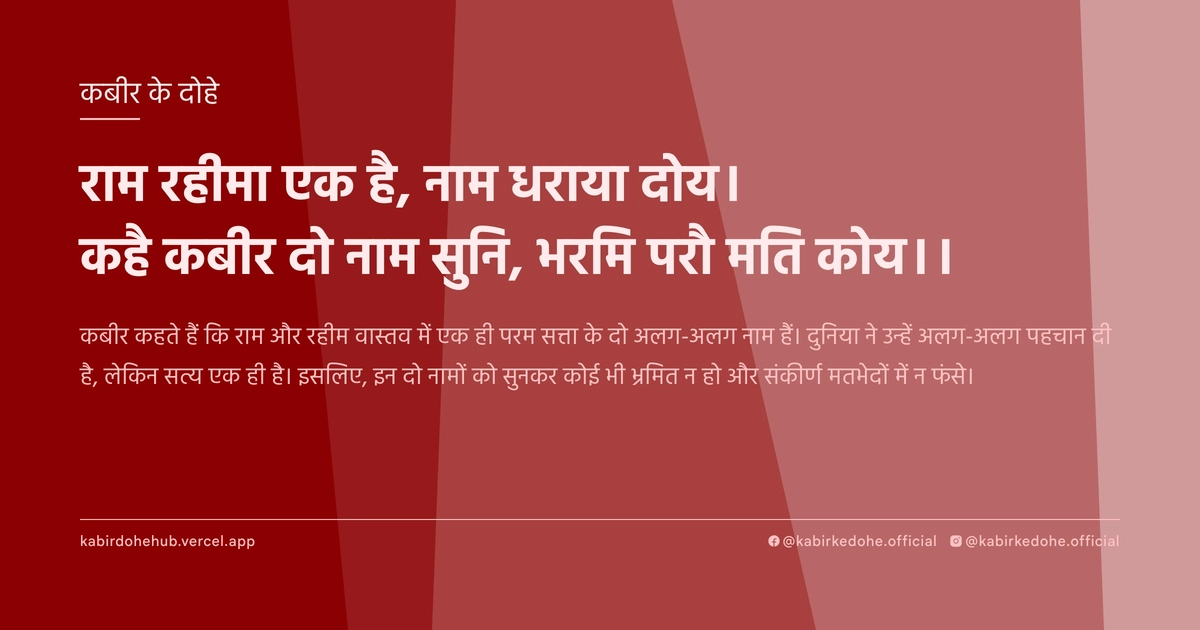
राम रहीमा एक है, नाम धराया दोय।
कहै कबीर दो नाम सुनि, भरमि परौ मति कोय।।
Ram raheema ek hai, naam dharaya doy. Kahe Kabir do naam suni, bharmi parau mati koy.
इस पृष्ठ पर इस कबीर दोहे का अर्थ (meaning), हिंदी व्याख्या और अंग्रेज़ी अनुवाद, दार्शनिक विश्लेषण और व्यावहारिक जीवन सीख दी गई है। यह दोहा हिंदू-मुस्लिम एकता (Hindu-muslim Unity) विषय से जुड़ा है — Kabir doha meaning and explanation in Hindi and English.
अर्थ (Meaning):
कबीर कहते हैं कि राम और रहीम वास्तव में एक ही परम सत्ता के दो अलग-अलग नाम हैं। दुनिया ने उन्हें अलग-अलग पहचान दी है, लेकिन सत्य एक ही है। इसलिए, इन दो नामों को सुनकर कोई भी भ्रमित न हो और संकीर्ण मतभेदों में न फंसे।
Kabir asserts that Ram and Rahim are merely two different names for the one Supreme Reality. Although the world has assigned them distinct identities, the underlying Truth remains singular. He urges seekers not to be deceived by these labels or fall into the trap of sectarian confusion.
व्याख्या (Interpretation):
इस दोहे का शाब्दिक अर्थ है कि ईश्वर एक है, चाहे उसे किसी भी नाम से पुकारा जाए। रूपक के स्तर पर, 'राम' और 'रहीम' केवल मानवीय धारणाएं हैं जो अनंत शून्य को सीमित करने का प्रयास करती हैं। यह निर्गुण भक्ति का सार है, जहाँ ईश्वर किसी आकार, नाम या धर्म में नहीं, बल्कि शुद्ध चेतना में निवास करता है। माया हमें यह विश्वास दिलाती है कि सत्य विभाजित है, जबकि अद्वैत वेदांत के अनुसार आत्मा और ब्रह्म एक ही हैं। कबीर यहाँ उस विरोधाभास को उजागर करते हैं जहाँ मनुष्य सत्य की खोज में उन्हीं नामों से लड़ता है जो उस सत्य तक पहुँचने के साधन होने चाहिए। यह द्वैत से अद्वैत की ओर संक्रमण का आह्वान है।
Literally, the couplet states that God is one, regardless of the name used. Metaphorically, 'Ram' and 'Rahim' are human constructs attempting to limit the infinite void. This embodies the essence of Nirgun Bhakti, where the Divine resides not in form or label, but in pure consciousness. Maya creates the illusion of a divided truth, whereas Advaita Vedanta posits the non-duality of Atman and Brahman. Kabir highlights the paradox where humanity fights over the very names intended as bridges to the Divine. It is a call to transition from duality to non-duality, recognizing that the labels are masks for a single, formless Light.
दार्शनिक विश्लेषण (Philosophical Analysis):
कबीर का यह संदेश उस समय के सामाजिक और धार्मिक परिवेश में एक क्रांतिकारी प्रहार था, जहाँ हिंदू और मुस्लिम समुदायों के बीच गहरी खाई थी। उन्होंने कर्मकांडों और बाहरी पहचानों को पूरी तरह नकार दिया, क्योंकि उनका मानना था कि सत्य किसी मंदिर या मस्जिद का मोहताज नहीं है। यह दृष्टिकोण सूफीवाद के 'वहदत-अल-वजूद' (अस्तित्व की एकता) और वेदांत के 'अहं ब्रह्मास्मि' के साथ गहराई से मेल खाता है।
दार्शनिक स्तर पर, कबीर तर्क देते हैं कि नाम केवल संकेत (pointers) हैं, गंतव्य नहीं। जब कोई व्यक्ति 'राम' या 'रहीम' के प्रति कट्टर हो जाता है, तो वह उस संकेत को ही सत्य मान लेता है और वास्तविक सत्य से दूर हो जाता है। यह अहंकार की एक सूक्ष्म परत है, जहाँ व्यक्ति अपनी धार्मिक पहचान को अपनी श्रेष्ठता का आधार बनाता है।
निर्गुण भक्ति का मार्ग यह सिखाता है कि ईश्वर 'निराकार' है। यदि ईश्वर सर्वव्यापी है, तो वह किसी एक धर्म की बपौती नहीं हो सकता। कबीर का प्रहार उन पंडितों और मौलवियों पर था जो शब्दों के जाल बुनकर ईश्वर को विभाजित कर रहे थे। उनके लिए, भक्ति का अर्थ बाहरी आडंबर नहीं, बल्कि आंतरिक शुद्धता और प्रेम था।
मनोवैज्ञानिक रूप से, यह दोहा संज्ञानात्मक विसंगति (cognitive dissonance) को दूर करने का प्रयास करता है। यह मनुष्य को यह समझने के लिए प्रेरित करता है कि घृणा का मूल अज्ञानता है। जब हम यह पहचान लेते हैं कि सामने वाला व्यक्ति भी उसी एक चेतना का हिस्सा है, तो द्वेष स्वतः समाप्त हो जाता है।
अंततः, कबीर का दर्शन 'शून्य' की ओर ले जाता है। जहाँ न कोई नाम बचता है, न कोई धर्म, और न ही कोई अहंकार। केवल एक शुद्ध, अविभाज्य अस्तित्व बचता है, जो समस्त सृष्टि में व्याप्त है। यह केवल धार्मिक सहिष्णुता नहीं, बल्कि एक गहन आध्यात्मिक एकता का बोध है।
Kabir's message was a revolutionary strike against the socio-religious landscape of his era, characterized by a deep chasm between Hindu and Muslim communities. He utterly rejected ritualism and external identities, believing that Truth is not hostage to any temple or mosque. This perspective aligns profoundly with the Sufi concept of 'Wahdat-al-Wujud' (Unity of Existence) and the Vedantic 'Aham Brahmasmi'.
Philosophically, Kabir argues that names are merely pointers, not the destination. When an individual becomes fanatical about 'Ram' or 'Rahim', they mistake the pointer for the Truth and drift away from the actual Reality. This is a subtle layer of ego, where one uses religious identity as a pedestal for superiority.
The path of Nirgun Bhakti teaches that the Divine is 'Nirakar' (formless). If God is omnipresent, He cannot be the exclusive property of one religion. Kabir's critique targeted the priests and clerics who wove webs of words to divide the Divine. For him, devotion was not about external pomp, but internal purity and love.
Psychologically, this couplet attempts to resolve cognitive dissonance. It urges humans to realize that the root of hatred is ignorance. Once we recognize that the 'other' is a manifestation of the same single consciousness, animosity dissolves naturally.
Ultimately, Kabir's philosophy leads toward the 'Shunya' (Void). A state where no name remains, no religion persists, and no ego survives. Only a pure, indivisible existence remains, pervading the entire cosmos. This is not mere religious tolerance, but a profound realization of spiritual oneness.
मूल संदेश (Core Message):
- नाम केवल बाहरी आवरण हैं, सत्य आंतरिक है।
- धार्मिक कट्टरता अज्ञानता का सबसे गहरा रूप है।
- एकता का अनुभव ही वास्तविक आध्यात्मिक उपलब्धि है।
- ईश्वर किसी एक भाषा या धर्म की सीमा में नहीं बंधा है।
- अहंकार को मिटाकर ही सार्वभौमिक प्रेम संभव है।
- Names are mere outer shells; Truth is internal.
- Religious fanaticism is the deepest form of ignorance.
- The experience of oneness is the true spiritual achievement.
- The Divine is not bound by the limits of one language or faith.
- Universal love is possible only after the annihilation of ego.
व्यावहारिक उदाहरण (Practical Example):
वाराणसी के एक पुराने घाट पर, माधव नाम का एक वृद्ध बुनकर रहता था। माधव का जीवन केवल अपने करघे और अपनी परंपराओं तक सीमित था। वह कट्टर था और मानता था कि केवल उसके तरीके से की गई पूजा ही सत्य है। उसके पड़ोस में करीम नाम का एक छोटा सा इत्र बेचने वाला था। दोनों के बीच वर्षों से एक अनकही दीवार थी, जो केवल धर्म और नाम के अंतर से बनी थी।
एक बार शहर में भीषण बाढ़ आई। गंगा का जलस्तर इतना बढ़ गया कि घाटों के घर डूबने लगे। माधव का करघा और उसकी सारी जमा पूँजी पानी में बह गई। वह असहाय होकर अपनी छत पर खड़ा था, जबकि पानी उसके पैरों को छूने लगा था। उसी समय, करीम ने अपनी छोटी नाव लेकर माधव की ओर रुख किया।
करीम ने माधव को बचाया और उसे अपने घर ले गया। माधव ने देखा कि करीम के घर में वही शांति और वही प्रेम था जो वह अपने मंदिर में खोजता था। जब माधव ने करीम से पूछा कि उसने एक 'दुश्मन' की मदद क्यों की, तो करीम ने मुस्कुराकर कहा, "माधव भाई, जब मैं इत्र बनाता हूँ, तो गुलाब और चमेली के नाम अलग होते हैं, लेकिन उनकी खुशबू तो अंततः हवा में एक ही तरह से घुलती है।"
माधव को कबीर का वह दोहा याद आया जो उसने बचपन में सुना था। उसे अचानक अहसास हुआ कि वह अब तक केवल 'नामों' से लड़ रहा था, जबकि 'सत्य' उसके बगल में इत्र बेच रहा था। उसने महसूस किया कि उसकी कट्टरता ने उसे अकेला कर दिया था, जबकि करीम की सरलता ने उसे जीवनदान दिया।
उस दिन के बाद, माधव ने अपने करघे पर केवल धार्मिक चित्र नहीं, बल्कि ऐसे वस्त्र बुनने शुरू किए जिनमें हर रंग एक-दूसरे में विलीन हो रहा था। उसने अपनी पहचान एक 'हिंदू बुनकर' से बदलकर केवल एक 'इंसान' की बना ली।
उसने देखा कि जब वह करीम के साथ बैठकर चाय पीता, तो उसे ईश्वर की उपस्थिति अधिक महसूस होती थी, बजाय उन घंटों के जो वह क्रोध और श्रेष्ठता के भाव से मंदिर में बिताता था। उसकी आंतरिक अशांति समाप्त हो गई।
गाँव के लोग हैरान थे कि दो कट्टर विरोधी अब सबसे गहरे मित्र बन गए थे। माधव अब दूसरों को यह नहीं बताता था कि कौन सा धर्म सही है, बल्कि यह दिखाता था कि प्रेम कैसे किया जाता है।
यह परिवर्तन केवल सामाजिक नहीं था, बल्कि आध्यात्मिक था। माधव ने जान लिया था कि राम और रहीम अलग-अलग रास्ते नहीं, बल्कि एक ही मंजिल के दो अलग-अलग नाम हैं।
On an ancient ghat in Varanasi lived an elderly weaver named Madhav. Madhav's life was confined to his loom and his rigid traditions. He was dogmatic, believing that only his specific mode of worship was the truth. Next to him lived Karim, a small-scale perfume seller. Between them stood an unspoken wall for years, built solely on the differences of religion and name.
One year, a devastating flood hit the city. The Ganges rose so high that the houses on the ghats began to sink. Madhav's loom and all his savings were swept away by the current. He stood helpless on his roof as the water touched his feet. At that moment, Karim approached him in his small boat.
Karim rescued Madhav and took him to his home. Madhav noticed that Karim's home held the same peace and love he had spent his life searching for in the temple. When Madhav asked why he would help an 'enemy', Karim smiled and said, "Brother Madhav, when I make perfumes, the names of rose and jasmine are different, but their fragrance eventually blends into the air as one."
Madhav suddenly recalled a couplet by Kabir he had heard in childhood. He realized he had been fighting with 'names' while the 'Truth' had been selling perfumes right next to him. He felt that his bigotry had isolated him, while Karim's simplicity had saved his life.
After that day, Madhav stopped weaving only religious imagery; he began creating fabrics where every color blended seamlessly into another. He shifted his identity from being a 'Hindu weaver' to simply being a 'human'.
He discovered that sitting with Karim over tea brought him a stronger sense of the Divine than the hours spent in the temple fueled by anger and a sense of superiority. His internal turmoil vanished.
The villagers were astonished that two fierce rivals had become the closest of friends. Madhav no longer told people which religion was correct; instead, he showed them how to love.
This transformation was not merely social, but spiritual. Madhav had realized that Ram and Rahim were not different paths, but two different names for the same destination.
अभ्यास मार्गदर्शन (Practice Guidance):
- दैनिक ध्यान: प्रतिदिन 20 मिनट मौन बैठें और अपने भीतर के उस केंद्र को खोजें जहाँ कोई नाम, धर्म या पहचान नहीं है। केवल शुद्ध अस्तित्व का अनुभव करें।
- आत्म-पूछताछ जर्नल: लिखें कि आप किन लोगों को 'अलग' मानते हैं और वह अलगाव किस नाम या लेबल पर आधारित है। पूछें, "यदि यह लेबल हटा दिया जाए, तो क्या हम एक ही चेतना नहीं हैं?"
- व्यवहारिक परिवर्तन: इस सप्ताह किसी ऐसे व्यक्ति के साथ समय बिताएं जिसकी धार्मिक या वैचारिक मान्यताएं आपसे पूरी तरह भिन्न हों। उनके साथ केवल मानवीय स्तर पर जुड़ने का प्रयास करें।
- डायग्नोस्टिक चेकलिस्ट: क्या आप किसी धर्म के नाम पर श्रेष्ठता महसूस करते हैं? क्या आप किसी दूसरे के प्रार्थना करने के तरीके पर निर्णय लेते हैं? यदि हाँ, तो आप अभी भी 'नामों' के भ्रम में हैं।
- Daily Meditation: Sit in silence for 20 minutes daily and seek the center within where no name, religion, or identity exists. Experience only pure existence.
- Self-Inquiry Journal: List the people you perceive as 'different' and identify the label causing that separation. Ask, "If this label were removed, are we not the same consciousness?"
- Behavioral Shift: Spend time this week with someone whose religious or ideological beliefs are diametrically opposite to yours. Attempt to connect solely on a human level.
- Diagnostic Checklist: Do you feel a sense of superiority based on your faith? Do you judge others' modes of prayer? If yes, you are still trapped in the illusion of 'names'.
चिंतन प्रश्न (Reflection Questions):
- मेरी धार्मिक पहचान मेरे भीतर के प्रेम को बढ़ाती है या मेरे अहंकार को?
- क्या मैं वास्तव में ईश्वर की खोज कर रहा हूँ, या केवल अपनी मान्यताओं की पुष्टि?
- यदि दुनिया से सभी धर्मों के नाम मिटा दिए जाएं, तो मेरी आध्यात्मिक पहचान क्या होगी?
- मैं उन लोगों के प्रति कैसा महसूस करता हूँ जो मेरे 'पवित्र' प्रतीकों का अनादर करते हैं—क्या वह क्रोध मेरा है या मेरे धर्म का?
- क्या मेरी करुणा केवल अपने समूह तक सीमित है, या यह वास्तव में सार्वभौमिक है?
- Does my religious identity expand the love within me, or does it feed my ego?
- Am I truly seeking the Divine, or merely seeking confirmation of my own beliefs?
- If all religious names were erased from the world, what would remain of my spiritual identity?
- How do I feel toward those who disrespect my 'sacred' symbols—is that anger mine, or is it the 'religion's'?
- Is my compassion limited to my own group, or is it truly universal?