
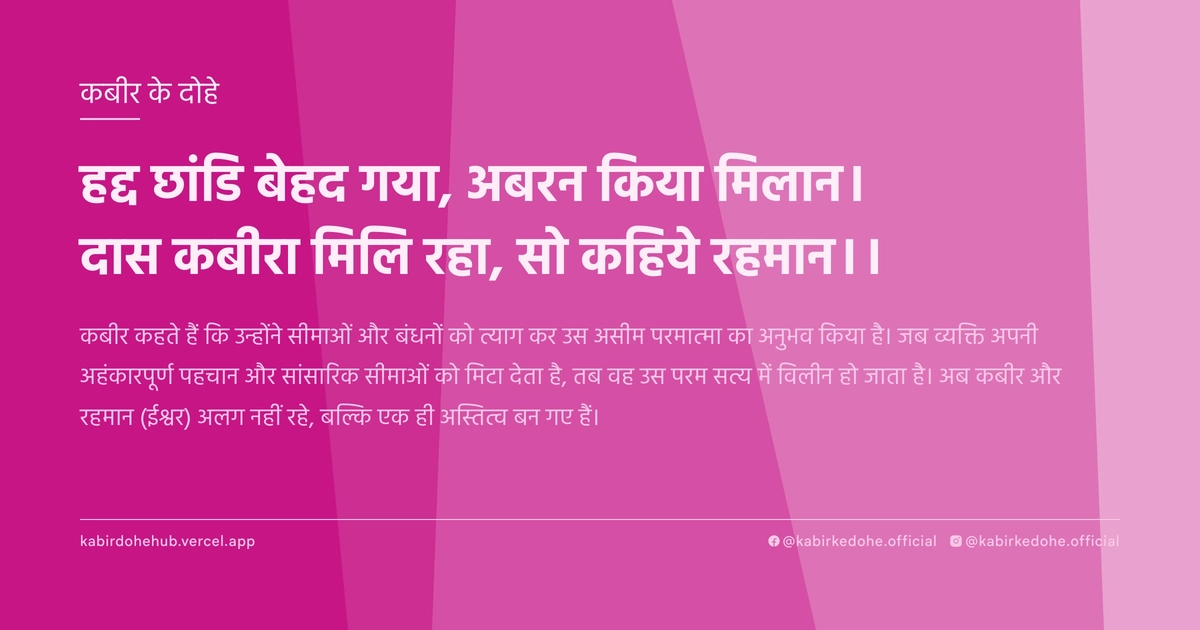
हद्द छांडि बेहद गया, अबरन किया मिलान।
दास कबीरा मिलि रहा, सो कहिये रहमान।।
Hadd chhandi behad gaya, abran kiya milan. Das kabira mili raha, so kahiye rahman.
इस पृष्ठ पर इस कबीर दोहे का अर्थ (meaning), हिंदी व्याख्या और अंग्रेज़ी अनुवाद, दार्शनिक विश्लेषण और व्यावहारिक जीवन सीख दी गई है। यह दोहा हिंदू-मुस्लिम एकता (Hindu-muslim Unity) विषय से जुड़ा है — Kabir doha meaning and explanation in Hindi and English.
अर्थ (Meaning):
कबीर कहते हैं कि उन्होंने सीमाओं और बंधनों को त्याग कर उस असीम परमात्मा का अनुभव किया है। जब व्यक्ति अपनी अहंकारपूर्ण पहचान और सांसारिक सीमाओं को मिटा देता है, तब वह उस परम सत्य में विलीन हो जाता है। अब कबीर और रहमान (ईश्वर) अलग नहीं रहे, बल्कि एक ही अस्तित्व बन गए हैं।
Kabir proclaims that he has transcended all boundaries and limitations to merge with the Infinite. When an individual sheds the restrictive shell of the ego and worldly identities, they dissolve into the Absolute Truth. Kabir and the Divine (Rahman) are no longer distinct entities but have become one singular existence.
व्याख्या (Interpretation):
इस दोहे का शाब्दिक अर्थ है सीमाओं का त्याग कर अनंत में प्रवेश करना। यहाँ 'हद्द' का अर्थ केवल भौतिक सीमा नहीं, बल्कि जाति, धर्म, और 'मैं' की भावना है। 'बेहद' वह निराकार ब्रह्म है जिसकी कोई सीमा नहीं है। यह अनुभव अद्वैत वेदांत के 'अहं ब्रह्मास्मि' के समान है, जहाँ आत्मा और परमात्मा का द्वैत समाप्त हो जाता है। कबीर यहाँ यह स्पष्ट कर रहे हैं कि जब तक 'मैं' है, तब तक 'वह' है; जैसे ही 'मैं' मिटता है, केवल 'वह' शेष रहता है। यह मिलन कोई बाहरी यात्रा नहीं, बल्कि आंतरिक चेतना का विस्तार है। यह एक ऐसी स्थिति है जहाँ भक्त और भगवान के बीच का पर्दा गिर जाता है और केवल शुद्ध अस्तित्व बचता है।
The literal meaning refers to abandoning limits to enter the Boundless. Here, 'Hadd' signifies not just physical boundaries, but the constructs of caste, creed, and the illusory sense of 'I'. 'Behad' represents the Formless Brahman, the Infinite. This experience mirrors the Advaita Vedanta realization of 'Aham Brahmasmi', where the duality between the Atman and Brahman vanishes. Kabir clarifies that as long as the 'I' exists, the 'Other' exists; once the 'I' is annihilated, only the Absolute remains. This union is not an external journey but an expansion of internal consciousness. It is a state where the veil between the devotee and the Divine falls, leaving only pure, non-dual existence.
दार्शनिक विश्लेषण (Philosophical Analysis):
कबीर का यह दोहा मध्यकालीन भारत के सामाजिक और धार्मिक संघर्षों के बीच एक क्रांतिकारी घोषणा है। उस समय समाज कर्मकांडों, बाहरी दिखावे और कठोर जातिगत विभाजनों में जकड़ा हुआ था। कबीर ने 'हद्द' (सीमा) शब्द का प्रयोग करके उन सभी कृत्रिम दीवारों पर प्रहार किया है जो मनुष्य को मनुष्य से और मनुष्य को ईश्वर से अलग करती हैं। उनका दर्शन निर्गुण भक्ति का है, जहाँ ईश्वर किसी मंदिर या मस्जिद में नहीं, बल्कि स्वयं के भीतर स्थित है।
यह विचार सूफीवाद के 'फना' (अहंकार का विनाश) के सिद्धांत से गहराई से जुड़ा है। सूफी मत में जब साधक अपनी व्यक्तिगत इच्छाओं और अहंकार को ईश्वर की इच्छा में विलीन कर देता है, तो वह 'फना' हो जाता है। कबीर का 'मिलि रहा' इसी अवस्था की ओर संकेत करता है। यह केवल एक धार्मिक मिलन नहीं, बल्कि एक मनोवैज्ञानिक रूपांतरण है जहाँ व्यक्ति अपनी संकीर्ण पहचान को वैश्विक चेतना में बदल देता है।
अद्वैत वेदांत के परिप्रेक्ष्य में, यह माया के पर्दे को हटाने की प्रक्रिया है। माया वह भ्रम है जो हमें यह विश्वास दिलाता है कि हम शरीर हैं या कोई सामाजिक पद। जब यह भ्रम टूटता है, तब केवल 'बेहद' (अनंत) शेष रहता है। कबीर का तर्क है कि जब तक आप खुद को एक 'नाम' या 'रूप' में देखते हैं, आप सीमित हैं। जैसे ही आप इस पहचान को छोड़ते हैं, आप अनंत हो जाते हैं।
कबीर ने 'रहमान' शब्द का प्रयोग करके यह दर्शाया कि सत्य किसी एक धर्म की बपौती नहीं है। रहमान, अल्लाह, राम या ब्रह्म—ये सब उस एक ही असीम सत्य के विभिन्न नाम हैं। उनका उद्देश्य धार्मिक समन्वय नहीं, बल्कि धार्मिकता से ऊपर उठकर सत्य की खोज करना था। वे ritualism (कर्मकांड) को एक बाधा मानते थे क्योंकि कर्मकांड अक्सर अहंकार को पुष्ट करते हैं, उसे मिटाते नहीं।
अंततः, यह दोहा अहंकार के पूर्ण विलोपन की बात करता है। जब कबीर कहते हैं कि 'दास कबीरा मिलि रहा', तो वे यह नहीं कह रहे कि कबीर नाम का व्यक्ति ईश्वर के पास गया, बल्कि यह कि कबीर की व्यक्तिगत पहचान पूरी तरह समाप्त हो गई और केवल वह दिव्य प्रकाश बचा। यह शून्य की अवस्था है, जहाँ पहुँचकर ही वास्तविक पूर्णता प्राप्त होती है।
This couplet is a revolutionary proclamation amidst the social and religious conflicts of medieval India. At that time, society was shackled by rituals, outward displays of piety, and rigid caste hierarchies. By using the word 'Hadd' (limit), Kabir attacks all artificial walls that separate human from human and human from the Divine. His philosophy is rooted in Nirgun Bhakti, where God resides not in temples or mosques, but within the self.
This thought is deeply aligned with the Sufi concept of 'Fana' (annihilation of the ego). In Sufism, when a seeker dissolves their personal desires and ego into the will of God, they achieve 'Fana'. Kabir's 'mili raha' (merging) points toward this exact state. This is not merely a religious union but a psychological transformation where the individual evolves from a narrow identity into a universal consciousness.
From the perspective of Advaita Vedanta, this is the process of lifting the veil of Maya. Maya is the illusion that convinces us we are the body or a social role. When this illusion shatters, only 'Behad' (the Infinite) remains. Kabir argues that as long as you perceive yourself as a 'name' or 'form', you are limited. The moment you relinquish this identity, you become infinite.
By using the term 'Rahman', Kabir demonstrates that Truth is not the monopoly of any single religion. Rahman, Allah, Ram, or Brahman—these are all different names for the same Boundless Truth. His objective was not religious syncretism, but transcending religion altogether to find Truth. He viewed ritualism as a barrier because rituals often reinforce the ego rather than annihilating it.
Ultimately, this doha speaks of the total dissolution of the ego. When Kabir says 'Das Kabira mili raha', he is not suggesting that a person named Kabir traveled to God, but that the personal identity of Kabir vanished entirely, leaving only the Divine Light. This is the state of 'Shunya' (Void), where true wholeness is finally realized.
मूल संदेश (Core Message):
- अहंकार की सीमाएं ही आत्मा के विस्तार में सबसे बड़ी बाधा हैं।
- सत्य किसी धर्म का नहीं, बल्कि संपूर्ण अस्तित्व का साझा अनुभव है।
- जब 'मैं' का विलोपन होता है, तभी 'परम' का प्राकट्य होता है।
- बाहरी पहचान को त्यागना ही वास्तविक स्वतंत्रता की पहली सीढ़ी है।
- ईश्वर कोई बाहरी सत्ता नहीं, बल्कि हमारी अपनी शुद्धतम चेतना है।
- The limits of the ego are the greatest obstacles to the expansion of the soul.
- Truth does not belong to any religion; it is a shared experience of all existence.
- Only when the 'I' is annihilated does the 'Absolute' manifest.
- Relinquishing external identity is the first step toward true liberation.
- God is not an external entity, but our own purest consciousness.
व्यावहारिक उदाहरण (Practical Example):
वाराणसी के एक पुराने घाट पर माधव नाम का एक वृद्ध बुनकर रहता था। माधव अपनी कला में निपुण था, लेकिन उसका मन हमेशा इस बात से व्यथित रहता था कि वह एक 'नीची' जाति का बुनकर है और समाज उसे सम्मान नहीं देता। वह घंटों मंदिर की सीढ़ियों पर बैठकर देखता कि कैसे लोग ऊँची जाति के पंडितों के सामने झुकते हैं, जबकि उसे स्पर्श तक वर्जित माना जाता था। माधव का जीवन उसकी जाति की 'हद्द' (सीमा) में कैद था।
एक दिन माधव की मुलाकात एक घुमंतू फकीर से हुई, जिसने उसे कबीर का यह दोहा सुनाया। फकीर ने उससे पूछा, "माधव, क्या यह कपड़ा, जिसे तुम बुन रहे हो, जानता है कि वह किस जाति का है? क्या धागे यह पूछते हैं कि उन्हें छूने वाला कौन है?" माधव चुप रहा। फकीर ने आगे कहा, "तूने खुद को इस जाति की सीमा में बांध लिया है, जबकि तू उस अनंत परमात्मा का हिस्सा है जिसने सबको समान बनाया है।"
माधव को पहली बार महसूस हुआ कि उसकी पीड़ा उसकी जाति के कारण नहीं, बल्कि उसकी उस पहचान के कारण थी जिसे समाज ने उसे दिया था। उसने महसूस किया कि वह जिसे 'अपनी सीमा' मान रहा था, वह वास्तव में एक मानसिक जेल थी। उसने तय किया कि वह अब खुद को एक 'बुनकर' या 'अछूत' के रूप में नहीं, बल्कि एक आत्मा के रूप में देखेगा।
अगले कुछ महीनों में माधव के व्यवहार में एक अद्भुत परिवर्तन आया। उसने दूसरों से सम्मान की उम्मीद करना छोड़ दिया और स्वयं सबको सम्मान देना शुरू किया। उसने देखा कि जब वह अपनी पहचान का अहंकार छोड़ देता है, तो उसे दूसरों में भी वही दिव्य प्रकाश दिखाई देता है। वह अब केवल कपड़े नहीं बुनता था, बल्कि अपने काम को ही ईश्वर की इबादत मानने लगा।
एक समय ऐसा आया जब शहर के सबसे बड़े मंदिर के पुजारी, जो कभी उसे छूते तक नहीं थे, माधव की शांति और निस्वार्थ भाव से प्रभावित हुए। वे उसके पास आने लगे, न कि उसकी जाति पूछने के लिए, बल्कि यह जानने के लिए कि वह इतना शांत कैसे रहता है। माधव ने उन्हें मुस्कुराकर कहा, "मैंने अपनी सीमाएं छोड़ दी हैं, अब मैं बस उस अनंत का हिस्सा हूँ।"
माधव का जीवन अब संघर्ष से मुक्त था। उसने पाया कि जब तक वह खुद को 'अलग' समझता था, वह दुखी था। जैसे ही उसने खुद को 'सबका' और 'सबमें' समझना शुरू किया, उसका दुख समाप्त हो गया। यह उसकी व्यक्तिगत पहचान का अंत था और एक सार्वभौमिक प्रेम की शुरुआत।
उसने अपनी पूरी संपत्ति और ज्ञान गरीब बच्चों को देना शुरू कर दिया, बिना यह सोचे कि वे किस धर्म या जाति के हैं। उसके लिए अब कोई पराया नहीं था। वह अब केवल एक बुनकर नहीं था, वह प्रेम का एक माध्यम बन गया था।
माधव की कहानी हमें सिखाती है कि हमारी सीमाएं बाहरी नहीं, आंतरिक होती हैं। जब हम अपनी पहचान के संकीर्ण दायरे को तोड़ देते हैं, तब हम उस 'बेहद' या अनंत आनंद का अनुभव करते हैं, जहाँ कोई भेद नहीं रह जाता।
On an ancient ghat in Varanasi lived an elderly weaver named Madhav. Madhav was a master of his craft, but his heart was always heavy with the realization that he belonged to a 'lower' caste and was denied respect by society. He would spend hours watching people bow before high-caste priests, while he himself was considered untouchable. Madhav's life was imprisoned within the 'Hadd' (limit) of his caste.
One day, Madhav met a wandering fakir who recited this doha of Kabir. The fakir asked him, "Madhav, does the cloth you are weaving know which caste it belongs to? Do the threads ask who is touching them?" Madhav remained silent. The fakir continued, "You have bound yourself within the limits of caste, while you are a part of that Infinite Divine who created everyone equal."
For the first time, Madhav realized that his suffering was not caused by his caste, but by the identity that society had imposed upon him. He understood that what he perceived as his 'limit' was actually a mental prison. He decided that he would no longer see himself as a 'weaver' or an 'untouchable', but as a pure soul.
Over the next few months, a profound change occurred in Madhav's behavior. He stopped expecting respect from others and began offering respect to everyone. He noticed that when he let go of the ego of identity, he began to see the same divine light in others. He no longer just wove cloth; he began to treat his work as a form of worship.
Eventually, the head priest of the city's largest temple, who once wouldn't even touch him, became fascinated by Madhav's peace and selflessness. He began visiting Madhav, not to question his caste, but to learn how he remained so serene. Madhav smiled and told him, "I have abandoned my limits; I am now simply a part of the Infinite."
Madhav's life was now free from conflict. He discovered that as long as he saw himself as 'separate', he was miserable. The moment he began to see himself as 'everyone' and 'in everyone', his sorrow vanished. This was the end of his personal identity and the beginning of a universal love.
He began giving his wealth and knowledge to poor children, regardless of their religion or caste. For him, no one was a stranger anymore. He was no longer just a weaver; he had become a vessel for love.
Madhav's story teaches us that our limits are not external, but internal. When we break the narrow confines of our identity, we experience that 'Behad' or infinite bliss, where all distinctions cease to exist.
अभ्यास मार्गदर्शन (Practice Guidance):
- दैनिक ध्यान: प्रतिदिन 20 मिनट मौन बैठें और अपनी पहचान (नाम, पेशा, रिश्ता) को एक-एक कर मानसिक रूप से त्यागें, जब तक कि केवल 'होने का अहसास' न बचे।
- आत्म-पूछताछ जर्नल: प्रतिदिन लिखें कि आज किस क्षण में आपने अपनी 'सीमा' (अहंकार या पूर्वाग्रह) को महसूस किया और उसे कैसे पार किया।
- व्यवहारिक परिवर्तन: दिन में कम से कम एक बार ऐसे व्यक्ति की सहायता करें जिससे आप वैचारिक या सामाजिक रूप से असहमत हैं, यह महसूस करते हुए कि आप दोनों एक ही स्रोत से हैं।
- डायग्नोस्टिक चेकलिस्ट: यदि आप अभी भी दूसरों के निर्णय से विचलित होते हैं या अपनी उपलब्धियों पर गर्व करते हैं, तो समझें कि आप अभी भी 'हद्द' (सीमा) में हैं। यदि आप दूसरों की सफलता में अपनी खुशी पाते हैं, तो आप 'बेहद' की ओर बढ़ रहे हैं।
- Daily Meditation: Sit in silence for 20 minutes daily and mentally relinquish your identities (name, profession, relationships) one by one until only the 'sense of being' remains.
- Self-Inquiry Journal: Record daily the moments where you felt your 'limit' (ego or prejudice) and how you consciously transcended it.
- Behavioral Shift: At least once a day, help someone with whom you are ideologically or socially disagreed, realizing that you both originate from the same source.
- Diagnostic Checklist: If you are still disturbed by others' judgments or prideful of your achievements, recognize that you are still within the 'Hadd' (limit). If you find joy in others' success, you are moving toward the 'Behad' (Infinite).
चिंतन प्रश्न (Reflection Questions):
- यदि आपसे आपका नाम, पद और सामाजिक पहचान छीन ली जाए, तो वास्तव में 'आप' कौन बचेंगे?
- आपकी वे कौन सी 'सीमाएं' (पूर्वाग्रह) हैं जो आपको दूसरों में ईश्वर देखने से रोकती हैं?
- क्या आपकी आध्यात्मिक साधना आपको विनम्र बना रही है, या यह आपके अहंकार को एक 'धार्मिक' रूप दे रही है?
- डिजिटल युग में, आपकी 'ऑनलाइन पहचान' किस तरह आपकी वास्तविक आत्मा को सीमित कर रही है?
- क्या आप वास्तव में उस सत्य को स्वीकार करने के लिए तैयार हैं जो आपकी सभी मान्यताओं को गलत साबित कर दे?
- If your name, title, and social identity were stripped away, who would 'you' actually be?
- What are the 'limits' (prejudices) that prevent you from seeing the Divine in others?
- Is your spiritual practice making you humble, or is it merely giving your ego a 'religious' mask?
- In the digital age, how is your 'online persona' limiting your authentic soul?
- Are you truly prepared to accept a Truth that proves all your current beliefs wrong?