
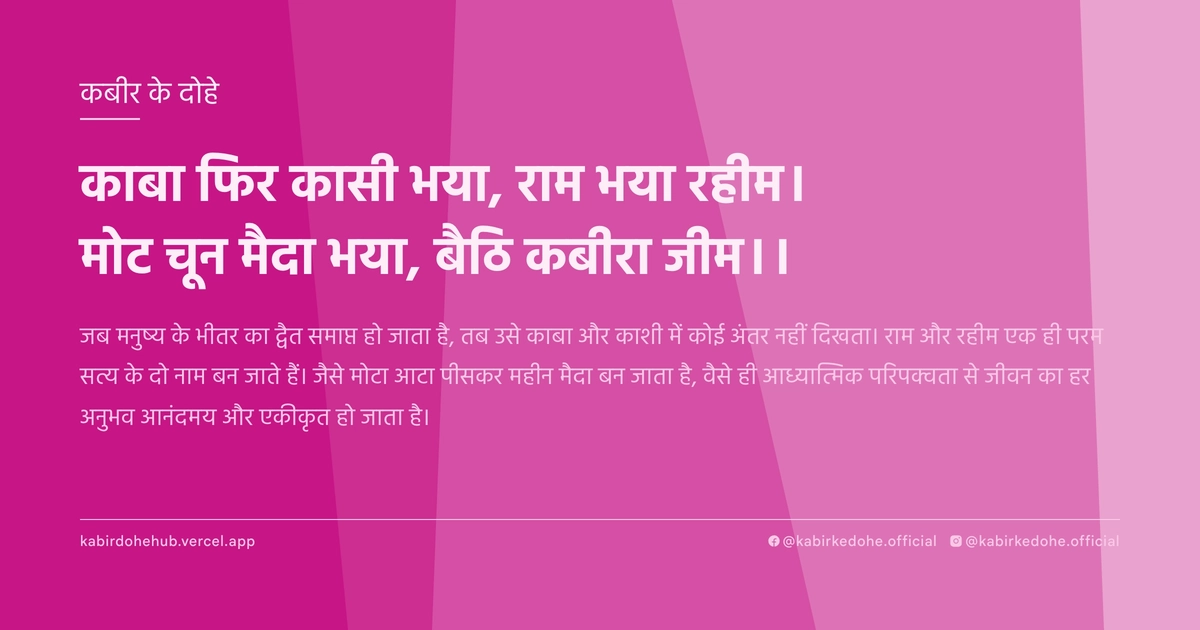
काबा फिर कासी भया, राम भया रहीम।
मोट चून मैदा भया, बैठि कबीरा जीम।।
Kaba phir Kasi bhaya, Ram bhaya Rahim. Mot choon maida bhaya, baithi Kabira jeem.
इस पृष्ठ पर इस कबीर दोहे का अर्थ (meaning), हिंदी व्याख्या और अंग्रेज़ी अनुवाद, दार्शनिक विश्लेषण और व्यावहारिक जीवन सीख दी गई है। यह दोहा हिंदू-मुस्लिम एकता (Hindu-muslim Unity) विषय से जुड़ा है — Kabir doha meaning and explanation in Hindi and English.
अर्थ (Meaning):
जब मनुष्य के भीतर का द्वैत समाप्त हो जाता है, तब उसे काबा और काशी में कोई अंतर नहीं दिखता। राम और रहीम एक ही परम सत्य के दो नाम बन जाते हैं। जैसे मोटा आटा पीसकर महीन मैदा बन जाता है, वैसे ही आध्यात्मिक परिपक्वता से जीवन का हर अनुभव आनंदमय और एकीकृत हो जाता है।
When the duality within a human vanishes, the distinction between Kaba and Kashi disappears. Ram and Rahim become two names for the same Ultimate Truth. Just as coarse grain is ground into fine flour, spiritual maturity transforms the fragmented experiences of life into a unified, blissful state of being.
व्याख्या (Interpretation):
यह दोहा धार्मिक सीमाओं के पूर्ण विलोपन की घोषणा करता है। शाब्दिक अर्थ में, यह इस्लाम के पवित्र काबा और हिंदू धर्म की पवित्र काशी के मिलन की बात करता है, लेकिन रूपक के स्तर पर यह 'अद्वैत' की स्थिति है। यहाँ 'राम' और 'रहीम' केवल व्यक्ति नहीं, बल्कि उस निराकार ब्रह्म (Nirgun Brahman) के प्रतीक हैं जो हर कण में व्याप्त है। 'मोटा आटा' अज्ञानता और अहंकार का प्रतीक है, जबकि 'मैदा' उस शुद्ध चेतना का है जो साधना के माध्यम से प्राप्त होती है। कबीर यहाँ यह समझा रहे हैं कि जब तक हम भेदों में उलझे हैं, हम सत्य के भूखे हैं, लेकिन जब भेद मिट जाते हैं, तब हम उस सत्य का रसास्वादन (जीमना) कर सकते हैं। यह माया के पर्दे के हटने और आत्मा का परमात्मा में विलीनीकरण की प्रक्रिया है।
This couplet proclaims the total dissolution of religious boundaries. Literally, it speaks of the merging of the sacred Kaba of Islam and the sacred Kashi of Hinduism, but metaphorically, it describes the state of 'Advaita' or non-duality. Here, 'Ram' and 'Rahim' are not mere personalities but symbols of the Formless Absolute (Nirgun Brahman) permeating every atom. The 'coarse grain' symbolizes ignorance and the fragmented ego, while the 'fine flour' represents the purified consciousness achieved through spiritual discipline. Kabir suggests that as long as we are entangled in distinctions, we remain hungry for truth; however, once these divisions vanish, we can finally feast upon the Divine. This is the process of the veil of Maya lifting and the Atman merging into the Brahman.
दार्शनिक विश्लेषण (Philosophical Analysis):
कबीर का यह दर्शन 15वीं शताब्दी के भारत के सामाजिक-धार्मिक तनावों के बीच एक क्रांतिकारी हस्तक्षेप था। उन्होंने उस समय की कट्टरता को चुनौती दी जहाँ धर्म को बाहरी कर्मकांडों और पहचानों से जोड़ा जाता था। कबीर का दृष्टिकोण 'निर्गुण भक्ति' का है, जहाँ ईश्वर किसी मंदिर या मस्जिद में नहीं, बल्कि मनुष्य के भीतर निवास करता है। यह विचार सूफी मत के 'वहदत-अल-वुजूद' (अस्तित्व की एकता) और वेदांत के 'अहं ब्रह्मास्मि' के साथ गहराई से मेल खाता है।
उनका प्रहार उन मुल्लाओं और पंडितों पर था जो धर्म के नाम पर दीवारें खड़ी करते थे। कबीर तर्क देते हैं कि यदि ईश्वर एक है, तो उसके नाम अलग होने का अर्थ केवल मानवीय अज्ञानता है। उनके लिए, धर्म का अर्थ पूजा पद्धति नहीं, बल्कि सत्य का अनुभव है। यह एक मनोवैज्ञानिक रूपांतरण है जहाँ साधक अपनी संकीर्ण पहचान (जाति, धर्म, देश) को त्यागकर एक सार्वभौमिक पहचान को अपनाता है।
यहाँ 'मैदा' बनने की प्रक्रिया अहंकार के विनाश (Fana) की प्रक्रिया है। जैसे अनाज को पीसने के लिए दबाव और घर्षण की आवश्यकता होती है, वैसे ही अहंकार को मिटाने के लिए आत्म-साक्षात्कार के कठिन संघर्ष की आवश्यकता होती है। जब अहंकार मिटता है, तो द्वैत (Dualism) समाप्त हो जाता है और केवल एकता बचती है।
यह दर्शन हमें सिखाता है कि सत्य विखंडित नहीं है। हम जिसे 'विभिन्न' मानते हैं, वह केवल हमारी दृष्टि का दोष है। जब दृष्टि शुद्ध होती है, तो विरोधी तत्व एक-दूसरे के पूरक बन जाते हैं। यह केवल धार्मिक सहिष्णुता नहीं है, बल्कि धार्मिक超越 (Transcendence) है।
अंततः, कबीर यह स्पष्ट करते हैं कि मोक्ष किसी भौगोलिक स्थान (काशी या काबा) की यात्रा में नहीं, बल्कि चेतना के स्तर को बदलने में है। जब आंतरिक यात्रा पूरी होती है, तो बाहरी दुनिया का हर कोना तीर्थ बन जाता है।
Kabir's philosophy was a revolutionary intervention amidst the socio-religious tensions of 15th-century India. He challenged the bigotry of an era where religion was tethered to external rituals and rigid identities. His approach is rooted in 'Nirgun Bhakti,' where the Divine does not reside in a temple or mosque but within the human heart. This vision aligns profoundly with the Sufi concept of 'Wahdat-al-Wujud' (Unity of Existence) and the Vedantic realization of 'Aham Brahmasmi' (I am Brahman).
His critique targeted the clerics and priests who erected walls in the name of faith. Kabir argued that if the Divine is One, then the existence of different names is merely a reflection of human ignorance. For him, religion was not a system of worship but an experience of Truth. This is a psychological transformation where the seeker sheds narrow identities—caste, creed, nationality—to embrace a universal consciousness.
The process of becoming 'fine flour' is analogous to the annihilation of the ego (Fana). Just as grain requires pressure and friction to be ground, the ego requires the rigorous struggle of self-inquiry to be dismantled. When the ego vanishes, duality ceases, and only Unity remains.
This philosophy teaches us that Truth is not fragmented. What we perceive as 'different' is merely a flaw in our perception. When vision is purified, opposing elements become complementary. This is not mere religious tolerance, but religious transcendence.
Ultimately, Kabir clarifies that liberation is not found in a geographical journey to Kashi or Kaba, but in the elevation of one's state of consciousness. When the inner journey is complete, every corner of the external world becomes a pilgrimage site.
मूल संदेश (Core Message):
- बाहरी तीर्थ केवल मन का भ्रम हैं, वास्तविक तीर्थ हृदय के भीतर है।
- नाम और रूप अलग हो सकते हैं, लेकिन तत्व हमेशा एक ही रहता है।
- अहंकार का पिसा जाना ही आध्यात्मिक परिपक्वता की पहली शर्त है।
- जब भेद मिटते हैं, तब जीवन का वास्तविक आनंद प्राप्त होता है।
- सत्य किसी एक धर्म की बपौती नहीं, बल्कि सार्वभौमिक अनुभव है।
- External pilgrimages are illusions of the mind; the true sanctuary is within the heart.
- Names and forms may differ, but the essential element always remains One.
- The grinding of the ego is the primary condition for spiritual maturity.
- When distinctions vanish, the true bliss of existence is realized.
- Truth is not the monopoly of any one religion, but a universal experience.
व्यावहारिक उदाहरण (Practical Example):
एक समय की बात है, बनारस के घाटों पर माधव नाम का एक वृद्ध नाविक रहता था। माधव का जीवन केवल नाव चलाने और यात्रियों को पार उतारने तक सीमित था। वह स्वभाव से बहुत सीधा था, लेकिन उसके मन में एक गहरी टीस थी। वह देखता था कि कैसे लोग धर्म के नाम पर आपस में लड़ते थे—कोई काशी की महिमा गाता, तो कोई काबा की ओर झुकता। माधव खुद को इन सबके बीच बहुत छोटा और अयोग्य महसूस करता था।
एक दिन, उसकी नाव पर एक शांत दिखने वाला फकीर सवार हुआ। फकीर ने देखा कि माधव नाव चलाते समय बहुत परेशान था। उसने पूछा, "बेटा, तू इस शांत गंगा में भी इतना अशांत क्यों है?"
माधव ने लंबी आह भरी और कहा, "बाबा, मैं यह नहीं समझ पाता कि ईश्वर एक है तो लोग अलग-अलग रास्तों पर क्यों लड़ते हैं? मुझे लगता है कि मैं कभी उस सत्य को नहीं जान पाऊंगा क्योंकि मैं न तो बड़ा पंडित हूँ और न ही कोई विद्वान।"
फकीर मुस्कुराया और उसने अपनी झोली से थोड़ा मोटा अनाज निकाला। उसने माधव से कहा, "इसे देख। क्या यह खाने योग्य है?"
माधव ने कहा, "नहीं बाबा, यह बहुत खुरदरा है, गले में चुभेगा।"
फकीर ने उस अनाज को एक छोटी चक्की में डालकर पीसना शुरू किया। कुछ देर बाद, वह खुरदरा अनाज महीन सफेद मैदे में बदल गया। फकीर ने कहा, "देख माधव, अनाज वही था, लेकिन जब वह अपनी कठोरता और आकार को छोड़कर पिसा गया, तब वह स्वादिष्ट और उपयोगी बन गया।"
माधव सोच में पड़ गया। फकीर ने आगे समझाया, "तेरा अहंकार और तेरी यह सोच कि तू 'छोटा' है, वही वह मोटा अनाज है। जब तू यह मान लेगा कि तेरे भीतर का राम और बाहर का रहीम एक ही हैं, तब तेरे लिए यह पूरी दुनिया एक ही मंदिर बन जाएगी।"
उस दिन माधव के भीतर कुछ टूट गया। उसने महसूस किया कि वह अब तक केवल पानी और नाव को देख रहा था, लेकिन उस पानी में बहने वाली चेतना को नहीं। उसने लोगों को पार उतारना बंद नहीं किया, लेकिन अब वह हर यात्री को एक ही ईश्वर का रूप मानने लगा।
अब माधव के लिए न तो काशी अलग थी और न ही कोई अन्य तीर्थ। वह नाव पर बैठे हर व्यक्ति में उसी एक नूर को देखने लगा। उसकी नाव अब केवल नदी पार नहीं कराती थी, बल्कि वह लोगों के दिलों के द्वैत को मिटाने का जरिया बन गई।
माधव का जीवन अब एक उत्सव बन गया था। उसने सीखा कि जब हम अपनी पहचान के 'खुरदरेपन' को मिटा देते हैं, तो जीवन का हर स्वाद आनंदमय हो जाता है।
Once, on the ghats of Varanasi, lived an elderly boatman named Madhav. Madhav's life was limited to rowing his boat and ferrying passengers across the river. He was simple by nature, but a deep ache resided in his heart. He watched as people fought in the name of religion—some praising the glory of Kashi, others bowing toward the Kaba.
Madhav felt small and unworthy amidst these conflicts. One day, a serene-looking fakir boarded his boat. The fakir noticed Madhav's inner turmoil and asked, "Son, why are you so restless even in the presence of the calm Ganges?"
Madhav sighed and replied, "Baba, I cannot understand why people fight over different paths if God is One. I feel I will never know the Truth because I am neither a great scholar nor a learned priest."
The fakir smiled and pulled out some coarse grain from his bag. He asked, "Look at this. Is it fit to eat as it is?"
Madhav replied, "No, Baba, it is too rough; it would prick the throat."
The fakir began to grind the grain in a small hand-mill. After a while, the coarse grain turned into fine, white flour. The fakir said, "See, Madhav, the grain was the same, but when it surrendered its hardness and shape to be ground, it became delicious and useful."
Madhav fell into deep thought. The fakir continued, "Your ego and your belief that you are 'small' are like that coarse grain. When you realize that the Ram within you and the Rahim outside are one and the same, the entire world will become a single temple for you."
In that moment, something broke inside Madhav. He realized he had been looking only at the water and the boat, ignoring the consciousness flowing through them. He didn't stop ferrying people, but he began to see every passenger as a manifestation of the same Divine.
For Madhav, Kashi was no longer separate from any other pilgrimage. He saw the same divine light in every person on his boat. His boat no longer just crossed the river; it became a vessel for dissolving the duality in people's hearts.
Madhav's life became a celebration. He learned that when we erase the 'roughness' of our identity, every flavor of life becomes blissful.
अभ्यास मार्गदर्शन (Practice Guidance):
- प्रतिदिन 20 मिनट मौन ध्यान करें, जहाँ आप अपनी पहचान (नाम, धर्म, पद) को धीरे-धीरे विसर्जित करें और केवल 'साक्षी' भाव में रहें।
- एक 'द्वैत डायरी' लिखें: दिन भर में जब भी आप किसी के प्रति पूर्वाग्रह या भेदभाव महसूस करें, उसे लिखें और फिर विश्लेषण करें कि वह भेद वास्तव में कहाँ है।
- व्यवहार परिवर्तन: सप्ताह में एक बार ऐसे व्यक्ति की मदद करें या उसके साथ समय बिताएं जिससे आपके विचार या विश्वास पूरी तरह भिन्न हों, और उनमें अपनी ही आत्मा को खोजें।
- नैदानिक चेकलिस्ट: क्या मैं अभी भी 'हम' और 'वे' के बीच अंतर कर रहा हूँ? क्या मेरी शांति बाहरी परिस्थितियों या धार्मिक पहचान पर निर्भर है? यदि हाँ, तो आप अभी भी 'मोटे अनाज' की स्थिति में हैं।
- Practice 20 minutes of silent meditation daily, gradually dissolving your identities (name, religion, status) and remaining only as the 'Witness'.
- Maintain a 'Duality Diary': Whenever you feel prejudice or distinction toward someone during the day, record it and analyze where that separation actually exists.
- Behavioral Shift: Once a week, help or spend time with someone whose beliefs or background are entirely different from yours, seeking your own soul within them.
- Diagnostic Checklist: Am I still distinguishing between 'us' and 'them'? Is my peace dependent on external circumstances or religious identity? If yes, you are still in the state of 'coarse grain'.
चिंतन प्रश्न (Reflection Questions):
- मेरी वह कौन सी धार्मिक या सामाजिक पहचान है जिसे मैं अपनी आत्मा से ज्यादा महत्व देता हूँ?
- यदि कल मेरी सारी बाहरी पहचानें छीन ली जाएं, तो मेरे भीतर क्या बचेगा?
- मैं किन लोगों को 'पराया' मानता हूँ और वह अलगाव मेरे भीतर किस डर से पैदा होता है?
- क्या मेरी भक्ति वास्तव में ईश्वर के लिए है, या केवल अपनी श्रेष्ठता सिद्ध करने के लिए?
- मेरे जीवन का वह कौन सा 'मोटा अनाज' (कठोरता) है जिसे पिसा जाना अभी बाकी है?
- Which religious or social identity do I value more than my own soul?
- If all my external identities were stripped away tomorrow, what would remain within me?
- Whom do I consider 'the other,' and from what internal fear does that separation arise?
- Is my devotion truly for the Divine, or merely a tool to prove my own superiority?
- What is the 'coarse grain' (rigidity) in my life that has yet to be ground down?