
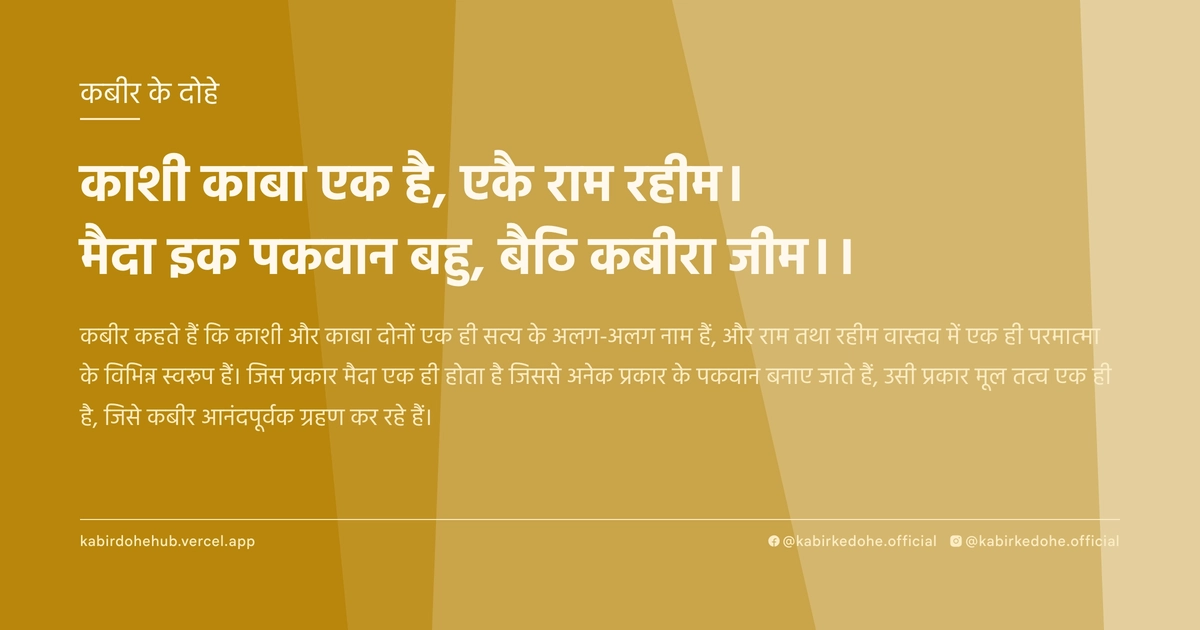
काशी काबा एक है, एकै राम रहीम।
मैदा इक पकवान बहु, बैठि कबीरा जीम।।
Kashi Kaba ek hai, ekai Ram Rahim. Maida ik pakwan bahu, baithi Kabira jeem.
इस पृष्ठ पर इस कबीर दोहे का अर्थ (meaning), हिंदी व्याख्या और अंग्रेज़ी अनुवाद, दार्शनिक विश्लेषण और व्यावहारिक जीवन सीख दी गई है। यह दोहा हिंदू-मुस्लिम एकता (Hindu-muslim Unity) विषय से जुड़ा है — Kabir doha meaning and explanation in Hindi and English.
अर्थ (Meaning):
कबीर कहते हैं कि काशी और काबा दोनों एक ही सत्य के अलग-अलग नाम हैं, और राम तथा रहीम वास्तव में एक ही परमात्मा के विभिन्न स्वरूप हैं। जिस प्रकार मैदा एक ही होता है जिससे अनेक प्रकार के पकवान बनाए जाते हैं, उसी प्रकार मूल तत्व एक ही है, जिसे कबीर आनंदपूर्वक ग्रहण कर रहे हैं।
Kabir asserts that Kashi and Kaaba are but different names for the same ultimate truth, and Ram and Rahim are merely diverse titles for the one singular Divine. Just as a single piece of flour can be transformed into numerous varied delicacies, the primordial essence remains one, and Kabir invites us to sit and feast upon this singular, universal truth.
व्याख्या (Interpretation):
यह दोहा द्वैत के भ्रम को मिटाकर अद्वैत की स्थापना करता है। काशी (हिंदू तीर्थ) और काबा (इस्लामिक तीर्थ) बाहरी प्रतीकों को दर्शाते हैं, जबकि 'एक' उस निर्गुण ब्रह्म की ओर संकेत करता है जो सीमाओं से परे है। यहाँ 'मैदा' शुद्ध चेतना या ब्रह्म का प्रतीक है, और 'पकवान' संसार के विभिन्न धर्मों, अनुष्ठानों और नामकरणों को दर्शाते हैं। कबीर यह समझाते हैं कि मनुष्य बाहरी रूपों में उलझकर मूल तत्व को भूल गया है। जब साधक यह जान लेता है कि विविधता केवल सतही है, तब वह धार्मिक कट्टरता से मुक्त होकर उस एक सत्य का अनुभव करता है। यह अनुभव ही वास्तविक 'भोज' या आध्यात्मिक तृप्ति है, जहाँ अब कोई 'पराया' नहीं बचता।
This couplet dismantles the illusion of duality to establish the primacy of Non-duality (Advaita). Kashi and Kaaba represent external symbols of faith, while 'One' points toward the Nirgun Brahman, which transcends all boundaries. Here, 'flour' symbolizes pure consciousness or the Absolute, and 'dishes' represent the myriad religions, rituals, and nomenclatures of the world. Kabir explains that humanity has become entangled in external forms, forgetting the primordial essence. Once the seeker realizes that diversity is merely superficial, they are liberated from religious bigotry to experience the singular Truth. This realization is the true 'feast' or spiritual fulfillment, where the concept of the 'other' ceases to exist.
दार्शनिक विश्लेषण (Philosophical Analysis):
कबीर का यह दृष्टिकोण उनके युग के गहरे सामाजिक और धार्मिक संघर्षों की प्रतिक्रिया था। उन्होंने देखा कि कैसे धर्म के नाम पर समाज विभाजित था, जहाँ लोग मंदिर और मस्जिद के बीच युद्ध कर रहे थे। कबीर ने 'निर्गुण भक्ति' का मार्ग चुना, जहाँ ईश्वर किसी मूर्ति या विशेष स्थान में नहीं, बल्कि प्रत्येक जीव के भीतर स्थित है। यह विचार उपनिषदों के 'अहं ब्रह्मास्मि' और सूफीवाद के 'वहदत-अल-वुजूद' (अस्तित्व की एकता) का संगम है।
वे कर्मकांडों और बाहरी आडंबरों का पुरजोर विरोध करते हैं क्योंकि उनका मानना था कि सत्य अनुभव का विषय है, न कि शास्त्र पढ़ने या तीर्थ यात्रा करने का। उनके लिए, काशी और काबा केवल भौगोलिक स्थान हैं; वास्तविक तीर्थ तो आत्मा का परमात्मा में विलीन होना है। यह विश्लेषण दर्शाता है कि कैसे कबीर ने जाति और धर्म की दीवारों को ढहाकर एक मानवीय धर्म की स्थापना की।
दार्शनिक स्तर पर, यह दोहा माया के प्रभाव को उजागर करता है। माया वह पर्दा है जो एक ही सत्य को अनेक रूपों में दिखाता है। जब व्यक्ति अपनी अहंकार-केंद्रित दृष्टि को त्यागता है, तो उसे समझ आता है कि राम और रहीम अलग नहीं हैं, बल्कि एक ही ऊर्जा के दो नाम हैं। यह अहंकार का विसर्जन ही मोक्ष का द्वार है।
सूफी संतों की तरह, कबीर प्रेम और एकता पर बल देते हैं। वे कहते हैं कि यदि आप ईश्वर को पाना चाहते हैं, तो आपको पहले उन विभाजनों को मिटाना होगा जिन्हें आपने अपने मन में बनाया है। यह मनोवैज्ञानिक रूपांतरण है जहाँ 'मैं' और 'तू' का भेद समाप्त हो जाता है।
अंततः, कबीर का संदेश यह है कि सत्य सरल है, लेकिन जटिलता हमने अपनी मान्यताओं में जोड़ ली है। वे हमें वापस उस सरलता की ओर बुलाते हैं जहाँ केवल प्रेम और एकता शेष रहती है। यह केवल धार्मिक सहिष्णुता नहीं है, बल्कि एक गहरा आध्यात्मिक बोध है कि हम सब एक ही स्रोत से निकले हैं।
Kabir's perspective was a direct response to the profound social and religious conflicts of his era. He witnessed a society fractured by faith, where people fought over the sanctity of temples versus mosques. Consequently, Kabir embraced the path of 'Nirgun Bhakti,' asserting that the Divine does not reside in idols or specific geographies, but within every living being. This philosophy is a confluence of the Upanishadic 'Aham Brahmasmi' (I am Brahman) and the Sufi concept of 'Wahdat al-Wujud' (Unity of Existence).
He vehemently rejected ritualism and outward displays of piety, believing that Truth is a matter of direct experience rather than scriptural study or pilgrimage. For Kabir, Kashi and Kaaba are merely geographical markers; the true pilgrimage is the merging of the Atman into the Paramatman. This analysis reveals how Kabir sought to demolish the walls of caste and creed to establish a universal religion of humanity.
On a philosophical level, this couplet exposes the mechanism of Maya. Maya is the veil that presents the singular Truth as a multitude of fragmented forms. When an individual transcends their ego-centric vision, they realize that Ram and Rahim are not distinct entities but two names for the same cosmic energy. The dissolution of this ego is the gateway to liberation.
Mirroring the Sufi masters, Kabir emphasizes love and unity. He suggests that to find God, one must first erase the divisions created within the mind. This is a psychological transformation where the distinction between 'I' and 'Thou' vanishes, leading to a state of wholeness.
Ultimately, Kabir's message is that Truth is simple, but we have layered it with complexities through our beliefs. He calls us back to a simplicity where only love and unity remain. This is not mere religious tolerance, but a profound spiritual realization that we all emanate from the same singular source.
मूल संदेश (Core Message):
- बाहरी प्रतीकों का मोह ही आध्यात्मिक अंधापन है।
- सत्य एक है, केवल उसे पुकारने वाले नाम अलग हैं।
- मानवता का धर्म सभी संकीर्ण धार्मिक पहचानों से ऊपर है।
- अहंकार का विसर्जन ही वास्तविक ईश्वर प्राप्ति का मार्ग है।
- विविधता को स्वीकार करना ही अद्वैत की पहली सीढ़ी है।
- प्रेम वह सेतु है जो काशी और काबा को जोड़ता है।
- Attachment to external symbols is the root of spiritual blindness.
- Truth is singular; only the names used to call it differ.
- The religion of humanity transcends all narrow sectarian identities.
- The dissolution of ego is the only true path to Divine realization.
- Accepting diversity is the first step toward experiencing Non-duality.
- Love is the bridge that unites Kashi and Kaaba.
व्यावहारिक उदाहरण (Practical Example):
एक समय की बात है, बनारस के घाटों पर रहने वाला एक वृद्ध बुनकर था जिसका नाम माधव था। माधव अपनी पूरी जिंदगी केवल अपने समुदाय के लोगों के साथ रहकर बिता चुका था और उसके मन में अन्य धर्मों के प्रति एक अनजाना डर और दूरी थी। वह मानता था कि पवित्रता केवल उसके अपने रीति-रिवाजों में है।
एक दिन, माधव की मुलाकात एक वृद्ध सूफी दरवेश से हुई जो घाट की सीढ़ियों पर चुपचाप बैठे थे। दरवेश के चेहरे पर एक ऐसी शांति थी जिसे माधव ने कभी नहीं देखा था। माधव ने उनसे पूछा, "आप यहाँ क्यों आए हैं? क्या आपका ईश्वर आपके काबा में नहीं रहता?"
दरवेश मुस्कुराए और उन्होंने माधव को एक सफेद आटे की लोई दिखाई। उन्होंने कहा, "देखो माधव, यह मैदा है। अब मैं इससे एक मीठा हलवा बनाऊँगा, और कुछ हिस्से से नमकीन पूरी। क्या हलवा और पूरी अलग-अलग चीजें हैं, या दोनों का मूल यह सफेद मैदा ही है?"
माधव चुप रहा। दरवेश ने आगे कहा, "ठीक वैसे ही, तुम्हारी काशी और मेरा काबा अलग-अलग पकवान हैं, लेकिन इन्हें बनाने वाला मैदा एक ही है। हम बस स्वाद के नाम में उलझे हैं, जबकि रसोइया एक ही है।"
यह बात माधव के हृदय में गहरे तक उतर गई। उसे महसूस हुआ कि उसने अब तक केवल 'पकवानों' की लड़ाई लड़ी थी, जबकि वह उस 'मैदे' को पहचानना भूल गया था जो हर इंसान के भीतर है।
अगले ही दिन से माधव का व्यवहार बदलने लगा। उसने उन लोगों से बात करना शुरू किया जिन्हें वह पहले 'अशुद्ध' मानता था। उसने देखा कि एक मुस्लिम पड़ोसी की तकलीफ और उसकी अपनी तकलीफ में कोई अंतर नहीं है।
उसने पाया कि जब वह दूसरों की सेवा बिना किसी धार्मिक लेबल के करता है, तो उसे वह शांति मिलती है जो उसे घंटों पूजा करने से नहीं मिली थी। उसका अहंकार, जो उसकी पहचान को केवल एक धर्म तक सीमित रखता था, धीरे-धीरे पिघलने लगा।
माधव अब केवल एक हिंदू बुनकर नहीं रहा, वह एक 'इंसान' बन गया। उसने जान लिया कि प्रेम ही वह एकमात्र भाषा है जिसे हर कोई समझता है, चाहे वह काशी में हो या काबा में।
उसकी आँखों में अब डर नहीं, बल्कि सबके लिए करुणा थी। वह समझ गया कि ईश्वर किसी एक इमारत में कैद नहीं है, बल्कि वह तो उस हवा की तरह है जो सबके लिए समान रूप से बहती है।
अंत में, माधव ने अपनी पूरी जिंदगी की कमाई का एक हिस्सा एक ऐसे स्कूल के लिए दान कर दिया जहाँ सभी धर्मों के बच्चे एक साथ पढ़ते थे, क्योंकि उसने जान लिया था कि सत्य एक ही है।
Once, in the ghats of Varanasi, lived an elderly weaver named Madhav. Madhav had spent his entire life associating only with his own community, harboring an unconscious fear and distance toward those of other faiths. He believed that purity resided solely within his own rituals.
One day, Madhav encountered an elderly Sufi dervish sitting silently on the steps of the ghat. The dervish possessed a serenity that Madhav had never witnessed. Madhav asked him, "Why have you come here? Does your God not reside in your Kaaba?"
The dervish smiled and showed Madhav a small lump of white flour. He said, "Look, Madhav, this is flour. Now, I will make a sweet halwa from some of it, and salty puris from another part. Are the halwa and the puri different things, or is the root of both this same white flour?"
Madhav remained silent. The dervish continued, "Similarly, your Kashi and my Kaaba are different dishes, but the flour used to make them is one. We are merely entangled in the names of the flavors, while the Cook is the same."
These words penetrated deep into Madhav's heart. He realized that he had spent his life fighting over 'dishes' while forgetting to recognize the 'flour' that exists within every human being.
From the very next day, Madhav's behavior began to change. He started conversing with people he had previously deemed 'impure.' He noticed that the suffering of a Muslim neighbor was no different from his own.
He discovered that when he served others without any religious labels, he experienced a peace that hours of ritualistic prayer had never provided. His ego, which had confined his identity to a single religion, began to melt away.
Madhav was no longer just a Hindu weaver; he became a 'human.' He understood that love is the only language everyone understands, whether in Kashi or Kaaba.
Fear vanished from his eyes, replaced by compassion for all. He realized that God is not imprisoned in a single building but is like the wind that blows equally for everyone.
Ultimately, Madhav donated a portion of his life's savings to a school where children of all faiths studied together, for he had finally understood that Truth is One.
अभ्यास मार्गदर्शन (Practice Guidance):
- प्रतिदिन 15 मिनट मौन ध्यान करें, जहाँ आप अपने भीतर के उस तत्व को खोजने का प्रयास करें जो धर्म, जाति और नाम से परे है।
- एक 'विविधता डायरी' लिखें: उन लोगों की सूची बनाएँ जिनसे आप वैचारिक मतभेदों के कारण दूर रहते हैं, और उनके भीतर अपनी ही तरह की मानवीय भावनाओं को खोजने का प्रयास करें।
- सचेत व्यवहार: जब भी आप किसी व्यक्ति को उसके धर्म या पहचान से जज करें, तो तुरंत खुद को याद दिलाएँ—'मैदा एक है, पकवान अनेक'।
- निदान चेकलिस्ट: क्या मैं अभी भी बाहरी प्रतीकों को सत्य मान रहा हूँ? क्या मेरा मन दूसरों के प्रति पूर्वाग्रह रखता है? क्या मैं ईश्वर को केवल अपने धर्म की सीमा में देखता हूँ? यदि हाँ, तो आप अभी भी द्वैत के भ्रम में हैं।
- Practice 15 minutes of silent meditation daily, attempting to connect with the element within you that exists beyond religion, caste, and name.
- Maintain a 'Diversity Journal': List people you distance yourself from due to ideological differences and consciously seek the shared human emotions within them.
- Conscious Behavior: Whenever you judge someone based on their religion or identity, immediately remind yourself—'The flour is one, the dishes are many.'
- Diagnostic Checklist: Am I still treating external symbols as the ultimate truth? Does my mind hold prejudices against others? Do I perceive the Divine only within the boundaries of my own faith? If yes, you are still under the illusion of duality.
चिंतन प्रश्न (Reflection Questions):
- यदि आपसे आपकी धार्मिक और सामाजिक पहचान छीन ली जाए, तो आपके पास क्या बचेगा?
- क्या आपकी आस्था आपको दूसरों के करीब लाती है, या यह आपके और दूसरों के बीच एक दीवार खड़ी करती है?
- आप किन 'पकवानों' (बाहरी रूपों) के इतने दीवाने हैं कि आप 'मैदे' (मूल तत्व) को भूल गए हैं?
- क्या आप वास्तव में उस सत्य को स्वीकार करने के लिए तैयार हैं जो आपकी वर्तमान मान्यताओं को चुनौती देता है?
- आपके भीतर का वह कौन सा डर है जो आपको दूसरे धर्म के व्यक्ति में अपना प्रतिबिंब देखने से रोकता है?
- क्या आपकी प्रार्थनाएँ केवल आपके अपने लाभ के लिए हैं, या वे पूरी मानवता के कल्याण की कामना करती हैं?
- If your religious and social identities were stripped away, what would remain of you?
- Does your faith bring you closer to others, or does it build a wall between you and the world?
- Which 'dishes' (external forms) are you so enamored with that you have forgotten the 'flour' (the essence)?
- Are you truly prepared to accept a Truth that challenges your current deeply held beliefs?
- What is the fear within you that prevents you from seeing your own reflection in a person of another faith?
- Are your prayers solely for your own benefit, or do they yearn for the welfare of all humanity?