
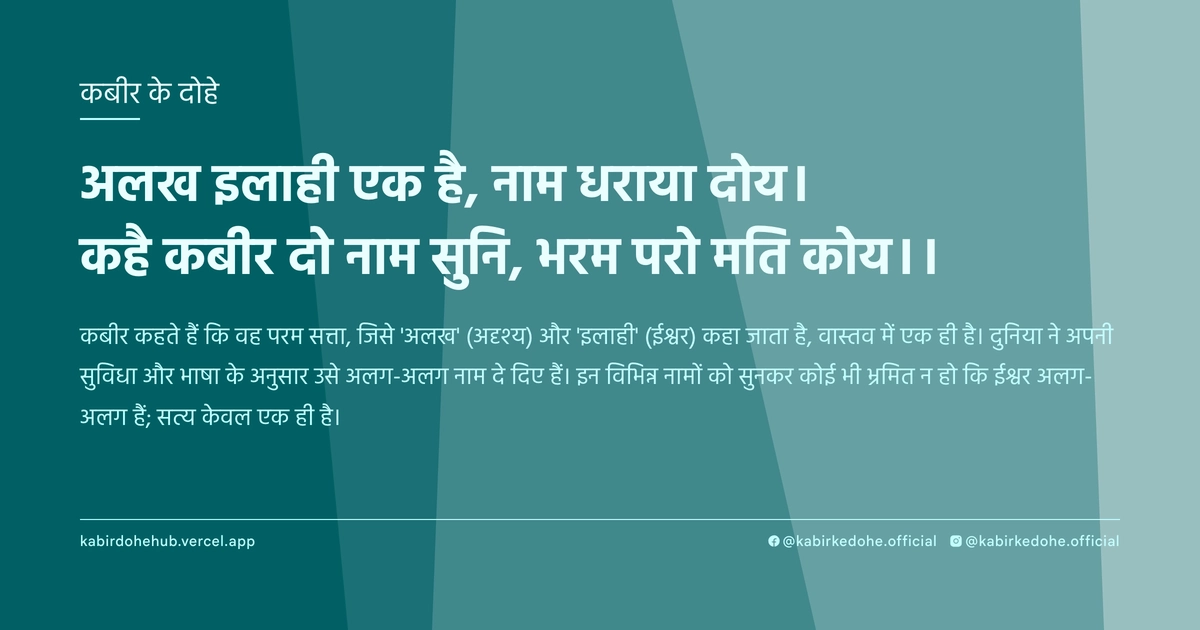
अलख इलाही एक है, नाम धराया दोय।
कहै कबीर दो नाम सुनि, भरम परो मति कोय।।
Alakh ilahi ek hai, naam dharaya doy. Kahai Kabir do naam suni, bharam paro mati koy.
इस पृष्ठ पर इस कबीर दोहे का अर्थ (meaning), हिंदी व्याख्या और अंग्रेज़ी अनुवाद, दार्शनिक विश्लेषण और व्यावहारिक जीवन सीख दी गई है। यह दोहा निर्गुण ब्रह्म (Nirguna Brahman) विषय से जुड़ा है — Kabir doha meaning and explanation in Hindi and English.
अर्थ (Meaning):
कबीर कहते हैं कि वह परम सत्ता, जिसे 'अलख' (अदृश्य) और 'इलाही' (ईश्वर) कहा जाता है, वास्तव में एक ही है। दुनिया ने अपनी सुविधा और भाषा के अनुसार उसे अलग-अलग नाम दे दिए हैं। इन विभिन्न नामों को सुनकर कोई भी भ्रमित न हो कि ईश्वर अलग-अलग हैं; सत्य केवल एक ही है।
Kabir asserts that the Supreme Reality, referred to as 'Alakh' (the Invisible) and 'Ilahi' (the Divine), is fundamentally one. Humanity has merely assigned different names to the same Truth based on linguistic and cultural convenience. He warns against the delusion of perceiving multiple gods simply because different names are used.
व्याख्या (Interpretation):
यह दोहा अद्वैत और सूफीवाद के मिलन बिंदु को दर्शाता है। 'अलख' शब्द हिंदू रहस्यवाद से है और 'इलाही' अरबी-फारसी मूल का है, जो यह संकेत देता है कि सत्य किसी एक धर्म की जागीर नहीं है। शाब्दिक अर्थ यह है कि नाम अलग हैं पर नामी (जिसका नाम रखा गया है) एक ही है। आध्यात्मिक स्तर पर, यह माया के उस पर्दे की ओर इशारा करता है जो एक ही प्रकाश को अलग-अलग रंगों के कांच से देखने पर भिन्न दिखाता है। कबीर यहाँ 'द्वैत' (duality) को एक मानसिक भ्रम बताते हैं। जब साधक अपनी अहंकारपूर्ण पहचान को मिटाता है, तो उसे समझ आता है कि राम और रहीम एक ही निराकार चेतना के दो नाम हैं। यह निर्गुण भक्ति का सार है, जहाँ ईश्वर किसी मूर्ति या विशेष नाम में नहीं, बल्कि संपूर्ण अस्तित्व में व्याप्त है।
This couplet represents the intersection of Advaita Vedanta and Sufism. The word 'Alakh' stems from Hindu mysticism, while 'Ilahi' is of Arabic-Persian origin, signaling that Truth is not the monopoly of any single religion. Literally, it suggests that while names differ, the Named remains one. Metaphorically, it points to the veil of Maya, which makes a single light appear as various colors when viewed through different tinted glasses. Kabir identifies 'duality' as a psychological delusion. Once the seeker dissolves the egoic identity, they realize that Ram and Rahim are merely two names for the same formless consciousness. This is the essence of Nirgun Bhakti, where the Divine is not confined to an idol or a specific name but permeates the entire existence.
दार्शनिक विश्लेषण (Philosophical Analysis):
कबीर का यह संदेश उस समय के कट्टरपंथी धार्मिक माहौल के विरुद्ध एक क्रांतिकारी प्रहार था, जहाँ हिंदू और मुसलमान अपनी-अपनी श्रेष्ठता सिद्ध करने में लगे थे। कबीर ने ritualism (कर्मकांड) को पूरी तरह नकार दिया क्योंकि वे जानते थे कि बाहरी क्रियाएं आत्मा के मिलन में बाधक होती हैं। उनका दर्शन 'शून्य' और 'अनहद नाद' पर आधारित है, जो किसी विशेष धर्म की सीमा में नहीं आता।
अद्वैत वेदांत के दृष्टिकोण से, यह 'ब्रह्म सत्यं जगन्मिथ्या' के सिद्धांत का समर्थन करता है। यहाँ 'दो नाम' माया की अभिव्यक्ति हैं, जबकि 'एक' वह शुद्ध चेतना है जिसे जाना नहीं जा सकता, केवल अनुभव किया जा सकता है। कबीर का तर्क है कि यदि हम नाम के पीछे भागते हैं, तो हम सत्य से दूर हो जाते हैं क्योंकि नाम केवल संकेत हैं, गंतव्य नहीं।
सूफीवाद के 'वहदत-अल-वजूद' (अस्तित्व की एकता) के साथ इसका गहरा संबंध है। सूफी संत भी मानते हैं कि संपूर्ण सृष्टि ईश्वर का ही प्रतिबिंब है। कबीर ने इन दोनों धाराओं को जोड़कर एक ऐसा सेतु बनाया जहाँ मनुष्य धर्म के नाम पर लड़ने के बजाय अपने भीतर के 'इलाही' को खोज सके।
मनोवैज्ञानिक स्तर पर, यह दोहा संज्ञानात्मक विसंगति (cognitive dissonance) को दूर करने का प्रयास है। जब मनुष्य यह स्वीकार कर लेता है कि उसके विरोधी की प्रार्थना भी उसी एक सत्ता तक पहुँच रही है, तो घृणा समाप्त हो जाती है और करुणा का जन्म होता है। यह अहंकार के विसर्जन की प्रक्रिया है।
अंततः, कबीर यह स्पष्ट करते हैं कि सत्य 'अनाम' है। जब हम उसे नाम देते हैं, तो हम उसे सीमित कर देते हैं। वास्तविक भक्ति वह है जो शब्दों और परिभाषाओं से परे जाकर उस मौन को अनुभव करे जहाँ कोई भेद नहीं बचता।
Kabir's message was a revolutionary strike against the dogmatic religious atmosphere of his era, where Hindus and Muslims were locked in conflicts of superiority. He completely rejected ritualism, recognizing that external ceremonies act as barriers to the union of the soul with the Divine. His philosophy is rooted in 'Shunya' (Void) and 'Anhad Naad' (Unstruck Sound), which transcend the boundaries of any specific religion.
From the perspective of Advaita Vedanta, this supports the principle of 'Brahman is Truth, the world is an illusion.' Here, the 'two names' are manifestations of Maya, while the 'One' is the pure consciousness that cannot be known through intellect, only experienced through realization. Kabir argues that chasing the name leads one away from the Truth, as names are merely pointers, not the destination.
There is a profound connection here with the Sufi concept of 'Wahdat-al-Wujud' (Unity of Existence). Sufi saints similarly believe that the entire creation is a reflection of the Divine. By merging these two streams, Kabir built a bridge allowing humans to seek the 'Ilahi' within themselves rather than fighting over religious labels.
Psychologically, this doha attempts to resolve cognitive dissonance. When a person accepts that the prayers of their perceived enemy reach the same singular entity, hatred vanishes and compassion is born. This is the process of the annihilation of the ego (Fana).
Ultimately, Kabir clarifies that Truth is 'Nameless.' By naming it, we limit it. True devotion is that which moves beyond words and definitions to experience the silence where all distinctions cease to exist.
मूल संदेश (Core Message):
- नाम केवल संकेत हैं, सत्य नहीं।
- धार्मिक कट्टरता अज्ञानता का परिणाम है।
- प्रेम ही एकमात्र सार्वभौमिक धर्म है।
- अद्वैत का अनुभव ही वास्तविक मोक्ष है।
- बाहरी पहचान को मिटाकर आंतरिक एकता को पहचानें।
- Names are mere pointers, not the Truth.
- Religious bigotry is a result of ignorance.
- Love is the only universal religion.
- The experience of non-duality is true liberation.
- Erase external identities to recognize internal unity.
व्यावहारिक उदाहरण (Practical Example):
एक समय की बात है, बनारस के घाटों पर रहने वाला एक वृद्ध बुनकर था जिसका नाम माधव था। माधव अपनी पूरी जिंदगी धर्मग्रंथों के शब्दों और नियमों में उलझा रहा। वह मानता था कि केवल उसके द्वारा जपे गए मंत्र ही उसे मोक्ष दिलाएंगे और अन्य धर्मों के लोग अंधेरे में हैं।
उसी घाट के पास एक मुस्लिम दरजी रहता था, जिसका नाम रहमत था। रहमत बहुत शांत स्वभाव का था और दिन भर सूफी कलाम गुनगुनाता रहता था। माधव और रहमत के बीच वर्षों तक केवल औपचारिक संबंध रहे, लेकिन माधव के मन में हमेशा यह विचार रहता था कि रहमत का रास्ता गलत है।
एक दिन बनारस में भीषण बाढ़ आई। घाटों पर पानी उफान पर था। माधव का घर पानी में डूब गया और वह अपने जीवन की सारी जमापूंजी और किताबें खो बैठा। वह असहाय होकर एक ऊंचे चबूतरे पर बैठा रो रहा था।
तभी रहमत वहां आया। उसने बिना कुछ पूछे माधव को सहारा दिया, उसे अपने घर ले गया और उसे भोजन और सूखे कपड़े दिए। माधव ने देखा कि रहमत की आंखों में वही करुणा थी जो वह अपने ग्रंथों में 'ईश्वर' के रूप में पढ़ता था।
उस रात, माधव ने देखा कि रहमत जिस ईश्वर को 'अल्लाह' कहकर पुकारता है, उसकी सेवा और प्रेम बिल्कुल वैसा ही है जैसा वह अपने 'राम' से चाहता था। माधव को अचानक कबीर का वह दोहा याद आया कि नाम दो हैं पर सत्ता एक है।
माधव को महसूस हुआ कि वह अब तक केवल शब्दों की पूजा कर रहा था, जबकि रहमत उस 'एक' को अपने कर्मों में जी रहा था। उसकी सारी धार्मिक श्रेष्ठता का अहंकार एक पल में ढह गया।
अगले दिन से माधव ने ग्रंथों के शब्दों पर बहस करना छोड़ दिया। उसने महसूस किया कि प्रेम ही वह एकमात्र भाषा है जिसे हर ईश्वर समझता है।
उसने रहमत के साथ मिलकर गरीबों के लिए कपड़े बुनना शुरू किया। अब वह मंत्रों को केवल होंठों से नहीं, बल्कि अपने हाथों की सेवा से जपता था।
माधव की जिंदगी में एक गहरा बदलाव आया। वह अब किसी को 'पराया' नहीं देखता था, क्योंकि उसे हर इंसान में वही 'अलख' नजर आने लगा था।
उसकी शांति अब बाहरी अनुष्ठानों पर नहीं, बल्कि आंतरिक एकता के अनुभव पर टिकी थी।
Once, in the ghats of Varanasi, lived an elderly weaver named Madhav. Madhav had spent his entire life entangled in the words and rules of religious scriptures. He believed that only the mantras he chanted would bring him salvation and that followers of other faiths were lost in darkness.
Near the same ghat lived a Muslim tailor named Rehmat. Rehmat was of a very calm nature and spent his days humming Sufi kalams. For years, Madhav and Rehmat shared only formal relations, but Madhav always harbored the belief that Rehmat's path was incorrect.
One day, a devastating flood hit Varanasi. The waters of the ghats surged violently. Madhav's house was submerged, and he lost all his life savings and his precious books. He sat helpless on a high platform, weeping.
Just then, Rehmat arrived. Without asking a single question, he supported Madhav, took him to his home, and provided him with food and dry clothes. Madhav noticed that the compassion in Rehmat's eyes was exactly what he had read about 'God' in his own scriptures.
That night, Madhav realized that the God Rehmat called 'Allah' was served with the same love and devotion that he sought from his 'Ram.' Suddenly, Kabir's couplet flashed through his mind: the names are two, but the Essence is one.
Madhav realized he had been worshipping mere words, while Rehmat was living that 'One' through his actions. All his pride of religious superiority collapsed in a single moment.
From the next day, Madhav stopped arguing over the words of scriptures. He realized that love is the only language that every God understands.
He began weaving clothes for the poor alongside Rehmat. He no longer chanted mantras only with his lips, but through the service of his hands.
A profound transformation occurred in Madhav's life. He no longer saw anyone as an 'outsider,' for he began to see that same 'Alakh' in every human being.
His peace was no longer dependent on external rituals, but on the internal experience of oneness.
अभ्यास मार्गदर्शन (Practice Guidance):
- दैनिक चिंतन: प्रतिदिन 15 मिनट मौन बैठें और यह विचार करें कि आपके भीतर की चेतना और दूसरे व्यक्ति की चेतना में कोई मौलिक अंतर नहीं है।
- स्व-पूछताछ जर्नल: उन स्थितियों को लिखें जब आपने किसी व्यक्ति को उसके धर्म, जाति या नाम के आधार पर परखा। फिर विश्लेषण करें कि उस समय आपका 'अहंकार' कैसे काम कर रहा था।
- व्यवहार परिवर्तन: सप्ताह में एक बार किसी ऐसे व्यक्ति की निस्वार्थ मदद करें जिसकी विचारधारा या विश्वास आपसे पूरी तरह अलग हो।
- निदान चेकलिस्ट: क्या मैं अभी भी शब्दों और लेबल से अधिक महत्व दे रहा हूँ? क्या मैं दूसरों की प्रार्थनाओं में अपनी ही प्रार्थना की गूँज सुन पा रहा हूँ? यदि नहीं, तो मैं अभी भी द्वैत के भ्रम में हूँ।
- Daily Contemplation: Sit in silence for 15 minutes daily and contemplate that there is no fundamental difference between the consciousness within you and the consciousness within another.
- Self-Inquiry Journal: Record instances where you judged someone based on their religion, caste, or name. Analyze how your 'ego' was operating during those moments.
- Behavioral Shift: Once a week, perform a selfless act of service for someone whose ideology or beliefs are entirely different from your own.
- Diagnostic Checklist: Am I still prioritizing labels and words over essence? Can I hear the echo of my own prayer in the prayers of others? If not, I am still trapped in the illusion of duality.
चिंतन प्रश्न (Reflection Questions):
- यदि आपसे आपकी धार्मिक और सामाजिक पहचान छीन ली जाए, तो आपका 'स्व' क्या बचेगा?
- क्या आपकी भक्ति वास्तव में ईश्वर के लिए है, या आप केवल अपनी धार्मिक श्रेष्ठता की पुष्टि करना चाहते हैं?
- आपकी डिजिटल पहचान (सोशल मीडिया) आपके वास्तविक आध्यात्मिक सत्य को कितना छुपाती या बढ़ा-चढ़ाकर दिखाती है?
- क्या आप किसी ऐसे व्यक्ति को प्रेम कर सकते हैं जो आपके ईश्वर का अपमान करता हो, यह जानते हुए कि वह भी उसी एक सत्ता का हिस्सा है?
- वह कौन सा डर है जो आपको यह मानने से रोकता है कि सत्य एक ही है और रास्ते अनेक?
- If your religious and social identities were stripped away, what would remain of your 'Self'?
- Is your devotion truly for the Divine, or are you merely seeking validation of your religious superiority?
- To what extent does your digital identity (social media) hide or exaggerate your actual spiritual truth?
- Can you love someone who insults your God, knowing that they too are a part of the same singular Essence?
- What is the fear that prevents you from accepting that Truth is one, though the paths are many?