
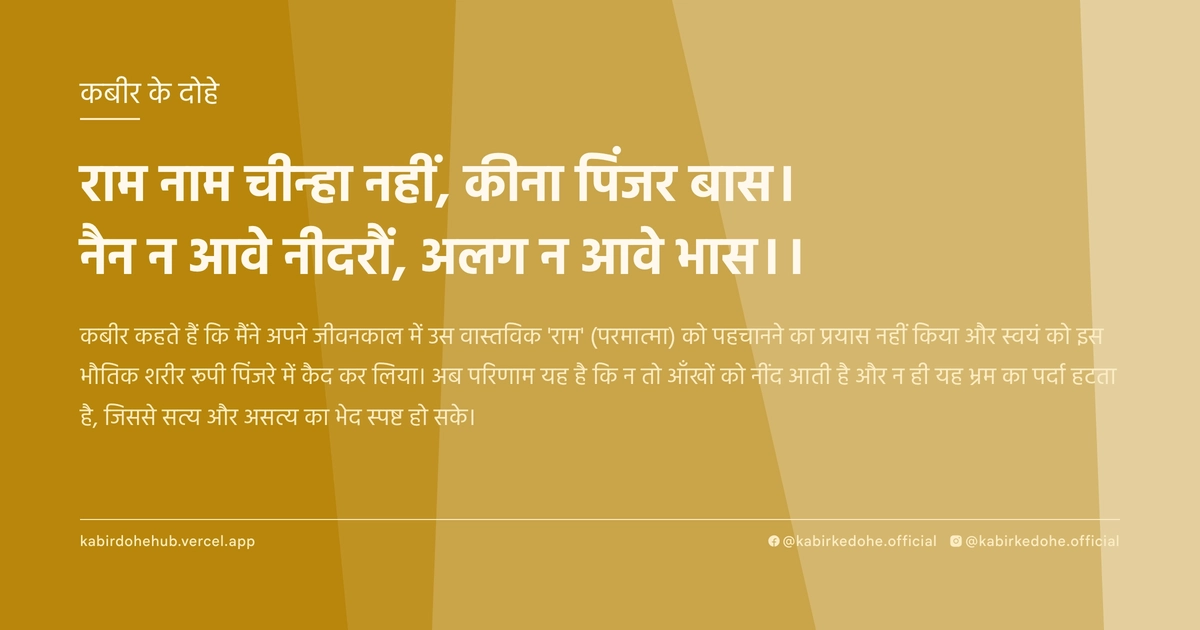
राम नाम चीन्हा नहीं, कीना पिंजर बास।
नैन न आवे नीदरौं, अलग न आवे भास।।
Ram naam cheenha nahi, keena pinjar baas. Nain na aave needaraun, alag na aave bhaas.
इस पृष्ठ पर इस कबीर दोहे का अर्थ (meaning), हिंदी व्याख्या और अंग्रेज़ी अनुवाद, दार्शनिक विश्लेषण और व्यावहारिक जीवन सीख दी गई है। यह दोहा मृतुक्यता (Mortality) विषय से जुड़ा है — Kabir doha meaning and explanation in Hindi and English.
अर्थ (Meaning):
कबीर कहते हैं कि मैंने अपने जीवनकाल में उस वास्तविक 'राम' (परमात्मा) को पहचानने का प्रयास नहीं किया और स्वयं को इस भौतिक शरीर रूपी पिंजरे में कैद कर लिया। अब परिणाम यह है कि न तो आँखों को नींद आती है और न ही यह भ्रम का पर्दा हटता है, जिससे सत्य और असत्य का भेद स्पष्ट हो सके।
Kabir laments that he failed to recognize the true essence of the Divine Name (Ram) during his conscious life, effectively imprisoning his soul within the cage of the physical body. Consequently, he now suffers from a state of spiritual restlessness where neither peace (sleep) nor clarity (discernment) can be attained, as the illusion of duality persists.
व्याख्या (Interpretation):
यह दोहा आत्मा की विस्मृति और उसके भौतिक बंधन के बीच के संघर्ष को दर्शाता है। 'राम' यहाँ किसी व्यक्ति विशेष नहीं, बल्कि उस निर्गुण ब्रह्म का प्रतीक है जो सर्वव्यापी है। 'पिंजर बास' शरीर को एक कारागार के रूप में चित्रित करता है, जहाँ अहंकार ने आत्मा को कैद कर रखा है। जब मनुष्य अपनी वास्तविक प्रकृति को भूलकर बाहरी दुनिया के मायाजाल में उलझ जाता है, तो वह एक ऐसी मानसिक स्थिति में पहुँच जाता है जहाँ शांति लुप्त हो जाती है। यहाँ 'नीदरौं' (नींद) का अभाव केवल शारीरिक अनिद्रा नहीं, बल्कि आध्यात्मिक अशांति है। 'भास' का न हटना यह दर्शाता है कि अज्ञानता का पर्दा इतना गहरा है कि जीव स्वयं को ब्रह्म से अलग मानता रहता है। यह अद्वैत वेदांत के उस सिद्धांत को पुष्ट करता है जहाँ अविद्या (ignorance) ही बंधन का मूल कारण है। अंततः, यह दोहा एक चेतावनी है कि आत्म-साक्षात्कार में विलंब केवल पश्चाताप और अंतहीन मानसिक द्वंद्व को जन्म देता है।
This couplet illustrates the struggle between the soul's forgetfulness and its material bondage. 'Ram' here does not refer to a mythological deity but symbolizes the Nirgun Brahman—the formless, omnipresent Absolute. The 'pinjar baas' (cage residence) portrays the physical body as a prison where the ego has incarcerated the spirit. When a human forgets their true nature and becomes entangled in the Maya of the external world, they enter a state of profound spiritual restlessness. The absence of 'nidauron' (sleep) is not merely physical insomnia but a metaphysical agitation. The inability to clear the 'bhaas' (illusion/glimmer) signifies that the veil of ignorance is so thick that the individual continues to perceive a separation between the Atman and Brahman. This aligns with Advaita Vedanta, where Avidya (ignorance) is identified as the root cause of bondage. Ultimately, the verse serves as a poignant warning that delaying self-realization leads only to regret and eternal psychological conflict.
दार्शनिक विश्लेषण (Philosophical Analysis):
कबीर का यह दर्शन उस युग की उपज है जहाँ धर्म कर्मकांडों और बाहरी आडंबरों में सिमट गया था। उन्होंने 'राम नाम' को किसी मंत्र के जाप के रूप में नहीं, बल्कि एक चेतना के रूप में परिभाषित किया। उनके लिए, परमात्मा को 'चीन्हना' (पहचानना) ही वास्तविक भक्ति है, न कि मंदिर या मस्जिद जाना। यह दृष्टिकोण सूफी मत के 'फना' (अहंकार का विनाश) और अद्वैत वेदांत के 'अहं ब्रह्मास्मि' के करीब है।
यहाँ शरीर को पिंजरा कहना भौतिकवाद पर एक कड़ा प्रहार है। कबीर तर्क देते हैं कि जब तक हम शरीर को ही अपनी पहचान मानते हैं, हम सत्य से दूर रहते हैं। यह 'देह-अभिमान' ही वह दीवार है जो आत्मा को उसके स्रोत से अलग करती है। ritualism (कर्मकांड) केवल इस पिंजरे की सलाखों को सजाने जैसा है, उन्हें तोड़ने जैसा नहीं।
मनोवैज्ञानिक स्तर पर, यह दोहा 'अस्तित्वगत संकट' (existential crisis) की बात करता है। जब व्यक्ति जीवन के अंतिम पड़ाव पर पहुँचकर महसूस करता है कि उसने केवल बाहरी दुनिया की दौड़ में समय व्यतीत किया, तो एक गहरा शून्य पैदा होता है। यह शून्य ही वह 'अनिद्रा' है जिसका कबीर उल्लेख कर रहे हैं—एक ऐसी बेचैनी जो तब तक नहीं जाती जब तक कि अहंकार का विसर्जन न हो जाए।
कबीर का विरोध केवल जाति या धर्म से नहीं था, बल्कि उस हर विचार से था जो मनुष्य को उसकी आंतरिक दिव्यता से अलग करता था। वे सिखाते हैं कि मुक्ति किसी बाहरी शक्ति द्वारा नहीं, बल्कि स्वयं के भीतर छिपे उस 'राम' को पहचानने से मिलती है। यह मार्ग कठिन है क्योंकि इसमें अपनी पूरी पहचान (identity) को मिटाना पड़ता है।
अंततः, यह विश्लेषण हमें बताता है कि आध्यात्मिक जागृति केवल ज्ञान का संचय नहीं है, बल्कि एक अनुभव है। जब तक 'भास' (माया का भ्रम) बना रहता है, तब तक ज्ञान केवल बौद्धिक व्यायाम है। वास्तविक रूपांतरण तब होता है जब साधक यह अनुभव करता है कि वह और वह अनंत सत्ता एक ही हैं, और इस बोध के साथ ही पिंजरे के द्वार खुल जाते हैं।
Kabir's philosophy emerged from an era where religion had shrunk into mere rituals and outward displays. He defines 'Ram Naam' not as the repetitive chanting of a mantra, but as a state of consciousness. For him, 'recognizing' (cheenha) the Divine is the only true devotion, far surpassing the act of visiting temples or mosques. This perspective closely mirrors the Sufi concept of 'Fana' (annihilation of the ego) and the Advaita Vedanta realization of 'Aham Brahmasmi' (I am Brahman).
Describing the body as a 'cage' is a severe critique of materialism. Kabir argues that as long as we identify ourselves with the physical form, we remain estranged from the Truth. This 'body-ego' is the very wall that separates the soul from its source. Ritualism, in this context, is merely like decorating the bars of the cage rather than breaking them.
On a psychological level, this verse addresses an 'existential crisis.' When an individual reaches the twilight of their life and realizes they spent their energy chasing external shadows, a profound void emerges. This void is the 'insomnia' Kabir mentions—a restlessness that persists until the ego is completely dissolved.
Kabir's opposition was not merely against caste or organized religion, but against any notion that separates a human from their inner divinity. He teaches that liberation is not granted by an external power but is achieved by recognizing the 'Ram' hidden within. This path is arduous because it requires the total erasure of one's constructed identity.
Ultimately, this analysis reveals that spiritual awakening is not the accumulation of knowledge, but a direct experience. As long as the 'bhaas' (the illusion of Maya) persists, knowledge remains a mere intellectual exercise. True transformation occurs only when the seeker experiences the non-duality of the self and the infinite, and with this realization, the doors of the cage swing open.
मूल संदेश (Core Message):
- बाहरी पहचान का मोह ही आत्मा का असली पिंजरा है।
- परमात्मा कोई बाहरी लक्ष्य नहीं, बल्कि आंतरिक पहचान है।
- अहंकार का विसर्जन ही वास्तविक मानसिक शांति का द्वार है।
- माया का भ्रम केवल आत्म-साक्षात्कार के माध्यम से मिट सकता है।
- जीवन का अंतिम सत्य शरीर से परे चेतना का विस्तार है।
- Attachment to external identity is the soul's true cage.
- The Divine is not an external goal, but an internal recognition.
- The dissolution of ego is the only gateway to real peace.
- The illusion of Maya can only be erased through self-realization.
- The ultimate truth of life is the expansion of consciousness beyond the body.
व्यावहारिक उदाहरण (Practical Example):
एक समय की बात है, बनारस के घाटों पर माधव नाम का एक वृद्ध बुनकर रहता था। माधव अपनी कला में निपुण था और शहर के सबसे महंगे रेशमी वस्त्र बुनता था। उसने अपना पूरा जीवन केवल धन संचय और अपनी सामाजिक प्रतिष्ठा को बढ़ाने में लगा दिया। वह मानता था कि उसकी श्रेष्ठता उसके द्वारा बुने गए कपड़ों की बारीकी में है।
माधव का एक बेटा था, जो एक साधारण साधु के साथ रहता था और उसे केवल आंतरिक शांति की बात करता था। माधव अपने बेटे का मज़ाक उड़ाता और कहता, 'शांति से पेट नहीं भरता, देख मेरी कुशलता, दुनिया मेरे आगे झुकती है।' माधव ने अपनी पूरी ऊर्जा बाहरी दुनिया को प्रभावित करने में लगा दी।
जैसे-जैसे वर्ष बीते, माधव की आँखों की रोशनी कम होने लगी और उसके हाथ कांपने लगे। एक दिन उसने महसूस किया कि जिस प्रतिष्ठा को उसने जीवन भर संजोया, वह केवल एक भ्रम था। उसके पास धन तो बहुत था, लेकिन उसके मन में एक अजीब सी बेचैनी थी। वह रात भर सो नहीं पाता था। उसे ऐसा लगता था जैसे वह एक सुनहरे पिंजरे में कैद है, जहाँ सुख की सारी वस्तुएं तो हैं, पर सुख स्वयं गायब है।
एक रात, जब वह अपनी पुरानी यादों के मलबे में खोया हुआ था, उसे अपने बेटे की एक बात याद आई: 'पिताजी, आप धागों को तो जोड़ रहे हैं, लेकिन अपनी आत्मा को उस परमात्मा से जोड़ना भूल गए।' माधव ने अचानक महसूस किया कि उसने जीवन भर केवल 'कपड़े' बुने, लेकिन अपनी 'चेतना' को कभी नहीं बुना।
उसने अपनी आँखें बंद कीं और पहली बार बाहरी दुनिया के शोर को शांत करने की कोशिश की। उसने महसूस किया कि वह जिसे 'मैं' कह रहा था—एक सफल बुनकर, एक अमीर आदमी—वह केवल एक मुखौटा था। वह मुखौटा ही उसका पिंजरा था।
उसने अपनी सारी संपत्ति का त्याग नहीं किया, लेकिन उसके प्रति अपना मोह छोड़ दिया। उसने उन गरीब बुनकरों की मदद करना शुरू किया जिन्हें वह कभी तुच्छ समझता था। उसने पाया कि जब वह दूसरों के दुख को अपना समझने लगा, तो उसके मन की बेचैनी कम होने लगी।
धीरे-धीरे, उसकी अनिद्रा समाप्त हो गई। अब उसे नींद इसलिए नहीं आती थी कि वह कुछ खो चुका था, बल्कि इसलिए आती थी क्योंकि उसने अंततः स्वयं को पा लिया था। उसने महसूस किया कि 'राम' कोई दूर बैठा देवता नहीं, बल्कि वह करुणा थी जो उसके भीतर जाग रही थी।
माधव की कहानी हमें सिखाती है कि सफलता का पिंजरा अक्सर सबसे अधिक आरामदायक होता है, लेकिन वह फिर भी एक पिंजरा ही है। जब तक हम अपनी पहचान बाहरी उपलब्धियों से जोड़ते हैं, हम उस आंतरिक प्रकाश से दूर रहते हैं जो हमें वास्तविक शांति देता है।
Once, on the ghats of Varanasi, lived an elderly weaver named Madhav. Madhav was a master of his craft, weaving the most expensive silk garments in the city. He spent his entire life accumulating wealth and enhancing his social prestige, believing his superiority lay in the intricacy of his weaves.
Madhav had a son who lived with a simple monk and spoke only of inner peace. Madhav would mock his son, saying, 'Peace does not fill the stomach; look at my skill, the world bows before me.' Madhav poured all his energy into influencing the external world.
As the years passed, Madhav's eyesight dimmed and his hands began to tremble. One day, he realized that the prestige he had cherished was merely an illusion. He had immense wealth, yet a strange restlessness gnawed at his mind. He could no longer sleep at night; he felt as if he were trapped in a golden cage, where every luxury existed, but peace itself was absent.
One night, lost in the debris of his memories, he recalled his son's words: 'Father, you are joining threads, but you have forgotten to join your soul with the Divine.' Madhav suddenly realized that he had spent his life weaving 'cloth,' but had never woven his 'consciousness.'
He closed his eyes and, for the first time, attempted to silence the noise of the external world. He realized that the 'I' he had claimed—a successful weaver, a rich man—was merely a mask. That mask was his cage.
He did not renounce all his possessions, but he relinquished his attachment to them. He began helping poor weavers whom he had once considered insignificant. He discovered that as he began to perceive the suffering of others as his own, the restlessness in his mind subsided.
Gradually, his insomnia vanished. He no longer stayed awake out of a sense of loss, but because he had finally found himself. He realized that 'Ram' was not a distant deity, but the compassion awakening within him.
Madhav's story teaches us that the cage of success is often the most comfortable, yet it remains a cage. As long as we tie our identity to external achievements, we remain distant from the inner light that grants true peace.
अभ्यास मार्गदर्शन (Practice Guidance):
- प्रतिदिन 20 मिनट मौन अभ्यास करें, जहाँ आप केवल अपनी श्वास को देखें और यह विचार करें कि 'मैं यह शरीर नहीं हूँ'।
- एक डायरी लिखें जिसमें आप अपनी उन पहचानों (जैसे पद, प्रतिष्ठा, रिश्ते) की सूची बनाएं जिनसे आप अत्यधिक चिपके हुए हैं, और विश्लेषण करें कि यदि ये छिन जाएं, तो आप कौन रहेंगे।
- व्यवहार परिवर्तन: दिन में कम से कम एक बार किसी ऐसे व्यक्ति की निस्वार्थ मदद करें जिससे आपका कोई निजी स्वार्थ न हो, ताकि अहंकार का पिंजरा ढीला हो सके।
- निदान चेकलिस्ट: क्या आप छोटी बातों पर विचलित होते हैं? क्या आपको रात में विचारों का अंतहीन चक्र परेशान करता है? क्या आप अपनी खुशी दूसरों की प्रशंसा पर निर्भर मानते हैं? यदि हाँ, तो आप अभी भी 'पिंजर बास' में हैं।
- Practice 20 minutes of daily silence, observing your breath and contemplating the thought: 'I am not this body.'
- Maintain a journal listing the identities (such as rank, prestige, relationships) you are most attached to, and analyze who you would be if these were stripped away.
- Behavioral Change: At least once a day, help someone selflessly without any personal motive, allowing the cage of the ego to loosen.
- Diagnostic Checklist: Do you get agitated by trivial matters? Does an endless cycle of thoughts disturb your sleep? Do you believe your happiness depends on the praise of others? If yes, you are still residing in the 'pinjar baas'.
चिंतन प्रश्न (Reflection Questions):
- यदि आपकी सारी सामाजिक उपलब्धियां और डिजिटल पहचान (Social Media Image) आज मिटा दी जाएं, तो आपके भीतर क्या बचेगा?
- वह कौन सा 'सत्य' है जिसे आप जानते हैं, लेकिन अपने अहंकार के कारण स्वीकार नहीं कर पा रहे हैं?
- आपकी अनिद्रा या मानसिक तनाव का मूल कारण बाहरी परिस्थितियां हैं या आपके भीतर का अनसुलझा द्वंद्व?
- क्या आप वास्तव में स्वतंत्र हैं, या आपने केवल अपने पिंजरे की सलाखों को अपनी पसंद के अनुसार सजाया है?
- आपकी प्रार्थनाएं परमात्मा को पाने के लिए हैं, या अपनी इच्छाओं को पूरा करवाने के लिए?
- If all your social achievements and digital identities were erased today, what would remain within you?
- What is the 'truth' that you know, but cannot accept because of your ego?
- Is the root cause of your insomnia or mental stress external circumstances, or an unresolved internal conflict?
- Are you truly free, or have you merely decorated the bars of your cage according to your preference?
- Are your prayers intended to reach the Divine, or merely to fulfill your own desires?