
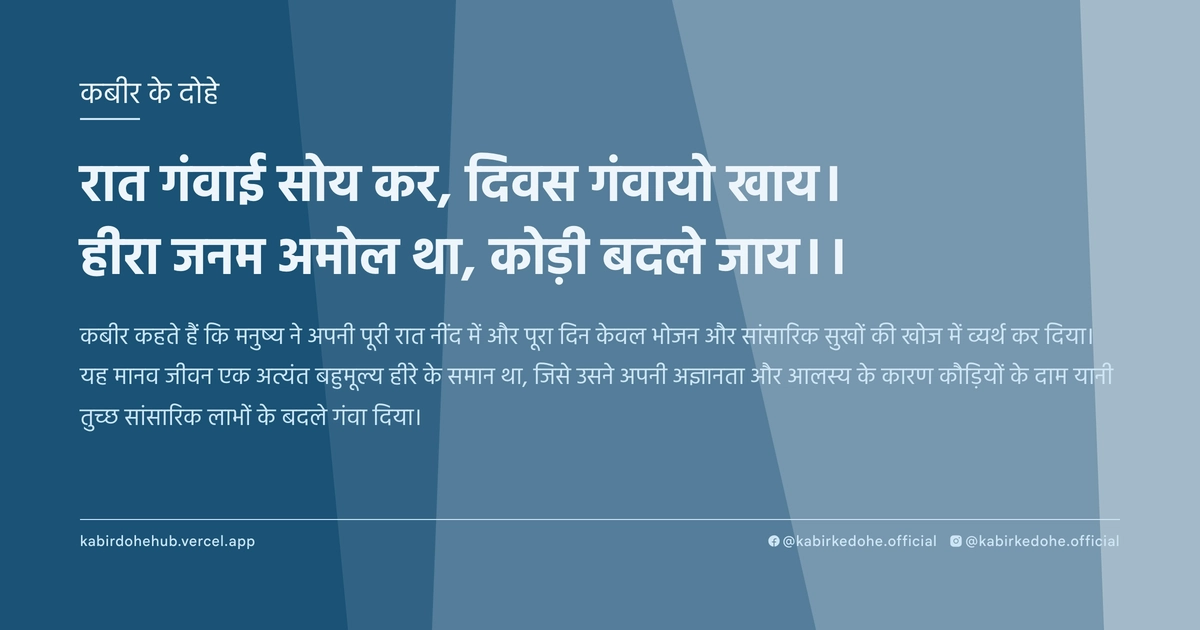
रात गंवाई सोय कर, दिवस गंवायो खाय।
हीरा जनम अमोल था, कोड़ी बदले जाय।।
Raat ganwayi soy kar, divas ganwayo khaay. Heera janam amol tha, kodi badle jaaye.
इस पृष्ठ पर इस कबीर दोहे का अर्थ (meaning), हिंदी व्याख्या और अंग्रेज़ी अनुवाद, दार्शनिक विश्लेषण और व्यावहारिक जीवन सीख दी गई है। यह दोहा समय का महत्व (The Value of Time) विषय से जुड़ा है — Kabir doha meaning and explanation in Hindi and English.
अर्थ (Meaning):
कबीर कहते हैं कि मनुष्य ने अपनी पूरी रात नींद में और पूरा दिन केवल भोजन और सांसारिक सुखों की खोज में व्यर्थ कर दिया। यह मानव जीवन एक अत्यंत बहुमूल्य हीरे के समान था, जिसे उसने अपनी अज्ञानता और आलस्य के कारण कौड़ियों के दाम यानी तुच्छ सांसारिक लाभों के बदले गंवा दिया।
Kabir laments that a human spends their nights in slumber and their days in the pursuit of food and sensory gratification. This human birth, which is as priceless as a rare diamond, is squandered and traded for mere shells—symbolizing the trivial, fleeting pleasures of the material world.
व्याख्या (Interpretation):
शाब्दिक रूप से, यह दोहा समय की बर्बादी की चेतावनी देता है। लेकिन आध्यात्मिक स्तर पर, 'रात' अज्ञानता और 'दिन' माया के प्रभाव का प्रतीक है। 'सोना' यहाँ केवल शारीरिक निद्रा नहीं, बल्कि चेतना की वह स्थिति है जहाँ आत्मा अपने वास्तविक स्वरूप को भूलकर अहंकार के स्वप्न में खोई रहती है। 'खाना' इंद्रिय सुखों की तृप्ति है जो कभी समाप्त नहीं होती। यह दोहा निर्गुण भक्ति के उस सिद्धांत को रेखांकित करता है जहाँ मानव शरीर को मोक्ष का एकमात्र द्वार माना गया है। यहाँ 'हीरा' आत्मा की उस शुद्धता और क्षमता का संकेत है जो ब्रह्म से मिलन कर सकती है, जबकि 'कौड़ी' उस भ्रम को दर्शाती है जिसे हम सफलता या संपत्ति समझते हैं। यह विरोधाभास है कि जिस जीव के पास अनंत की शक्ति है, वह क्षणभंगुर वस्तुओं के पीछे भाग रहा है।
Literally, this couplet warns against the waste of time. Spiritually, however, 'night' symbolizes the darkness of ignorance and 'day' represents the distractions of Maya. 'Sleeping' is not merely physical slumber but a state of spiritual unconsciousness where the Atman forgets its divine nature, lost in the dream of the ego. 'Eating' signifies the endless pursuit of sensory gratification. This verse underscores the Nirgun Bhakti principle that human birth is the sole gateway to liberation. The 'diamond' represents the intrinsic purity and potential of the soul to merge with the Formless Brahman, while 'shells' symbolize the trivial illusions we mistake for success or wealth. It highlights the central paradox: a being possessing the capacity for infinity is preoccupied with the infinitesimal.
दार्शनिक विश्लेषण (Philosophical Analysis):
कबीर का यह दोहा 15वीं शताब्दी के सामाजिक और धार्मिक परिवेश की प्रतिक्रिया है, जहाँ लोग कर्मकांडों और बाहरी आडंबरों में उलझे थे। कबीर ने ritualism का पुरजोर विरोध किया क्योंकि उनका मानना था कि मोक्ष मंदिर या मस्जिद जाने से नहीं, बल्कि आंतरिक जागृति से मिलता है। यह विचार अद्वैत वेदांत के करीब है, जहाँ यह माना जाता है कि जीव और ब्रह्म एक ही हैं, लेकिन अज्ञान (Avidya) के कारण हम स्वयं को अलग और सीमित महसूस करते हैं।
सूफीवाद के प्रभाव में, कबीर 'इश्क' या प्रेम के माध्यम से अहंकार के विसर्जन की बात करते हैं। यहाँ 'हीरा' वह रूह है जो अपने मूल स्रोत (परमात्मा) से बिछड़ गई है। जब मनुष्य केवल शारीरिक आवश्यकताओं (भोजन, नींद) को ही जीवन का उद्देश्य मान लेता है, तो वह अपनी आध्यात्मिक क्षमता का गला घोंट देता है। यह मनोवैज्ञानिक रूप से 'कम्फर्ट ज़ोन' का वह जाल है जो मनुष्य को सत्य की खोज से रोकता है।
कबीर जाति और वर्ग के भेदों को नकारते हुए यह संदेश देते हैं कि आध्यात्मिक अवसर सबके लिए समान है, चाहे वह एक बुनकर हो या राजा। उनके लिए 'समय' केवल घड़ी की सुइयां नहीं, बल्कि 'अवसर' है। यदि इस जन्म में जागृति नहीं हुई, तो आत्मा पुनः जन्म और मृत्यु के चक्र (Samsara) में फंस जाएगी।
यह विश्लेषण स्पष्ट करता है कि कबीर केवल आलस्य की निंदा नहीं कर रहे, बल्कि उस 'मानसिक जड़ता' पर प्रहार कर रहे हैं जो हमें यह विश्वास दिलाती है कि जीवन केवल जीवित रहने (survival) के लिए है, न कि जागने (awakening) के लिए। वे हमें याद दिलाते हैं कि अस्तित्व का मूल्य उसकी भौतिक उपयोगिता में नहीं, बल्कि उसकी चेतना के विस्तार में है।
अंततः, यह दोहा अहंकार के विनाश (Fana) की मांग करता है। जब तक 'मैं' (अहंकार) भोजन और नींद की इच्छाओं से संचालित है, तब तक वह 'हीरा' धूल में दबा रहेगा। वास्तविक उपलब्धि वह है जब मनुष्य अपनी तुच्छ इच्छाओं को त्यागकर उस अनंत आनंद की खोज करे जो जन्म और मृत्यु से परे है।
Kabir’s verse is a reaction to the 15th-century socio-religious landscape, where people were entangled in rigid rituals and outward displays of piety. Kabir vehemently rejected ritualism, asserting that liberation comes not from visiting temples or mosques, but through internal awakening. This aligns with Advaita Vedanta, which posits that the individual soul (Atman) and the ultimate reality (Brahman) are one, separated only by the veil of ignorance (Avidya).
Influenced by Sufism, Kabir speaks of the annihilation of the ego through divine love. Here, the 'diamond' is the soul that has been estranged from its source. When a human limits their life's purpose to biological needs—food and sleep—they stifle their spiritual potential. Psychologically, this represents the 'comfort zone' trap that prevents a seeker from venturing into the arduous path of truth.
By disregarding caste and class, Kabir suggests that spiritual opportunity is universal, whether one is a weaver or a king. For him, 'time' is not merely chronological but an 'opportunity.' Failure to awaken in this lifetime results in the soul remaining trapped in the cycle of birth and death (Samsara).
This analysis clarifies that Kabir is not merely condemning laziness, but attacking the 'mental inertia' that convinces us that life is about survival rather than awakening. He reminds us that the value of existence lies not in material utility, but in the expansion of consciousness.
Ultimately, the verse demands the dissolution of the ego (Fana). As long as the 'I' is driven by the desires for food and sleep, the 'diamond' remains buried in dust. True achievement is when one transcends trivial desires to seek the infinite bliss that exists beyond the duality of birth and death.
मूल संदेश (Core Message):
- अज्ञानता की नींद सबसे गहरी और खतरनाक होती है।
- इंद्रिय सुख क्षणभंगुर हैं, जबकि आत्म-ज्ञान शाश्वत है।
- मानव जीवन एक दुर्लभ अवसर है, इसे व्यर्थ न करें।
- बाहरी कर्मकांडों से ऊपर उठकर आंतरिक सत्य को खोजें।
- अहंकार का विसर्जन ही वास्तविक जागृति का मार्ग है।
- समय का सही उपयोग केवल आध्यात्मिक उन्नति में है।
- The sleep of ignorance is the deepest and most dangerous state.
- Sensory pleasures are fleeting; self-realization is eternal.
- Human birth is a rare opportunity; do not squander it.
- Rise above external rituals to discover the internal truth.
- The dissolution of the ego is the only path to true awakening.
- The only meaningful use of time is spiritual evolution.
व्यावहारिक उदाहरण (Practical Example):
वाराणसी के घाटों पर रहने वाले एक वृद्ध विधवा, जानकी का वर्णन करें। जानकी ने अपना पूरा जीवन केवल परंपराओं के पालन, सुबह-शाम की पूजा और दूसरों की सेवा में बिता दिया। वह मानती थी कि यही उसका धर्म है।
वह हर दिन वही दिनचर्या दोहराती: स्नान, प्रार्थना, और सादा भोजन। उसके जीवन में कोई शिकायत नहीं थी, लेकिन एक गहरी शून्यता थी। वह केवल 'जीवित' थी, 'जागृत' नहीं।
एक दिन उसकी मुलाकात एक घुमंतू साधु से हुई जिसने उसे कबीर का यह दोहा सुनाया। साधु ने उससे पूछा, "माँ, क्या आप केवल इस शरीर को पालने के लिए पैदा हुई थीं, या अपनी आत्मा को जानने के लिए?"
जानकी को पहले तो यह बात अजीब लगी। उसने सोचा कि वह तो धर्म का पालन कर रही है। लेकिन साधु ने समझाया कि केवल रस्मों को निभाना 'सोने' के समान है—एक ऐसी नींद जहाँ आप क्रियाएँ तो कर रहे हैं, पर चेतना शून्य है।
जानकी ने महसूस किया कि उसने अपनी पूरी उम्र केवल 'सुरक्षित' रहने और 'भोजन' की चिंता में बिता दी। उसने कभी यह नहीं पूछा कि "मैं कौन हूँ?"
उसने अपनी दिनचर्या बदली। अब वह केवल पूजा नहीं करती थी, बल्कि मौन रहकर अपने भीतर के शोर को सुनने लगी। उसने बाहरी दिखावे की पूजा को छोड़कर आंतरिक आत्म-निरीक्षण शुरू किया।
उसने पाया कि जब वह दूसरों की सेवा बिना किसी 'पुण्य' की लालसा के करती थी, तब वह वास्तव में जाग रही थी। उसने अपनी पहचान एक 'विधवा' से बदलकर एक 'साधक' की बना ली।
उसका जीवन अब कौड़ियों के मोल नहीं था। उसने समझ लिया कि जीवन की सार्थकता इस बात में नहीं है कि हमने कितने साल जिए, बल्कि इस बात में है कि हम कितने 'जागृत' क्षण जिए।
अंततः, जानकी के चेहरे पर एक ऐसी शांति आई जो किसी भी धार्मिक अनुष्ठान से नहीं मिली थी। वह अब उस 'हीरे' को पहचान चुकी थी जो उसके भीतर हमेशा से था।
उसका परिवर्तन यह दर्शाता है कि जागृति किसी भी उम्र में संभव है, बशर्ते हम अपनी मानसिक निद्रा को त्यागने का साहस करें।
Consider Janaki, an elderly widow living on the ghats of Varanasi. Janaki had spent her entire life adhering to strict traditions, performing morning and evening prayers, and serving others. She believed this was her sole religious duty.
Her days were a repetitive loop: bathing in the Ganges, praying, and eating simple meals. There were no complaints in her life, yet there was a profound emptiness. She was merely 'surviving,' not 'awakening.'
One day, she met a wandering monk who recited this specific Doha by Kabir. The monk asked her, "Mother, were you born merely to sustain this body, or to realize the soul within?"
Initially, Janaki found the question strange. She felt she was already pious. But the monk explained that performing rituals mechanically is like 'sleeping'—a state where one acts, but consciousness remains dormant.
Janaki realized she had spent her entire existence seeking 'security' and worrying about 'sustenance.' She had never once asked the fundamental question: "Who am I?"
She altered her routine. Instead of mindless prayer, she began practicing silence, listening to the internal noise of her own mind. She shifted from outward piety to inward self-inquiry.
She discovered that when she served others without the desire for 'spiritual merit' (punya), she was truly awake. She transformed her identity from a 'widow' to a 'seeker.'
Her life was no longer traded for shells. She understood that the meaning of life is not measured by the number of years lived, but by the number of 'awakened' moments experienced.
Eventually, a peace settled upon Janaki's face that no religious ceremony could have provided. She had finally recognized the 'diamond' that had always resided within her.
Her transformation demonstrates that awakening is possible at any age, provided one has the courage to abandon their mental slumber.
अभ्यास मार्गदर्शन (Practice Guidance):
- प्रतिदिन 20 मिनट का 'साक्षी भाव' ध्यान करें, जहाँ आप अपने विचारों को बिना किसी निर्णय के केवल देखें, जैसे आप किसी और को देख रहे हों।
- एक 'जागरूकता डायरी' लिखें: दिन भर में उन क्षणों को नोट करें जब आप 'ऑटो-पायलट' मोड में थे (जैसे बिना सोचे खाना या सोशल मीडिया स्क्रॉल करना)।
- व्यवहार परिवर्तन: दिन में कम से कम एक बार किसी ऐसे कार्य को पूरी सचेतता के साथ करें जिसे आप आमतौर पर यांत्रिक रूप से करते हैं (जैसे बर्तन धोना या चलना)।
- नैदानिक चेकलिस्ट (Diagnostic Checklist): क्या मैं केवल अपनी शारीरिक जरूरतों के लिए जी रहा हूँ? क्या मेरा दिन केवल जिम्मेदारियों के बोझ तले दबा है? क्या मैं अपनी आंतरिक शांति के लिए समय निकालता हूँ? यदि उत्तर 'हाँ' है, तो आप अभी भी 'सो' रहे हैं।
- Practice 20 minutes of 'Witness Consciousness' (Sakshi Bhava) daily, observing your thoughts without judgment, as if you are watching a stranger.
- Maintain an 'Awareness Journal': Note the moments throughout the day when you were on 'auto-pilot' (e.g., mindless eating or scrolling through social media).
- Behavioral Shift: Perform at least one routine task with absolute mindfulness—something you usually do mechanically, such as washing dishes or walking.
- Diagnostic Checklist: Am I living solely for my physical needs? Is my day consumed entirely by obligations? Do I carve out time for internal silence? If the answers are 'Yes,' you are still 'asleep' in the spiritual sense.
चिंतन प्रश्न (Reflection Questions):
- मेरे जीवन का कौन सा हिस्सा 'सोने' (अचेतन अवस्था) जैसा है, जहाँ मैं केवल आदत के वश में हूँ?
- मैं अपनी पहचान को किन 'कौड़ियों' (पद, प्रतिष्ठा, संपत्ति) से जोड़कर बैठा हूँ, जो वास्तव में तुच्छ हैं?
- यदि आज मेरा जीवन समाप्त हो जाए, तो क्या मैं कह पाऊँगा कि मैंने अपने 'हीरे' को पहचाना?
- मेरी डिजिटल पहचान (सोशल मीडिया) मेरे वास्तविक आत्म का कितना हिस्सा ढक लेती है?
- क्या मेरी धार्मिक मान्यताएँ मुझे वास्तव में जगा रही हैं, या वे मुझे एक नए प्रकार की नींद में सुला रही हैं?
- मैं किस डर से अपनी आंतरिक शांति की खोज को टालता रहता हूँ?
- Which part of my life resembles 'sleep' (unconsciousness), where I am merely acting out of habit?
- To which 'shells' (status, reputation, wealth) have I attached my identity, knowing they are ultimately trivial?
- If my life ended today, could I honestly say that I recognized the 'diamond' within?
- How much of my digital persona masks the reality of my authentic self?
- Are my religious beliefs truly awakening me, or are they lulling me into a different kind of slumber?
- What fear prevents me from pursuing the discovery of my internal silence?