
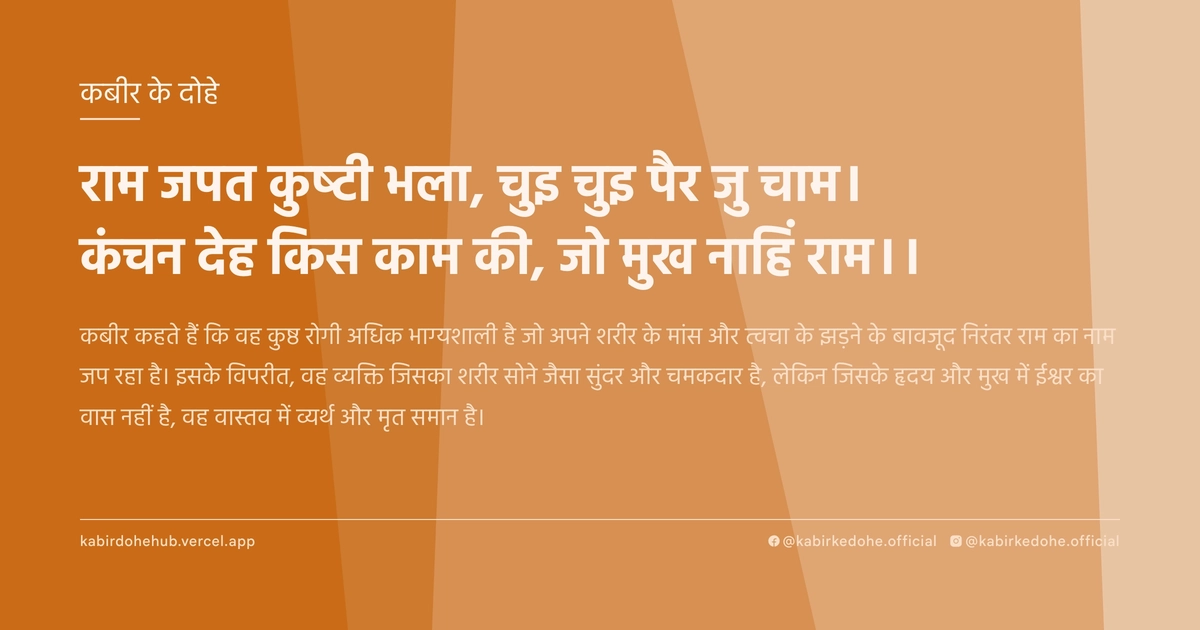
राम जपत कुष्टी भला, चुइ चुइ पैर जु चाम।
कंचन देह किस काम की, जो मुख नाहिं राम।।
Raam japat kushti bhala, chui chui pair ju chaam. Kanchan deh kis kaam ki, jo mukh naahin raam.
इस पृष्ठ पर इस कबीर दोहे का अर्थ (meaning), हिंदी व्याख्या और अंग्रेज़ी अनुवाद, दार्शनिक विश्लेषण और व्यावहारिक जीवन सीख दी गई है। यह दोहा भक्ति (Bhakti) विषय से जुड़ा है — Kabir doha meaning and explanation in Hindi and English.
अर्थ (Meaning):
कबीर कहते हैं कि वह कुष्ठ रोगी अधिक भाग्यशाली है जो अपने शरीर के मांस और त्वचा के झड़ने के बावजूद निरंतर राम का नाम जप रहा है। इसके विपरीत, वह व्यक्ति जिसका शरीर सोने जैसा सुंदर और चमकदार है, लेकिन जिसके हृदय और मुख में ईश्वर का वास नहीं है, वह वास्तव में व्यर्थ और मृत समान है।
Kabir asserts that a leper who constantly chants the name of the Divine, even as their skin and flesh peel away, is far superior to a person possessing a golden, flawless physique whose heart and lips are devoid of the Divine presence. True beauty lies in spiritual alignment, not physical perfection.
व्याख्या (Interpretation):
यह दोहा शारीरिक सुंदरता और आध्यात्मिक चेतना के बीच के विरोधाभास को दर्शाता है। 'कुष्टी' (कुष्ठ रोग) यहाँ केवल एक बीमारी नहीं, बल्कि सांसारिक क्षय और कष्ट का प्रतीक है। कबीर का तर्क है कि जब शरीर नश्वर है और अंततः नष्ट होना ही है, तो उसकी बाहरी चमक का कोई मूल्य नहीं है। 'कंचन देह' माया के उस भ्रम को दर्शाता है जहाँ मनुष्य बाहरी रूप और सामाजिक प्रतिष्ठा को ही सत्य मान लेता है। यहाँ 'राम' किसी व्यक्ति विशेष नहीं, बल्कि निर्गुण ब्रह्म या उस सार्वभौमिक चेतना का प्रतीक हैं जो आत्मा के भीतर निवास करती है। यह अद्वैत वेदांत के उस सिद्धांत की पुष्टि करता है कि आत्मा शरीर से स्वतंत्र है और उसकी पूर्णता केवल परमात्मा के साथ एकाकार होने में है।
This couplet highlights the stark paradox between physical aesthetics and spiritual consciousness. The 'leper' serves as a metaphor for the decay of the material world and the fragility of the human vessel. Kabir argues that since the body is transient and destined for dissolution, its external luster is an illusion. The 'golden body' represents the veil of Maya, where humanity mistakes outward appearance and social status for ultimate truth. Here, 'Ram' does not refer to a mythological figure but to the Nirgun Brahman—the formless, universal consciousness. This aligns with Advaita Vedanta, suggesting that the Atman (soul) is distinct from the physical shell, and true liberation is found only in the realization of non-duality between the self and the Divine.
दार्शनिक विश्लेषण (Philosophical Analysis):
कबीर का यह दृष्टिकोण उनके युग के कट्टरपंथी कर्मकांडों और जातिगत श्रेष्ठता के विरुद्ध एक सशक्त प्रहार है। उस समय समाज में शारीरिक शुद्धता और कुल की शुद्धता को मोक्ष का आधार माना जाता था। कबीर इस धारणा को उलट देते हुए कहते हैं कि ईश्वर की दृष्टि में कोई 'अशुद्ध' नहीं है; केवल अहंकार ही अशुद्ध है। वे सूफी मत के 'इश्क' और भक्ति मार्ग के 'समर्पण' को जोड़ते हैं, जहाँ प्रेमी अपने अस्तित्व को मिटाकर ही प्रियतम (ईश्वर) को पाता है।
दार्शनिक स्तर पर, यह दोहा 'देह-अध्यास' (शरीर के साथ तादात्म्य) के त्याग की बात करता है। जब मनुष्य स्वयं को शरीर मानता है, तो वह बीमारी, बुढ़ापे और मृत्यु से डरता है। लेकिन जब वह स्वयं को शुद्ध चेतना मानता है, तो शारीरिक पीड़ा केवल एक बाहरी घटना बन जाती है। यह मनोवैज्ञानिक रूपांतरण है जहाँ व्यक्ति बाहरी दुनिया के मूल्यांकन से मुक्त होकर आंतरिक शांति की ओर बढ़ता है।
कबीर यहाँ यह स्पष्ट करते हैं कि भक्ति किसी विशेष वर्ग या 'सुंदर' लोगों के लिए आरक्षित नहीं है। एक कुष्ठ रोगी, जिसे समाज ने बहिष्कृत कर दिया है, वह अपनी पीड़ा को साधना में बदलकर ईश्वर के सबसे करीब हो सकता है। यह सामाजिक न्याय का एक आध्यात्मिक आयाम है, जो बताता है कि सच्ची दिव्यता हाशिए पर पड़े लोगों के भीतर छिपी हो सकती है।
अद्वैत वेदांत के संदर्भ में, यह दोहा 'माया' के पर्दों को हटाने का आह्वान है। सोने जैसा शरीर एक स्वर्ण पिंजरा है यदि उसमें चेतना जागृत नहीं है। वास्तविक 'कंचन' (सोना) वह है जो तपस्या और प्रेम की अग्नि में तपकर कुंदन बन चुका हो। बाहरी चमक केवल दृष्टि को भ्रमित करती है, जबकि आंतरिक प्रकाश आत्मा को मुक्त करता है।
अंततः, कबीर हमें यह सिखाते हैं कि भक्ति का अर्थ केवल माला जपना नहीं, बल्कि अपनी पहचान को भौतिकता से ऊपर उठाना है। जब अहंकार (Ego) का विसर्जन होता है, तब व्यक्ति यह महसूस करता है कि वह न तो शरीर है और न ही उसकी बीमारियाँ, बल्कि वह वह अनंत राम है जो हर कण में व्याप्त है।
Kabir’s perspective serves as a powerful critique of the rigid ritualism and caste-based hierarchies of his era. During his time, physical purity and lineage were erroneously viewed as prerequisites for salvation. Kabir subverts this notion, asserting that in the eyes of the Divine, no one is 'impure'; only the ego is an impurity. He bridges the Sufi concept of 'Ishq' (divine love) with the Bhakti path of total surrender, where the seeker finds the Beloved only after the annihilation of the self.
Philosophically, this doha addresses the cessation of 'Deha-adhyasa' (identification with the body). When a human identifies solely with the physical form, they become prisoners of fear—fear of disease, aging, and death. However, by identifying as pure consciousness, physical suffering becomes a mere external event. This is a psychological transformation where the individual transcends societal validation to achieve internal stillness.
Kabir emphasizes that devotion is not the exclusive preserve of a privileged or 'beautiful' class. A leper, cast out by society, can transform their agony into a spiritual discipline, becoming closer to the Divine than a healthy priest. This introduces a spiritual dimension to social justice, suggesting that true divinity often resides within those marginalized by the world.
In the context of Advaita Vedanta, this couplet is a call to pierce the veil of Maya. A golden body is merely a gilded cage if consciousness remains dormant. The true 'Kanchan' (gold) is the soul that has been purified in the fire of longing and austerity. External brilliance only distracts the eye, while internal illumination liberates the spirit.
Ultimately, Kabir teaches that Bhakti is not the mechanical repetition of a name, but the elevation of identity above materiality. When the ego is dissolved, the seeker realizes they are neither the body nor its ailments, but the infinite Ram that permeates every atom of existence.
मूल संदेश (Core Message):
- बाहरी सुंदरता एक क्षणभंगुर भ्रम है जो आत्मा को ढक लेता है।
- शारीरिक कष्ट आध्यात्मिक जागृति के लिए एक उत्प्रेरक बन सकते हैं।
- सच्ची दिव्यता अहंकार के विसर्जन और आंतरिक समर्पण में निहित है।
- शरीर का क्षय अनिवार्य है, लेकिन चेतना का विस्तार शाश्वत है।
- ईश्वर की खोज बाहरी चमक में नहीं, बल्कि आंतरिक मौन में है।
- External beauty is a fleeting illusion that veils the true soul.
- Physical suffering can serve as a catalyst for spiritual awakening.
- True divinity resides in the dissolution of ego and inner surrender.
- The decay of the body is inevitable, but the expansion of consciousness is eternal.
- The Divine is found not in outward luster, but in the depths of inner silence.
व्यावहारिक उदाहरण (Practical Example):
वाराणसी के एक पुराने घाट पर माधव नाम का एक वृद्ध व्यक्ति रहता था। माधव एक समय में शहर का सबसे प्रतिष्ठित स्वर्णकार था, जिसके पास धन और सुंदरता दोनों थी। लेकिन समय के साथ उसे एक गंभीर त्वचा रोग हो गया, जिससे उसका चेहरा और हाथ क्षत-विक्षत हो गए। समाज, जिसने कभी उसकी प्रशंसा की थी, अब उसे 'अछूत' मानकर दूर हटने लगा।
माधव पहले गहरे अवसाद में चला गया। वह अपनी पुरानी तस्वीरों को देखता और रोता कि उसकी 'कंचन देह' अब मिट्टी बन चुकी है। उसे लगता था कि ईश्वर ने उसके साथ अन्याय किया है। वह घंटों मंदिर की सीढ़ियों पर बैठकर अपनी किस्मत को कोसता था।
एक दिन उसने देखा कि एक अन्य रोगी, जो उससे भी अधिक बीमार था, बड़े आनंद से राम नाम का जाप कर रहा था। उस व्यक्ति के चेहरे पर एक ऐसी शांति थी जो माधव ने अपने सबसे समृद्ध दिनों में भी महसूस नहीं की थी। माधव ने उससे पूछा, 'तुम्हें दर्द नहीं होता? लोग तुम्हें घृणा से देखते हैं, फिर भी तुम कैसे मुस्कुरा रहे हो?'
उस रोगी ने धीमे से कहा, 'भाई, यह शरीर तो एक पुराना कपड़ा है जो फट रहा है। मैं इस कपड़े से प्यार नहीं करता, मैं उस पहनने वाले से प्यार करता हूँ जो कभी नहीं मरता। जब मैं राम को याद करता हूँ, तो मुझे यह शरीर महसूस ही नहीं होता।'
यह बात माधव के हृदय में बिजली की तरह कौंधी। उसे समझ आया कि वह अब तक केवल अपने शरीर की सुंदरता से प्रेम कर रहा था, न कि उस चेतना से जो उसके भीतर थी। उसने महसूस किया कि उसकी बीमारी वास्तव में एक वरदान थी, क्योंकि इसने उसे उसकी बाहरी पहचान के अहंकार से मुक्त कर दिया था।
माधव ने अपनी शेष जीवन की दिशा बदल ली। उसने अपनी बची हुई संपत्ति उन लोगों की सेवा में लगा दी जो लाइलाज बीमारियों से जूझ रहे थे। अब वह खुद को 'बीमार' नहीं, बल्कि 'मुक्त' महसूस करता था।
वह अब घाट पर बैठकर लोगों को यह नहीं बताता था कि वह कितना अमीर था, बल्कि यह बताता था कि वह अब कितना शांत है। उसकी बाहरी त्वचा भले ही झुर्रीदार और बदरंग थी, लेकिन उसकी आँखों में एक दिव्य चमक आ गई थी।
एक दिन एक युवक उसके पास आया और पूछा, 'बाबा, आप इतने कष्ट में होकर भी इतने खुश कैसे हैं?' माधव ने मुस्कुराकर जवाब दिया, 'बेटा, जब तक मैं सोने की मूर्ति बनने की कोशिश कर रहा था, मैं दुखी था। जिस दिन मैं मिट्टी बन गया, मैं ईश्वर से मिल गया।'
माधव का जीवन अब एक जीवित उदाहरण बन गया था कि आंतरिक सौंदर्य बाहरी विनाश के बीच भी खिल सकता है। उसने यह जान लिया था कि शरीर का क्षय आत्मा का विस्तार है।
On an ancient ghat in Varanasi lived an elderly man named Madhav. In his youth, Madhav was the city's most prestigious goldsmith, possessing both immense wealth and striking physical beauty. However, as years passed, he contracted a severe skin disease that left his face and hands scarred and distorted.
The society that once showered him with praise now viewed him as an outcast, recoiling in disgust. Madhav spiraled into a deep depression. He would gaze at his old portraits and weep, lamenting that his 'golden body' had turned to dust. He felt betrayed by the Divine, spending hours on temple steps cursing his fate.
One day, he noticed another patient, even more afflicted than himself, chanting the name of Ram with profound joy. There was a serenity on that man's face that Madhav had never experienced even during his most prosperous days. Madhav asked, 'Do you not feel the pain? People look at you with hatred, yet how do you smile?'
The patient replied softly, 'Brother, this body is but an old garment that is tearing. I do not love the garment; I love the Wearer who never dies. When I remember the Divine, I cease to feel this body.'
These words struck Madhav like a bolt of lightning. He realized he had been in love with his physical shell, not the consciousness residing within. He understood that his illness was actually a blessing, as it had stripped away the ego associated with his outward identity.
Madhav redirected the course of his remaining life. He dedicated his remaining wealth to serving those suffering from incurable diseases. He no longer perceived himself as 'sick,' but as 'liberated.'
He stopped telling people about his past riches and instead spoke of his present peace. Though his skin remained wrinkled and discolored, a divine radiance emerged in his eyes.
One day, a young man approached him and asked, 'Baba, how are you so happy despite such suffering?' Madhav smiled and replied, 'Son, as long as I tried to be a golden statue, I was miserable. The day I became dust, I found God.'
Madhav's life became a living testament that inner beauty can bloom amidst external decay. He had learned that the dissolution of the body is the expansion of the soul.
अभ्यास मार्गदर्शन (Practice Guidance):
- दैनिक चिंतन: प्रतिदिन 15 मिनट मौन बैठें और विचार करें कि आपकी कौन सी पहचान (नाम, पद, रूप) केवल एक 'मुखौटा' है।
- आत्म-पूछताछ जर्नल: लिखें कि जब आप शारीरिक या मानसिक रूप से अस्वस्थ होते हैं, तो आपका अहंकार कैसे प्रतिक्रिया करता है। क्या आप शरीर को ही 'स्वयं' मान लेते हैं?
- व्यवहार परिवर्तन: दिन में कम से कम एक बार किसी ऐसे व्यक्ति की निस्वार्थ सेवा करें जिसे समाज 'अवांछनीय' या 'असुंदर' मानता है, ताकि आप बाहरी रूप के पार देख सकें।
- निदान चेकलिस्ट: यदि आप अपनी सुंदरता या स्वास्थ्य के खोने पर अत्यधिक भयभीत हैं, तो आप अभी भी 'कंचन देह' के भ्रम में हैं। यदि आप पीड़ा में भी आंतरिक स्थिरता महसूस करते हैं, तो आप जागृति की ओर हैं।
- Daily Contemplation: Spend 15 minutes in silence daily, questioning which parts of your identity (name, status, appearance) are merely 'masks'.
- Self-Inquiry Journaling: Document how your ego reacts during physical or mental illness. Do you mistakenly identify yourself solely with the suffering body?
- Behavioral Shift: Once a day, perform a selfless act of service for someone marginalized or deemed 'unattractive' by society to train your vision to see beyond the physical form.
- Diagnostic Checklist: If you feel intense fear at the thought of losing beauty or health, you are still trapped in the illusion of the 'golden body'. If you maintain internal stability amidst pain, you are moving toward awakening.
चिंतन प्रश्न (Reflection Questions):
- यदि कल आपकी सारी शारीरिक सुंदरता और सामाजिक प्रतिष्ठा छीन ली जाए, तो आपके पास 'स्वयं' के रूप में क्या बचेगा?
- आप दूसरों को उनकी बाहरी दिखावट के आधार पर कितना आंकते हैं, और यह आपके अपने आंतरिक अंधकार को कैसे दर्शाता है?
- क्या आपका 'डिजिटल व्यक्तित्व' (सोशल मीडिया प्रोफाइल) आपकी 'कंचन देह' का आधुनिक संस्करण है जिसे आप बचाने की कोशिश कर रहे हैं?
- आप अपनी बीमारियों और कमजोरियों को बोझ मानते हैं या उन्हें अपनी आत्मा को शुद्ध करने के अवसर के रूप में देखते हैं?
- क्या आप वास्तव में उस सत्य को स्वीकार कर सकते हैं कि एक 'अछूत' या 'रोगी' आपसे अधिक आध्यात्मिक रूप से उन्नत हो सकता है?
- If all your physical beauty and social prestige were stripped away tomorrow, what would remain of 'you'?
- To what extent do you judge others by their appearance, and how does this reflect your own internal shadows?
- Is your 'digital persona' (social media profile) a modern version of the 'golden body' that you are desperately trying to preserve?
- Do you view your illnesses and weaknesses as burdens, or as opportunities to purify your soul?
- Can you truly accept the possibility that a marginalized or suffering person may be spiritually far more advanced than you?