
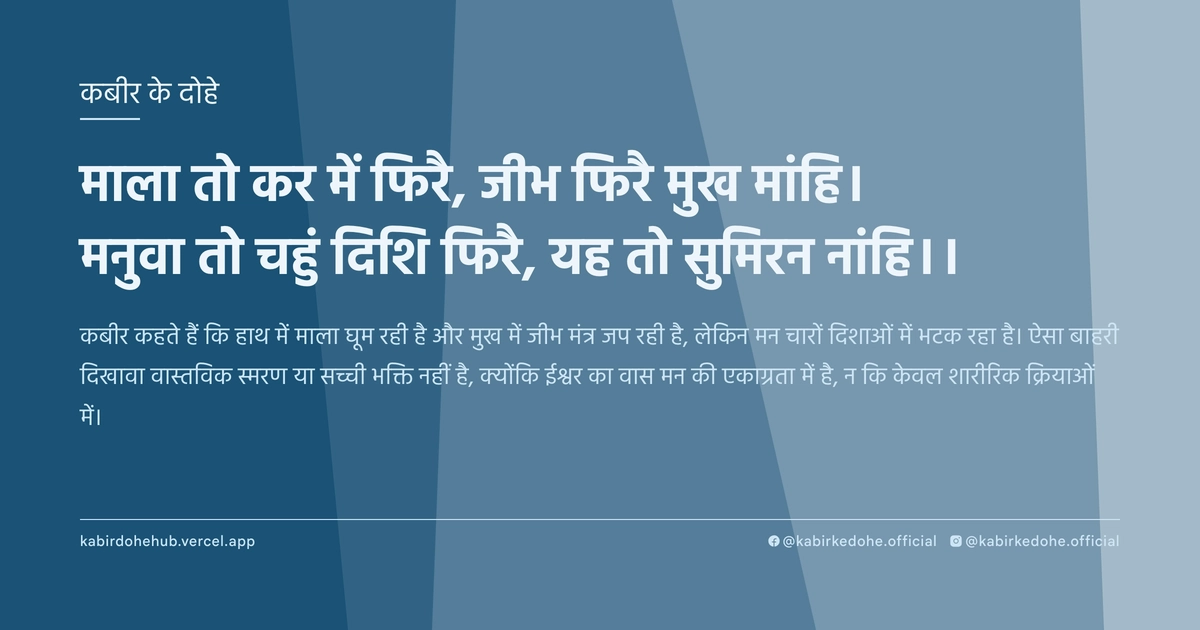
माला तो कर में फिरै, जीभ फिरै मुख मांहि।
मनुवा तो चहुं दिशि फिरै, यह तो सुमिरन नांहि।।
Maala to kar me phirai, jeebh phirai mukh maanhi. Manuva to chahun dishi phirai, yeh to sumiran naanhi.
इस पृष्ठ पर इस कबीर दोहे का अर्थ (meaning), हिंदी व्याख्या और अंग्रेज़ी अनुवाद, दार्शनिक विश्लेषण और व्यावहारिक जीवन सीख दी गई है। यह दोहा धार्मिक पाखंड (Religious Hypocrisy) विषय से जुड़ा है — Kabir doha meaning and explanation in Hindi and English.
अर्थ (Meaning):
कबीर कहते हैं कि हाथ में माला घूम रही है और मुख में जीभ मंत्र जप रही है, लेकिन मन चारों दिशाओं में भटक रहा है। ऐसा बाहरी दिखावा वास्तविक स्मरण या सच्ची भक्ति नहीं है, क्योंकि ईश्वर का वास मन की एकाग्रता में है, न कि केवल शारीरिक क्रियाओं में।
Kabir observes that while the prayer beads rotate in the hand and the tongue chants mantras within the mouth, the mind continues to wander in all four directions. He asserts that such external ritualism is not true remembrance (Sumiran), as genuine devotion requires the alignment of the mind, not just the body.
व्याख्या (Interpretation):
यह दोहा बाहरी कर्मकांड और आंतरिक जागरूकता के बीच के गहरे विरोधाभास को दर्शाता है। कबीर यहाँ 'माला' और 'जीभ' को केवल भौतिक उपकरणों के रूप में देखते हैं, जबकि 'मनुवा' (मन) वास्तविक केंद्र है। जब तक मन विखरे हुए विचारों और सांसारिक इच्छाओं में उलझा है, तब तक जप केवल एक यांत्रिक व्यायाम है। यह निर्गुण भक्ति का सार है, जहाँ ईश्वर को किसी बाहरी वस्तु में नहीं, बल्कि अपनी चेतना के भीतर खोजा जाता है। माया यहाँ उस भ्रम का नाम है जो हमें विश्वास दिलाता है कि शारीरिक अनुष्ठान हमें मोक्ष दिला देंगे। अंततः, यह आत्मा और परमात्मा के मिलन के लिए मानसिक एकाग्रता की अनिवार्यता पर जोर देता है।
This couplet highlights the profound paradox between external ritualism and internal awareness. Kabir views the 'beads' and the 'tongue' as mere physical instruments, while the 'Manuwa' (mind) is the actual locus of spiritual practice. As long as the mind is fragmented across worldly desires and distractions, chanting remains a mechanical exercise. This aligns with Nirgun Bhakti, where the Divine is sought not through external objects but within one's own consciousness. 'Maya' here represents the illusion that physical rituals alone can grant liberation. Ultimately, it emphasizes that the non-duality of Atman and Brahman can only be realized when the wandering mind is anchored in the present moment.
दार्शनिक विश्लेषण (Philosophical Analysis):
कबीर का यह प्रहार उनके युग के उस धार्मिक पाखंड पर है जहाँ धर्म केवल प्रदर्शन बन गया था। वे कर्मकांडीय धर्म (Ritualism) का पुरजोर विरोध करते हैं क्योंकि यह व्यक्ति को उसकी आंतरिक शून्यता से दूर ले जाता है। उनके विचार अद्वैत वेदांत के करीब हैं, जहाँ 'अहं ब्रह्मास्मि' का अनुभव केवल तब संभव है जब मन की चंचलता समाप्त हो जाए।
सूफी मत के 'नफ्स' (अहंकार) के विचार की तरह, कबीर भी मानते हैं कि जब तक अहंकार और इच्छाएं मन को नियंत्रित करती हैं, तब तक प्रार्थना केवल शोर है। वे सिखाते हैं कि सच्ची भक्ति 'सहज' होनी चाहिए, न कि थोपी हुई।
यहाँ 'सुमिरन' का अर्थ केवल नाम जपना नहीं, बल्कि 'होश' में रहना है। जब मन चारों दिशाओं में भटकता है, तो वह वास्तव में अपनी पहचान को बाहरी दुनिया के टुकड़ों में खोज रहा होता है, जो कि अज्ञानता की पराकाष्ठा है।
कबीर का दर्शन मनोवैज्ञानिक रूपांतरण पर केंद्रित है। वे चाहते हैं कि साधक अपनी बाहरी पहचान (जाति, धर्म, पद) को त्यागकर उस आंतरिक मौन को प्राप्त करे जहाँ द्वैत समाप्त हो जाता है।
अतः, यह दोहा हमें चेतावनी देता है कि हम धर्म के 'रूप' में इतने न खो जाएं कि हम उसके 'तत्व' को ही भूल जाएं। वास्तविक आध्यात्मिकता वह है जो हमें बाहरी दिखावे से मुक्त कर आंतरिक सत्य से मिलाए।
Kabir’s critique is a direct assault on the religious hypocrisy of his era, where faith had devolved into mere performance. He vehemently opposes ritualism because it distracts the individual from their own internal void. His perspective aligns closely with Advaita Vedanta, where the realization of 'Aham Brahmasmi' (I am Brahman) is only possible once the restlessness of the mind is extinguished.
Similar to the Sufi concept of 'Nafs' (the ego/lower self), Kabir believes that as long as ego and desires govern the mind, prayer is nothing more than noise. He advocates for 'Sahaja'—a natural, spontaneous state of being—rather than forced piety.
In this context, 'Sumiran' (remembrance) is not the repetitive chanting of a name, but the state of absolute mindfulness. When the mind wanders in four directions, it is searching for its identity in the fragments of the external world, which is the pinnacle of ignorance.
Kabir's philosophy focuses on psychological transformation. He urges the seeker to shed external identities—caste, religion, or status—to attain that internal silence where duality ceases to exist.
Therefore, this doha warns us not to become so enamored with the 'form' of religion that we forget its 'essence.' True spirituality is that which liberates us from external pretension and connects us to the inner truth.
मूल संदेश (Core Message):
- बाहरी दिखावा आध्यात्मिक प्रगति का प्रमाण नहीं है।
- सच्ची भक्ति मन की एकाग्रता और जागरूकता में निहित है।
- यांत्रिक प्रार्थना केवल अहंकार को पुष्ट करती है, उसे मिटाती नहीं।
- ईश्वर को खोजने के लिए पहले मन के भटकाव को रोकना होगा।
- मौन और सजगता ही वास्तविक सुमिरन का मार्ग हैं।
- External display is not evidence of spiritual progress.
- True devotion resides in the concentration and awareness of the mind.
- Mechanical prayer reinforces the ego rather than dissolving it.
- To find the Divine, one must first still the wandering mind.
- Silence and mindfulness are the only true paths to remembrance.
व्यावहारिक उदाहरण (Practical Example):
वाराणसी के एक पुराने घाट पर माधव नाम का एक वृद्ध नाविक रहता था। वह प्रतिदिन घंटों मंदिर में बैठकर माला फेरता और जोर-जोर से मंत्र पढ़ता था, ताकि लोग उसे एक महान भक्त समझें।
माधव को अपनी इस 'भक्ति' पर बहुत गर्व था। वह अक्सर अन्य नाविकों को उपदेश देता कि बिना माला के ईश्वर नहीं मिलते।
एक दिन, उसकी नाव में एक शांत साधु सवार हुए। साधु ने देखा कि माधव मंत्र तो पढ़ रहा है, लेकिन उसकी आँखें लगातार घाट पर खड़े अमीर व्यापारियों को देख रही थीं और वह मन ही मन सोच रहा था कि आज उसे कितनी कमाई होगी।
साधु ने मुस्कुराते हुए पूछा, 'माधव, तुम किसे याद कर रहे हो? उस ईश्वर को जो तुम्हारे भीतर है, या उन सिक्कों को जो तुम्हारी जेब में आने वाले हैं?'
माधव सकपका गया। उसने कहा, 'महाराज, मैं तो माला फेर रहा हूँ, यही तो सुमिरन है।'
साधु ने उत्तर दिया, 'तुम्हारी उंगलियां तो काम कर रही हैं, लेकिन तुम्हारा मन बाजार में घूम रहा है। यह सुमिरन नहीं, केवल एक खेल है। क्या तुम कभी चुप रहकर अपने भीतर की हलचल को देख सकते हो?'
यह बात माधव के हृदय में गहरे तक उतर गई। उसे एहसास हुआ कि उसने वर्षों तक केवल एक अभिनय किया था।
अगले कुछ महीनों तक माधव ने माला छोड़ दी। उसने केवल यह अभ्यास किया कि जब भी वह नाव चलाए, वह अपनी सांसों और पानी की लहरों के प्रति पूरी तरह सजग रहे।
धीरे-धीरे, उसका अहंकार मिटने लगा। अब वह दूसरों को उपदेश नहीं देता था, बल्कि उनकी सेवा में आनंद खोजने लगा।
उसकी शांति अब बाहरी प्रदर्शन में नहीं, बल्कि उसके कर्मों की ईमानदारी और मन की स्थिरता में झलकती थी।
On an ancient ghat in Varanasi lived an elderly boatman named Madhav. Every day, he spent hours in the temple rotating his prayer beads and chanting mantras loudly, ensuring everyone perceived him as a great devotee.
Madhav took immense pride in this 'devotion.' He often lectured other boatmen, claiming that God cannot be reached without the use of a mala.
One day, a serene monk boarded his boat. The monk noticed that while Madhav was chanting, his eyes were constantly scanning the wealthy merchants on the ghat, and his mind was calculating how much profit he would make that day.
The monk asked with a smile, 'Madhav, whom are you remembering? The Divine within you, or the coins that are about to enter your pocket?'
Madhav was taken aback. He replied, 'Maharaj, I am rotating the beads; is this not Sumiran?'
The monk replied, 'Your fingers are working, but your mind is wandering in the marketplace. This is not remembrance; it is merely a game. Can you ever be silent and observe the turbulence within?'
These words pierced Madhav's heart. He realized that for years, he had been performing a mere act.
For the next few months, Madhav abandoned the beads. He practiced one thing: whenever he rowed the boat, he remained fully aware of his breath and the ripples of the water.
Gradually, his ego began to dissolve. He stopped lecturing others and instead found joy in serving them.
His peace was no longer reflected in external displays, but in the honesty of his actions and the stillness of his mind.
अभ्यास मार्गदर्शन (Practice Guidance):
- प्रतिदिन 15 मिनट 'साक्षी भाव' का अभ्यास करें: अपनी सांसों को देखें और जब मन भटके, तो बिना निर्णय के उसे वापस लाएं।
- जर्नलिंग प्रॉम्प्ट: 'आज मैंने कितनी बार बाहरी क्रियाओं का उपयोग अपनी आंतरिक शून्यता को छिपाने के लिए किया?'
- व्यवहार परिवर्तन: किसी भी धार्मिक या सामाजिक कार्य को करते समय, अपना ध्यान 'परिणाम' या 'दिखावे' से हटाकर 'प्रक्रिया' पर केंद्रित करें।
- डायग्नोस्टिक चेकलिस्ट: क्या मैं प्रार्थना के दौरान दूसरों की राय के बारे में सोच रहा हूँ? क्या मेरी शांति केवल शांत वातावरण में रहती है? क्या मैं कर्मकांडों को अपनी आध्यात्मिक प्रगति का पैमाना मान रहा हूँ?
- Practice 'Witness Consciousness' for 15 minutes daily: Observe your breath and, whenever the mind wanders, gently bring it back without judgment.
- Journaling Prompt: 'How many times today did I use external rituals to mask my internal emptiness?'
- Behavioral Shift: While performing any religious or social act, shift your focus from the 'result' or 'appearance' to the 'process' itself.
- Diagnostic Checklist: Am I thinking about others' opinions during prayer? Does my peace exist only in quiet environments? Am I using rituals as the primary metric of my spiritual progress?
चिंतन प्रश्न (Reflection Questions):
- मेरे जीवन में ऐसे कौन से 'मानसिक माला' हैं जिन्हें मैं केवल दुनिया को दिखाने के लिए फेर रहा हूँ?
- जब मैं शांत बैठता हूँ, तो मेरा मन किन 'चार दिशाओं' में सबसे अधिक भागता है और क्यों?
- क्या मेरी धार्मिक पहचान मेरे वास्तविक आध्यात्मिक विकास में बाधा बन रही है?
- मैं अपनी छवि (Image) को बचाने के लिए कितनी ऊर्जा खर्च करता हूँ, और उस ऊर्जा का कितना हिस्सा आत्म-साक्षात्कार में जाता है?
- यदि मुझसे मेरे सभी बाहरी प्रतीक (कपड़े, माला, पद) छीन लिए जाएं, तो क्या मेरे पास कोई आंतरिक सत्य बचेगा?
- What are the 'mental beads' in my life that I rotate merely for the world to see?
- When I sit in silence, in which 'four directions' does my mind run most frequently, and why?
- Is my religious identity becoming an obstacle to my actual spiritual growth?
- How much energy do I spend protecting my public image, and how much of that energy goes toward self-realization?
- If all my external symbols—clothes, beads, titles—were stripped away, would any internal truth remain?