
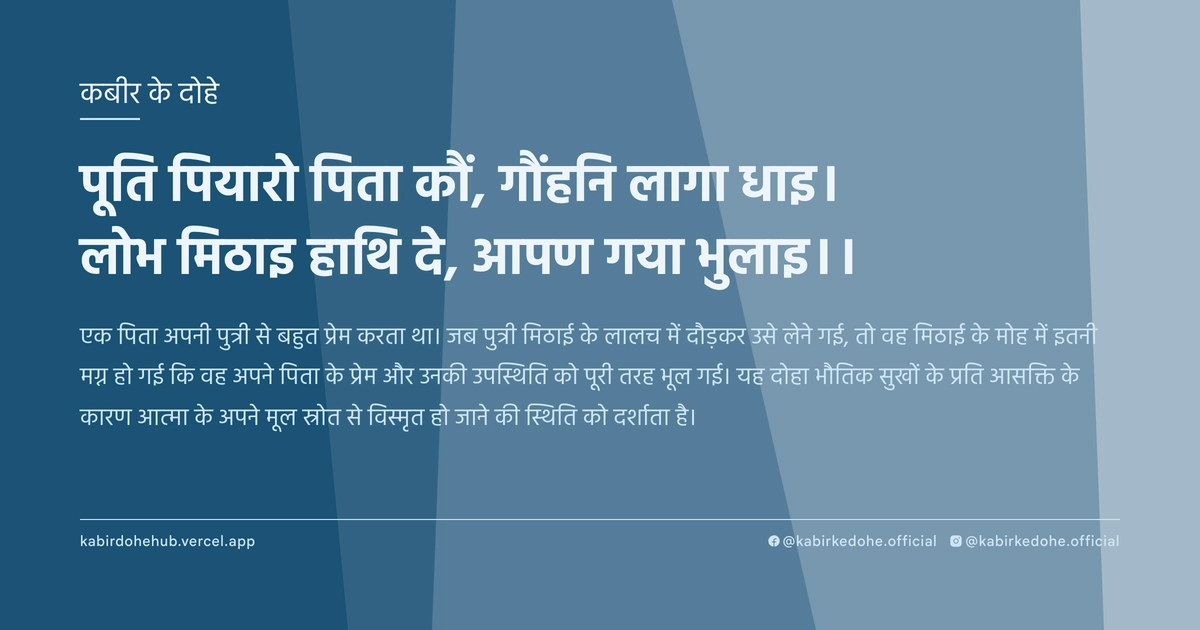
पूति पियारो पिता कौं, गौंहनि लागा धाइ।
लोभ मिठाइ हाथि दे, आपण गया भुलाइ।।
Putti piyaro pita kau, gaunhani laga dhai. Lobh mithai haathi de, apan gaya bhulai.
इस पृष्ठ पर इस कबीर दोहे का अर्थ (meaning), हिंदी व्याख्या और अंग्रेज़ी अनुवाद, दार्शनिक विश्लेषण और व्यावहारिक जीवन सीख दी गई है। यह दोहा लोभ (Greed) विषय से जुड़ा है — Kabir doha meaning and explanation in Hindi and English.
अर्थ (Meaning):
एक पिता अपनी पुत्री से बहुत प्रेम करता था। जब पुत्री मिठाई के लालच में दौड़कर उसे लेने गई, तो वह मिठाई के मोह में इतनी मग्न हो गई कि वह अपने पिता के प्रेम और उनकी उपस्थिति को पूरी तरह भूल गई। यह दोहा भौतिक सुखों के प्रति आसक्ति के कारण आत्मा के अपने मूल स्रोत से विस्मृत हो जाने की स्थिति को दर्शाता है।
A father cherished his daughter deeply. However, lured by the promise of sweets, the daughter rushed forward in greed. In her intense craving for the sugary treat, she completely forgot the father who provided it and the love he held for her. This verse serves as a metaphor for the soul's tendency to forget its divine origin while chasing transient worldly pleasures.
व्याख्या (Interpretation):
यहाँ 'पुत्री' जीवात्मा का प्रतीक है और 'पिता' परमात्मा या निर्गुण ब्रह्म का। मिठाई 'माया' या सांसारिक सुखों का प्रतिनिधित्व करती है। जब आत्मा भौतिक जगत के प्रलोभनों में फंसती है, तो वह अपनी वास्तविक पहचान और ईश्वर के साथ अपने संबंध को भूल जाती है। यह अद्वैत वेदांत के उस सिद्धांत को दर्शाता है जहाँ अविद्या (अज्ञान) के कारण हम स्वयं को ब्रह्म से अलग मानते हैं। मिठाई का स्वाद क्षणिक है, लेकिन पिता का प्रेम शाश्वत है; फिर भी जीव क्षणिक सुख के लिए शाश्वत आनंद का त्याग कर देता है। यह विरोधाभास मानव अस्तित्व की सबसे बड़ी त्रासदी है—सत्य के पास होकर भी असत्य की खोज करना।
In this mystical allegory, the 'daughter' symbolizes the individual soul (Jivatma) and the 'father' represents the Formless Divine (Nirgun Brahman). The 'sweets' are a metaphor for Maya—the illusory attractions of the material world. When the soul becomes entangled in sensory gratifications, it suffers from spiritual amnesia, forgetting its primordial connection to the Source. This aligns with Advaita Vedanta's concept of Avidya, where ignorance veils the non-dual reality of Atman and Brahman. The paradox lies in the soul choosing the ephemeral sweetness of worldly desire over the eternal bliss of divine union. The daughter's rush toward the sweet represents the frantic nature of egoic desire, which blinds the seeker to the presence of the Beloved who is already standing right there.
दार्शनिक विश्लेषण (Philosophical Analysis):
कबीर का यह दोहा मध्यकालीन भारत के उस सामाजिक और धार्मिक परिवेश में रचा गया था जहाँ कर्मकांड और बाहरी आडंबर चरम पर थे। कबीर ने यहाँ किसी मंदिर या मस्जिद की बात नहीं की, बल्कि मानवीय मनोविज्ञान के माध्यम से आध्यात्मिक सत्य को समझाया है। वे यह तर्क देते हैं कि ईश्वर को पाने के लिए किसी कठिन यात्रा की आवश्यकता नहीं है, क्योंकि वह 'पिता' की तरह हमारे साथ है; समस्या हमारी 'मिठाई' यानी इच्छाओं की है।
यह विश्लेषण सूफी मत के 'इश्क-ए-हकीकी' (दिव्य प्रेम) और 'इश्क-ए-मजाजी' (सांसारिक प्रेम) के बीच के संघर्ष को दर्शाता है। जब तक मनुष्य सांसारिक आकर्षणों में डूबा रहता है, वह उस परम सत्य को नहीं देख पाता जो उसके भीतर और बाहर व्याप्त है। कबीर यहाँ अहंकार के विलीनीकरण की बात करते हैं। मिठाई का लोभ वास्तव में 'अहं' (Ego) का विस्तार है, जो हमें यह विश्वास दिलाता है कि बाहरी वस्तुएं हमें पूर्णता प्रदान करेंगी।
अद्वैत वेदांत के परिप्रेक्ष्य में, यह दोहा 'माया' के प्रभाव की व्याख्या करता है। माया वह शक्ति है जो सत्य को छुपाती है और असत्य को सत्य के रूप में प्रस्तुत करती है। जैसे पुत्री को मिठाई सबसे महत्वपूर्ण लगी, वैसे ही साधक को संसार की उपलब्धियां सबसे महत्वपूर्ण लगती हैं। कबीर इस भ्रम को तोड़ने का आह्वान करते हैं।
वे ritualism (कर्मकांड) का विरोध करते हुए यह स्पष्ट करते हैं कि मोक्ष किसी बाहरी क्रिया से नहीं, बल्कि आंतरिक जागरूकता से मिलता है। यदि मन मिठाई (इच्छाओं) में अटका है, तो हज़ारों तीर्थ यात्राएं भी व्यर्थ हैं। वास्तविक भक्ति वह है जहाँ साधक अपनी इच्छाओं का त्याग कर उस स्रोत की ओर लौटे जो उसे बिना शर्त प्रेम करता है।
अंततः, यह दोहा मनोवैज्ञानिक रूपांतरण की प्रक्रिया है। यह हमें सिखाता है कि हमारी पीड़ा का कारण ईश्वर की अनुपस्थिति नहीं, बल्कि हमारी अपनी विस्मृति (forgetfulness) है। जब हम अपनी तृष्णाओं को पहचान लेते हैं, तब हम स्वतः ही उस 'पिता' यानी परमात्मा की उपस्थिति का अनुभव करने लगते हैं।
Kabir composed this verse during a tumultuous era of medieval India, marked by rigid caste hierarchies and superficial religious rituals. By using a domestic metaphor, Kabir bypasses the complex theological debates of his time to address the fundamental psychology of the human spirit. He posits that the Divine is not a distant entity to be reached through arduous pilgrimages, but a present reality—the 'Father'—whose presence is obscured by our own distractions.
This analysis resonates deeply with Sufi thought, specifically the tension between 'Ishq-e-Majazi' (metaphorical/worldly love) and 'Ishq-e-Haqiqi' (Divine love). The 'sweets' represent the lower desires that tether the soul to the earth. Kabir suggests that the pursuit of sensory pleasure is a diversion that leads to spiritual amnesia. The tragedy is not that the Father is absent, but that the daughter is distracted.
From the lens of Advaita Vedanta, this doha illustrates the mechanism of Maya. Maya is the cosmic illusion that makes the transient appear permanent and the fragmented appear whole. The daughter's obsession with the sweet is a perfect mirror for the human ego's obsession with identity, status, and possession. The ego convinces us that fulfillment lies in the 'object' (the sweet) rather than the 'subject' (the Divine Source).
Kabir’s rejection of ritualism is implicit here. He suggests that no amount of external piety can replace the internal realization of one's origin. If the mind is preoccupied with the 'sweetness' of worldly validation, the most sacred rituals become mere performances. True liberation (Mukti) occurs only when the soul ceases its frantic rush toward the illusory and turns back toward the silent, loving presence of the Nirgun Brahman.
Ultimately, the verse describes a process of psychological annihilation. The 'death' of the desire for the sweet is the 'birth' of the realization of the Father. It corrects the common misconception that spirituality is about adding something new to one's life; instead, Kabir argues it is about subtracting the distractions that prevent us from seeing what has always been there.
मूल संदेश (Core Message):
- सांसारिक आकर्षण आत्मा की स्मृति को धुंधला कर देते हैं।
- इच्छाओं का त्याग ही परमात्मा से मिलन का एकमात्र द्वार है।
- ईश्वर कहीं दूर नहीं, बल्कि हमारी विस्मृति के पीछे छिपा है।
- क्षणभंगुर सुखों का पीछा करना शाश्वत आनंद को खोना है।
- अहंकार वह पर्दा है जो हमें हमारे वास्तविक पिता से अलग करता है।
- Worldly attractions blur the soul's memory of its origin.
- The relinquishing of desire is the only gateway to the Divine.
- God is not distant, but hidden behind our own forgetfulness.
- Chasing transient pleasures is the act of losing eternal bliss.
- The ego is the veil that separates us from our primordial Source.
व्यावहारिक उदाहरण (Practical Example):
वाराणसी के एक पुराने घाट पर रहने वाले एक वृद्ध विधवा, जानकी, की कहानी है। जानकी ने अपना पूरा जीवन धर्म और परंपराओं के पालन में बिता दिया था। वह हर दिन घंटों पूजा-पाठ करती और मानती थी कि यही मोक्ष का मार्ग है। उनके मन में एक गहरी इच्छा थी कि उन्हें स्वर्ग में स्थान मिले और उनके पूर्वज उन्हें आशीर्वाद दें। यह 'स्वर्ग की इच्छा' उनके लिए उस 'मिठाई' की तरह थी, जिसके पीछे वह जीवन भर दौड़ती रहीं।
एक दिन उनकी मुलाकात एक घुमक्कड़ फकीर से हुई, जिसने उन्हें कबीर का यह दोहा सुनाया। फकीर ने उनसे पूछा, "माँ, आप जिस ईश्वर की पूजा कर रही हैं, क्या वह आपके भीतर नहीं है? फिर आप स्वर्ग की मिठाई के लिए इतनी व्याकुल क्यों हैं?"
जानकी को पहले तो यह बात अजीब लगी। लेकिन धीरे-धीरे उन्हें अहसास हुआ कि उनकी पूजा भक्ति नहीं, बल्कि एक सौदा थी। वह ईश्वर से प्रेम नहीं करती थीं, बल्कि ईश्वर के माध्यम से मिलने वाले 'पुरस्कारों' (स्वर्ग, सुख, सम्मान) की लालसा रखती थीं। वह उस पुत्री की तरह थीं जो पिता के प्रेम को भूलकर केवल मिठाई की ओर दौड़ रही थी।
इस बोध ने जानकी के जीवन को बदल दिया। उन्होंने घंटों के औपचारिक अनुष्ठानों को कम किया और मौन ध्यान का अभ्यास शुरू किया। अब वह पूजा इसलिए नहीं करती थीं कि उन्हें कुछ 'मिले', बल्कि इसलिए कि वह उस परमात्मा के साथ केवल 'होना' चाहती थीं।
उनके व्यवहार में एक गहरा बदलाव आया। पहले वह दूसरों की गलतियों पर क्रोध करती थीं क्योंकि वह 'शुद्धता' की तलाश में थीं। अब वह सबके प्रति करुणा से भर गईं, क्योंकि उन्होंने देखा कि हर व्यक्ति उसी 'मिठाई' के भ्रम में भटक रहा है।
उनकी आंतरिक शांति देखकर मोहल्ले के लोग हैरान थे। उन्होंने पाया कि जानकी अब किसी बाहरी मान्यता की मोहताज नहीं थीं। उन्होंने अपनी 'इच्छाओं की मिठाई' को त्याग दिया था और अब वह उस 'पिता' (परमात्मा) की गोद में सुकून महसूस कर रही थीं।
एक दिन जब उनके परिवार ने उन्हें किसी बड़े धार्मिक आयोजन में जाने के लिए कहा, तो उन्होंने विनम्रता से मना कर दिया। उन्होंने कहा, "मैं अब बाहर नहीं दौड़ूँगी, क्योंकि मेरा घर मेरे भीतर ही है।"
जानकी का जीवन अब एक जीवित उदाहरण था कि कैसे बाहरी लक्ष्यों का त्याग आंतरिक पूर्णता की ओर ले जाता है। उन्होंने सीखा कि असली मिठास मिठाई में नहीं, बल्कि उस प्रेम में है जो हमें बिना किसी शर्त के मिला हुआ है।
अंत में, जानकी ने अपनी शेष आयु सेवा में बिताई, बिना किसी फल की इच्छा के। उनकी आँखों में अब वह लालसा नहीं थी, बल्कि एक गहरा, शांत संतोष था, जो केवल तभी आता है जब आत्मा अपनी विस्मृति से जाग जाती है।
Consider the story of Janaki, an elderly widow living on the ancient ghats of Varanasi. Janaki had spent her entire existence adhering strictly to religious traditions. She spent hours in ritualistic prayer, convinced that this was the only path to salvation. Deep within her was a longing for a place in heaven and the blessings of her ancestors—this 'desire for heaven' was the 'sweet' she had been chasing her entire life.
One day, she encountered a wandering fakir who recited this specific doha by Kabir. The fakir asked her, "Mother, is the God you worship not already within you? Then why are you so anxious for the sweets of paradise?"
At first, Janaki found the question unsettling. However, she gradually realized that her prayers were not acts of devotion, but a transaction. She did not love God; she loved the 'rewards' (heaven, comfort, prestige) she believed God would provide. She was exactly like the daughter in the poem, ignoring the Father's presence in her frantic rush toward the treat.
This realization triggered a profound shift in Janaki's life. She reduced her hours of formal rituals and began practicing silent contemplation. She no longer prayed to 'get' something; she prayed simply to 'be' with the Divine.
Her behavior transformed. Previously, she would judge others for their lack of purity, driven by her own rigid standards. Now, she was filled with compassion, recognizing that every human being was merely chasing their own version of the 'sweet.'
People in her neighborhood noticed a new, radiating peace in her. They saw that Janaki was no longer dependent on external validation or religious milestones. She had discarded the 'sweets of desire' and found solace in the unconditional love of the 'Father.'
When her family later urged her to attend a grand religious festival, she gently declined. She told them, "I will no longer run outside, for I have found my home within."
Janaki's life became a living testament to the idea that relinquishing external goals leads to internal wholeness. She discovered that true sweetness does not lie in the object of desire, but in the Source that provides all existence.
In her final years, she dedicated herself to selfless service, without any expectation of reward. The hunger in her eyes had been replaced by a deep, silent contentment—the kind that only arrives when the soul awakens from its long slumber of forgetfulness.
Her transformation was complete: from a seeker of rewards to a lover of the Truth.
अभ्यास मार्गदर्शन (Practice Guidance):
- दैनिक आत्म-निरीक्षण: दिन के अंत में यह विश्लेषण करें कि आज आपने किन 'मिठाइयों' (क्षणभंगुर इच्छाओं) के लिए अपनी शांति और आंतरिक केंद्र को खोया।
- साक्षी भाव का अभ्यास: जब भी किसी वस्तु या प्रशंसा की तीव्र इच्छा हो, तो स्वयं से पूछें, "क्या यह मिठाई मुझे मेरे मूल स्रोत से दूर ले जा रही है?"
- मौन चिंतन: प्रतिदिन 20 मिनट पूर्ण मौन में बैठें। किसी मंत्र या विचार के बिना, केवल उस 'पिता' (अस्तित्व) की उपस्थिति को महसूस करें जो बिना किसी शर्त के आपके साथ है।
- डायग्नोस्टिक चेकलिस्ट: यदि आप छोटी बातों पर विचलित होते हैं, दूसरों से तुलना करते हैं, या भविष्य के पुरस्कारों के लिए वर्तमान को त्याग रहे हैं, तो समझ लें कि आप अभी भी 'मिठाई' के मोह में हैं।
- Daily Self-Inquiry: At the end of each day, analyze which 'sweets' (transient desires) caused you to lose your inner peace and center.
- Practice of the Witness: Whenever a strong craving for an object or validation arises, ask yourself: "Is this sweet leading me away from my primordial Source?"
- Silent Contemplation: Sit in complete silence for 20 minutes daily. Without mantras or thoughts, simply feel the presence of the 'Father' (Existence) who is with you unconditionally.
- Diagnostic Checklist: If you find yourself easily agitated by trifles, constantly comparing yourself to others, or sacrificing the present for future rewards, recognize that you are still under the spell of the 'sweet'.
चिंतन प्रश्न (Reflection Questions):
- मेरे जीवन की वह 'मिठाई' क्या है जिसके लिए मैं अपने मानसिक सुकून और रिश्तों की बलि दे रहा हूँ?
- क्या मेरी धार्मिकता वास्तव में ईश्वर के प्रति प्रेम है, या केवल स्वर्ग और पुरस्कारों का एक लालच?
- जब मैं अपनी डिजिटल पहचान (सोशल मीडिया) को संवारता हूँ, तो मैं किस 'मिठाई' की तलाश कर रहा होता हूँ?
- मेरे भीतर का वह कौन सा हिस्सा है जो अभी भी यह मानता है कि बाहरी उपलब्धियां मुझे पूर्ण बनाएंगी?
- यदि आज मेरी सारी बाहरी उपलब्धियां छीन ली जाएं, तो क्या मैं उस 'पिता' की उपस्थिति में शांत रह पाऊंगा?
- क्या मैं वास्तव में स्वतंत्र हूँ, या मैं अपनी इच्छाओं का एक गुलाम हूँ जो मुझे निरंतर दौड़ने पर मजबूर करती हैं?
- What is the 'sweet' in my life for which I am sacrificing my mental peace and relationships?
- Is my spirituality truly a love for the Divine, or merely a greed for heaven and rewards?
- When I curate my digital identity, what specific 'sweet' of validation am I chasing?
- Which part of me still believes that external achievements will bring me wholeness?
- If all my external accolades were stripped away today, could I remain peaceful in the presence of the 'Father'?
- Am I truly free, or am I a slave to desires that keep me in a state of perpetual running?