
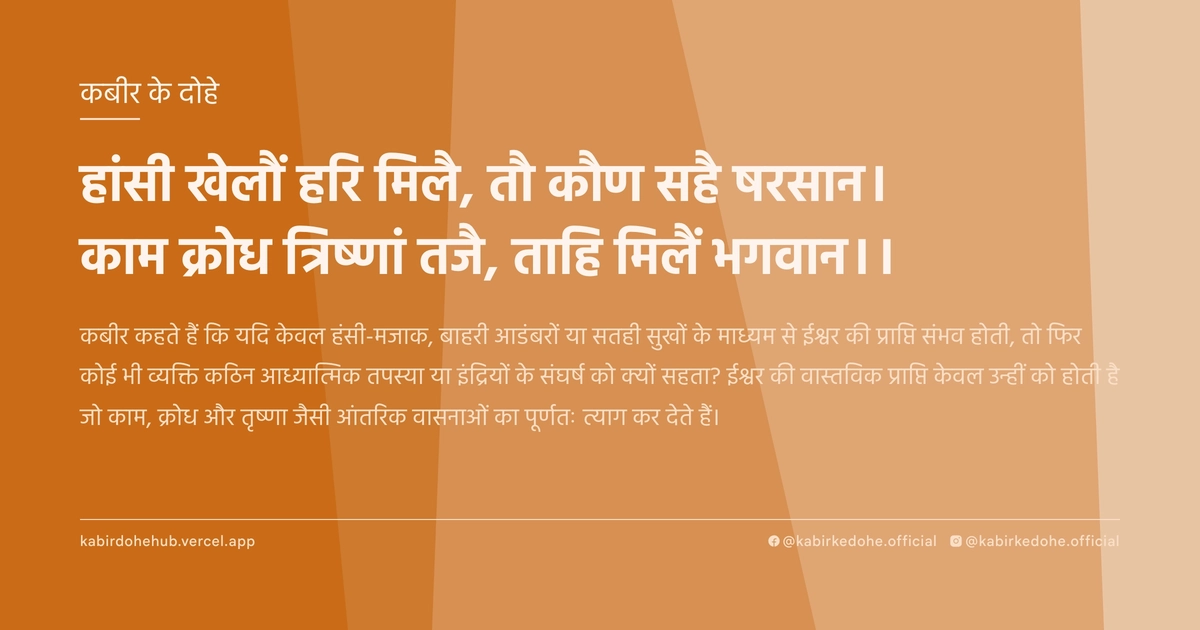
हांसी खेलौं हरि मिलै, तौ कौण सहै षरसान।
काम क्रोध त्रिष्णां तजै, ताहि मिलैं भगवान।।
Hansi khelau Hari milai, tau kaun sahai sharsan. Kaam krodh trishna tajai, tahi milai bhagwan.
इस पृष्ठ पर इस कबीर दोहे का अर्थ (meaning), हिंदी व्याख्या और अंग्रेज़ी अनुवाद, दार्शनिक विश्लेषण और व्यावहारिक जीवन सीख दी गई है। यह दोहा संयम (Self-discipline) विषय से जुड़ा है — Kabir doha meaning and explanation in Hindi and English.
अर्थ (Meaning):
कबीर कहते हैं कि यदि केवल हंसी-मजाक, बाहरी आडंबरों या सतही सुखों के माध्यम से ईश्वर की प्राप्ति संभव होती, तो फिर कोई भी व्यक्ति कठिन आध्यात्मिक तपस्या या इंद्रियों के संघर्ष को क्यों सहता? ईश्वर की वास्तविक प्राप्ति केवल उन्हीं को होती है जो काम, क्रोध और तृष्णा जैसी आंतरिक वासनाओं का पूर्णतः त्याग कर देते हैं।
Kabir asserts that if the Divine could be attained through mere laughter, superficial play, or outward rituals, then no one would endure the rigorous struggle of spiritual discipline. True realization of God is reserved only for those who have completely renounced lust, anger, and insatiable desire, purifying the soul from within.
व्याख्या (Interpretation):
यह दोहा आध्यात्मिक सतहीपन और वास्तविक रूपांतरण के बीच के अंतर को स्पष्ट करता है। 'हांसी खेलौं' यहाँ उन लोगों का प्रतीक है जो धर्म को केवल एक सामाजिक खेल या मानसिक संतोष के साधन के रूप में देखते हैं। कबीर स्पष्ट करते हैं कि मोक्ष कोई आकस्मिक घटना नहीं है, बल्कि एक आंतरिक युद्ध है। 'षरसान' या इंद्रियों का संघर्ष वह अग्नि है जिससे गुजरकर ही आत्मा शुद्ध होती है। यह निर्गुण भक्ति का सार है, जहाँ ईश्वर किसी बाहरी मूर्ति में नहीं, बल्कि काम, क्रोध और लोभ के विसर्जन के बाद प्रकट होने वाले शून्य में स्थित है। जब अहंकार और वासना का पर्दा हटता है, तब आत्मा और ब्रह्म की अद्वैत स्थिति स्वतः प्रकट हो जाती है।
This couplet elucidates the stark contrast between spiritual superficiality and genuine transformation. 'Hansi khelon' symbolizes those who treat spirituality as a social game or a mere psychological comfort. Kabir clarifies that liberation is not a coincidental event but an internal war. The 'sharasaan' or the struggle with the senses is the purifying fire through which the soul must pass. This is the essence of Nirgun Bhakti, where the Divine resides not in external idols, but in the void that emerges after the dissolution of lust, anger, and greed. When the veil of ego and desire is lifted, the non-dual state of Atman and Brahman reveals itself spontaneously.
दार्शनिक विश्लेषण (Philosophical Analysis):
कबीर का यह दृष्टिकोण उनके युग के धार्मिक पाखंडों पर एक कड़ा प्रहार है। उन्होंने देखा कि लोग तीर्थयात्राओं और माला जपने जैसे बाहरी कर्मकांडों को ही मोक्ष का मार्ग मान बैठे थे, जबकि उनके भीतर क्रोध और ईर्ष्या का वास था। कबीर यहाँ 'अद्वैत वेदांत' के उस सिद्धांत को पुष्ट करते हैं जहाँ माया (illusion) का अंत केवल ज्ञान और वैराग्य से संभव है।
सूफी मत के 'नफ्स' (अहंकार) के विनाश की अवधारणा यहाँ स्पष्ट दिखती है। जैसे सूफी संत अपनी इच्छाओं को मारकर ईश्वर में विलीन होना चाहते हैं, कबीर भी काम, क्रोध और तृष्णा के त्याग को अनिवार्य बताते हैं। उनके लिए ईश्वर कोई बाहरी सत्ता नहीं, बल्कि अंतर्मन की वह शुद्धता है जो वासनाओं के शांत होने पर जागृत होती है।
यह दोहा मनोवैज्ञानिक रूपांतरण की बात करता है। काम, क्रोध और तृष्णा केवल भावनाएं नहीं हैं, बल्कि वे मानसिक बंधन हैं जो चेतना को सीमित करते हैं। जब तक व्यक्ति इन आवेगों के अधीन है, वह सत्य का अनुभव नहीं कर सकता क्योंकि उसका दर्पण धुंधला है।
कबीर जाति और धर्म के भेदों को नकारते हुए यह संदेश देते हैं कि आध्यात्मिक योग्यता किसी कुल या कर्मकांड से नहीं, बल्कि चरित्र की शुद्धि से आती है। यह एक क्रांतिकारी विचार था जिसने तत्कालीन समाज में व्याप्त श्रेष्ठता के अहंकार को चुनौती दी।
अंततः, यह विश्लेषण हमें बताता है कि 'भगवान' का मिलना कोई भौतिक प्राप्ति नहीं है, बल्कि स्वयं के विकारों का अंत है। जब 'मैं' (अहंकार) समाप्त होता है, तभी 'वह' (परमात्मा) शेष रहता है। यही वह बिंदु है जहाँ भक्त और भगवान एक हो जाते हैं।
Kabir's perspective is a scathing critique of the religious hypocrisies of his era. He observed people treating pilgrimages and the mechanical chanting of beads as the path to salvation, while their hearts remained infested with anger and jealousy. Here, he reinforces the Advaita Vedanta principle that the dissolution of Maya (illusion) is possible only through true knowledge and detachment.
The Sufi concept of the annihilation of the 'Nafs' (ego) is vividly apparent. Just as Sufi saints seek to extinguish their desires to merge with the Divine, Kabir deems the renunciation of lust, anger, and greed as indispensable. For him, God is not an external entity but the inherent purity of the inner self that awakens once passions are stilled.
This couplet speaks of psychological transformation. Lust, anger, and greed are not merely emotions but mental shackles that limit consciousness. As long as an individual is enslaved by these impulses, they cannot experience Truth because their internal mirror is clouded.
By rejecting caste and sectarian divisions, Kabir conveys that spiritual eligibility is derived not from lineage or ritual, but from the purification of character. This was a revolutionary idea that challenged the prevailing notions of superiority in his society.
Ultimately, this analysis reveals that 'finding God' is not a physical acquisition but the cessation of one's own vices. When the 'I' (ego) vanishes, only 'He' (the Divine) remains. This is the precise point where the devotee and the Divine become one.
मूल संदेश (Core Message):
- बाहरी आडंबर केवल भ्रम हैं, आंतरिक शुद्धि ही सत्य है।
- क्रोध और तृष्णा आत्मा के मार्ग में सबसे बड़े अवरोध हैं।
- ईश्वर की प्राप्ति कोई उपलब्धि नहीं, बल्कि अहंकार का विसर्जन है।
- सच्ची भक्ति कर्मकांडों में नहीं, बल्कि व्यवहार के रूपांतरण में है।
- जब वासनाएं शांत होती हैं, तब परमात्मा स्वतः प्रकट होता है।
- External rituals are mere illusions; internal purity is the only truth.
- Anger and greed are the primary obstacles on the soul's journey.
- Attaining the Divine is not an achievement, but the dissolution of ego.
- True devotion lies not in rituals, but in the transformation of behavior.
- When passions are stilled, the Divine reveals itself spontaneously.
व्यावहारिक उदाहरण (Practical Example):
वाराणसी के एक पुराने घाट पर रहने वाले माधव नाम के एक वृद्ध बुनकर थे। माधव अपनी कला में निपुण थे, लेकिन उनका स्वभाव अत्यंत उग्र था। वे छोटी-छोटी बातों पर अपने शिष्यों और परिवार पर चिल्लाते थे। उन्हें विश्वास था कि वे दिन भर मंदिर जाते हैं और घंटों पूजा करते हैं, इसलिए वे ईश्वर के प्रिय हैं।
एक दिन उनके पास एक फकीर आया जिसने माधव के क्रोध को देखा। फकीर ने उनसे कहा, "माधव, तुम्हारी पूजा केवल एक खेल है, एक हंसी-मजाक है, क्योंकि तुम्हारे भीतर का क्रोध तुम्हारी सारी भक्ति को जला रहा है।"
माधव को पहले तो यह बात चुभी, लेकिन फिर उन्होंने गौर किया कि पूजा के बाद भी उनके मन में शांति नहीं थी। वे अभी भी दूसरों से ईर्ष्या करते थे और अपनी श्रेष्ठता सिद्ध करने के लिए लड़ते थे।
उन्होंने महसूस किया कि मंदिर जाना आसान है, लेकिन अपने क्रोध को जीतना सबसे कठिन तपस्या है। उन्होंने तय किया कि वे अब बाहरी दिखावे के बजाय अपने व्यवहार पर काम करेंगे।
अगले कुछ महीनों तक, जब भी उन्हें क्रोध आता, वे चुप हो जाते और अपनी सांसों पर ध्यान केंद्रित करते। उन्होंने अपनी तृष्णा को कम किया और जो कुछ उनके पास था, उसमें संतोष करना सीखा।
धीरे-धीरे, उनके चेहरे की कठोरता कम होने लगी। उनके शिष्यों ने महसूस किया कि अब माधव केवल उपदेश नहीं देते, बल्कि उनके व्यक्तित्व से करुणा झलकती है।
एक दिन, एक कठिन परिस्थिति में जब उनके सबसे प्रिय करघे टूट गए, माधव विचलित नहीं हुए। उन्होंने मुस्कुराते हुए कहा, "यह भी ईश्वर की इच्छा है।"
उस क्षण माधव को वह शांति महसूस हुई जो उन्हें हजारों घंटों की मंदिर की पूजा में नहीं मिली थी। उन्हें समझ आया कि ईश्वर मंदिर की दीवारों में नहीं, बल्कि उनके शांत और वासना-मुक्त मन में निवास करते हैं।
यह 'कबीर ट्विस्ट' था—बाहरी भक्ति से आंतरिक शुद्धि की ओर संक्रमण। माधव अब केवल एक बुनकर नहीं थे, बल्कि एक जीवित उदाहरण थे कि कैसे काम, क्रोध और तृष्णा का त्याग वास्तविक ईश्वर-प्राप्ति का मार्ग है।
उनकी पूरी जीवनशैली बदल गई; अब वे दूसरों की सेवा में आनंद पाते थे और उनका अहंकार पूरी तरह विलीन हो चुका था।
In the ancient ghats of Varanasi lived an elderly weaver named Madhav. Madhav was a master of his craft, but his temperament was volatile. He would scream at his apprentices and family over the smallest inconveniences. He firmly believed that because he visited the temple daily and spent hours in prayer, he was beloved by God.
One day, a wandering dervish arrived and witnessed Madhav's rage. The dervish told him, "Madhav, your worship is merely a game, a superficial play, for the anger within you is incinerating all your devotion."
Initially, Madhav felt insulted, but he soon realized that despite his prayers, there was no peace in his heart. He was still consumed by jealousy and a constant need to prove his superiority.
He understood that visiting a temple is easy, but conquering one's own anger is the most rigorous penance. He decided to stop focusing on outward displays and instead work on his internal behavior.
For the next few months, whenever anger surged, he would remain silent and focus on his breath. He curtailed his cravings and learned to find contentment in what he already possessed.
Gradually, the hardness of his countenance faded. His apprentices noticed that Madhav no longer just gave sermons; compassion now radiated from his very presence.
One day, when his most prized looms were destroyed in an accident, Madhav did not become agitated. He smiled and said, "This too is the will of the Divine."
In that moment, Madhav experienced a profound peace that thousands of hours of temple rituals had never provided. He realized that God does not reside within temple walls, but within a mind cleansed of passion and greed.
This was the 'Kabir Twist'—the transition from external piety to internal purity. Madhav was no longer just a weaver; he became a living testament that the renunciation of lust, anger, and greed is the true path to the Divine.
His entire way of life changed; he now found joy in serving others, and his ego had completely dissolved.
अभ्यास मार्गदर्शन (Practice Guidance):
- दैनिक आत्म-निरीक्षण: प्रतिदिन 15 मिनट मौन बैठें और दिन भर में आए क्रोध या लालच के क्षणों को बिना किसी निर्णय के देखें।
- भावनात्मक उपवास: सप्ताह में एक दिन ऐसा चुनें जब आप किसी भी परिस्थिति में प्रतिक्रिया (Reaction) नहीं करेंगे, बल्कि केवल अवलोकन (Observation) करेंगे।
- जर्नलिंग प्रॉम्प्ट: "आज मेरे भीतर किस वासना ने मुझे सत्य से दूर किया?" इस प्रश्न पर गहराई से विचार करें और लिखें।
- डायग्नोस्टिक चेकलिस्ट: क्या मैं पूजा के बाद भी दूसरों के प्रति द्वेष रखता हूँ? क्या मेरी शांति बाहरी परिस्थितियों पर निर्भर है? यदि हाँ, तो आपकी भक्ति अभी भी 'हांसी खेल' (सतही) है।
- Daily Self-Inquiry: Sit in silence for 15 minutes daily and observe the moments of anger or greed that surfaced during the day without judgment.
- Emotional Fasting: Choose one day a week where you commit to not reacting to any external provocation, but instead remaining a conscious observer.
- Journaling Prompt: Reflect and write on the question: "Which specific desire or passion pulled me away from my center today?"
- Diagnostic Checklist: Do I still harbor malice toward others after my prayers? Is my peace dependent on external circumstances? If yes, your devotion is still 'Hansi Khel' (superficial).
चिंतन प्रश्न (Reflection Questions):
- क्या मेरी धार्मिक पहचान वास्तव में मुझे एक बेहतर इंसान बना रही है, या यह केवल मेरे अहंकार को संतुष्ट करने का एक साधन है?
- मैं किन गुप्त इच्छाओं (Hidden Desires) को अपनी 'आध्यात्मिकता' के पर्दे के पीछे छिपाकर रखता हूँ?
- यदि आज मुझसे मेरी सभी सामाजिक और धार्मिक उपाधियाँ छीन ली जाएँ, तो मेरे भीतर क्या बचेगा?
- क्या मैं वास्तव में क्षमा करता हूँ, या मैं केवल अपनी श्रेष्ठता दिखाने के लिए क्षमा का नाटक करता हूँ?
- मेरे जीवन का कौन सा 'आडंबर' मुझे यह विश्वास दिलाने में मदद करता है कि मैं आध्यात्मिक रूप से उन्नत हूँ?
- Is my religious identity actually making me a better human, or is it merely a tool to feed my ego?
- What hidden desires do I conceal behind the veil of my 'spirituality'?
- If all my social and religious titles were stripped away today, what would remain within me?
- Do I truly forgive, or do I merely simulate forgiveness to maintain a sense of moral superiority?
- Which 'ritual' in my life helps me maintain the illusion that I am spiritually advanced?