
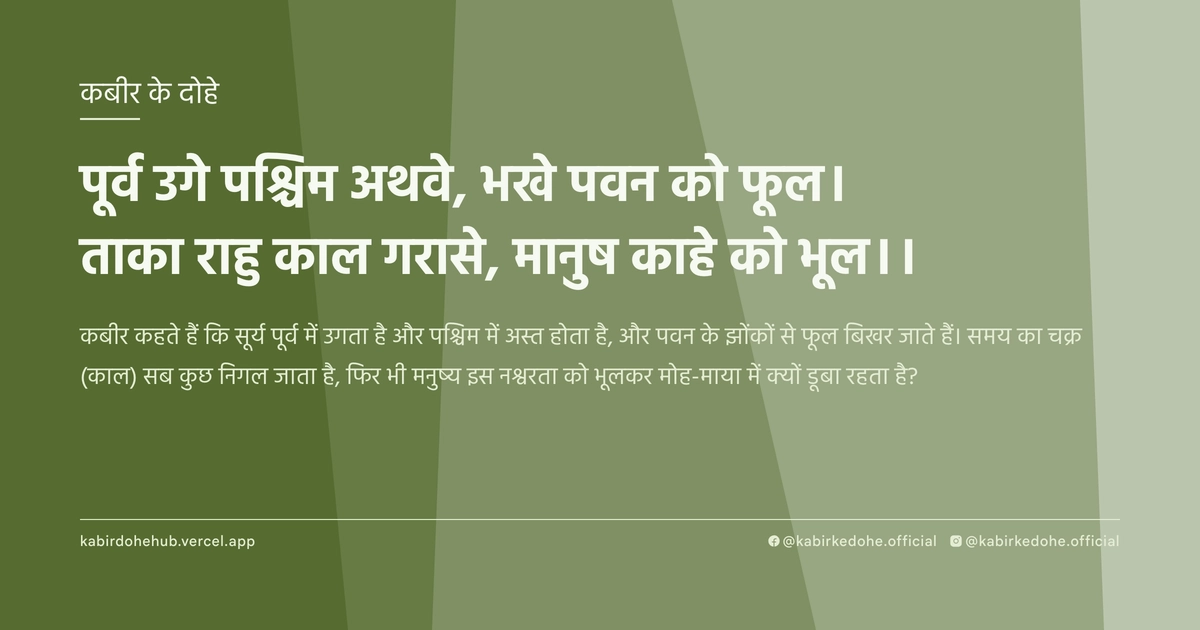
पूर्व उगे पश्चिम अथवे, भखे पवन को फूल।
ताका राहु काल गरासे, मानुष काहे को भूल।।
Purv uge paschim athve, bhakhe pavan ko phool. Taka rahu kaal garase, manush kahe ko bhul.
इस पृष्ठ पर इस कबीर दोहे का अर्थ (meaning), हिंदी व्याख्या और अंग्रेज़ी अनुवाद, दार्शनिक विश्लेषण और व्यावहारिक जीवन सीख दी गई है। यह दोहा अनित्य (Impermanence) विषय से जुड़ा है — Kabir doha meaning and explanation in Hindi and English.
अर्थ (Meaning):
कबीर कहते हैं कि सूर्य पूर्व में उगता है और पश्चिम में अस्त होता है, और पवन के झोंकों से फूल बिखर जाते हैं। समय का चक्र (काल) सब कुछ निगल जाता है, फिर भी मनुष्य इस नश्वरता को भूलकर मोह-माया में क्यों डूबा रहता है?
Kabir observes that the sun rises in the east and sets in the west, and flowers are scattered by the wind. The relentless cycle of time (Kaal) eventually consumes everything, yet humans inexplicably forget this impermanence and remain trapped in worldly attachments.
व्याख्या (Interpretation):
यह दोहा प्रकृति के अटल नियमों के माध्यम से जीवन की क्षणभंगुरता को दर्शाता है। सूर्य का उदय और अस्त होना समय की निरंतरता का प्रतीक है, जबकि पवन द्वारा फूल का झड़ना जीवन की नाजुकता को दर्शाता है। यहाँ 'राहु' और 'काल' केवल खगोलीय पिंड या समय नहीं हैं, बल्कि उस विनाशकारी शक्ति के प्रतीक हैं जो अहंकार और भौतिक शरीर को मिटा देती है। यह निर्गुण भक्ति का सार है, जहाँ साधक को यह समझना होता है कि केवल वह निराकार ब्रह्म ही सत्य है, बाकी सब माया है। मनुष्य की 'भूल' यह है कि वह स्वयं को इस नश्वर शरीर के साथ जोड़ लेता है, जबकि वह वास्तव में अविनाशी आत्मा है। यह विरोधाभास ही मानवीय दुख का मूल कारण है—एक अनंत सत्ता का सीमित शरीर में कैद होकर खुद को सीमित समझना।
This couplet utilizes the immutable laws of nature to illustrate the transience of existence. The rising and setting of the sun symbolize the relentless flow of time, while the flower scattered by the wind represents the fragility of human life. Here, 'Rahu' and 'Kaal' are not merely astronomical entities or chronological time, but symbols of the destructive force that erases ego and the physical form. This aligns with Nirgun Bhakti, where the seeker must realize that only the formless Brahman is eternal, and everything else is Maya (illusion). The 'forgetfulness' of man lies in identifying the self with the perishable body, ignoring the immortal Atman. This paradox—an infinite consciousness perceiving itself as a limited entity—is the root of all human suffering.
दार्शनिक विश्लेषण (Philosophical Analysis):
कबीर का यह विचार उनके युग के कर्मकांडीय और बाहरी आडंबरों के विरुद्ध एक सशक्त प्रहार है। उन्होंने देखा कि लोग तीर्थयात्राओं और पूजा-पाठ में समय व्यतीत करते हैं, जबकि वे मृत्यु की वास्तविकता को पूरी तरह अनदेखा कर देते हैं। यह दृष्टिकोण अद्वैत वेदांत के करीब है, जहाँ 'माया' को वह पर्दा माना गया है जो सत्य को छुपाता है। कबीर तर्क देते हैं कि जब प्रकृति का हर कण—चाहे वह सूर्य हो या फूल—परिवर्तनशील है, तो मनुष्य अपनी स्थिरता का भ्रम कैसे पाल सकता है?
सूफी मत के 'फना' (अहंकार का विनाश) के सिद्धांत से जुड़ते हुए, कबीर समझाते हैं कि जब तक मनुष्य यह नहीं मानता कि वह 'काल' के अधीन है, वह उस 'अकाल' (समय से परे) परमात्मा को प्राप्त नहीं कर सकता। यह केवल मृत्यु का भय नहीं है, बल्कि मृत्यु की जागरूकता के माध्यम से जीवन को सार्थक बनाने का आह्वान है। वे जाति और धर्म के भेदभाव को निरर्थक बताते हैं क्योंकि काल की गालि में सब समान रूप से विलीन होते हैं।
मनोवैज्ञानिक स्तर पर, यह दोहा 'संज्ञानात्मक विसंगति' (Cognitive Dissonance) को संबोधित करता है। मनुष्य जानता है कि वह मरेगा, फिर भी वह ऐसे जीता है जैसे वह अमर हो। कबीर इस विसंगति को दूर करने के लिए 'वैराग्य' का मार्ग सुझाते हैं। यह वैराग्य संसार को छोड़कर भागना नहीं है, बल्कि संसार में रहते हुए उससे अनासक्त रहना है।
कबीर की चुनौती यह है कि हम अपनी पहचान को 'पद', 'संपत्ति' या 'शरीर' से हटाकर उस शुद्ध चेतना पर केंद्रित करें जो जन्म और मृत्यु के चक्र से मुक्त है। वे चेतावनी देते हैं कि जो व्यक्ति केवल बाहरी दुनिया की चमक-धमक में खोया रहता है, वह उस फूल की तरह है जो हवा के एक झोंके से बिखर जाता है।
अंततः, यह विश्लेषण हमें यह समझने पर मजबूर करता है कि आध्यात्मिक जागृति तब होती है जब हम अपनी नश्वरता को स्वीकार कर लेते हैं। जब अहंकार का विसर्जन होता है, तभी आत्मा का परमात्मा के साथ मिलन संभव होता है। यह 'शून्य' की अवस्था है जहाँ न कोई खोने का डर है और न पाने की लालसा।
Kabir's insight is a powerful critique of the ritualistic and external pomposity of his era. He observed people spending lifetimes in pilgrimages and rote prayers while completely ignoring the visceral reality of death. This perspective aligns closely with Advaita Vedanta, where 'Maya' is the veil that obscures the ultimate truth. Kabir argues that if every particle of nature—from the celestial sun to the delicate flower—is subject to change, how can a human cling to the illusion of permanence?
Connecting to the Sufi concept of 'Fana' (the annihilation of the ego), Kabir explains that until one acknowledges their submission to 'Kaal' (Time), they cannot attain the 'Akaal' (the Timeless Divine). This is not a call to morbid fear, but an invitation to live meaningfully through the awareness of mortality. He renders caste and religious divisions irrelevant, as all are equally consumed by the maw of time.
On a psychological level, this doha addresses 'cognitive dissonance.' Humans are intellectually aware of their mortality, yet they live as if they are immortal. Kabir suggests 'Vairagya' (detachment) to resolve this conflict. This detachment is not an escape from the world, but a way of living within it without being possessed by it.
Kabir challenges us to shift our identity from 'status,' 'wealth,' or 'the physical body' toward the pure consciousness that transcends the cycle of birth and death. He warns that those lost in the glitter of the material world are like flowers scattered by a single gust of wind.
Ultimately, this analysis compels us to realize that spiritual awakening occurs only when we embrace our transience. When the ego is dissolved, the union of Atman and Brahman becomes possible. This is the state of 'Shunya' (the Void), where there is neither the fear of loss nor the craving for acquisition.
मूल संदेश (Core Message):
- नश्वरता को स्वीकार करना ही वास्तविक स्वतंत्रता है।
- अहंकार समय की लहरों में सबसे पहले बहता है।
- बाहरी चमक माया है; आंतरिक शांति ही सत्य है।
- प्रकृति के नियमों के विरुद्ध जाना दुख का कारण है।
- समय सबको समान करता है, इसलिए विनम्र बनें।
- अमरता शरीर में नहीं, बल्कि निस्वार्थ कर्मों में है।
- Accepting impermanence is the gateway to true liberation.
- The ego is the first thing swept away by the tides of time.
- External glitter is Maya; internal stillness is the only truth.
- Resisting the laws of nature is the primary source of suffering.
- Time is the great equalizer; therefore, cultivate humility.
- Immortality resides not in the body, but in selfless actions.
व्यावहारिक उदाहरण (Practical Example):
वाराणसी के घाटों पर रहने वाले एक वृद्ध कुम्हार, माधव, की कहानी है। माधव अपनी कला में निपुण था और उसे अपनी बनाई मिट्टी की मूर्तियों पर बहुत गर्व था। वह मानता था कि उसकी कला उसे अमर बना देगी। वह अक्सर अपने छोटे शिष्यों को डांटता था कि वे उसकी बारीकियों को समझें, क्योंकि वह खुद को उस कला का एकमात्र स्वामी मानता था।
एक दिन, शहर में भीषण बाढ़ आई। गंगा का जलस्तर इतनी तेजी से बढ़ा कि माधव की कार्यशाला और उसके जीवन भर की सारी कृतियाँ पानी में बह गईं। उसकी सबसे सुंदर मूर्तियाँ, जिन्हें उसने महीनों की मेहनत से गढ़ा था, मिट्टी के ढेरों में बदल गईं और पानी में विलीन हो गईं। माधव टूट गया और घंटों तक किनारे पर बैठकर रोता रहा।
तभी उसकी मुलाकात एक फकीर से हुई, जिसने उसे कबीर का यह दोहा सुनाया। फकीर ने कहा, 'माधव, तू मिट्टी से मिट्टी का मोह कर बैठा था। जिस पवन ने तेरे फूलों को उड़ाया, वह तुझे यह बताने आई है कि तू मूर्तियों का निर्माता नहीं, बल्कि समय का एक छोटा सा हिस्सा है।'
माधव को अचानक अहसास हुआ कि उसका अहंकार उसकी कला में नहीं, बल्कि इस भ्रम में था कि वह समय को जीत सकता है। उसने देखा कि जिस तरह सूर्य डूबकर कल फिर उगता है, वैसे ही विनाश भी सृजन का एक हिस्सा है।
उसने रोना बंद किया और अपनी बची हुई मिट्टी उठाई। लेकिन इस बार, उसने मूर्तियाँ बेचने या प्रसिद्धि पाने के लिए नहीं बनाईं। उसने गाँव के बच्चों के लिए छोटे-छोटे खिलौने बनाना शुरू किया, जिन्हें वह मुफ्त में बाँटता था।
उसका व्यवहार पूरी तरह बदल गया। वह अब अहंकारी शिक्षक नहीं, बल्कि एक विनम्र मार्गदर्शक बन गया था। उसने सीखा कि असली कला वह नहीं जो संग्रहालयों में सजे, बल्कि वह है जो दूसरों के चेहरे पर मुस्कान लाए।
वह अब हर शाम गंगा की लहरों को देखता और मुस्कुराता, यह जानते हुए कि सब कुछ बह जाएगा, लेकिन वह प्रेम जो उसने बाँटा, वह समय की सीमा से परे है।
माधव ने अपनी पहचान को 'महान कलाकार' से बदलकर 'सेवा करने वाला मनुष्य' कर लिया। उसने पाया कि जब उसने अपनी अमरता का दावा छोड़ दिया, तभी वह वास्तव में शांति से जीना सीख पाया।
उसकी यह यात्रा एक गहरे मानसिक परिवर्तन की थी—जहाँ विनाश ने उसे विनाशक नहीं, बल्कि एक करुणावान इंसान बना दिया।
This is the story of Madhav, an elderly potter living on the ghats of Varanasi. Madhav was a master of his craft and took immense pride in the clay idols he created. He believed his art would make him immortal. He often scolded his young apprentices, believing himself to be the sole master of this intricate art.
One day, a devastating flood hit the city. The waters of the Ganges rose so rapidly that Madhav's workshop and all the creations of his lifetime were swept away. His most beautiful idols, crafted over months of labor, dissolved back into mud and vanished into the current. Madhav was shattered and spent hours weeping on the riverbank.
There, he met a wandering fakir who recited this specific doha of Kabir to him. The fakir said, 'Madhav, you fell in love with the mud. The wind that blew away your flowers has come to tell you that you are not the master of art, but a small fragment of Time.'
Madhav suddenly realized that his ego lay not in his art, but in the delusion that he could conquer time. He observed that just as the sun sets only to rise again, destruction is merely a part of creation.
He stopped weeping and gathered the remaining clay. However, this time, he did not create idols for sale or fame. He began making small clay toys for the village children, which he distributed for free.
His behavior transformed completely. He was no longer an arrogant teacher but a humble guide. He learned that true art is not that which adorns museums, but that which brings a smile to another's face.
He would now watch the waves of the Ganges every evening and smile, knowing that while everything would eventually flow away, the love he shared existed beyond the boundaries of time.
Madhav shifted his identity from 'The Great Artist' to 'A Servant of Humanity.' He discovered that only when he abandoned the claim to immortality could he truly learn to live in peace.
His journey was one of profound psychological shift—where destruction did not make him a victim, but a compassionate human being.
अभ्यास मार्गदर्शन (Practice Guidance):
- दैनिक चिंतन: हर सुबह सूर्योदय और शाम को सूर्यास्त देखते समय यह विचार करें कि यह चक्र निरंतर है और आपका अस्तित्व इसमें एक क्षण मात्र है।
- आत्म-पूछताछ जर्नल: प्रतिदिन लिखें—'आज मैंने किस ऐसी चीज़ पर अपना अहंकार जताया जो वास्तव में मेरे नियंत्रण में नहीं है?'
- व्यवहार परिवर्तन: सप्ताह में एक बार ऐसी वस्तु का त्याग करें जिससे आप अत्यधिक मोह रखते हों, ताकि आप अनासक्ति का अभ्यास कर सकें।
- डायग्नोस्टिक चेकलिस्ट: क्या आप छोटी असफलताओं पर अत्यधिक विलाप करते हैं? क्या आप अपनी उपलब्धियों को अपनी स्थायी पहचान मानते हैं? यदि हाँ, तो आप 'काल' की वास्तविकता को भूल रहे हैं।
- Daily Contemplation: Observe the sunrise and sunset daily, reflecting on the fact that this cycle is eternal and your existence is but a fleeting moment within it.
- Self-Inquiry Journaling: Write daily—'What did I claim ownership over today that is actually beyond my control?'
- Behavioral Shift: Once a week, consciously let go of a material object or a perceived status you are overly attached to, practicing the art of non-attachment.
- Diagnostic Checklist: Do you grieve excessively over minor setbacks? Do you mistake your achievements for your permanent identity? If yes, you are ignoring the reality of 'Kaal'.
चिंतन प्रश्न (Reflection Questions):
- यदि आज आपकी सारी सामाजिक पहचान (पद, नाम, रिश्ता) छीन ली जाए, तो आपका 'मैं' क्या बचेगा?
- आप अपनी डिजिटल छवि (Social Media Ego) को संवारने में कितना समय बिताते हैं, जबकि वह एक क्षणभंगुर प्रतिबिंब है?
- क्या आपका डर मृत्यु का है, या उस पहचान के खोने का जिसे आपने बड़ी मेहनत से बनाया है?
- आप किन चीजों को 'स्थायी' मानते हैं, और क्या वास्तव में उनमें से कोई भी समय की कसौटी पर खरी उतरी है?
- क्या आप दूसरों की मदद इसलिए करते हैं क्योंकि आप करुणा महसूस करते हैं, या इसलिए ताकि आपकी 'छवि' अच्छी बने?
- If all your social identities (title, name, relationships) were stripped away today, what would remain of your 'I'?
- How much time do you spend polishing your digital ego, knowing it is but a flickering reflection?
- Is your fear truly about death, or is it about the loss of the identity you have painstakingly constructed?
- What do you perceive as 'permanent' in your life, and has any of it actually withstood the test of time?
- Do you help others out of genuine compassion, or to reinforce a curated image of yourself as a 'good person'?