
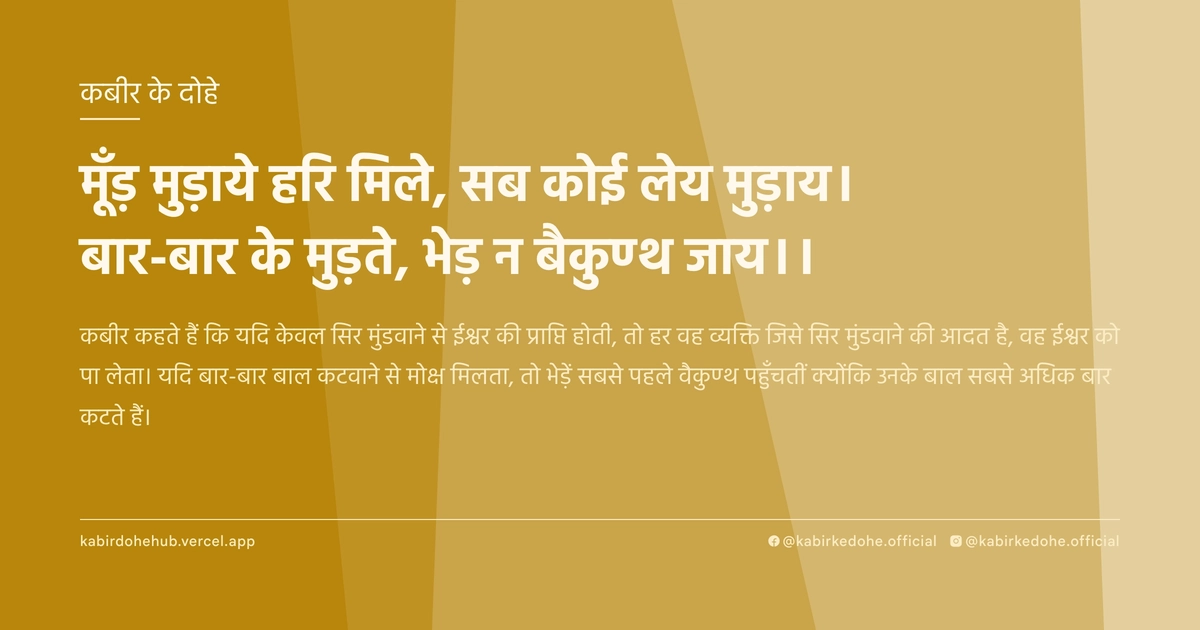
मूँड़ मुड़ाये हरि मिले, सब कोई लेय मुड़ाय।
बार-बार के मुड़ते, भेड़ न बैकुण्ठ जाय।।
Mund mudaye hari mile, sab koy ley muday. Baar-baar ke mudte, bhed na baikunth jaaye.
इस पृष्ठ पर इस कबीर दोहे का अर्थ (meaning), हिंदी व्याख्या और अंग्रेज़ी अनुवाद, दार्शनिक विश्लेषण और व्यावहारिक जीवन सीख दी गई है। यह दोहा धार्मिक पाखंड (Religious Hypocrisy) विषय से जुड़ा है — Kabir doha meaning and explanation in Hindi and English.
अर्थ (Meaning):
कबीर कहते हैं कि यदि केवल सिर मुंडवाने से ईश्वर की प्राप्ति होती, तो हर वह व्यक्ति जिसे सिर मुंडवाने की आदत है, वह ईश्वर को पा लेता। यदि बार-बार बाल कटवाने से मोक्ष मिलता, तो भेड़ें सबसे पहले वैकुण्ठ पहुँचतीं क्योंकि उनके बाल सबसे अधिक बार कटते हैं।
Kabir asserts that if shaving the head were the key to attaining the Divine, everyone who shaves their head would find God. If repetitive tonsuring led to liberation, sheep would be the first to reach Vaikuntha, as their wool is shorn most frequently.
व्याख्या (Interpretation):
यह दोहा बाहरी कर्मकांडों और दिखावे पर एक तीखा प्रहार है। कबीर यहाँ 'मुंडन' को एक प्रतीक के रूप में उपयोग कर रहे हैं, जो उस समय के धार्मिक पाखंड को दर्शाता है जहाँ लोग मानते थे कि शारीरिक परिवर्तन या बाहरी त्याग से आध्यात्मिक उन्नति संभव है। वह स्पष्ट करते हैं कि ईश्वर 'निर्गुण' है, जिसका कोई भौतिक आकार या बाहरी अनुष्ठान से संबंध नहीं है। यहाँ 'भेड़' का उदाहरण एक गहरा व्यंग्य है, जो यह बताता है कि बिना विवेक और आंतरिक रूपांतरण के, अंधानुकरण केवल एक पशुवत क्रिया है। यह आत्मा और ब्रह्म के मिलन की बात करता है, जो केवल आंतरिक शुद्धि और अहंकार के विसर्जन से संभव है, न कि बालों को हटाने से।
This couplet is a sharp critique of external rituals and superficial displays of piety. Kabir uses 'shaving the head' as a metaphor for the religious hypocrisy of his time, where it was believed that physical alterations or outward renunciation could trigger spiritual evolution. He clarifies that the Divine is 'Nirgun' (formless), possessing no connection to physical rituals. The analogy of the 'sheep' serves as a profound satire, suggesting that blind imitation without discernment is merely an animalistic act. It emphasizes that the union of Atman and Brahman is achieved only through internal purification and the dissolution of the ego, not through the removal of hair.
दार्शनिक विश्लेषण (Philosophical Analysis):
कबीर का यह दर्शन उनके युग के कट्टरपंथ और कर्मकांडीय हिंदू-इस्लाम दोनों के विरुद्ध एक विद्रोह था। वह 'अद्वैत वेदांत' के उस सिद्धांत का समर्थन करते हैं जहाँ सत्य आंतरिक अनुभव का विषय है, न कि बाहरी प्रदर्शन का। उनके लिए, धर्म वह नहीं है जो मंदिर या मस्जिद में किया जाए, बल्कि वह है जो हृदय की गहराई में घटित हो।
यहाँ कबीर 'माया' के उस जाल की बात कर रहे हैं जहाँ मनुष्य प्रतीकों को ही सत्य मान लेता है। जब कोई व्यक्ति बाहरी क्रियाओं (जैसे मुंडन, व्रत या तीर्थयात्रा) में उलझता है, तो वह वास्तव में अपने अहंकार को और पुष्ट करता है, यह सोचकर कि वह 'पवित्र' हो गया है। यह 'अहंकार' ही वह पर्दा है जो जीव को ब्रह्म से अलग करता है।
सूफी मत के 'फना' (अहंकार का विनाश) के समान, कबीर यहाँ यह समझा रहे हैं कि जब तक 'मैं' का भाव समाप्त नहीं होता, तब तक ईश्वर की प्राप्ति असंभव है। बाहरी त्याग केवल एक भ्रम है यदि आंतरिक वासनाएँ और क्रोध अभी भी जीवित हैं।
कबीर का दृष्टिकोण सामाजिक समानता पर आधारित था। उन्होंने जाति और वर्ण व्यवस्था को चुनौती दी, क्योंकि ये व्यवस्थाएं भी बाहरी पहचान पर आधारित थीं। उनका तर्क था कि यदि ईश्वर केवल एक विशेष क्रिया से मिलता, तो वह केवल कुछ विशेषाधिकार प्राप्त लोगों तक सीमित रह जाता, जबकि सत्य सार्वभौमिक है।
अंततः, यह दोहा मनोवैज्ञानिक रूपांतरण की मांग करता है। यह हमें सिखाता है कि आध्यात्मिक यात्रा 'करने' (Doing) के बारे में नहीं, बल्कि 'होने' (Being) के बारे में है। जब हम बाहरी आडंबरों को त्याग कर मौन और आत्म-निरीक्षण की ओर मुड़ते हैं, तभी वास्तविक ज्ञान का उदय होता है।
Kabir's philosophy represents a rebellion against the rigid orthodoxy and ritualism of both Hinduism and Islam during his era. He champions the principle of Advaita Vedanta, where Truth is a matter of internal experience rather than external performance. For him, religion is not what is practiced in temples or mosques, but what unfolds in the depths of the heart.
Here, Kabir addresses the trap of 'Maya,' where humans mistake symbols for the ultimate Truth. When an individual becomes obsessed with external acts—such as shaving the head, fasting, or pilgrimages—they inadvertently strengthen their ego by believing they have become 'holy.' This ego is the very veil that separates the Jiva (individual soul) from Brahman.
Parallel to the Sufi concept of 'Fana' (the annihilation of the self), Kabir explains that as long as the sense of 'I' persists, the realization of the Divine is impossible. External renunciation is a mere illusion if internal cravings and anger remain untouched.
Kabir's perspective was rooted in social equality. He challenged the caste system because it, too, was based on external identity. He argued that if God were attainable through a specific ritual, Truth would be limited to a privileged few, whereas the Divine is universal.
Ultimately, this couplet demands a psychological transformation. It teaches us that the spiritual journey is not about 'Doing' but about 'Being.' Only when we abandon outward pretenses and turn toward silence and self-inquiry does true gnosis emerge.
मूल संदेश (Core Message):
- बाहरी दिखावा आध्यात्मिक प्रगति का प्रमाण नहीं है।
- अहंकार का विसर्जन ही वास्तविक मोक्ष का मार्ग है।
- ईश्वर किसी क्रिया में नहीं, बल्कि शुद्ध चेतना में है।
- अंधानुकरण सत्य की खोज में सबसे बड़ी बाधा है।
- आंतरिक रूपांतरण ही एकमात्र वास्तविक तीर्थयात्रा है।
- External appearances are not evidence of spiritual progress.
- The dissolution of ego is the only path to true liberation.
- The Divine resides not in an act, but in pure consciousness.
- Blind imitation is the greatest obstacle in the search for Truth.
- Internal transformation is the only authentic pilgrimage.
व्यावहारिक उदाहरण (Practical Example):
वाराणसी के एक पुराने घाट पर रहने वाले माधव नाम के एक वृद्ध बुनकर थे। माधव अपनी पूरी जिंदगी धार्मिक अनुष्ठानों में बिता चुके थे। उन्होंने कई बार सिर मुंडवाया, कठिन व्रत रखे और गंगा में अनगिनत डुबकियाँ लगाईं, इस उम्मीद में कि एक दिन उन्हें मोक्ष मिल जाएगा। उनके मोहल्ले के लोग उन्हें बहुत 'धार्मिक' मानते थे, और माधव को भी इस बात का गर्व था कि वे दूसरों से अधिक पवित्र हैं।
एक दिन, माधव की मुलाकात एक घुमंतू फकीर से हुई जो घाट की सीढ़ियों पर चुपचाप बैठा था। माधव ने गर्व से फकीर को अपने मुंडित सिर और माथे पर लगे तिलक के बारे में बताया, यह दावा करते हुए कि ये उनके समर्पण के प्रतीक हैं। फकीर ने मंद मुस्कान के साथ माधव की ओर देखा और पास में चर रही एक भेड़ की ओर इशारा किया, जिसके ऊन हाल ही में काटे गए थे।
फकीर ने पूछा, "माधव, क्या इस भेड़ ने भी ईश्वर को पाने के लिए अपने बाल त्यागे हैं? या यह केवल प्रकृति का नियम है?" माधव चुप हो गए। फकीर ने आगे कहा, "जिस तरह भेड़ के बाल कटने से उसकी आत्मा नहीं बदलती, वैसे ही सिर मुंडवाने से तुम्हारा अहंकार नहीं मिटता। तुम केवल शरीर को बदल रहे हो, हृदय को नहीं।"
यह बात माधव के भीतर गहरे तक उतर गई। उन्हें एहसास हुआ कि उन्होंने वर्षों तक केवल 'दिखावे' की पूजा की थी। उन्होंने पाया कि उनका गर्व, जिसे वे 'भक्ति' समझ रहे थे, वास्तव में उनके और ईश्वर के बीच की सबसे बड़ी दीवार थी।
अगले कुछ महीनों में, माधव ने बाहरी अनुष्ठानों को कम कर दिया। उन्होंने अपना समय दूसरों की निस्वार्थ सेवा में लगाना शुरू किया। उन्होंने गरीब बच्चों को मुफ्त में बुनाई सिखानी शुरू की और अपने भीतर के क्रोध और श्रेष्ठता के भाव को त्याग दिया।
अब माधव जब गंगा किनारे बैठते, तो वे किसी बाहरी चिन्ह के लिए नहीं, बल्कि उस असीम शांति के लिए बैठते जो केवल अहंकार के विसर्जन से आती है।
उनके चेहरे पर अब वह कृत्रिम धार्मिकता नहीं, बल्कि एक सहज करुणा थी। उन्होंने जान लिया था कि ईश्वर किसी विशेष क्रिया में नहीं, बल्कि शुद्ध प्रेम और विनम्रता में बसता है।
माधव की यह यात्रा एक 'कबीर ट्विस्ट' थी—जहाँ एक बाहरी धार्मिक व्यक्ति वास्तव में एक आध्यात्मिक मनुष्य बन गया। उन्होंने सीखा कि असली मुंडन तो अहंकार का होना चाहिए, बालों का नहीं।
In the ancient ghats of Varanasi lived an elderly weaver named Madhav. Madhav had spent his entire life immersed in religious rituals. He had shaved his head numerous times, observed rigorous fasts, and taken countless dips in the Ganges, hoping that one day he would attain liberation. The people of his neighborhood regarded him as very 'religious,' and Madhav took pride in believing he was holier than others.
One day, Madhav encountered a wandering fakir sitting silently on the steps of the ghat. With pride, Madhav told the fakir about his shaved head and the tilak on his forehead, claiming these were symbols of his total surrender. The fakir looked at Madhav with a gentle smile and pointed toward a sheep grazing nearby, whose wool had recently been shorn.
The fakir asked, "Madhav, has this sheep also renounced its hair to find God? Or is it merely the law of nature?" Madhav fell silent. The fakir continued, "Just as the shearing of a sheep does not change its soul, shaving your head does not erase your ego. You are merely altering the body, not the heart."
These words penetrated deep into Madhav's consciousness. He realized that for years, he had only worshipped 'appearance.' He discovered that his pride, which he had mistaken for 'devotion,' was actually the greatest wall between him and the Divine.
Over the next few months, Madhav reduced his external rituals. He began spending his time in selfless service to others. He started teaching weaving to poor children for free and let go of his feelings of anger and superiority.
Now, when Madhav sat by the Ganges, he did so not for any external sign, but for that infinite peace that comes only from the dissolution of the ego.
His face no longer bore a mask of artificial piety, but a natural compassion. He had learned that God does not reside in a specific act, but in pure love and humility.
Madhav's journey was a 'Kabir Twist'—where a superficially religious man truly became a spiritual human. He learned that the only thing that truly needs to be shorn is the ego, not the hair.
अभ्यास मार्गदर्शन (Practice Guidance):
- दैनिक आत्म-निरीक्षण: प्रतिदिन 15 मिनट मौन बैठें और विचार करें कि क्या आपके कार्य दूसरों को प्रभावित करने के लिए हैं या आंतरिक शांति के लिए।
- अहंकार की पहचान: जब भी आप स्वयं को दूसरों से 'बेहतर' या 'अधिक आध्यात्मिक' महसूस करें, तो तुरंत रुकें और उस विचार के स्रोत को पहचानें।
- सेवा का अभ्यास: सप्ताह में एक बार ऐसा कार्य करें जिसमें आपकी पहचान गुप्त रहे, ताकि 'पुण्य' का अहंकार पैदा न हो।
- डायग्नोस्टिक चेकलिस्ट: क्या मैं अपनी धार्मिक पहचान को अपनी श्रेष्ठता का आधार मानता हूँ? क्या मैं दूसरों के बाहरी पहनावे से उनके चरित्र का निर्णय करता हूँ? यदि हाँ, तो मैं अभी भी कर्मकांड के भ्रम में हूँ।
- Daily Self-Inquiry: Sit in silence for 15 minutes daily and contemplate whether your actions are intended to impress others or to achieve internal peace.
- Ego Recognition: Whenever you feel 'superior' or 'more spiritual' than others, stop immediately and identify the source of that thought.
- Practice of Anonymity: Once a week, perform an act of service where your identity remains hidden, ensuring that the ego of 'doing good' does not arise.
- Diagnostic Checklist: Do I use my religious identity as a basis for superiority? Do I judge others' character by their external attire? If yes, I am still trapped in the illusion of ritualism.
चिंतन प्रश्न (Reflection Questions):
- मेरे जीवन में ऐसे कौन से 'मुंडन' या बाहरी प्रतीक हैं जिन्हें मैं अपनी आध्यात्मिक योग्यता मानता हूँ?
- यदि मेरी सभी धार्मिक पहचानें छीन ली जाएँ, तो मेरे भीतर क्या बचेगा?
- क्या मैं वास्तव में सत्य की खोज कर रहा हूँ, या केवल एक 'आदर्श' व्यक्ति दिखने की कोशिश कर रहा हूँ?
- मेरे भीतर का 'भेड़' कौन है जो बिना सोचे-समझे परंपराओं का पालन कर रहा है?
- क्या मेरी भक्ति मुझे दूसरों के प्रति अधिक विनम्र बनाती है या अधिक अहंकारी?
- What are the 'shavings' or external symbols in my life that I mistake for spiritual merit?
- If all my religious identities were stripped away, what would remain within me?
- Am I truly searching for Truth, or am I merely trying to appear as an 'ideal' person?
- Who is the 'sheep' within me that follows traditions without questioning?
- Does my devotion make me more humble toward others, or more arrogant?