
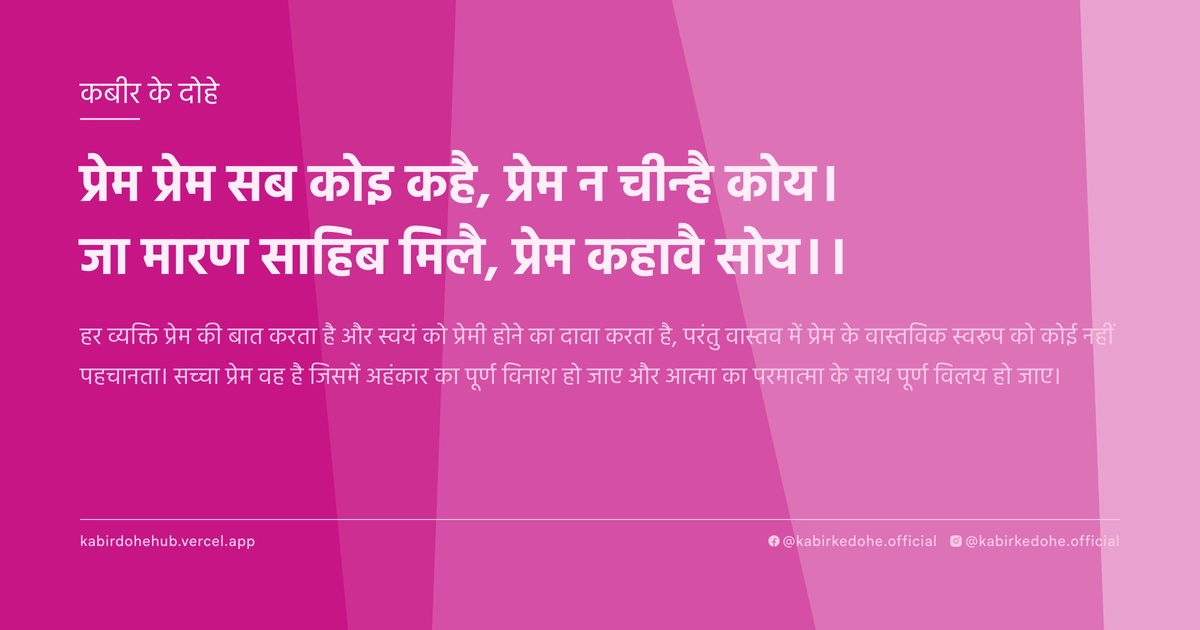
प्रेम प्रेम सब कोइ कहै, प्रेम न चीन्है कोय।
जा मारण साहिब मिलै, प्रेम कहावै सोय।।
Prem prem sab koi kahai, prem na chinnai koy. Ja maaran saahib milai, prem kahaavai soy.
इस पृष्ठ पर इस कबीर दोहे का अर्थ (meaning), हिंदी व्याख्या और अंग्रेज़ी अनुवाद, दार्शनिक विश्लेषण और व्यावहारिक जीवन सीख दी गई है। यह दोहा भक्ति (Bhakti) विषय से जुड़ा है — Kabir doha meaning and explanation in Hindi and English.
अर्थ (Meaning):
हर व्यक्ति प्रेम की बात करता है और स्वयं को प्रेमी होने का दावा करता है, परंतु वास्तव में प्रेम के वास्तविक स्वरूप को कोई नहीं पहचानता। सच्चा प्रेम वह है जिसमें अहंकार का पूर्ण विनाश हो जाए और आत्मा का परमात्मा के साथ पूर्ण विलय हो जाए।
Everyone speaks of love and claims to be a lover, yet none truly recognize the essence of real love. True love is not an emotion or an attachment, but a transformative fire that annihilates the ego, leading to the ultimate union of the individual soul with the Divine.
व्याख्या (Interpretation):
कबीर यहाँ 'प्रेम' के दो स्तरों के बीच अंतर कर रहे हैं: सांसारिक मोह और आध्यात्मिक विरह। पहली पंक्ति में वे सामाजिक पाखंड पर प्रहार करते हैं जहाँ प्रेम केवल शब्दों का खेल है। दूसरी पंक्ति में 'मारण' शब्द का प्रयोग अत्यंत महत्वपूर्ण है, जो मृत्यु नहीं बल्कि 'अहंकार की मृत्यु' का प्रतीक है। यह निर्गुण भक्ति का सार है, जहाँ भक्त स्वयं को मिटाकर उस निराकार ब्रह्म में लीन हो जाता है। यह अद्वैत वेदांत के उस सत्य को दर्शाता है जहाँ ज्ञाता, ज्ञान और ज्ञेय का भेद समाप्त हो जाता है। माया द्वारा निर्मित 'मैं' जब मरता है, तभी वास्तविक प्रेम का उदय होता है।
Kabir distinguishes between two levels of love: worldly attachment and spiritual longing. In the first line, he critiques social hypocrisy where love is merely a linguistic ornament. The word 'maaran' (killing/death) in the second line is pivotal; it does not signify physical demise but the 'death of the ego.' This is the core of Nirgun Bhakti, where the devotee dissolves their identity to merge with the Formless Absolute. It mirrors the Advaita Vedanta truth where the distinction between the knower, the known, and the knowledge vanishes. Only when the 'I' constructed by Maya is annihilated does authentic love emerge, transforming the seeker into the Sought.
दार्शनिक विश्लेषण (Philosophical Analysis):
कबीर का यह दोहा उस युग की प्रतिक्रिया है जहाँ धर्म केवल कर्मकांडों और बाहरी दिखावे तक सीमित था। उन्होंने प्रेम को एक ऐसी अग्नि के रूप में प्रस्तुत किया है जो अशुद्धियों को जला देती है। यह दृष्टिकोण सूफी मत के 'फना' (Fana) के सिद्धांत के समान है, जहाँ प्रेमी अपने अस्तित्व को ईश्वर की इच्छा में विलीन कर देता है।
यहाँ प्रेम कोई भावना नहीं, बल्कि एक आध्यात्मिक प्रक्रिया है। कबीर का तर्क है कि जब तक 'मैं' जीवित है, तब तक 'प्रेम' असंभव है, क्योंकि प्रेम में दो का होना आवश्यक है, लेकिन वास्तविक मिलन में द्वैत का अंत होना अनिवार्य है। यह अद्वैत दर्शन की पराकाष्ठा है।
जाति और धर्म के बंधनों को नकारते हुए, कबीर बताते हैं कि ईश्वर किसी मंदिर या मस्जिद में नहीं, बल्कि उस हृदय में मिलता है जो पूरी तरह समर्पित है। ritualism (कर्मकांड) केवल अहंकार को पुष्ट करता है, जबकि आत्म-समर्पण उसे नष्ट करता है।
मनोवैज्ञानिक स्तर पर, यह दोहा 'पहचान के संकट' को संबोधित करता है। हम अपनी सामाजिक भूमिकाओं (पिता, पुत्र, पद) को ही अपनी पहचान मान लेते हैं। कबीर कहते हैं कि ये सभी मुखौटे हैं। जब ये मुखौटे गिरते हैं, तभी शुद्ध चेतना का अनुभव होता है।
अंततः, यह दोहा हमें सिखाता है कि प्रेम का अर्थ पाना नहीं, बल्कि स्वयं को खो देना है। यह 'प्राप्ति' की नहीं, बल्कि 'विलय' की यात्रा है। जो स्वयं को मिटाने का साहस रखता है, वही वास्तव में परमात्मा को प्राप्त करता है।
Kabir's couplet is a reaction to an era where religion was confined to rituals and outward displays. He presents love not as a sentiment, but as a purifying fire that incinerates all impurities. This perspective aligns closely with the Sufi concept of 'Fana' (annihilation), where the lover dissolves their existence into the will of the Beloved.
In this context, love is a rigorous spiritual process rather than an emotion. Kabir argues that as long as the 'I' exists, true love is impossible. While human love requires duality (lover and beloved), divine love demands the end of duality. This is the pinnacle of Advaita Vedanta—the realization of non-duality.
Rejecting the shackles of caste and creed, Kabir asserts that the Divine is not found in temples or mosques, but in a heart completely surrendered. Ritualism only reinforces the ego, whereas total surrender dismantles it.
Psychologically, this verse addresses the 'crisis of identity.' We mistake our social roles—father, son, professional title—for our true self. Kabir identifies these as masks. Only when these masks are stripped away does pure consciousness emerge.
Ultimately, the couplet teaches that love is not about acquisition, but about loss. It is a journey of dissolution, not attainment. Only those with the courage to erase their own ego can truly encounter the Divine.
मूल संदेश (Core Message):
- शब्दों का प्रेम केवल मोह है, मौन का प्रेम ही वास्तविक है।
- अहंकार की मृत्यु ही परमात्मा का जन्म है।
- प्रेम पाने का नाम नहीं, स्वयं को खोने का नाम है।
- द्वैत का अंत ही अद्वैत की शुरुआत है।
- सच्चा प्रेमी वह है जो स्वयं को शून्य कर ले।
- Love in words is mere attachment; love in silence is truth.
- The death of the ego is the birth of the Divine.
- Love is not about acquisition, but about total loss of self.
- The end of duality is the beginning of non-duality.
- A true lover is one who becomes a void.
व्यावहारिक उदाहरण (Practical Example):
वाराणसी के घाटों पर रहने वाला एक वृद्ध विधवा, जानकी, अपना पूरा जीवन धर्म के कठोर नियमों और बाहरी शुद्धि में बिता चुकी थी। वह हर किसी को उपदेश देती थी कि ईश्वर को पाने के लिए पवित्रता अनिवार्य है, और वह स्वयं को दूसरों से अधिक 'पवित्र' मानती थी।
उसका अहंकार उसकी भक्ति के पीछे छिपा था। वह प्रेम की बातें करती थी, लेकिन उसके हृदय में उन लोगों के प्रति तिरस्कार था जो उसके अनुसार 'अपवित्र' थे।
एक दिन, उसने एक युवा भिखारी को देखा जो भूख से बेहाल था, लेकिन वह एक छोटे से कुत्ते के साथ अपनी आधी रोटी साझा कर रहा था। उस भिखारी की आँखों में एक ऐसी करुणा थी जिसे जानकी ने अपने वर्षों के अनुष्ठानों में कभी महसूस नहीं किया था।
जानकी ने उससे पूछा, 'तुम इतने अभाव में होकर भी यह प्रेम कैसे दिखा सकते हो?' भिखारी ने सरलता से कहा, 'माँ, जब मैं खुद को भूल जाता हूँ, तो मुझे बस आप और वह कुत्ता ही दिखते हैं। मेरे पास देने के लिए कुछ नहीं है, इसलिए मैं अपना 'अहं' ही दे देता हूँ।'
यह बात जानकी के हृदय पर बिजली की तरह गिरी। उसे अहसास हुआ कि उसकी 'पवित्रता' वास्तव में उसका अहंकार था, जो उसे ईश्वर से दूर रख रहा था।
उसने महसूस किया कि वह अब तक केवल 'प्रेम की बातें' कर रही थी, लेकिन उसने कभी उस प्रेम को 'पहचाना' नहीं था जो स्वयं को मिटा देता है।
उस रात, जानकी ने अपने सभी धार्मिक अहंकार को त्याग दिया। उसने अपनी बची हुई संपत्ति उन लोगों में बाँट दी जिन्हें वह अब तक तुच्छ समझती थी।
उसने पाया कि जब उसने अपनी श्रेष्ठता का भ्रम खो दिया, तब उसे पहली बार अपने भीतर एक असीम शांति और परमात्मा की उपस्थिति महसूस हुई।
उसका जीवन अब नियमों से नहीं, बल्कि निस्वार्थ सेवा से संचालित था। वह अब 'प्रेम' कह नहीं रही थी, बल्कि वह स्वयं 'प्रेम' बन गई थी।
यह उसका 'मारण' था—उस पुराने, अहंकारी व्यक्तित्व की मृत्यु, जिससे एक नई, प्रेममय आत्मा का जन्म हुआ।
Janaki, an elderly widow living on the ghats of Varanasi, had spent her entire life adhering to strict religious codes and outward purity. She preached to everyone that purity was essential to reach God, believing herself to be more 'pure' than others.
Her ego was hidden behind her devotion. She spoke of love, but her heart harbored contempt for those she deemed 'impure.'
One day, she noticed a young beggar, frail from hunger, sharing half of his meager piece of bread with a stray dog. In the beggar's eyes was a compassion that Janaki had never felt in all her years of rituals.
Janaki asked him, 'How can you show such love while having so little?' The beggar replied simply, 'Mother, when I forget myself, I only see you and this dog. I have nothing to give, so I give away my 'I'.'
These words struck Janaki like a bolt of lightning. She realized that her 'purity' was actually her ego, a wall separating her from the Divine.
She understood that she had only been 'speaking of love,' but had never 'recognized' the love that requires the death of the self.
That night, Janaki renounced her religious pride. She distributed her remaining meager possessions among those she had previously looked down upon.
She discovered that once the illusion of her superiority vanished, she felt an infinite peace and the actual presence of the Divine within her for the first time.
Her life was no longer governed by rules, but by selfless service. She was no longer 'speaking' of love; she had become love itself.
This was her 'maaran'—the death of the old, arrogant persona, giving birth to a new, loving soul.
अभ्यास मार्गदर्शन (Practice Guidance):
- प्रतिदिन 20 मिनट मौन ध्यान करें, जहाँ आप अपने 'मैं' (अहंकार) के विचारों को केवल एक साक्षी की तरह देखें और उन्हें विलीन होने दें।
- एक 'अहंकार डायरी' लिखें: दिन भर में उन क्षणों को नोट करें जब आपने अपनी श्रेष्ठता महसूस की या दूसरों को नीचा दिखाया, और फिर विश्लेषण करें कि वह कौन सा मुखौटा था।
- सचेत सेवा (Conscious Service): किसी ऐसे व्यक्ति की मदद करें जिससे आप नापसंद करते हैं, बिना उन्हें यह बताए कि आप उनकी मदद कर रहे हैं।
- निदान चेकलिस्ट: क्या मैं अपनी अच्छाई का श्रेय खुद ले रहा हूँ? क्या मैं दूसरों की भक्ति या प्रेम को परख रहा हूँ? यदि हाँ, तो प्रेम अभी केवल शब्दों में है।
- Practice 20 minutes of silent meditation daily, observing the thoughts of 'I' (ego) as a witness and allowing them to dissolve into the void.
- Maintain an 'Ego Journal': Note moments throughout the day when you felt superior or judged others, and analyze which mask you were wearing.
- Conscious Service: Perform an act of kindness for someone you genuinely dislike, ensuring the act remains anonymous to prevent the ego from taking credit.
- Diagnostic Checklist: Am I taking credit for my own goodness? Am I judging the quality of others' devotion? If yes, your love is still merely linguistic.
चिंतन प्रश्न (Reflection Questions):
- मेरे जीवन में 'प्रेम' एक भावना है या एक उपकरण जिसके माध्यम से मैं अपनी छवि सुधारता हूँ?
- यदि मेरी सभी सामाजिक उपलब्धियाँ और पहचान छीन ली जाएँ, तो क्या मेरे भीतर कुछ बचेगा जिसे मैं 'प्रेम' कह सकूँ?
- मैं किन लोगों को 'अपवित्र' या 'अयोग्य' मानता हूँ, और यह धारणा मेरे अहंकार को कैसे पुष्ट करती है?
- क्या मैं वास्तव में ईश्वर से प्रेम करता हूँ, या मैं उस 'पुरस्कार' से प्रेम करता हूँ जो मुझे एक भक्त होने पर मिलता है?
- मेरे भीतर का वह कौन सा हिस्सा है जो अभी भी मरने (मिटने) से डर रहा है?
- Is love in my life a genuine spiritual force, or a tool I use to polish my public image?
- If all my social achievements and identities were stripped away, would there be anything left in me that I could call 'love'?
- Whom do I consider 'impure' or 'unworthy,' and how does this judgment reinforce my own ego?
- Do I truly love the Divine, or am I in love with the 'reward' and status that comes with being a devotee?
- Which part of my internal identity is still terrified of 'dying' or being erased?