
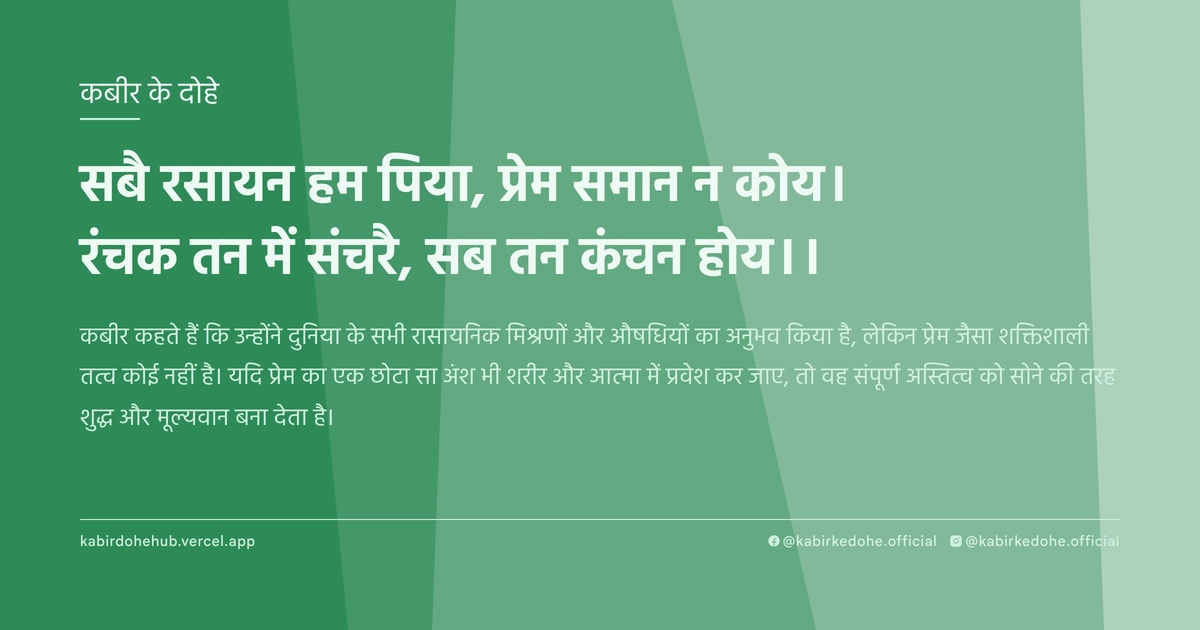
सबै रसायन हम पिया, प्रेम समान न कोय।
रंचक तन में संचरै, सब तन कंचन होय।।
Sabai rasaayan hum piya, prem samaan na koy. Ranchak tan mein sancharai, sab tan kanchan hoye.
इस पृष्ठ पर इस कबीर दोहे का अर्थ (meaning), हिंदी व्याख्या और अंग्रेज़ी अनुवाद, दार्शनिक विश्लेषण और व्यावहारिक जीवन सीख दी गई है। यह दोहा भक्ति (Bhakti) विषय से जुड़ा है — Kabir doha meaning and explanation in Hindi and English.
अर्थ (Meaning):
कबीर कहते हैं कि उन्होंने दुनिया के सभी रासायनिक मिश्रणों और औषधियों का अनुभव किया है, लेकिन प्रेम जैसा शक्तिशाली तत्व कोई नहीं है। यदि प्रेम का एक छोटा सा अंश भी शरीर और आत्मा में प्रवेश कर जाए, तो वह संपूर्ण अस्तित्व को सोने की तरह शुद्ध और मूल्यवान बना देता है।
Kabir asserts that he has tasted all the alchemical elixirs of the world, yet none equals the power of Divine Love. If even a tiny fraction of this love permeates the body and soul, it transforms the entire being into pure gold, refining the coarse human nature into a state of spiritual brilliance.
व्याख्या (Interpretation):
शाब्दिक रूप से, कबीर यहाँ 'रसायन' (Alchemy) का उल्लेख कर रहे हैं, जो उस समय के पारद और धातुओं को सोने में बदलने के विज्ञान से प्रेरित है। आध्यात्मिक स्तर पर, यह 'प्रेम' मानवीय आसक्ति नहीं, बल्कि 'ईश्वरीय प्रेम' या 'भक्ति' है। यह प्रेम निर्गुण भक्ति का सार है, जहाँ भक्त और भगवान के बीच का द्वैत समाप्त हो जाता है। माया के प्रभाव में मनुष्य स्वयं को शरीर मानता है, लेकिन प्रेम का स्पर्श उसे यह अहसास कराता है कि वह वास्तव में ब्रह्म का अंश है। यह रूपांतरण वैसा ही है जैसे लोहे का सोना बनना; यहाँ अहंकार का विसर्जन होता है और आत्मा की शुद्धता प्रकट होती है। यह विरोधाभास है कि सबसे सरल भावना—प्रेम—ही सबसे कठिन आध्यात्मिक उपलब्धि है।
Literally, Kabir references 'Rasayan' (Alchemy), drawing from the contemporary pursuit of turning base metals into gold. Spiritually, this 'Love' is not mundane attachment but 'Ishq-e-Haqiqi' or Divine Love. It is the essence of Nirgun Bhakti, where the duality between the devotee and the Divine dissolves. Under the veil of Maya, man identifies with the physical shell, but the touch of Love reveals the Atman's identity as Brahman. This transformation mirrors the alchemical process; the ego is incinerated, and the soul's inherent purity emerges. The central paradox lies in the fact that the simplest human emotion—love—is the most profound and difficult spiritual achievement, requiring the total annihilation of the 'I'.
दार्शनिक विश्लेषण (Philosophical Analysis):
कबीर का यह दोहा मध्यकालीन भारत के उस सामाजिक-धार्मिक परिवेश में रचा गया जहाँ कर्मकांड और बाहरी आडंबर चरम पर थे। कबीर ने स्पष्ट रूप से उन 'रसायनों' (शास्त्रों, अनुष्ठानों, और बाहरी योग क्रियाओं) को नकार दिया जो केवल बौद्धिक संतोष देते हैं। उनका दर्शन अद्वैत वेदांत के करीब है, जहाँ आत्मा और परमात्मा की एकता पर जोर दिया गया है, लेकिन उन्होंने इसे सूफी मत के 'इश्क' (प्रेम) के साथ जोड़ा।
यहाँ 'कंचन' (सोना) केवल भौतिक समृद्धि नहीं, बल्कि 'चित्त शुद्धि' का प्रतीक है। जब अहंकार (Ego) समाप्त होता है, तो जो शेष बचता है वह शुद्ध चेतना है। कबीर का तर्क है कि ज्ञान केवल सूचना है, लेकिन प्रेम एक अनुभव है जो रूपांतरण लाता है। यह सूफीवाद के 'फना' (स्वयं का विनाश) के समान है, जहाँ प्रेमी अपने अस्तित्व को प्रेमी (ईश्वर) में विलीन कर देता है।
सामाजिक रूप से, यह प्रेम जाति और धर्म की सीमाओं को तोड़ता है। यदि प्रेम ही सर्वोच्च रसायन है, तो यह किसी विशेष कुल या धर्म की बपौती नहीं हो सकता। यह एक सार्वभौमिक सत्य है जो हर मनुष्य के भीतर सुप्त अवस्था में है।
मनोवैज्ञानिक स्तर पर, कबीर 'भाव' की प्रधानता की बात कर रहे हैं। वे बताते हैं कि जब तक हृदय में करुणा और प्रेम नहीं जागता, तब तक हज़ारों ग्रंथों का अध्ययन व्यर्थ है। यह एक आंतरिक रसायन विज्ञान है जहाँ घृणा और क्रोध जैसे भारी तत्व प्रेम की अग्नि में जलकर हल्के और उज्ज्वल हो जाते हैं।
अंततः, यह दोहा यह संदेश देता है कि मोक्ष किसी कठिन तपस्या या बाहरी यात्रा से नहीं, बल्कि हृदय के भीतर प्रेम के एक छोटे से बीज के अंकुरण से प्राप्त होता है। यह 'सहज मार्ग' है, जो जटिलता को सरलता में बदल देता है।
This couplet was composed during a medieval Indian era dominated by rigid ritualism and external piety. Kabir explicitly rejects the 'alchemies' of his time—the rote memorization of scriptures, elaborate rituals, and mechanical yoga—which provided only intellectual satisfaction without spiritual transformation. His philosophy aligns closely with Advaita Vedanta's non-duality, yet it is infused with the Sufi concept of 'Ishq' (Divine Love).
'Kanchan' (Gold) here symbolizes 'Chitta Shuddhi' or the purification of the consciousness. When the ego is incinerated, what remains is pure, luminous awareness. Kabir argues that knowledge is merely information, whereas love is a lived experience that catalyzes transformation. This is analogous to the Sufi state of 'Fana' (annihilation), where the lover dissolves their identity into the Beloved.
Socially, this love transcends the boundaries of caste and creed. If love is the supreme alchemy, it cannot be the monopoly of any particular sect or religion. It is a universal truth latent within every human being, regardless of their social standing.
Psychologically, Kabir emphasizes the primacy of 'Bhava' (emotion/devotion). He suggests that without the awakening of compassion and love, the study of a thousand texts is futile. It is an internal chemistry where heavy elements like hatred and anger are burned away by the fire of love, leaving behind a light, radiant spirit.
Ultimately, the doha teaches that liberation (Mukti) is not achieved through arduous penance or external pilgrimages, but through the germination of a tiny seed of love within the heart. This is the 'Sahaja Marg' (the Natural Path), which transforms complexity into profound simplicity.
मूल संदेश (Core Message):
- बाहरी अनुष्ठान केवल आवरण हैं, प्रेम ही वास्तविक कुंजी है।
- अहंकार का विसर्जन ही आत्मा का स्वर्ण रूपांतरण है।
- प्रेम कोई भावना नहीं, बल्कि एक आध्यात्मिक रसायन है।
- निस्वार्थ करुणा ही ईश्वर तक पहुँचने का सबसे छोटा मार्ग है।
- जब 'मैं' मिटता है, तब केवल 'प्रेम' शेष रहता है।
- External rituals are mere veils; love is the only true key.
- The dissolution of ego is the golden transformation of the soul.
- Love is not merely an emotion, but a spiritual alchemy.
- Selfless compassion is the shortest path to the Divine.
- When the 'I' vanishes, only 'Love' remains.
व्यावहारिक उदाहरण (Practical Example):
वाराणसी के घाटों पर रहने वाला एक वृद्ध विधवा, जानकी, अपना पूरा जीवन कठोर नियमों, उपवासों और दूसरों की आलोचना में बिता चुकी थी। वह मानती थी कि पवित्रता केवल बाहरी शुद्धि और कठोर त्याग से आती है। वह अपने आस-पास के लोगों को उनकी गलतियों के लिए कोसती रहती थी और खुद को श्रेष्ठ मानती थी।
एक दिन, उसने देखा कि एक छोटा बच्चा, जो एक अछूत परिवार से था, एक घायल कुत्ते की देखभाल कर रहा था। वह बच्चा अपनी भूख की परवाह किए बिना अपनी रोटी का टुकड़ा उस जानवर को खिला रहा था और उसकी आँखों में एक ऐसी करुणा थी जिसे जानकी ने अपने जीवन के सभी उपवासों में कभी महसूस नहीं किया था।
जानकी को अचानक महसूस हुआ कि उसकी सारी 'पवित्रता' वास्तव में एक अहंकार था। उसने देखा कि वह बच्चा, जिसे समाज 'अपवित्र' मानता था, वास्तव में उस प्रेम से भरा था जिसने उसे सोने की तरह शुद्ध बना दिया था।
उस क्षण जानकी के भीतर कुछ टूट गया। उसने पहली बार उस बच्चे को पुकारा और उसकी मदद करने लगी। उसने महसूस किया कि जिस शांति की तलाश में उसने दशकों तक कठोर तप किया, वह उस बच्चे की एक सरल मुस्कान और निस्वार्थ प्रेम में छिपी थी।
धीरे-धीरे, जानकी का व्यवहार बदलने लगा। उसने लोगों की आलोचना करना छोड़ दिया और उनके दुखों को अपना समझने लगी। वह अब केवल मंदिर में पूजा नहीं करती थी, बल्कि हर पीड़ित व्यक्ति की सेवा में ईश्वर को खोजने लगी।
उसका घर, जो पहले सन्नाटे और कड़वाहट से भरा था, अब प्रेम और करुणा का केंद्र बन गया। लोग उसके पास शांति की तलाश में आने लगे, क्योंकि उसकी वाणी में अब कठोरता नहीं, बल्कि शहद जैसी मिठास थी।
उसने पाया कि जब उसने अपने भीतर के 'न्यायाधीश' को मारकर 'प्रेमी' को जन्म दिया, तो उसका जीवन वास्तव में 'कंचन' हो गया। उसकी बाहरी पहचान एक विधवा की थी, लेकिन उसकी आंतरिक पहचान अब सार्वभौमिक प्रेम की थी।
यह जानकी का 'कबीर ट्विस्ट' था—बाहरी अनुष्ठानों का त्याग और आंतरिक प्रेम का स्वीकार। उसने सीखा कि प्रेम का एक छोटा सा अंश ही पूरे जीवन की कड़वाहट को मिटाने के लिए पर्याप्त है।
Janaki, an elderly widow living on the ghats of Varanasi, had spent her entire life adhering to rigid rules, fasting, and criticizing others. She believed that purity was achieved only through external cleanliness and severe austerity. She constantly judged those around her, viewing herself as spiritually superior.
One day, she observed a young boy from an 'untouchable' family tending to a wounded dog. The child, ignoring his own hunger, fed his small piece of bread to the animal, his eyes reflecting a depth of compassion that Janaki had never encountered in all her years of fasting.
Suddenly, Janaki realized that her perceived 'purity' was actually a sophisticated form of ego. She saw that the boy, whom society deemed 'impure,' was infused with a love that had rendered his soul as pure as gold.
In that moment, something broke within Janaki. For the first time, she reached out to the boy and began helping him. She realized that the peace she had sought through decades of austerity was hidden in the simple smile and selfless love of that child.
Gradually, Janaki's behavior transformed. She stopped judging others and began to empathize with their suffering. She no longer sought God only in the temple but began finding the Divine in the service of every distressed soul.
Her home, once filled with silence and bitterness, became a sanctuary of love and compassion. People began visiting her seeking peace, for her voice no longer held judgment, but a honey-like sweetness.
She discovered that by killing the 'judge' within and giving birth to the 'lover,' her life had truly become 'Kanchan' (gold). While her external identity remained that of a widow, her internal identity had merged with universal love.
This was Janaki's 'Kabir Twist'—the abandonment of external rituals in favor of internal love. She learned that a tiny fraction of genuine love is sufficient to erase a lifetime of bitterness.
अभ्यास मार्गदर्शन (Practice Guidance):
- दैनिक ध्यान: प्रतिदिन 20 मिनट मौन बैठें और हृदय केंद्र में प्रेम की एक सुनहरी रोशनी की कल्पना करें जो धीरे-धीरे आपके पूरे शरीर में फैल रही है।
- आत्म-पूछताछ जर्नल: हर रात लिखें—'आज मैंने किस क्षण में अपने अहंकार को प्रेम के लिए समर्पित किया?' और 'कहाँ मेरी प्रतिक्रिया में प्रेम के बजाय निर्णय (Judgment) था?'
- व्यवहार परिवर्तन: दिन में कम से कम एक ऐसा कार्य करें जो पूरी तरह निस्वार्थ हो और जिसके बारे में किसी को पता न चले।
- निदान चेकलिस्ट: क्या मैं दूसरों की गलतियों पर तुरंत प्रतिक्रिया देता हूँ? (विफलता) | क्या मैं अजनबियों में भी अपने जैसे ही दुख और प्रेम को देख पाता हूँ? (सफलता) | क्या मेरी शांति बाहरी परिस्थितियों पर निर्भर है? (विफलता) | क्या मैं बिना किसी शर्त के क्षमा करने में सक्षम हूँ? (सफलता)
- Daily Meditation: Sit in silence for 20 minutes daily, visualizing a golden light of love at the heart center, gradually expanding to permeate every cell of your body.
- Self-Inquiry Journaling: Every night, record—'In which moment did I surrender my ego to love today?' and 'Where did my reaction stem from judgment rather than love?'
- Behavioral Shift: Perform at least one completely selfless act daily that remains anonymous and unacknowledged.
- Diagnostic Checklist: Do I react instantly to others' flaws? (Failure) | Can I perceive my own suffering and love in strangers? (Success) | Is my peace dependent on external conditions? (Failure) | Am I capable of unconditional forgiveness? (Success)
चिंतन प्रश्न (Reflection Questions):
- मेरा 'आध्यात्मिक गर्व' मुझे वास्तव में प्रेम करने से कैसे रोक रहा है?
- यदि मेरी सारी सामाजिक पहचान (पद, जाति, धर्म) छीन ली जाए, तो क्या मेरे भीतर प्रेम बचेगा?
- मैं किन लोगों को प्रेम नहीं कर पाता, और वह कौन सा आंतरिक डर है जो मुझे रोकता है?
- क्या मेरा प्रेम केवल उन लोगों के लिए है जो मुझे पसंद करते हैं, या यह सार्वभौमिक है?
- मेरे जीवन का वह कौन सा हिस्सा है जिसे मैं अभी भी 'सुधारने' की कोशिश कर रहा हूँ, जबकि मुझे उसे 'प्रेम' करने की ज़रूरत है?
- डिजिटल युग में, क्या मेरा 'प्रेम' केवल एक प्रदर्शन (Performance) है या एक वास्तविक अनुभव?
- How is my 'spiritual pride' actually preventing me from truly loving?
- If all my social identities (status, caste, religion) were stripped away, would love be all that remains?
- Who are the people I find impossible to love, and what internal fear is blocking me?
- Is my love reserved only for those who mirror my preferences, or is it universal?
- Which part of my life am I still trying to 'fix' when I actually need to 'love' it?
- In the digital age, is my 'love' merely a performance for an audience or a genuine internal experience?