
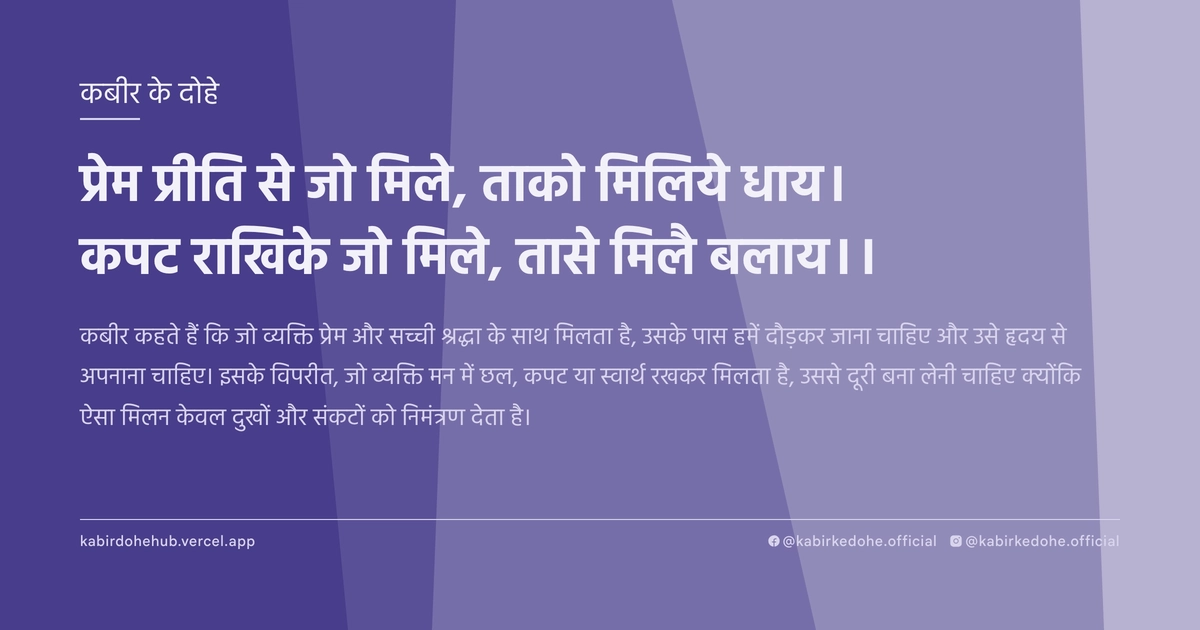
प्रेम प्रीति से जो मिले, ताको मिलिये धाय।
कपट राखिके जो मिले, तासे मिलै बलाय।।
Prem preeti se jo mile, taako miliye dhaay. Kapat rakhike jo mile, taase milai balaay.
इस पृष्ठ पर इस कबीर दोहे का अर्थ (meaning), हिंदी व्याख्या और अंग्रेज़ी अनुवाद, दार्शनिक विश्लेषण और व्यावहारिक जीवन सीख दी गई है। यह दोहा सत्य (Truth) विषय से जुड़ा है — Kabir doha meaning and explanation in Hindi and English.
अर्थ (Meaning):
कबीर कहते हैं कि जो व्यक्ति प्रेम और सच्ची श्रद्धा के साथ मिलता है, उसके पास हमें दौड़कर जाना चाहिए और उसे हृदय से अपनाना चाहिए। इसके विपरीत, जो व्यक्ति मन में छल, कपट या स्वार्थ रखकर मिलता है, उससे दूरी बना लेनी चाहिए क्योंकि ऐसा मिलन केवल दुखों और संकटों को निमंत्रण देता है।
Kabir asserts that one should rush to embrace and connect with those who approach with genuine love and sincere affection. Conversely, he warns that meeting or associating with those who harbor deceit, hypocrisy, or hidden agendas in their hearts only brings about misfortune and spiritual distress.
व्याख्या (Interpretation):
शाब्दिक अर्थ में यह दोहा सामाजिक व्यवहार की बात करता है, परंतु आध्यात्मिक स्तर पर यह 'भाव' की शुद्धता पर केंद्रित है। यहाँ 'प्रेम' केवल मानवीय भावना नहीं, बल्कि वह दिव्य चेतना है जो अहंकार को मिटा देती है। जब हम किसी से प्रेमपूर्वक मिलते हैं, तो हम वास्तव में अपने भीतर के परमात्मा का दूसरे में साक्षात्कार करते हैं, जो निर्गुण भक्ति का मूल है। कपट का अर्थ है 'माया' का पर्दा, जहाँ व्यक्ति अपनी पहचान को झूठे मुखौटों से ढकता है। यह द्वैत पैदा करता है और आत्मा को सत्य से दूर ले जाता है। कबीर संकेत करते हैं कि बिना हृदय की पवित्रता के कोई भी आध्यात्मिक या सांसारिक संबंध फलदायी नहीं हो सकता। अंततः, यह दोहा हमें सिखाता है कि बाहरी मिलन से अधिक महत्वपूर्ण आंतरिक संरेखण है।
Literally, this couplet addresses social conduct, but spiritually, it focuses on the purity of 'Bhava' (inner disposition). Here, 'Love' is not merely a human emotion but the divine consciousness that dissolves the ego. When we meet someone with love, we are essentially witnessing the Atman within the other, which is the core of Nirgun Bhakti. 'Deceit' represents the veil of Maya, where an individual hides their true self behind false masks, creating a duality that separates the soul from the Truth. Kabir suggests that no spiritual or worldly connection can be fruitful without the purity of heart. Ultimately, the doha teaches that internal alignment is far more critical than the external act of meeting. It highlights the paradox that true connection requires the total annihilation of the calculating mind.
दार्शनिक विश्लेषण (Philosophical Analysis):
कबीर का यह दोहा उस युग की उपज है जहाँ धार्मिक पाखंड और बाहरी कर्मकांड चरम पर थे। उन्होंने देखा कि लोग मंदिर-मस्जिद तो जाते हैं, लेकिन उनके दिलों में घृणा और छल भरा होता है। कबीर ने इस 'दिखावे' को सिरे से खारिज कर दिया। उनका दर्शन अद्वैत वेदांत के करीब है, जहाँ वे मानते हैं कि ईश्वर किसी विशेष स्थान पर नहीं, बल्कि शुद्ध प्रेम में निवास करता है।
सूफी मत के 'इश्क-ए-हकीकी' (ईश्वरीय प्रेम) का प्रभाव यहाँ स्पष्ट है। सूफीवाद में भी यह माना गया है कि अहंकार (नफ्स) को मिटाए बिना खुदा की प्राप्ति असंभव है। कबीर के लिए 'कपट' वही अहंकार है जो मनुष्य को उसकी वास्तविक प्रकृति से अलग करता है। जब तक मन में छल है, तब तक व्यक्ति 'माया' के जाल में फंसा रहता है और सत्य का अनुभव नहीं कर पाता।
यह दोहा जाति और धर्म की सीमाओं को तोड़ता है। कबीर कहते हैं कि एक उच्च जाति का कपटी व्यक्ति, एक निम्न जाति के प्रेमी व्यक्ति से कहीं अधिक निम्न है। यहाँ नैतिकता का पैमाना जन्म या शास्त्र नहीं, बल्कि हृदय की सच्चाई है। यह सामाजिक क्रांति का एक सूक्ष्म आह्वान है, जहाँ मानवीय संवेदनाओं को धार्मिक नियमों से ऊपर रखा गया है।
मनोवैज्ञानिक स्तर पर, यह दोहा 'प्रोजेक्शन' और 'शैडो' के सिद्धांत को छूता है। जो व्यक्ति कपट करता है, वह वास्तव में अपने आंतरिक डर और असुरक्षा को छिपा रहा होता है। ऐसा व्यक्ति दूसरों के लिए विषाक्त होता है क्योंकि उसका व्यवहार उसकी आंतरिक उथल-पुथल का प्रतिबिंब होता है। कबीर हमें सचेत करते हैं कि ऐसे नकारात्मक ऊर्जा क्षेत्रों से बचना आत्म-संरक्षण का हिस्सा है।
अंततः, कबीर का संदेश यह है कि परमात्मा तक पहुँचने का एकमात्र मार्ग 'प्रेम' है। यह प्रेम कोई सांसारिक मोह नहीं, बल्कि एक आध्यात्मिक अनुशासन है। जब हम बिना किसी शर्त के, बिना किसी अपेक्षा के किसी से मिलते हैं, तो वह मिलन केवल दो शरीरों का नहीं, बल्कि दो आत्माओं का मिलन बन जाता है, जिससे द्वैत समाप्त होता है और अद्वैत की स्थिति प्राप्त होती है।
This doha emerges from an era where religious hypocrisy and external rituals were rampant. Kabir observed that while people frequented temples and mosques, their hearts remained filled with hatred and deceit. He categorically rejected this 'performance' of piety, aligning his philosophy with Advaita Vedanta, suggesting that the Divine resides not in structures, but in pure, unadulterated love.
The influence of the Sufi concept of 'Ishq-e-Haqiqi' (Divine Love) is evident here. Sufism posits that reaching the Creator is impossible without the annihilation of the ego (Nafs). For Kabir, 'deceit' is that very ego which alienates the human being from their true nature. As long as hypocrisy exists, the individual remains trapped in the web of Maya, unable to perceive the Absolute Truth.
This teaching transcends the boundaries of caste and creed. Kabir asserts that a deceitful person of high caste is spiritually inferior to a loving person of low caste. Here, the metric of morality is not birth or scripture, but the authenticity of the heart. This is a subtle call for social revolution, prioritizing human empathy over rigid religious laws.
Psychologically, the doha touches upon the concepts of projection and the 'shadow.' A deceitful person is essentially hiding their internal fears and insecurities. Such individuals become toxic to others because their behavior is a reflection of their internal turmoil. Kabir warns that avoiding these negative energy fields is a necessary act of spiritual self-preservation.
Ultimately, Kabir's message is that the only path to the Divine is through Love. This is not mundane attachment, but a spiritual discipline. When we meet another without conditions or expectations, the encounter ceases to be between two bodies and becomes a union of two souls, dissolving duality and realizing the state of Non-duality (Advaita).
मूल संदेश (Core Message):
- अहंकार और दिखावा सत्य के मार्ग में सबसे बड़ी बाधाएं हैं।
- शुद्ध प्रेम ही वह एकमात्र कुंजी है जो ईश्वरीय द्वार खोलती है।
- बाहरी शिष्टाचार व्यर्थ है यदि हृदय में छल व्याप्त है।
- सच्चा मिलन वह है जहाँ दो आत्माएं बिना किसी मुखौटे के मिलें।
- निस्वार्थ भाव ही मनुष्य को पशुता से दिव्यता की ओर ले जाता है।
- Ego and performance are the greatest obstacles on the path to Truth.
- Pure love is the only key that unlocks the gates of the Divine.
- External etiquette is futile if the heart is permeated by deceit.
- True union occurs only when two souls meet without any masks.
- Selflessness is the bridge that leads a human from animality to divinity.
व्यावहारिक उदाहरण (Practical Example):
वाराणसी के एक पुराने घाट पर रहने वाली एक वृद्ध विधवा, जानकी, का जीवन अत्यंत कठिन था। वह दूसरों के घरों में बर्तन मांजकर अपना गुजारा करती थी। शहर के लोग उसे उसकी गरीबी और उसकी स्थिति के कारण अनदेखा करते थे, लेकिन जानकी के भीतर एक असीम करुणा थी। वह अपनी छोटी सी कमाई में से भी कुछ हिस्सा भूखे कुत्तों और पक्षियों को खिलाने में खर्च करती थी।
उसी शहर में एक प्रतिष्ठित पंडित जी थे, जो शास्त्रों के ज्ञाता थे और पूरे शहर में अपनी धर्मपरायणता के लिए जाने जाते थे। वे हमेशा माथे पर चंदन लगाकर और हाथ में माला लेकर चलते थे। लेकिन उनके भीतर एक गहरा अहंकार था। वे अपनी प्रतिष्ठा को बनाए रखने के लिए अक्सर झूठ बोलते थे और गुप्त रूप से अपने प्रतिस्पर्धियों को नीचा दिखाने की साजिशें रचते थे।
एक दिन, पंडित जी के घर में एक बड़ा उत्सव था। उन्होंने शहर के सभी 'विद्वानों' को आमंत्रित किया था। जानकी को वहां केवल सफाई के काम के लिए बुलाया गया था। उत्सव के दौरान, पंडित जी ने एक बहुत ही जटिल आध्यात्मिक प्रश्न पर चर्चा शुरू की, जिसमें वे अपनी श्रेष्ठता सिद्ध करने की कोशिश कर रहे थे। वे शब्दों के जाल बुन रहे थे, लेकिन उनकी बातों में वह गहराई नहीं थी जो आत्मा को छुए।
तभी, एक बाहरी यात्री, जो एक महान संत थे, वहां पहुंचे। उन्होंने पंडित जी के शब्दों की चमक देखी, लेकिन उनकी आंखों में छिपे कपट को भी पहचान लिया। संत ने पंडित जी की बातों का उत्तर देने के बजाय, चुपचाप कोने में खड़ी जानकी की ओर देखा, जो पूरी श्रद्धा और प्रेम से उस माहौल की सेवा कर रही थी।
संत ने पंडित जी के सामने से उठकर जानकी के चरणों में अपना सिर झुका दिया। पूरा दरबार सन्न रह गया। पंडित जी क्रोधित हुए और बोले, "महाराज, यह तो एक साधारण दासी है, इसमें आपको क्या दिखा? मैं यहाँ शास्त्रों की चर्चा कर रहा हूँ!"
संत ने मुस्कुराते हुए कहा, "पंडित जी, आपके पास शब्दों का भंडार है, लेकिन हृदय में कपट है। आप सत्य को जानते हैं, पर उसे जीते नहीं। इस स्त्री के पास कोई शास्त्र नहीं है, लेकिन इसका हृदय प्रेम की शुद्धता से भरा है। आपने मुझे अपने ज्ञान से बुलाने की कोशिश की, लेकिन इस स्त्री की निस्वार्थ सेवा ने मुझे अपनी ओर खींचा।"
पंडित जी को पहली बार अपनी आंतरिक रिक्तता का अहसास हुआ। उन्हें समझ आया कि वे अब तक केवल एक मुखौटा पहनकर जी रहे थे। उन्होंने महसूस किया कि उनकी सारी पूजा-पाठ व्यर्थ थी क्योंकि उसमें 'प्रेम' नहीं, बल्कि 'अहंकार' था।
उस दिन के बाद, पंडित जी ने अपनी दिखावटी जीवनशैली छोड़ दी। उन्होंने जानकी को अपनी मार्गदर्शक माना और सीखा कि कैसे बिना किसी स्वार्थ के दूसरों की सेवा की जाती है। उन्होंने जाना कि ईश्वर मंदिर की मूर्तियों में नहीं, बल्कि उस प्रेम में है जो एक इंसान को दूसरे इंसान से बिना किसी शर्त के जोड़ता है।
In the ancient ghats of Varanasi lived Janaki, an elderly widow whose life was marked by extreme hardship. She earned a meager living by scrubbing pots in others' homes. The townspeople ignored her due to her poverty and social status, yet Janaki possessed an infinite reservoir of compassion. She spent a portion of her tiny earnings feeding stray dogs and birds.
In the same city lived a prestigious Pandit, a scholar of the scriptures known throughout the town for his outward piety. He always wore sandalwood paste on his forehead and carried prayer beads. However, beneath this facade lay a deep-seated ego. He frequently lied to maintain his reputation and secretly plotted to undermine his rivals.
One day, the Pandit hosted a grand celebration at his home, inviting all the 'learned' men of the city. Janaki was summoned only to perform the cleaning chores. During the feast, the Pandit initiated a complex spiritual debate, attempting to prove his superiority. He wove a web of sophisticated words, but his discourse lacked the depth that touches the soul.
At that moment, a traveling monk, a realized saint, arrived. He noticed the brilliance of the Pandit's words but immediately sensed the deceit hidden in his eyes. Instead of engaging in the debate, the saint looked toward Janaki, who was serving the guests with profound devotion and love in a quiet corner.
To the shock of the entire assembly, the saint stood up and bowed deeply at Janaki's feet. The Pandit was outraged and exclaimed, "Maharaj, she is but a simple servant! What do you see in her? I am here discussing the highest scriptures!"
The saint smiled and replied, "Pandit ji, you possess a treasury of words, but your heart is filled with deceit. You know the Truth, but you do not live it. This woman has no scriptures, yet her heart is pure love. You tried to attract me with your knowledge, but this woman's selfless service pulled me toward her."
For the first time, the Pandit felt his internal emptiness. He realized he had been living behind a mask. He understood that all his rituals were futile because they were fueled by ego rather than love.
From that day forward, the Pandit abandoned his performative lifestyle. He accepted Janaki as his spiritual guide and learned how to serve others without expectation. He discovered that God does not reside in the idols of temples, but in the love that connects one human being to another without conditions.
अभ्यास मार्गदर्शन (Practice Guidance):
- प्रतिदिन 15 मिनट मौन ध्यान करें, जहाँ आप अपने भीतर उठने वाले 'कपट' या 'दिखावे' के विचारों को बिना किसी निर्णय के केवल देखें।
- एक 'ईमानदारी जर्नल' बनाएँ: दिन भर में ऐसे क्षणों को लिखें जब आपने अपनी छवि को बेहतर दिखाने के लिए झूठ बोला या अपनी भावनाओं को छिपाया।
- व्यवहार परिवर्तन: प्रतिदिन कम से कम एक व्यक्ति की मदद करें, लेकिन इस शर्त पर कि उस व्यक्ति को कभी पता न चले कि मदद किसने की है (गुमनाम सेवा)।
- निदान चेकलिस्ट: क्या मैं दूसरों की प्रशंसा पाने के लिए अच्छे कार्य करता हूँ? क्या मैं लोगों से मिलते समय उनके लाभ के बारे में सोचता हूँ? यदि हाँ, तो यह 'कपट' की उपस्थिति है।
- Practice 15 minutes of silent meditation daily, observing the thoughts of 'deceit' or 'performance' that arise within you without judgment.
- Maintain an 'Honesty Journal': Record moments during the day when you lied or suppressed your true feelings simply to project a better image of yourself.
- Behavioral Shift: Perform at least one act of kindness daily, ensuring that the recipient never discovers who helped them (anonymous service).
- Diagnostic Checklist: Do I perform good deeds primarily to receive praise? Do I calculate the potential benefit when meeting someone? If yes, this indicates the presence of 'Kapat' (deceit).
चिंतन प्रश्न (Reflection Questions):
- मेरे व्यक्तित्व का वह कौन सा हिस्सा है जिसे मैं दुनिया से छिपाता हूँ ताकि मैं 'अच्छा' दिख सकूँ?
- क्या मेरा प्रेम वास्तव में दूसरे के लिए है, या यह केवल मेरी अपनी भावनात्मक जरूरतों को पूरा करने का एक तरीका है?
- जब मैं किसी ऐसे व्यक्ति से मिलता हूँ जिसे मैं 'नापसंद' करता हूँ, तो मेरा व्यवहार कितना कृत्रिम होता है?
- मेरे जीवन में 'कपट' के वे कौन से सूक्ष्म रूप हैं जिन्हें मैं 'डिप्लोमेसी' या 'समझदारी' का नाम देता हूँ?
- यदि आज मेरी सारी सामाजिक प्रतिष्ठा और पद छीन लिए जाएं, तो क्या मेरे भीतर इतना प्रेम बचेगा कि मैं दूसरों से जुड़ सकूँ?
- Which part of my personality do I hide from the world just to appear 'good' or 'righteous'?
- Is my love truly for the other, or is it merely a way to satisfy my own emotional needs?
- How artificial is my behavior when I encounter someone I fundamentally dislike?
- What are the subtle forms of 'deceit' in my life that I mislabel as 'diplomacy' or 'prudence'?
- If all my social status and titles were stripped away today, would there be enough love left within me to connect with others?