
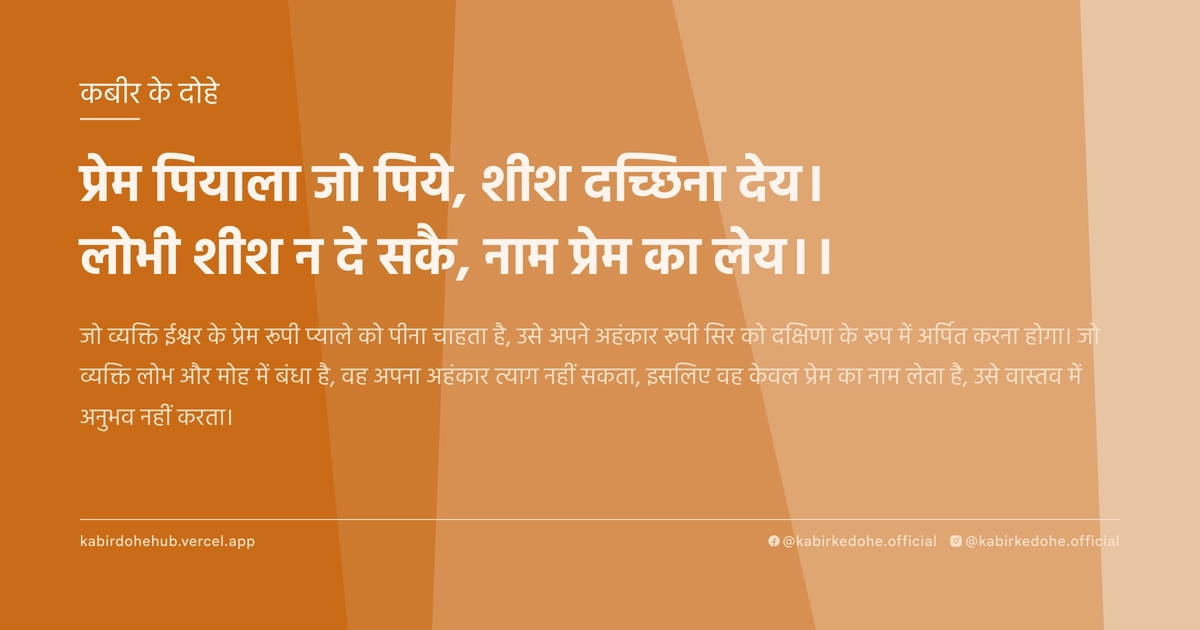
प्रेम पियाला जो पिये, शीश दच्छिना देय।
लोभी शीश न दे सकै, नाम प्रेम का लेय।।
Prem piyala jo piye, sheesh dacchina dey. Lobhi sheesh na de sakai, naam prem ka ley.
इस पृष्ठ पर इस कबीर दोहे का अर्थ (meaning), हिंदी व्याख्या और अंग्रेज़ी अनुवाद, दार्शनिक विश्लेषण और व्यावहारिक जीवन सीख दी गई है। यह दोहा भक्ति (Bhakti) विषय से जुड़ा है — Kabir doha meaning and explanation in Hindi and English.
अर्थ (Meaning):
जो व्यक्ति ईश्वर के प्रेम रूपी प्याले को पीना चाहता है, उसे अपने अहंकार रूपी सिर को दक्षिणा के रूप में अर्पित करना होगा। जो व्यक्ति लोभ और मोह में बंधा है, वह अपना अहंकार त्याग नहीं सकता, इसलिए वह केवल प्रेम का नाम लेता है, उसे वास्तव में अनुभव नहीं करता।
Whoever wishes to drink from the cup of Divine Love must offer their head—the symbol of ego—as a gift. The greedy, bound by attachment and self-interest, cannot surrender this ego; thus, they merely utter the word 'love' without ever tasting its true essence.
व्याख्या (Interpretation):
इस दोहे का शाब्दिक अर्थ है कि आध्यात्मिक ज्ञान की प्राप्ति के लिए पूर्ण समर्पण आवश्यक है। यहाँ 'शीश' केवल शारीरिक सिर नहीं, बल्कि 'अहंकार' (Ego) का प्रतीक है। कबीर निरगुण भक्ति की बात करते हैं जहाँ ईश्वर किसी मूर्ति में नहीं, बल्कि हृदय की गहराई में है। माया मनुष्य को यह विश्वास दिलाती है कि वह अपनी पहचान और पद को बचाकर मोक्ष पा सकता है, लेकिन अद्वैत वेदांत के अनुसार, जब तक 'मैं' (Individual Ego) जीवित है, तब तक 'ब्रह्म' (Universal Consciousness) का अनुभव असंभव है। यह एक विरोधाभास है: जिसे पाना है, उसे पाने के लिए पहले खुद को पूरी तरह खोना होगा। यह पूर्ण विसर्जन ही आत्मा और परमात्मा के मिलन की एकमात्र शर्त है।
Literally, the couplet asserts that spiritual realization requires total surrender. The 'head' here is not a physical organ but a metaphor for the 'Ahamkara' or the ego. Kabir speaks of Nirgun Bhakti, where the Divine is not found in idols but within the depths of the heart. Maya creates the illusion that one can achieve liberation while clinging to personal identity and status, yet according to Advaita Vedanta, as long as the 'I' persists, the experience of Brahman is impossible. This presents a central paradox: to attain the Ultimate, one must first lose the self entirely. This total dissolution is the only prerequisite for the union of the Atman and the Paramatman.
दार्शनिक विश्लेषण (Philosophical Analysis):
कबीर का यह दोहा मध्यकालीन भारत के उस दौर का है जब धर्म कर्मकांडों और बाहरी दिखावे में सिमट गया था। कबीर ने पुरोहितवाद और जातिगत श्रेष्ठता को चुनौती दी, क्योंकि ये दोनों ही अहंकार के सबसे प्रबल रूप हैं। उनका दर्शन सूफीवाद के 'फना' (स्वयं का विनाश) और वेदांत के 'अद्वैत' (गैर-द्वैत) का संगम है। वे कहते हैं कि प्रेम कोई भावना नहीं, बल्कि एक अग्नि है जो अशुद्धियों को जला देती है।
यहाँ 'लोभी' शब्द केवल धन के लालच के लिए नहीं है, बल्कि यह उस मानसिक स्थिति को दर्शाता है जहाँ व्यक्ति अपनी पहचान, अपनी प्रतिष्ठा और अपने 'सही होने' के गर्व को छोड़ने से डरता है। यह मनोवैज्ञानिक बंधन ही है जो साधक को किनारे पर खड़ा रखता है।
कबीर के अनुसार, अधिकांश लोग 'प्रेम का नाम' लेते हैं, जिसका अर्थ है कि वे प्रेम के बारे में बात करते हैं, कविताएँ पढ़ते हैं या धार्मिक चर्चाएँ करते हैं, लेकिन वे उस प्रेम में डूबने का साहस नहीं करते। यह 'बौद्धिक प्रेम' और 'अनुभवात्मक प्रेम' के बीच का अंतर है।
दार्शनिक स्तर पर, यह दोहा इस सत्य को उजागर करता है कि ज्ञान (Jnana) और भक्ति (Bhakti) अलग नहीं हैं। जब अहंकार का विसर्जन होता है, तो ज्ञान स्वतः प्रकट हो जाता है। यह शून्य की अवस्था है जहाँ से सृजन शुरू होता है।
अंततः, कबीर यह समझाते हैं कि ईश्वर की प्राप्ति किसी मंदिर या मस्जिद में नहीं, बल्कि उस क्षण में होती है जब मनुष्य अपनी सीमित पहचान को त्यागकर अनंत में विलीन हो जाता है। यह अहंकार की मृत्यु और आत्मा का पुनर्जन्म है।
This couplet emerges from a medieval Indian era where religion had devolved into rigid rituals and outward displays. Kabir challenged the priestly class and caste hierarchies, recognizing them as the most potent forms of ego. His philosophy is a synthesis of the Sufi concept of 'Fana' (annihilation of the self) and the Vedantic principle of 'Advaita' (non-duality). He posits that Love is not a mere emotion, but a transformative fire that incinerates all impurities.
The term 'greedy' (Lobhi) does not refer solely to material wealth, but to a psychological state where an individual clings to their identity, reputation, and the pride of being 'right.' This mental attachment is the very barrier that keeps the seeker stranded on the shore of superficiality.
Kabir observes that most people merely 'take the name of love,' meaning they discuss love, read poetry, or engage in religious discourse, yet they lack the courage to actually drown in it. This highlights the critical distinction between intellectual knowledge of love and the experiential realization of it.
On a philosophical level, the verse reveals that Jnana (knowledge) and Bhakti (devotion) are not disparate paths. When the ego is dissolved, knowledge manifests spontaneously. It is the state of 'Shunya' (void) from which all true creation begins.
Ultimately, Kabir teaches that the Divine is not found in temples or mosques, but in the precise moment a human transcends their limited identity to merge with the Infinite. It is the death of the ego and the rebirth of the soul.
मूल संदेश (Core Message):
- अहंकार का त्याग ही वास्तविक प्रेम का प्रवेश द्वार है।
- बौद्धिक ज्ञान केवल शब्द हैं; अनुभव ही वास्तविक सत्य है।
- जब 'मैं' मिटता है, तभी 'वह' (परमात्मा) प्रकट होता है।
- समर्पण का अर्थ हारना नहीं, बल्कि अनंत में विलीन होना है।
- प्रेम कोई भावना नहीं, बल्कि स्वयं के विसर्जन की प्रक्रिया है।
- The surrender of ego is the only gateway to true Love.
- Intellectual knowledge is mere words; experience is the only truth.
- Only when the 'I' vanishes does the 'Divine' manifest.
- Surrender is not defeat, but merging into the Infinite.
- Love is not an emotion, but a process of self-dissolution.
व्यावहारिक उदाहरण (Practical Example):
वाराणसी के घाटों पर रहने वाले एक वृद्ध विधवा, जानकी, की कहानी है। जानकी ने अपना पूरा जीवन कठोर नियमों, सामाजिक मर्यादाओं और इस विश्वास में बिताया कि उनकी पवित्रता उनके त्याग और दूसरों की तुलना में उनके अधिक 'धार्मिक' होने में निहित है। वह अन्य महिलाओं को उनकी गलतियों पर टोकती और स्वयं को आध्यात्मिक रूप से श्रेष्ठ मानती थी।
एक दिन, एक युवा साधु उनके पास आए और उन्होंने जानकी से पूछा, 'माँ, आप ईश्वर को कितना चाहती हैं?' जानकी ने गर्व से कहा, 'मैं अपना पूरा जीवन उनकी सेवा में लगा चुकी हूँ।' साधु मुस्कुराए और बोले, 'लेकिन आप अभी भी अपनी इस श्रेष्ठता को पकड़े हुए हैं। क्या आप इस गर्व को छोड़कर केवल एक साधारण स्त्री बन सकती हैं?'
जानकी को पहले तो यह बात चुभी, लेकिन रात भर वह सोचती रहीं। उन्हें एहसास हुआ कि उनकी 'भक्ति' वास्तव में उनके अहंकार का एक नया रूप थी। वे ईश्वर से प्रेम नहीं कर रही थीं, बल्कि वे इस बात से प्रेम कर रही थीं कि वे एक 'भक्त' हैं।
अगली सुबह, उन्होंने अपनी वह पुरानी चादर फेंकी जिसे वे अपनी पवित्रता का प्रतीक मानती थीं और घाट पर सफाई करने वाली एक अन्य महिला की मदद करने लगीं, बिना यह सोचे कि वह उनके स्तर की है या नहीं।
जैसे ही उन्होंने अपनी 'श्रेष्ठता' का वह मानसिक बोझ उतारा, उन्हें एक असीम शांति का अनुभव हुआ। उन्होंने महसूस किया कि जिस ईश्वर को वे नियमों में खोज रही थीं, वह तो उनके भीतर की विनम्रता में छिपा था।
उनका व्यवहार पूरी तरह बदल गया। अब वे दूसरों को सुधारने के बजाय, उनकी सेवा करने लगीं।
उनकी आँखों में अब निर्णय नहीं, बल्कि करुणा थी।
यह जानकी का 'शीश' देना था—अपने अहंकार का विसर्जन।
अब वे केवल प्रेम की बातें नहीं करती थीं, बल्कि वे स्वयं प्रेम बन गई थीं।
उनकी मुक्ति किसी तीर्थ में नहीं, बल्कि अपने भीतर के 'मैं' को मारने में मिली।
Consider the story of Janaki, an elderly widow living on the ghats of Varanasi. Janaki spent her entire life adhering to rigid rules, social norms, and the belief that her sanctity lay in her sacrifices and her perceived 'superior piety' compared to others. She frequently corrected other women and viewed herself as spiritually advanced.
One day, a young monk approached her and asked, 'Mother, how much do you love the Divine?' Janaki replied with pride, 'I have dedicated my entire life to His service.' The monk smiled and said, 'But you are still clinging to this sense of superiority. Can you let go of this pride and simply become an ordinary woman?'
Initially, Janaki felt offended, but she pondered this throughout the night. She realized that her 'devotion' was actually a sophisticated form of ego. She wasn't loving God; she was loving the identity of being a 'devotee.'
The next morning, she cast aside the old shawl she used as a symbol of her purity and began helping another woman clean the ghats, without considering whether the other woman was of her social or spiritual standing.
As she shed the mental burden of her 'superiority,' she experienced an overwhelming sense of peace. She realized that the Divine she had sought through rules was hidden within her own humility.
Her behavior transformed completely. Instead of trying to correct others, she began to serve them.
Her eyes no longer held judgment, but compassion.
This was Janaki's act of 'offering her head'—the dissolution of her ego.
She no longer merely spoke of love; she became love itself.
Her liberation was found not in a pilgrimage, but in the killing of the 'I' within.
अभ्यास मार्गदर्शन (Practice Guidance):
- प्रतिदिन 20 मिनट मौन ध्यान करें, जहाँ आप अपने भीतर उठने वाले 'मैं' (अहंकार) के विचारों को केवल देखें, बिना उनसे जुड़े।
- एक डायरी लिखें जिसमें आप उन क्षणों को दर्ज करें जब आपने अपनी बात सही साबित करने के लिए बहस की। विश्लेषण करें कि उस समय आपका 'शीश' (अहंकार) कैसे सक्रिय था।
- सचेत सेवा: सप्ताह में एक बार ऐसा कार्य करें जिसमें आपको कोई श्रेय न मिले और आपकी पहचान गुप्त रहे।
- निदान चेकलिस्ट: क्या मैं दूसरों को छोटा महसूस कराता हूँ? क्या मैं अपनी धार्मिकता का प्रदर्शन करता हूँ? क्या मैं आलोचना सुनकर विचलित होता हूँ? यदि हाँ, तो अहंकार अभी जीवित है।
- Practice 20 minutes of silent meditation daily, observing the arising thoughts of 'I' (ego) without attaching to them.
- Maintain a journal recording moments where you argued just to prove yourself right. Analyze how your 'head' (ego) was active during that interaction.
- Conscious Service: Once a week, perform an act of kindness where you receive no credit and your identity remains anonymous.
- Diagnostic Checklist: Do I make others feel inferior? Do I perform my spirituality for an audience? Do I feel disturbed by criticism? If yes, the ego is still alive.
चिंतन प्रश्न (Reflection Questions):
- मेरी वह कौन सी 'पवित्रता' या 'अच्छाई' है जिसका उपयोग मैं दूसरों को नीचा दिखाने के लिए करता हूँ?
- यदि मेरी सारी उपलब्धियाँ और पद छीन लिए जाएँ, तो मेरे भीतर क्या बचेगा?
- क्या मैं वास्तव में प्रेम करना चाहता हूँ, या मैं केवल 'प्रेम करने वाले' की छवि पसंद करता हूँ?
- मेरे जीवन का वह कौन सा क्षेत्र है जहाँ मैं अभी भी अपनी 'सही होने' की जिद पर अड़ा हूँ?
- क्या मेरी भक्ति मुझे विनम्र बना रही है, या मुझे और अधिक अहंकारी?
- डिजिटल दुनिया में मेरी छवि (Profile) मेरे वास्तविक स्वरूप को कितना ढक रही है?
- What 'purity' or 'goodness' do I possess that I secretly use to feel superior to others?
- If all my achievements and titles were stripped away, what would remain of me?
- Do I truly desire to love, or do I simply enjoy the image of being a 'loving person'?
- In which area of my life am I still stubbornly clinging to the need to be 'right'?
- Is my spirituality making me humble, or is it fueling a more subtle form of pride?
- To what extent does my digital persona mask the shadows of my true self?