
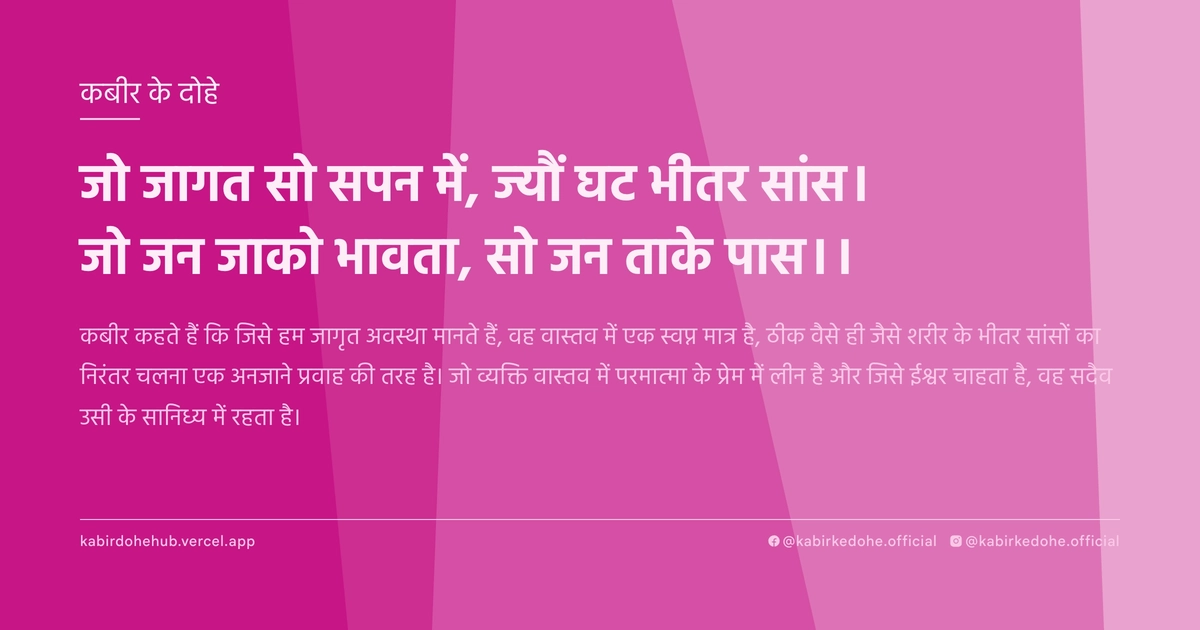
जो जागत सो सपन में, ज्यौं घट भीतर सांस।
जो जन जाको भावता, सो जन ताके पास।।
Jo jaagat so sapan mein, jyaun ghat bhitar saans. Jo jan jaako bhavta, so jan taake paas.
इस पृष्ठ पर इस कबीर दोहे का अर्थ (meaning), हिंदी व्याख्या और अंग्रेज़ी अनुवाद, दार्शनिक विश्लेषण और व्यावहारिक जीवन सीख दी गई है। यह दोहा अंतर ज्योति (The Inner Light) विषय से जुड़ा है — Kabir doha meaning and explanation in Hindi and English.
अर्थ (Meaning):
कबीर कहते हैं कि जिसे हम जागृत अवस्था मानते हैं, वह वास्तव में एक स्वप्न मात्र है, ठीक वैसे ही जैसे शरीर के भीतर सांसों का निरंतर चलना एक अनजाने प्रवाह की तरह है। जो व्यक्ति वास्तव में परमात्मा के प्रेम में लीन है और जिसे ईश्वर चाहता है, वह सदैव उसी के सानिध्य में रहता है।
Kabir asserts that what we perceive as the waking state is actually a dream, much like the unconscious flow of breath within the body. He suggests that the one who is truly beloved by the Divine, and who reciprocates that love, remains in eternal communion with the Absolute, transcending the illusion of separation.
व्याख्या (Interpretation):
इस दोहे का शाब्दिक अर्थ है कि हमारी जाग्रत अवस्था भी एक सपना है। रूपकात्मक रूप से, कबीर यहाँ 'माया' के प्रभाव की व्याख्या कर रहे हैं, जहाँ संसार की भौतिकता को सत्य मान लिया जाता है। 'घट भीतर सांस' का उल्लेख यह दर्शाता है कि सत्य हमारे भीतर ही है, फिर भी हम उसे बाहर खोजते हैं। यह निर्गुण भक्ति का सार है, जहाँ ईश्वर किसी मंदिर या मस्जिद में नहीं, बल्कि आत्मा के भीतर स्थित है। अद्वैत वेदांत के अनुसार, जब तक अहंकार है, तब तक हम स्वप्न में हैं; अहंकार के मिटते ही ब्रह्म का साक्षात्कार होता है। यह विरोधाभास है कि हम जागते हुए भी सो रहे हैं और केवल प्रेम के माध्यम से ही वास्तविक जागरण संभव है।
Literally, the verse claims that our waking life is a dream. Metaphorically, Kabir explores the veil of Maya, where material existence is mistaken for ultimate reality. The reference to 'breath within the body' signifies that the Truth is immanent, yet overlooked. This aligns with Nirgun Bhakti, where the Divine is not an external deity but the formless essence within. According to Advaita Vedanta, the ego is the primary architect of this 'waking dream'; only upon its dissolution does the non-duality of Atman and Brahman emerge. The central paradox is that humanity remains asleep while awake, and only through the alchemy of divine love can one achieve true awakening.
दार्शनिक विश्लेषण (Philosophical Analysis):
कबीर का यह दृष्टिकोण उनके युग के कट्टरपंथी धार्मिक अनुष्ठानों के विरुद्ध एक सशक्त प्रहार था। उन्होंने बाहरी आडंबरों, जैसे तीर्थयात्रा या मूर्ति पूजा, को 'स्वप्न' के समान निरर्थक बताया। उनके लिए सत्य का मार्ग आंतरिक अनुभव का मार्ग है, न कि शास्त्रों के रटने का।
यह दर्शन सूफीवाद के 'फना' (अहंकार का विनाश) और अद्वैत वेदांत के 'माया' सिद्धांत का संगम है। कबीर तर्क देते हैं कि जब तक मनुष्य स्वयं को शरीर और नाम से पहचानता है, वह भ्रमित रहता है। वास्तविक ज्ञान वह है जो यह समझा दे कि देखने वाला और जो देखा जा रहा है, वे एक ही हैं।
मनोवैज्ञानिक स्तर पर, कबीर यहाँ चेतना की परतों की बात कर रहे हैं। सांसों का उदाहरण यह बताता है कि हम सबसे महत्वपूर्ण सत्य (जीवन शक्ति) के प्रति सबसे अधिक लापरवाह होते हैं। यह विस्मृति ही दुख का मूल कारण है।
कबीर जाति और वर्ग के भेदों को नकारते हुए यह संदेश देते हैं कि परमात्मा की कृपा किसी विशेष कुल या धर्म के लिए आरक्षित नहीं है। 'जो जन जाको भावता' का अर्थ है कि केवल प्रेम और समर्पण ही वह कुंजी है जो इस मायावी स्वप्न को तोड़ सकती है।
अंततः, यह दोहा हमें भौतिक जगत की क्षणभंगुरता को स्वीकार करने और उस शाश्वत तत्व की ओर मुड़ने का आह्वान करता है जो समय और स्थान से परे है। यह केवल दार्शनिक चर्चा नहीं, बल्कि एक आध्यात्मिक क्रांति है जो व्यक्ति को स्वयं के भीतर खोजने के लिए प्रेरित करती है।
Kabir's perspective serves as a potent critique of the rigid ritualism prevalent in his era. He dismisses external displays of piety—such as pilgrimages or idol worship—as futile 'dreams,' arguing that truth is found through internal experience rather than scriptural rote learning.
This philosophy represents a synthesis of the Sufi concept of 'Fana' (annihilation of the ego) and the Advaita Vedanta doctrine of 'Maya.' Kabir argues that as long as a human identifies with the body or a social label, they remain trapped in an illusion. True gnosis is the realization that the observer and the observed are one.
Psychologically, Kabir addresses the layers of consciousness. The analogy of the breath suggests that humans are most oblivious to the very essence that sustains them. This collective amnesia is the root cause of all existential suffering.
By rejecting caste and sectarian divides, Kabir emphasizes that divine grace is not reserved for a specific lineage or religion. 'Jo jan jako bhavta' implies that love and surrender are the only keys capable of shattering the veil of this illusory dream.
Ultimately, this verse calls for an acceptance of the transience of the material world and a redirection toward the eternal element that transcends time and space. It is not merely a philosophical discourse but a spiritual revolution urging the individual to seek the Infinite within.
मूल संदेश (Core Message):
- जाग्रत अवस्था भी माया का एक सूक्ष्म स्वप्न है।
- सत्य बाहर नहीं, बल्कि भीतर की सांसों में निहित है।
- अहंकार का विसर्जन ही वास्तविक जागरण का एकमात्र मार्ग है।
- ईश्वर और भक्त के बीच कोई दूरी नहीं, केवल भ्रम है।
- प्रेम ही वह सेतु है जो स्वप्न से सत्य की ओर ले जाता है।
- The waking state is but a subtle dream of Maya.
- Truth resides not externally, but within the rhythm of breath.
- Dissolution of the ego is the only path to true awakening.
- There is no distance between the Divine and the devotee, only illusion.
- Love is the sole bridge leading from the dream to the Reality.
व्यावहारिक उदाहरण (Practical Example):
एक समय की बात है, वाराणसी के घाटों पर एक वृद्ध विधवा रहती थी, जिसका नाम जानकी था। जानकी का पूरा जीवन धर्म-कर्म और कठोर नियमों के पालन में बीता था। वह प्रतिदिन घंटों पूजा करती और मानती थी कि उसकी भक्ति उसे मोक्ष दिलाएगी।
वह अपने आस-पास के लोगों को 'अज्ञानी' मानती थी क्योंकि वे उसकी तरह कठोर तपस्या नहीं करते थे। उसका अहंकार उसकी धार्मिकता के पीछे छिपा हुआ था। वह मानती थी कि वह 'जागृत' है और बाकी सब सो रहे हैं।
एक दिन, घाट की सीढ़ियों पर एक फकीर बैठा था, जो बस मुस्कुरा रहा था और चुपचाप बहती गंगा को देख रहा था। जानकी ने उससे पूछा, 'तुम यहाँ बेकार बैठे हो, क्या तुम्हें मोक्ष की चिंता नहीं?'
फकीर ने धीरे से कहा, 'माँ, तुम जिस मोक्ष को बाहर खोज रही हो, वह तो तुम्हारी अपनी सांसों की लय में छिपा है। तुम जाग रही हो, फिर भी तुम इस भ्रम के सपने में हो कि तुम और ईश्वर अलग हो।'
जानकी को पहले तो यह बात अजीब लगी, लेकिन फकीर की आँखों में एक ऐसी शांति थी जो उसने अपनी वर्षों की तपस्या में नहीं पाई थी। उसने महसूस किया कि उसकी पूजा केवल एक सामाजिक प्रदर्शन बन गई थी।
उस रात, जानकी ने पहली बार अपनी आँखें बंद कीं और बाहरी मंत्रों को छोड़कर केवल अपनी आती-जाती सांसों पर ध्यान लगाया। उसने महसूस किया कि वह जिसे 'मैं' कह रही थी, वह केवल एक विचार था।
जैसे ही उसने अपना अहंकार छोड़ा, उसे अनुभव हुआ कि वह पूरी सृष्टि के साथ एक है। वह जिसे 'परमात्मा' मानकर बाहर खोज रही थी, वह उसके हृदय की धड़कन में ही मौजूद था।
जानकी का जीवन बदल गया। अब वह केवल पूजा नहीं करती थी, बल्कि हर इंसान में उसी दिव्य प्रकाश को देखती थी। उसकी कठोरता करुणा में बदल गई, और वह वास्तव में 'जाग' गई।
Once, on the ghats of Varanasi, lived an elderly widow named Janaki. Her entire life had been consumed by religious rigor and the strict adherence to rituals. She spent hours in prayer daily, believing her piety was the sole ticket to salvation.
She viewed those around her as 'ignorant' because they did not practice the same austerities. Her ego was cleverly hidden behind her religious devotion; she believed she was 'awake' while the rest of the world slumbered.
One day, she encountered a wandering dervish sitting on the stone steps, simply smiling and watching the flow of the Ganges. Janaki asked him, 'Why do you sit idle? Do you not worry about your salvation?'
The dervish replied softly, 'Mother, the salvation you seek externally is hidden within the very rhythm of your breath. You believe you are awake, yet you are dreaming the dream of separation between yourself and the Divine.'
Initially, Janaki found this absurd, but she noticed a profound peace in the dervish's eyes—a peace she had never attained through years of discipline. She realized her prayers had become a social performance.
That night, Janaki closed her eyes and, abandoning external mantras, focused solely on the ebb and flow of her breath. She realized that the 'I' she had clung to was merely a fleeting thought.
As she surrendered her ego, she felt an overwhelming sense of oneness with the entire universe. The Divine she had been searching for externally was pulsating within her own heartbeat.
Janaki's life was transformed. She no longer prayed out of obligation but saw the divine light in every human being. Her rigidity dissolved into compassion, and she finally truly 'awoke.'
अभ्यास मार्गदर्शन (Practice Guidance):
- प्रतिदिन 20 मिनट 'साक्षी भाव' का अभ्यास करें: अपनी सांसों को देखें बिना उन्हें नियंत्रित किए, यह महसूस करते हुए कि आप केवल एक दृष्टा हैं।
- आत्म-पूछताछ जर्नल: प्रतिदिन लिखें कि आज आपने किन क्षणों में अपने 'अहंकार' (जैसे श्रेष्ठता या क्रोध) को अपनी पहचान बनाया और वह कैसे एक भ्रम था।
- मौन का अभ्यास: सप्ताह में एक बार कुछ घंटे पूर्ण मौन रहें, ताकि बाहरी शोर कम हो और आंतरिक ध्वनि सुनाई दे।
- निदान चेकलिस्ट: क्या मैं अभी भी दूसरों को सही या गलत साबित करने की कोशिश कर रहा हूँ? क्या मेरी शांति बाहरी परिस्थितियों पर निर्भर है? यदि हाँ, तो मैं अभी भी 'स्वप्न' में हूँ।
- Practice 'Witness Consciousness' for 20 minutes daily: Observe your breath without trying to control it, realizing you are merely the observer.
- Self-Inquiry Journaling: Record moments where you identified with your 'ego' (e.g., feelings of superiority or anger) and analyze how that was an illusion.
- Practice of Silence: Spend a few hours in complete silence once a week to diminish external noise and amplify the internal resonance.
- Diagnostic Checklist: Am I still trying to prove others wrong or myself right? Is my peace dependent on external circumstances? If yes, I am still residing in the 'dream'.
चिंतन प्रश्न (Reflection Questions):
- यदि आपकी वर्तमान पहचान (नाम, पद, प्रतिष्ठा) एक सपना है, तो वह 'मैं' कौन है जो इस सपने को देख रहा है?
- आपकी कौन सी ऐसी मान्यताएं हैं जिन्हें आप सत्य मानते हैं, लेकिन वे वास्तव में आपके सामाजिक कंडीशनिंग का परिणाम हैं?
- क्या आप अपनी डिजिटल पहचान (सोशल मीडिया) को अपनी वास्तविक पहचान समझने की भूल कर रहे हैं?
- जब आप अकेले होते हैं, तो वह कौन सा डर या खालीपन उभरता है जिसे आप बाहरी शोर से ढकने की कोशिश करते हैं?
- क्या आप वास्तव में प्रेम करते हैं, या आप केवल उस छवि से प्रेम करते हैं जो दूसरा व्यक्ति आपकी इच्छा के अनुसार प्रस्तुत करता है?
- If your current identity (name, rank, status) is a dream, who is the 'I' that is witnessing this dream?
- Which of your deeply held beliefs are actually products of social conditioning rather than intrinsic truth?
- Are you mistaking your digital persona for your authentic self?
- In absolute solitude, what fear or void emerges that you typically mask with external noise?
- Do you truly love others, or do you only love the image they project that aligns with your desires?