
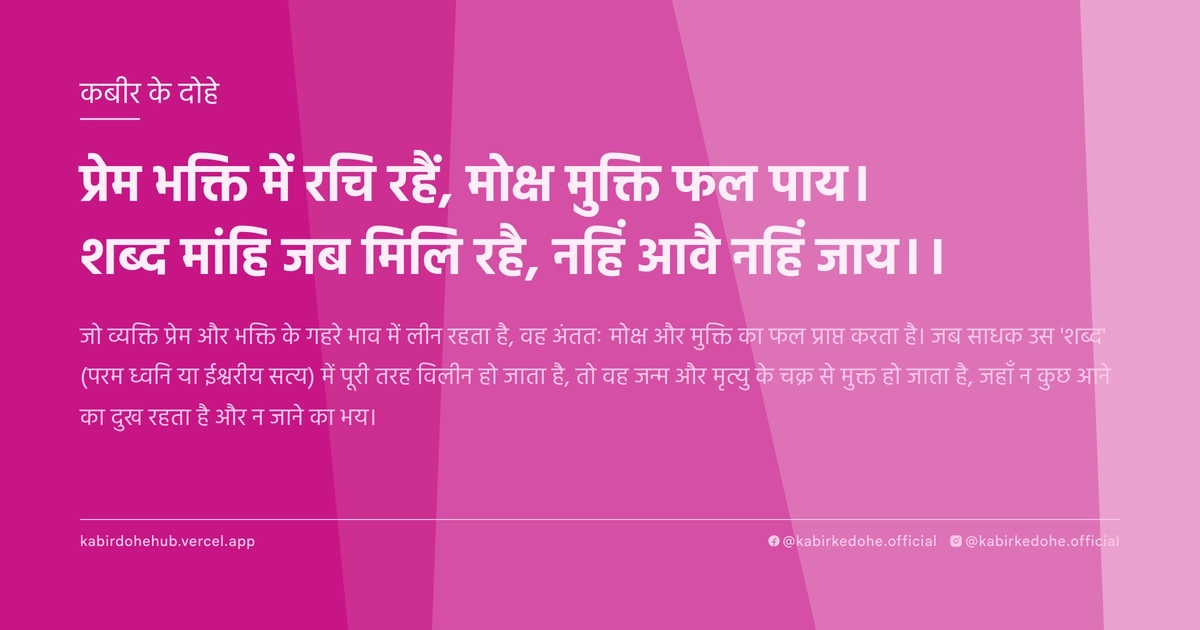
प्रेम भक्ति में रचि रहैं, मोक्ष मुक्ति फल पाय।
शब्द मांहि जब मिलि रहै, नहिं आवै नहिं जाय।।
Prem bhakti me rachi rahain, moksh mukti phal paay. Shabd maahi jab mili rahai, nahin aavai nahin jaaye.
इस पृष्ठ पर इस कबीर दोहे का अर्थ (meaning), हिंदी व्याख्या और अंग्रेज़ी अनुवाद, दार्शनिक विश्लेषण और व्यावहारिक जीवन सीख दी गई है। यह दोहा मुक्ति (Liberation) विषय से जुड़ा है — Kabir doha meaning and explanation in Hindi and English.
अर्थ (Meaning):
जो व्यक्ति प्रेम और भक्ति के गहरे भाव में लीन रहता है, वह अंततः मोक्ष और मुक्ति का फल प्राप्त करता है। जब साधक उस 'शब्द' (परम ध्वनि या ईश्वरीय सत्य) में पूरी तरह विलीन हो जाता है, तो वह जन्म और मृत्यु के चक्र से मुक्त हो जाता है, जहाँ न कुछ आने का दुख रहता है और न जाने का भय।
One who remains completely immersed in the essence of love and devotion eventually attains the fruit of liberation and salvation. When the seeker merges entirely into the 'Shabd' (the primordial sound or divine truth), they transcend the cycle of coming and going, reaching a state of eternal stillness where duality ceases to exist.
व्याख्या (Interpretation):
इस दोहे का शाब्दिक अर्थ है कि प्रेमपूर्ण भक्ति से मुक्ति मिलती है। गहराई में, कबीर 'प्रेम' को केवल मानवीय भावना नहीं, बल्कि एक ब्रह्मांडीय शक्ति के रूप में देखते हैं। यहाँ 'रचि रहैं' का अर्थ है अहंकार का पूर्ण विसर्जन। 'शब्द' यहाँ केवल बोला गया शब्द नहीं, बल्कि 'अनहद नाद' या वह आदि ध्वनि है जो निराकार ब्रह्म का प्रतीक है। जब आत्मा इस शब्द में विलीन होती है, तो वह द्वैत (मैं और तू) को समाप्त कर देती है। यह स्थिति अद्वैत वेदांत के 'तत्वमसि' (वह तू ही है) के समान है। यहाँ मोक्ष कोई बाहरी स्थान नहीं, बल्कि अपनी वास्तविक प्रकृति को पहचान लेना है। इस प्रकार, साधक माया के भ्रम से मुक्त होकर उस शून्य में स्थित हो जाता है जहाँ समय और स्थान का कोई अस्तित्व नहीं रहता।
Literally, the verse suggests that loving devotion leads to liberation. Metaphorically, Kabir presents 'Love' not as a mere emotion, but as a cosmic force of integration. The phrase 'rachi rahain' implies the total dissolution of the ego into the divine. 'Shabd' refers not to spoken language, but to the 'Anhad Naad'—the unstruck sound, the vibration of the formless Brahman. When the Atman merges with this Shabd, the illusion of duality (the separation between seeker and sought) vanishes. This aligns with the Advaita Vedanta concept of 'Tat Tvam Asi' (Thou Art That). Liberation here is not a destination or a heaven, but the realization of one's inherent nature. The seeker transcends the Maya of birth and death, entering a state of absolute stillness where the paradox of existence is resolved into a singular, eternal presence.
दार्शनिक विश्लेषण (Philosophical Analysis):
कबीर का यह दर्शन निर्गुण भक्ति की पराकाष्ठा है, जहाँ ईश्वर किसी मूर्ति या मंदिर में नहीं, बल्कि हृदय के प्रेम और आंतरिक ध्वनि में निवास करता है। उनके समय में धर्म कर्मकांडों, जातिगत भेदभाव और बाहरी आडंबरों में जकड़ा हुआ था। कबीर ने इन सबको नकारते हुए 'प्रेम' को ही एकमात्र मार्ग बताया। यह दृष्टिकोण सूफी मत के 'इश्क-ए-हकीकी' (ईश्वरीय प्रेम) से गहराई से मेल खाता है, जहाँ प्रेमी और प्रियतम का भेद मिट जाता है।
दार्शनिक स्तर पर, यह दोहा अहंकार के विनाश (Fana) की बात करता है। जब तक 'मैं' है, तब तक 'वह' है; जब 'मैं' मिटता है, तब केवल 'वह' शेष रहता है। यह अद्वैत वेदांत के उस सिद्धांत की पुष्टि करता है कि आत्मा और परमात्मा वास्तव में एक ही हैं, बस अज्ञानता की परत ने उन्हें अलग दिखाया है। कबीर यहाँ मोक्ष को किसी परलोक की प्राप्ति नहीं, बल्कि इसी जीवन में चेतना के रूपांतरण के रूप में देखते हैं।
वे कर्मकांडीय मोक्ष की अवधारणा को चुनौती देते हैं। उनके अनुसार, तीर्थयात्रा या माला जपना तब तक व्यर्थ है जब तक हृदय में प्रेम का संचार न हो। सच्चा ज्ञान वह है जो व्यक्ति को विनम्र बनाए और उसे समस्त सृष्टि के साथ एकाकार कर दे। यह मनोवैज्ञानिक रूपांतरण है जहाँ भय समाप्त हो जाता है और केवल अनंत शांति बचती है।
कबीर का 'शब्द' योग का संदर्भ है, जहाँ ध्वनि के माध्यम से चेतना को ऊर्ध्वगामी किया जाता है। यह प्रक्रिया बौद्ध धर्म के शून्य और सूफीवाद के नूर के करीब है। यहाँ 'नहिं आवै नहिं जाय' का अर्थ है कि साधक अब समय के रैखिक प्रवाह (linear time) से बाहर निकल चुका है।
अंततः, यह विश्लेषण स्पष्ट करता है कि कबीर के लिए भक्ति कोई धार्मिक क्रिया नहीं, बल्कि एक अस्तित्वगत क्रांति है। यह व्यक्ति को सामाजिक पहचान (जाति, धर्म, पद) से मुक्त कर उसे एक सार्वभौमिक चेतना में बदल देती है, जिससे वह स्वयं को संपूर्ण ब्रह्मांड के रूप में अनुभव करने लगता है।
Kabir's philosophy here represents the pinnacle of Nirgun Bhakti, where the Divine resides not in idols or temples, but within the heart's love and the inner vibration. During his era, religion was stifled by rigid rituals, caste hierarchies, and outward displays of piety. Kabir rejected these, asserting that 'Love' is the only authentic gateway to the Truth. This perspective resonates deeply with the Sufi concept of 'Ishq-e-Haqiqi' (Divine Love), where the distinction between the lover and the Beloved is completely obliterated.
On a philosophical level, this verse speaks of the annihilation of the ego, similar to the Sufi concept of 'Fana'. As long as the 'I' exists, the 'Other' persists; when the 'I' dissolves, only the Absolute remains. This validates the Advaita Vedanta principle that Atman and Brahman are non-dual, separated only by the veil of Avidya (ignorance). For Kabir, Moksha is not a post-mortem destination but a transformation of consciousness achievable in the present life.
He challenges the ritualistic notion of salvation. Pilgrimages and repetitive chanting are futile unless they ignite a genuine fire of love in the heart. True knowledge is that which fosters humility and integrates the individual with the entire cosmos. This is a psychological shift where fear is replaced by an infinite, unshakable peace.
The reference to 'Shabd' points toward the practice of Shabad Yoga, where consciousness is elevated through the perception of the primordial sound. This process mirrors the Buddhist concept of Sunyata (emptiness) and the Sufi notion of Nur (Divine Light). The phrase 'neither coming nor going' signifies that the seeker has stepped out of linear time and the cycle of Samsara.
Ultimately, this analysis reveals that for Kabir, devotion is not a religious act but an existential revolution. It strips away social identities—caste, creed, and status—transforming the individual into a universal consciousness who experiences themselves as the entirety of existence.
मूल संदेश (Core Message):
- अहंकार ही वह पर्दा है जो हमें सत्य से अलग करता है।
- प्रेम केवल भावना नहीं, बल्कि परमात्मा तक पहुँचने का एकमात्र सेतु है।
- सच्ची भक्ति बाहरी अनुष्ठानों में नहीं, बल्कि आंतरिक विलीनीकरण में है।
- जब 'मैं' मिटता है, तब ब्रह्मांड की अनंत शांति प्रकट होती है।
- मोक्ष कोई स्थान नहीं, बल्कि चेतना की एक उच्चतम अवस्था है।
- The ego is the only veil separating the seeker from the Truth.
- Love is not a mere emotion, but the only bridge to the Divine.
- True devotion lies in internal merging, not in external rituals.
- When the 'I' dissolves, the infinite peace of the universe manifests.
- Liberation is not a place, but a supreme state of consciousness.
व्यावहारिक उदाहरण (Practical Example):
वाराणसी के एक पुराने घाट पर रहने वाले रामू नाम के एक वृद्ध बुनकर थे। रामू का पूरा जीवन सूत कातने और कपड़े बुनने में बीता, लेकिन उनके मन में हमेशा एक बेचैनी रहती थी। वे घंटों मंदिर जाते, लंबी मालाएँ जपते और कठिन उपवास रखते, इस उम्मीद में कि उन्हें मोक्ष मिल जाएगा। लेकिन उनके भीतर का क्रोध और अहंकार कम नहीं हुआ; वे अक्सर अपने पड़ोसियों और परिवार से छोटी-छोटी बातों पर झगड़ते थे।
एक दिन उनकी मुलाकात एक घुमक्कड़ फकीर से हुई, जिसने रामू की बेचैनी को देख कर बस इतना कहा, 'रामू, तू धागों को तो सीधा कर रहा है, लेकिन अपने हृदय के प्रेम को उलझाए बैठा है। मोक्ष मालाओं में नहीं, उस प्रेम में है जो बिना किसी शर्त के बहता है।'
रामू को यह बात समझ नहीं आई, लेकिन उन्होंने प्रयोग करने का निर्णय लिया। उन्होंने अपनी दिनचर्या बदली। अब वे केवल मोक्ष के लिए पूजा नहीं करते थे, बल्कि अपने काम को ही प्रार्थना बना लिया। जब वे कपड़ा बुनते, तो वे यह सोचते कि यह धागा केवल सूत नहीं, बल्कि पूरी सृष्टि का एक हिस्सा है।
उन्होंने अपने घर के पास रहने वाले एक अनाथ बच्चे को, जिसे समाज ने दुत्कारा था, सहारा देना शुरू किया। उन्होंने उस बच्चे को बिना किसी स्वार्थ के प्रेम करना शुरू किया। धीरे-धीरे, रामू के भीतर का 'मैं'—वह बुनकर जो खुद को दूसरों से श्रेष्ठ समझता था—मिटने लगा।
एक शाम, जब वे घाट पर बैठे थे, उन्हें महसूस हुआ कि उनके भीतर का शोर शांत हो गया है। उन्हें अब किसी मंदिर जाने की आवश्यकता महसूस नहीं हुई। उन्हें वह 'शब्द' सुनाई देने लगा—एक ऐसी शांति जो उनके भीतर से आ रही थी।
उन्होंने पाया कि जब वे उस बच्चे की मुस्कान में विलीन हो जाते, तो उन्हें अपने दुखों का स्मरण नहीं रहता। उनका अहंकार, जो उन्हें दूसरों से अलग करता था, अब प्रेम के धागों में घुल चुका था।
रामू अब केवल एक बुनकर नहीं थे; वे प्रेम के एक माध्यम बन गए थे। उनके व्यवहार में एक ऐसी सौम्यता आई कि पूरा मोहल्ला उनकी ओर आकर्षित होने लगा।
अंत में, रामू ने महसूस किया कि मोक्ष कोई ऐसी जगह नहीं है जहाँ मरने के बाद जाया जाता है, बल्कि यह तो वह स्थिति है जहाँ आप जीवित रहते हुए भी इस दुनिया के मोह और द्वेष से ऊपर उठ जाते हैं। वे अब 'आने और जाने' के भय से मुक्त थे, क्योंकि वे उस शाश्वत प्रेम में रचे-बसे थे।
In the ancient ghats of Varanasi lived an elderly weaver named Ramu. Ramu had spent his entire life spinning yarn and weaving cloth, yet a persistent restlessness haunted his soul. He spent hours in temples, chanted endless beads, and observed rigorous fasts, hoping to secure 'Moksha'. However, his inner anger and ego remained untouched; he frequently clashed with his neighbors and family over trivial matters.
One day, he encountered a wandering fakir who, noticing Ramu's turmoil, simply said, 'Ramu, you are straightening the threads of your loom, but you have left the love in your heart tangled. Liberation is not found in beads, but in the love that flows without condition.'
Ramu didn't fully grasp the meaning, but he decided to experiment. He altered his daily rhythm. He stopped treating prayer as a transaction for salvation and instead turned his work into a prayer. As he wove, he began to perceive the thread not just as cotton, but as a fragment of the universal fabric.
He began supporting an orphaned child living nearby, whom society had shunned. He started loving the child without any expectation of reward. Slowly, the 'I'—the weaver who considered himself superior to others—began to dissolve.
One evening, while sitting on the ghats, Ramu realized that the inner noise had fallen silent. He no longer felt the compulsive need to visit the temple. He began to hear the 'Shabd'—a profound silence emanating from within his own being.
He discovered that whenever he merged into the child's innocent smile, he forgot his own sorrows. His ego, which had acted as a wall between him and the world, had now dissolved into the threads of love.
Ramu was no longer just a weaver; he had become a medium for love. A gentle serenity entered his demeanor, drawing the entire neighborhood toward him.
Ultimately, Ramu realized that Moksha is not a destination reached after death, but a state of being where one transcends the attachments and animosities of the world while still alive. He was now free from the fear of 'coming and going,' for he was completely immersed in that eternal, formless love.
अभ्यास मार्गदर्शन (Practice Guidance):
- प्रतिदिन 20 मिनट मौन ध्यान करें, जहाँ आप बाहरी ध्वनियों को छोड़कर अपने भीतर की सूक्ष्म ध्वनि (अनहद नाद) को सुनने का प्रयास करें।
- स्व-अन्वेषण जर्नल: प्रतिदिन लिखें कि आज किस क्षण में आपका 'अहंकार' (Ego) हावी हुआ और आप उसे प्रेम में कैसे बदल सकते थे।
- निस्वार्थ सेवा: सप्ताह में एक बार किसी ऐसे व्यक्ति की मदद करें जिससे आपका कोई व्यक्तिगत संबंध न हो और बदले में कुछ न माँगें।
- डायग्नोस्टिक चेकलिस्ट: क्या मैं अभी भी 'मैं' और 'मेरे' के भाव में हूँ? क्या मेरी भक्ति में डर है या प्रेम? क्या मैं दूसरों में उसी ईश्वर को देख पा रहा हूँ जिसे मैं खोज रहा हूँ?
- Practice 20 minutes of silent meditation daily, shifting focus from external noises to the subtle inner vibration (Anhad Naad).
- Self-Inquiry Journaling: Record moments where your 'Ego' dominated your reactions and reflect on how that energy could have been transformed into love.
- Selfless Service: Once a week, assist someone with whom you have no personal connection, expecting absolutely nothing in return.
- Diagnostic Checklist: Am I still operating from a place of 'I' and 'Mine'? Is my devotion driven by fear or by love? Do I recognize the same Divine essence in others that I seek within myself?
चिंतन प्रश्न (Reflection Questions):
- मेरी भक्ति क्या वास्तव में प्रेम है, या यह केवल मेरे डर और असुरक्षाओं को छिपाने का एक तरीका है?
- मैं अपनी सामाजिक पहचान (पद, जाति, धर्म) को कितना महत्व देता हूँ, और यदि यह सब छीन लिया जाए, तो मेरा वास्तविक 'मैं' क्या बचेगा?
- क्या मैं दूसरों की मदद इसलिए करता हूँ ताकि मैं खुद को 'अच्छा' महसूस कर सकूँ, या वास्तव में मैं उनमें खुद को देखता हूँ?
- मेरे जीवन का वह कौन सा 'शब्द' या सत्य है जिसे मैं स्वीकार करने से डरता हूँ?
- क्या मेरी शांति बाहरी परिस्थितियों पर निर्भर है, या वह मेरे भीतर के शून्य से उपजती है?
- Is my devotion truly love, or is it merely a mechanism to mask my fears and insecurities?
- How much value do I place on my social identity, and if all labels were stripped away, what would remain of the real 'I'?
- Do I help others to reinforce my image as a 'good person,' or do I genuinely see myself in them?
- What is that one 'Shabd' or truth in my life that I am most afraid to acknowledge?
- Is my peace dependent on external circumstances, or does it arise from the inner void of stillness?