
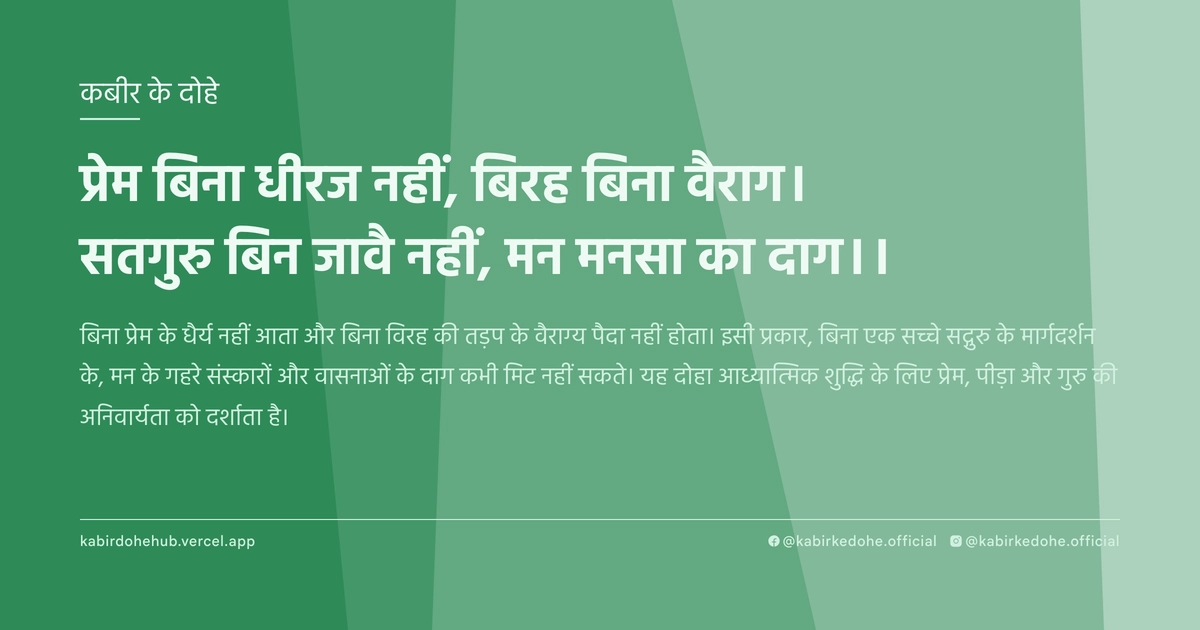
प्रेम बिना धीरज नहीं, बिरह बिना वैराग।
सतगुरु बिन जावै नहीं, मन मनसा का दाग।।
Prem bina dheeraj nahi, birah bina vairag. Satguru bin jaavai nahi, man mansa ka daag.
इस पृष्ठ पर इस कबीर दोहे का अर्थ (meaning), हिंदी व्याख्या और अंग्रेज़ी अनुवाद, दार्शनिक विश्लेषण और व्यावहारिक जीवन सीख दी गई है। यह दोहा गुरु महत्व (The Guru's Importance) विषय से जुड़ा है — Kabir doha meaning and explanation in Hindi and English.
अर्थ (Meaning):
बिना प्रेम के धैर्य नहीं आता और बिना विरह की तड़प के वैराग्य पैदा नहीं होता। इसी प्रकार, बिना एक सच्चे सद्गुरु के मार्गदर्शन के, मन के गहरे संस्कारों और वासनाओं के दाग कभी मिट नहीं सकते। यह दोहा आध्यात्मिक शुद्धि के लिए प्रेम, पीड़ा और गुरु की अनिवार्यता को दर्शाता है।
Without love, there is no patience; without the agony of separation, there is no true detachment. Similarly, without the guidance of a True Guru, the deep-seated stains of desire and mental impressions cannot be erased. This couplet emphasizes that love, longing, and a spiritual guide are essential for the purification of the soul.
व्याख्या (Interpretation):
शाब्दिक अर्थ यह है कि प्रेम धैर्य सिखाता है और विरह संसार से मोह हटाता है। गहराई में, 'प्रेम' यहाँ केवल मानवीय अनुराग नहीं, बल्कि परमात्मा के प्रति अनन्य अनुराग है। 'बिरह' वह आध्यात्मिक तड़प है जो साधक को अहम् से मुक्त कर शून्य की ओर ले जाती है। यह निर्गुण भक्ति का सार है जहाँ ईश्वर किसी मूर्ति में नहीं, बल्कि हृदय की व्याकुलता में मिलता है। मनसा के दाग वे संचित कर्म और वासनाएँ हैं जो अविद्या के कारण चिपके हुए हैं। केवल सद्गुरु की ज्ञान-रश्मि ही इस अंधकार को मिटा सकती है। यह अद्वैत वेदांत के उस सत्य को पुष्ट करता है कि जब तक 'मैं' का भ्रम नहीं मिटता, तब तक ब्रह्म का साक्षात्कार असंभव है।
Literally, love fosters patience and separation breeds detachment. Metaphorically, 'Love' refers to the divine longing for the Formless (Nirgun), and 'Separation' (Birah) is the existential ache that strips away the ego. In the path of Nirgun Bhakti, this longing is the fuel for spiritual evolution, transforming a worldly existence into a quest for the Absolute. The 'stains of the mind' are the Sanchita Karmas and latent desires (Vasanas) that cloud the Atman. Only the light of a Satguru—a realized master—can dissolve these illusions. This aligns with Advaita Vedanta, suggesting that the perceived duality between the self and the Divine is a veil that only the alchemy of love and the guidance of a Guru can pierce.
दार्शनिक विश्लेषण (Philosophical Analysis):
कबीर का यह दोहा मध्यकालीन भारत के उस संक्रमण काल की उपज है जहाँ कर्मकांड और बाह्य आडंबर चरम पर थे। कबीर ने मंदिर-मस्जिद के विवादों से ऊपर उठकर 'हृदय' को ही वास्तविक तीर्थ घोषित किया। यहाँ प्रेम का अर्थ है 'समर्पण'। सूफी मत के 'इश्क-ए-हकीकी' (ईश्वरीय प्रेम) और भारतीय भक्ति परंपरा का संगम यहाँ स्पष्ट दिखता है। कबीर तर्क देते हैं कि केवल शास्त्र पढ़ने से मुक्ति नहीं मिलती; जब तक हृदय में विरह की अग्नि न जले, तब तक वैराग्य केवल एक दिखावा है।
दार्शनिक स्तर पर, यह 'अहंकार' के विसर्जन की प्रक्रिया है। जब मनुष्य किसी उच्च सत्ता के प्रति प्रेम करता है, तो उसका केंद्र 'स्व' से हटकर 'पर' पर चला जाता है, जिससे धैर्य का जन्म होता है। विरह वह मनोवैज्ञानिक दबाव है जो व्यक्ति को भौतिक सुखों की निस्सारता का बोध कराता है। यह एक प्रकार की 'सकारात्मक पीड़ा' है जो आत्मा को परिष्कृत करती है।
सद्गुरु की भूमिका यहाँ एक उत्प्रेरक (Catalyst) की है। कबीर के अनुसार, मन की वासनाएँ इतनी गहरी होती हैं कि व्यक्ति स्वयं उन्हें देख नहीं पाता। जैसे आँखें स्वयं को नहीं देख सकतीं, वैसे ही मन स्वयं की अशुद्धियों को नहीं पहचान सकता। गुरु वह दर्पण है जो साधक को उसकी वास्तविक स्थिति दिखाता है और उसे अद्वैत की ओर ले जाता है।
यह शिक्षण जाति और धर्म के बंधनों को तोड़ता है। प्रेम और विरह सार्वभौमिक हैं; वे किसी विशेष कुल या संप्रदाय की बपौती नहीं हैं। कबीर यहाँ यह स्पष्ट कर रहे हैं कि आध्यात्मिक प्रगति का मार्ग बौद्धिक विमर्श नहीं, बल्कि भावनात्मक रूपांतरण है।
अंततः, यह दोहा हमें बताता है कि मोक्ष कोई बाहरी उपलब्धि नहीं, बल्कि आंतरिक शुद्धि है। जब प्रेम, विरह और गुरु का त्रिकोण पूर्ण होता है, तब मन के सारे 'दाग' मिट जाते हैं और जीव ब्रह्म में लीन हो जाता है। यह पूर्ण समर्पण की अवस्था है जहाँ ज्ञाता, ज्ञान और ज्ञेय का भेद समाप्त हो जाता है।
Kabir’s couplet emerges from a medieval Indian era rife with rigid ritualism and sectarian conflict. By emphasizing internal transformation over external piety, Kabir aligns himself with the radical essence of the Bhakti movement. The 'Love' he speaks of is not mundane affection but 'Divine Love,' mirroring the Sufi concept of 'Ishq-e-Haqiqi.' He posits that intellectual knowledge of the scriptures is sterile unless ignited by the fire of longing (Birah), which transforms a mere practitioner into a seeker.
Philosophically, this is a treatise on the dissolution of the ego. When a seeker shifts their center of gravity from the 'I' to the 'Divine,' patience naturally arises because the ego's demand for immediate gratification is silenced. Separation is presented as a psychological necessity; it is the 'sacred pain' that reveals the emptiness of material pursuits, leading to Vairagya (dispassion). This is not a rejection of the world, but a transcendence of it.
The role of the Satguru is that of a spiritual catalyst. Kabir suggests that the 'stains' of the mind—the latent impressions or Vasanas—are so deeply embedded that the individual is blind to them. Just as an eye cannot see itself, the mind cannot perceive its own delusions. The Guru acts as the mirror, reflecting the seeker's ignorance and providing the precise knowledge (Jnana) required to incinerate the ego.
This teaching systematically dismantles caste and religious hierarchies. Love and longing are universal human experiences, inaccessible to those who rely solely on birthright or ritual purity. Kabir asserts that spiritual evolution is a matter of emotional and experiential alchemy, not social standing or theological scholarship.
Ultimately, the doha describes the process of returning to the primordial state of non-duality (Advaita). When the triad of Love, Longing, and Guidance converges, the illusion of separation vanishes. The 'stains' are not removed by scrubbing, but by the light of realization that reveals they were never truly there, as the Atman is eternally pure.
मूल संदेश (Core Message):
- प्रेम ही वह एकमात्र शक्ति है जो कठिन समय में धैर्य प्रदान करती है।
- संसार से विरक्ति केवल बाहरी त्याग से नहीं, बल्कि आंतरिक तड़प से आती है।
- गुरु केवल मार्गदर्शक नहीं, बल्कि मन के अंधकार को मिटाने वाला प्रकाश है।
- मानसिक वासनाओं का अंत केवल ज्ञान और प्रेम के संगम से संभव है।
- अहंकार का विसर्जन ही वास्तविक आध्यात्मिक शुद्धि का एकमात्र मार्ग है।
- Love is the only force capable of granting true patience amidst turmoil.
- Detachment is not a physical act of leaving, but an internal state of longing.
- The Guru is not merely a teacher, but the light that incinerates mental darkness.
- The eradication of mental stains requires the union of divine love and wisdom.
- The dissolution of the ego is the only path to genuine spiritual purification.
व्यावहारिक उदाहरण (Practical Example):
वाराणसी के एक पुराने घाट पर माधव नाम का एक वृद्ध बुनकर रहता था। वह अपनी कला में निपुण था, लेकिन उसका मन हमेशा अशांत रहता था। वह अपनी गरीबी और समाज की उपेक्षा से चिढ़ा हुआ था। वह घंटों मंदिर में बैठता, लेकिन उसके भीतर क्रोध की अग्नि जलती रहती थी। वह सोचता था कि ईश्वर उसे क्यों नहीं सुनता।
एक दिन उसकी मुलाकात एक फकीर से हुई, जिसने उससे कहा, 'माधव, तू मंदिर में ईश्वर को ढूँढ रहा है, लेकिन तेरे भीतर का क्रोध ईश्वर के लिए जगह ही नहीं छोड़ रहा। तू चाहता है कि तुझे शांति मिले, लेकिन तूने प्रेम को कभी जाना ही नहीं।'
माधव ने पूछा, 'प्रेम कैसे करूँ? मेरे पास तो कुछ नहीं है।'
फकीर ने मुस्कुराते हुए कहा, 'प्रेम वस्तु का नहीं, अस्तित्व का होता है। अपनी पीड़ा को ईश्वर के प्रति तड़प में बदल दे। जब तक तू अपनी कमी को शिकायत मानेगा, तू दुखी रहेगा; जब तू इसे विरह मानेगा, तब तू मुक्त होगा।'
माधव ने इस बात पर विचार करना शुरू किया। उसने अपनी शिकायतें छोड़ दीं और अपनी तड़प को एक प्रार्थना बना लिया। उसने महसूस किया कि उसकी गरीबी वास्तव में उसे भौतिक मोह से दूर ले जाने का एक जरिया थी। धीरे-धीरे, उसका क्रोध करुणा में बदलने लगा।
लेकिन वह अभी भी भ्रमित था कि इस मार्ग पर कैसे चले। फकीर ने उसे मार्गदर्शन देना शुरू किया, उसे सिखाया कि कैसे अपने मन के विचारों को साक्षी भाव से देखे। फकीर उसके लिए वह 'सद्गुरु' बन गया जिसने उसे बताया कि उसके मन के 'दाग' वास्तव में उसकी अपनी धारणाएँ थीं।
एक शाम, जब वह अपना कपड़ा बुन रहा था, उसे अचानक महसूस हुआ कि वह और उसका कपड़ा, वह और वह करघा, सब एक ही चेतना का हिस्सा हैं। उसके भीतर का द्वंद्व समाप्त हो गया।
उसने देखा कि अब वह गरीब होने के बावजूद दुनिया का सबसे अमीर व्यक्ति महसूस कर रहा था क्योंकि उसके पास 'धैर्य' था। वह अब दूसरों की मदद करने लगा, बिना किसी अपेक्षा के।
उसकी कला में अब एक नई चमक थी, क्योंकि वह अब केवल कपड़े नहीं, बल्कि प्रेम बुन रहा था। उसके जीवन का रूपांतरण यह सिद्ध करता था कि बिना विरह की तड़प और गुरु के ज्ञान के, मन की गंदगी नहीं जाती।
माधव अब घाट पर केवल एक बुनकर नहीं, बल्कि एक शांत आत्मा के रूप में जाना जाने लगा, जिसने प्रेम के माध्यम से स्वयं को पा लिया था।
In the ancient alleys of Varanasi lived an elderly weaver named Madhav. Though a master of his craft, his heart was a storm of resentment. He felt cheated by life, bitter about his poverty and the indifference of the society around him. He spent hours in temples, yet his prayers were mere demands, fueled by an underlying anger toward the Divine.
One afternoon, he encountered a wandering Sufi mystic. The mystic looked at him and said, 'Madhav, you seek God in the temple, but your anger has left no room for Him within you. You crave peace, yet you have never tasted the sweetness of Love.'
Confused, Madhav asked, 'How can I love when I have nothing and the world has given me nothing?'
The mystic replied, 'Love is not about possessing things; it is about longing for the Source. Transform your suffering into a sacred ache. As long as you view your pain as a complaint, you will remain a prisoner. When you view it as Birah—the longing for the Beloved—you will be liberated.'
Madhav began to meditate on these words. He consciously shifted his perspective, turning his grievances into a silent prayer. He started realizing that his poverty was not a punishment, but a stripping away of material illusions that had previously blinded him.
However, he struggled to navigate this internal shift. The mystic became his Satguru, teaching him the art of 'Sakshi' (witnessing). He guided Madhav to observe his thoughts without judgment, showing him that the 'stains' on his mind were merely false identities he had clung to for decades.
One evening, while working at his loom, a profound realization struck him. He felt that the thread, the loom, and the weaver were not separate entities but expressions of a single, universal consciousness. The duality that had caused his suffering vanished in an instant.
He discovered that he possessed a profound patience (Dheeraj) that he had never known before. The external circumstances of his life hadn't changed, but his internal landscape had been completely rewritten.
He began to share his earnings and his peace with other struggling artisans, acting not out of duty, but out of a genuine overflow of love. His weaving took on a celestial quality, as if he were weaving light into fabric.
Madhav’s transformation illustrated the core of Kabir’s wisdom: that without the catalyst of longing and the light of a guide, the ego’s stains remain permanent. He became a living testament to the power of divine love.
अभ्यास मार्गदर्शन (Practice Guidance):
- प्रतिदिन 20 मिनट मौन बैठें और अपने भीतर की 'तड़प' या 'अधूरेपन' को महसूस करें। इसे शिकायत के बजाय परमात्मा के लिए विरह के रूप में स्वीकार करें।
- एक डायरी लिखें जिसमें आप अपनी उन मानसिक आदतों (दागों) को दर्ज करें जो आपको शांति से रोकती हैं। फिर विचार करें कि एक 'आदर्श गुरु' या विवेकपूर्ण दृष्टिकोण उन्हें कैसे मिटा सकता है।
- व्यवहार परिवर्तन: जब भी क्रोध या अधीरता आए, रुकें और स्वयं से पूछें, 'क्या यह मेरा अहंकार बोल रहा है या मेरा प्रेम?'
- डायग्नोस्टिक चेकलिस्ट: क्या मैं परिस्थितियों को बदलने की कोशिश कर रहा हूँ (अहंकार) या अपनी प्रतिक्रिया को बदल रहा हूँ (धैर्य)? क्या मेरी भक्ति केवल माँगने तक सीमित है या इसमें समर्पण भी है?
- Spend 20 minutes daily in silence, focusing on the feeling of 'emptiness' or 'longing' within. Instead of viewing it as a lack, perceive it as 'Birah'—a sacred longing for the Divine.
- Maintain a spiritual journal to document the 'stains' (recurring negative patterns) of your mind. Contemplate how a shift in consciousness or a Guru's perspective could dissolve these patterns.
- Behavioral Shift: Whenever anger or impatience arises, pause and ask, 'Is this my ego speaking, or is this a lack of love?'
- Diagnostic Checklist: Am I trying to change the external situation (Ego) or my internal response (Patience)? Is my devotion based on petitioning for gains or on total surrender?
चिंतन प्रश्न (Reflection Questions):
- क्या मेरा 'धैर्य' वास्तव में धैर्य है, या यह केवल परिस्थितियों के प्रति मेरी मजबूरी और उदासीनता है?
- मैं किन सांसारिक वस्तुओं या रिश्तों के प्रति इतना आसक्त हूँ कि उनके बिना मैं विरह की पीड़ा महसूस नहीं कर पाता?
- मेरे जीवन में 'सद्गुरु' की परिभाषा क्या है—क्या मैं केवल एक व्यक्ति की तलाश में हूँ या अपने भीतर के विवेक को जगाने की?
- मेरे मन के वे कौन से 'दाग' हैं जिन्हें मैं समाज के सामने छिपाता हूँ, लेकिन वे मेरी आंतरिक शांति को नष्ट कर रहे हैं?
- क्या मैं वास्तव में प्रेम करना चाहता हूँ, या मैं केवल प्रेम पाने का इच्छुक हूँ?
- Is my 'patience' truly a spiritual virtue, or is it merely a mask for helplessness and indifference?
- Which worldly attachments are so strong that they prevent me from experiencing the sacred ache of divine longing?
- What is my definition of a 'Satguru'—am I searching for a charismatic personality or for the awakening of my own inner discernment?
- What are the 'stains' of my mind that I hide from the world, yet allow to erode my inner peace?
- Do I truly desire to love unconditionally, or am I merely desperate to be loved?