
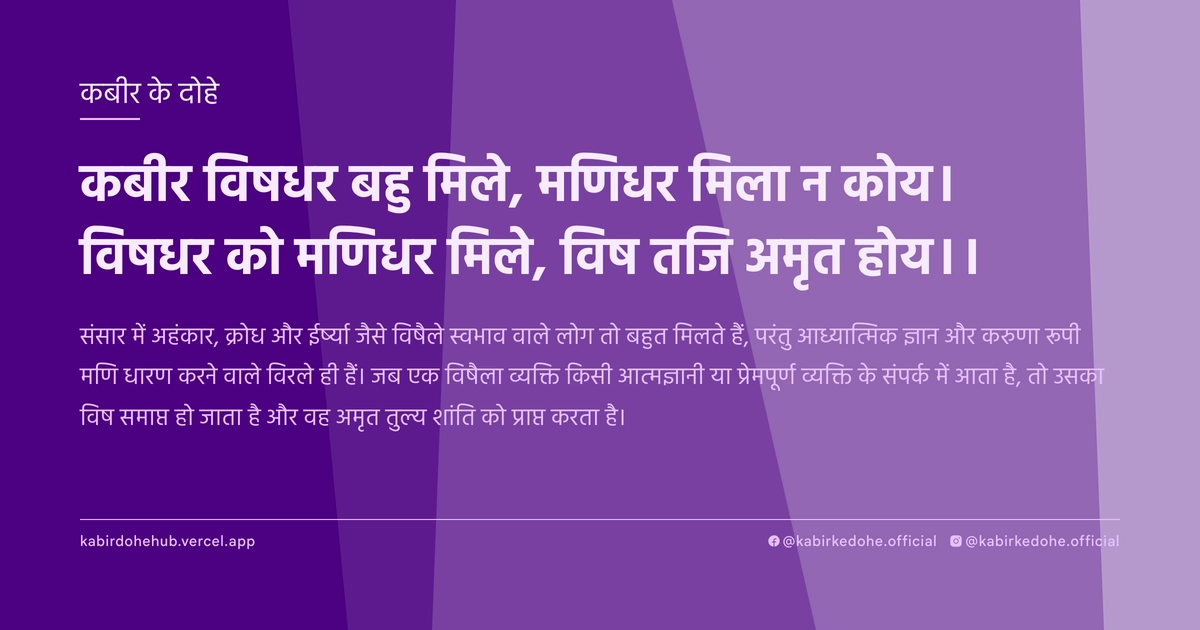
कबीर विषधर बहु मिले, मणिधर मिला न कोय।
विषधर को मणिधर मिले, विष तजि अमृत होय।।
Kabir vishdhar bahu mile, manidhar mila na koy. Vishdhar ko manidhar mile, vish taji amrit hoye.
इस पृष्ठ पर इस कबीर दोहे का अर्थ (meaning), हिंदी व्याख्या और अंग्रेज़ी अनुवाद, दार्शनिक विश्लेषण और व्यावहारिक जीवन सीख दी गई है। यह दोहा सत्संग (Satsang) विषय से जुड़ा है — Kabir doha meaning and explanation in Hindi and English.
अर्थ (Meaning):
संसार में अहंकार, क्रोध और ईर्ष्या जैसे विषैले स्वभाव वाले लोग तो बहुत मिलते हैं, परंतु आध्यात्मिक ज्ञान और करुणा रूपी मणि धारण करने वाले विरले ही हैं। जब एक विषैला व्यक्ति किसी आत्मज्ञानी या प्रेमपूर्ण व्यक्ति के संपर्क में आता है, तो उसका विष समाप्त हो जाता है और वह अमृत तुल्य शांति को प्राप्त करता है।
The world is teeming with 'Vishdhars'—those possessed by the poison of ego, anger, and hatred. However, 'Manidhars'—those who possess the jewel of spiritual wisdom and divine love—are exceedingly rare. When a poisonous soul encounters a jewel-bearing soul, the toxicity is neutralized, and the poison is transformed into the nectar of immortality and peace.
व्याख्या (Interpretation):
यहाँ 'विषधर' केवल सांप नहीं, बल्कि मानव मन के विकारों का प्रतीक है, जबकि 'मणिधर' उस जागृत चेतना का प्रतीक है जिसने आत्म-साक्षात्कार कर लिया है। यह दोहा द्वैत से अद्वैत की यात्रा को दर्शाता है। माया के प्रभाव में मनुष्य स्वयं को अलग और प्रतिस्पर्धी मानता है, जो उसके भीतर क्रोध का विष भरता है। निरगुण भक्ति के संदर्भ में, यह मणि वह 'शब्द' या 'नाम' है जो अहंकार को मिटा देता है। जब जीव (विषधर) का मिलन ब्रह्म (मणिधर) से होता है, तो पृथकता का भ्रम टूट जाता है। यह रूपांतरण बाहरी नहीं, बल्कि आंतरिक है, जहाँ अज्ञान का अंधकार ज्ञान के प्रकाश से मिट जाता है। अंततः, यह इस विरोधाभास को उजागर करता है कि जिसे हम शत्रु या विषैला समझते हैं, वह वास्तव में केवल एक ऐसा जीव है जिसे अभी तक अपनी आंतरिक मणि नहीं मिली है।
In this verse, 'Vishdhar' (poison-bearer) represents the human psyche clouded by 'Kleshas' or afflictions, while 'Manidhar' (jewel-bearer) symbolizes the awakened consciousness of a realized soul. The doha illustrates the transition from duality to non-duality (Advaita). Under the influence of Maya, humans perceive themselves as separate entities, fueling the poison of competition and hatred. In the context of Nirgun Bhakti, the 'jewel' is the internal resonance of the formless Divine. When the individual soul (Jiva) aligns with the Universal Soul (Brahman), the illusion of separation dissolves. This transformation is not a physical change but a metaphysical shift where ignorance is incinerated by the fire of wisdom. It highlights the profound paradox: the 'poisonous' person is merely a soul awaiting the catalyst of divine love to realize its own inherent purity.
दार्शनिक विश्लेषण (Philosophical Analysis):
कबीर का यह दोहा मध्यकालीन भारत के सामाजिक और धार्मिक संघर्षों के बीच एक सेतु का कार्य करता है। उस समय समाज जाति, धर्म और कर्मकांडों के कारण गहरे विभाजन में था, जिसने लोगों के भीतर 'विष' या घृणा भर दी थी। कबीर ने बाहरी कर्मकांडों के बजाय आंतरिक शुद्धि पर बल दिया, जो कि सूफी मत के 'इश्क-ए-हकीकी' (ईश्वरीय प्रेम) और अद्वैत वेदांत के 'अहं ब्रह्मास्मि' के सिद्धांतों से मेल खाता है।
यहाँ विष का अर्थ है 'अहंकार' (Ego)। जब तक मनुष्य स्वयं को शरीर और नाम से पहचानता है, वह विषैला रहता है। कबीर का तर्क है कि ज्ञान केवल पुस्तकों से नहीं, बल्कि एक जीवित 'मणिधर' (गुरु या संत) के सान्निध्य से आता है। यह गुरु-शिष्य परंपरा का सार है, जहाँ गुरु का अस्तित्व ही शिष्य के विकारों को सोख लेता है।
यह विश्लेषण हमें बताता है कि घृणा का उत्तर घृणा से देना केवल विष को बढ़ाना है। सूफीवाद की तरह, कबीर यहाँ 'फना' (अहंकार का विनाश) की बात कर रहे हैं। जब व्यक्ति का 'मैं' मिटता है, तभी वह 'अमृत' या सार्वभौमिक प्रेम का अनुभव कर सकता है।
कबीर ने जाति व्यवस्था को पूरी तरह नकारा क्योंकि वह समाज में कृत्रिम विभाजन पैदा करती थी, जो वास्तव में एक मानसिक विष है। उनके लिए, मानवता की एकता ही वह एकमात्र मणि है जो समाज के जहर को खत्म कर सकती है।
मनोवैज्ञानिक स्तर पर, यह दोहा 'प्रोजेक्शन' की प्रक्रिया को समझाता है। हम दूसरों में जो विष देखते हैं, वह अक्सर हमारे अपने भीतर का प्रतिबिंब होता है। जब हम स्वयं को 'मणिधर' (करुणावान) बनाते हैं, तो सामने वाले का व्यवहार स्वतः बदलने लगता है।
अंततः, यह दोहा यह स्थापित करता है कि मुक्ति किसी मंदिर या मस्जिद में नहीं, बल्कि चेतना के रूपांतरण में है। विष से अमृत की यात्रा ही वास्तविक आध्यात्मिक विकास है।
This doha serves as a spiritual bridge amidst the socio-religious turbulence of medieval India, where society was fractured by caste and ritualism, creating a pervasive 'poison' of hatred. Kabir emphasizes internal purification over external piety, aligning his thought with the Sufi concept of 'Ishq-e-Haqiqi' (Divine Love) and the Advaita Vedanta principle of 'Aham Brahmasmi' (I am Brahman).
The 'poison' here is a metaphor for the 'Ahamkara' or ego. As long as a human identifies with the limited physical body and social labels, they remain toxic. Kabir posits that true knowledge is not academic but experiential, transmitted through the presence of a 'Manidhar' (a living Guru or Saint). This reflects the essence of the Guru-Shishya tradition, where the Guru's realized state acts as a catalyst for the disciple's transformation.
Philosophically, this suggests that responding to hate with hate only amplifies the toxicity. Similar to the Sufi path of 'Fana' (annihilation of the self), Kabir suggests that only when the 'I' is extinguished can the 'Amrit' or universal love be tasted. The ego is the barrier; its removal is the cure.
Kabir's rejection of the caste system is rooted in this philosophy. Caste is a social poison that creates artificial hierarchies. For Kabir, the recognition of a single, universal humanity is the only 'jewel' capable of neutralizing this systemic toxicity.
Psychologically, the verse addresses the concept of projection. The poison we perceive in others is often a reflection of our own internal unrest. By cultivating the 'jewel' of equanimity and compassion within, we change the frequency of our interactions, thereby transforming the other person's response.
Ultimately, the doha asserts that liberation is not found in shrines or rituals but in the transmutation of consciousness. The journey from poison to nectar is the only authentic spiritual evolution.
मूल संदेश (Core Message):
- अहंकार और घृणा आत्मा के लिए विष के समान हैं।
- आध्यात्मिक ज्ञान और प्रेम ही वह मणि है जो विष को मिटाती है।
- सच्चा रूपांतरण बाहरी बदलाव नहीं, बल्कि आंतरिक चेतना का जागरण है।
- करुणा का एक स्पर्श कठोरतम हृदय को भी पिघला सकता है।
- जब 'मैं' मिटता है, तभी सार्वभौमिक अमृत का अनुभव होता है।
- हर विषैला व्यक्ति वास्तव में एक प्यासा आत्मा है जिसे प्रेम की आवश्यकता है।
- Ego and hatred are toxins that poison the soul's essence.
- Spiritual wisdom and love are the only jewels that neutralize toxicity.
- True transformation is not a change in behavior, but an awakening of consciousness.
- A single touch of genuine compassion can melt the hardest of hearts.
- The experience of universal nectar begins only when the 'I' is extinguished.
- Every 'poisonous' person is actually a thirsty soul longing for love.
व्यावहारिक उदाहरण (Practical Example):
वाराणसी के एक पुराने घाट पर माधव नाम का एक वृद्ध नाविक रहता था। माधव स्वभाव से अत्यंत क्रोधी और कड़वा था। उसकी कड़वाहट इतनी थी कि घाट के अन्य नाविक और यहाँ तक कि उसके अपने परिवार के लोग भी उससे दूर रहते थे। वह छोटी-छोटी बातों पर चिल्लाता और हर किसी में दोष ढूँढता था। उसका मन ईर्ष्या और पुराने दुखों के विष से भरा हुआ था।
उसी घाट के किनारे एक मौन साधु आकर रुके, जिन्हें लोग 'स्वामी जी' कहते थे। स्वामी जी के चेहरे पर एक असीम शांति और आँखों में गहरी करुणा थी। वे घंटों चुपचाप गंगा की लहरों को देखते रहते थे। माधव ने कई बार उन्हें उकसाने की कोशिश की, उनके सामने चिल्लाया और यहाँ तक कि उनका अपमान भी किया, लेकिन स्वामी जी ने कभी पलटकर क्रोध नहीं किया।
एक दिन, माधव की नाव एक दुर्घटना का शिकार हो गई और उसका सारा सामान पानी में बह गया। वह हताश होकर किनारे पर बैठा रो रहा था। तभी स्वामी जी उसके पास आए और बिना कुछ कहे उसके कंधे पर हाथ रखा। उस स्पर्श में कोई निर्णय नहीं था, कोई उपदेश नहीं था, बस एक गहरा स्वीकार था।
माधव ने पहली बार महसूस किया कि कोई उसे उसके क्रोध के बावजूद स्वीकार कर रहा है। उसने स्वामी जी से पूछा, "आप मुझे इतनी नफरत के बाद भी प्रेम कैसे कर सकते हैं?" स्वामी जी मुस्कुराए और बोले, "बेटा, मैं तुम्हें नहीं देख रहा, मैं तुम्हारे भीतर उस प्रकाश को देख रहा हूँ जिसे तुमने क्रोध की धूल से ढँक लिया है।"
यह शब्द माधव के लिए उस 'मणि' की तरह थे जिसने उसके भीतर के वर्षों पुराने विष को पिघलाना शुरू कर दिया। उसे एहसास हुआ कि उसका क्रोध वास्तव में उसकी अपनी आंतरिक पीड़ा का एक मुखौटा था।
अगले कुछ महीनों में, माधव का व्यवहार बदलने लगा। उसने चिल्लाना छोड़ दिया और दूसरों की मदद करना शुरू किया। जो लोग उससे डरते थे, वे अब उसके पास सुकून के लिए आने लगे।
माधव ने सीखा कि जब हम दूसरे के भीतर के 'ईश्वर' को देखते हैं, तो सामने वाले का 'विष' अपने आप अमृत में बदलने लगता है। उसने अपनी नाव को केवल सवारी ढोने का साधन नहीं, बल्कि लोगों को शांति पहुँचाने का माध्यम बना लिया।
इस प्रकार, एक 'विषधर' नाविक, एक 'मणिधर' साधु के सान्निध्य में आकर स्वयं एक मणि बन गया। उसका जीवन अब कड़वाहट से नहीं, बल्कि करुणा के अमृत से सराबोर था।
On an ancient ghat in Varanasi lived an elderly boatman named Madhav. Madhav was known for his volatile temper and caustic tongue. His bitterness was so profound that other boatmen and even his own kin avoided him. He would scream over trivialities and find faults in everyone; his mind was a reservoir of the poison of envy and old grievances.
Near the same ghat, a silent monk arrived, known to the locals as 'Swami Ji'. He possessed an infinite peace in his countenance and a deep, oceanic compassion in his eyes. He would spend hours in stillness, watching the ripples of the Ganges. Madhav tried many times to provoke him, shouting in his presence and even insulting him, but Swami Ji never reacted with anger.
One day, Madhav's boat capsized in a freak accident, and all his meager belongings were swept away by the current. He sat on the shore, broken and weeping. Swami Ji approached him and, without a word, placed a hand on his shoulder. In that touch, there was no judgment, no sermon—only a profound, unconditional acceptance.
For the first time, Madhav felt seen despite his toxicity. He asked, 'How can you love me after all the hatred I have shown you?' Swami Ji smiled and replied, 'My son, I am not looking at you; I am looking at the light within you, which you have merely covered with the dust of anger.'
These words acted as the 'jewel' that began to dissolve the years of poison within Madhav. He realized that his anger was merely a mask for his own unhealed internal wounds.
Over the following months, Madhav's demeanor shifted. He stopped shouting and began helping others. Those who once feared him now sought his company for solace.
Madhav learned that when we perceive the 'Divine' within another, the 'poison' of the other naturally transforms into nectar. He turned his boat from a mere commercial vessel into a medium for spreading peace.
Thus, a 'poison-bearing' boatman, through the proximity of a 'jewel-bearing' monk, became a jewel himself. His life was no longer defined by bitterness, but saturated with the nectar of compassion.
अभ्यास मार्गदर्शन (Practice Guidance):
- दैनिक आत्म-निरीक्षण: प्रतिदिन 15 मिनट मौन बैठें और अपने भीतर उठने वाले क्रोध या ईर्ष्या (विष) को बिना किसी निर्णय के देखें। यह पहचानें कि यह विष कहाँ से आ रहा है।
- करुणा का अभ्यास: दिन में कम से कम एक व्यक्ति के प्रति, जिससे आप असहमत हैं, मन में यह भाव लाएं कि 'इस व्यक्ति के भीतर भी वही दिव्य प्रकाश है जो मेरे भीतर है'।
- जर्नलिंग प्रॉम्प्ट: 'मेरे जीवन का वह कौन सा पुराना घाव है जो आज भी विष बनकर दूसरों पर निकलता है?' इस पर विस्तार से लिखें और उसे क्षमा करें।
- डायग्नोस्टिक चेकलिस्ट: क्या मैं दूसरों की गलतियों पर तुरंत प्रतिक्रिया करता हूँ? (विष का संकेत) | क्या मैं सामने वाले के दुख को अपने दुख की तरह महसूस कर पा रहा हूँ? (मणि का संकेत) | क्या मेरी उपस्थिति दूसरों को शांत करती है या तनावग्रस्त? (स्थिति का आकलन)।
- Daily Self-Observation: Sit in silence for 15 minutes daily and observe the arising of anger or envy (poison) without judgment. Trace the root of this toxicity within your own history.
- Compassion Practice: At least once a day, toward someone you strongly disagree with, consciously cultivate the thought: 'The same divine light that resides in me, resides in this person.'
- Journaling Prompt: 'Which old wound in my life continues to manifest as poison toward others?' Write about it in detail and consciously practice forgiveness.
- Diagnostic Checklist: Do I react instantly to others' mistakes? (Sign of poison) | Can I feel another's pain as my own? (Sign of the jewel) | Does my presence generally calm others or stress them? (Assessment of current state).
चिंतन प्रश्न (Reflection Questions):
- मेरे व्यक्तित्व का वह कौन सा हिस्सा है जिसे मैं दुनिया से छिपाता हूँ क्योंकि वह 'विषैला' है?
- क्या मैं वास्तव में दूसरों की मदद करना चाहता हूँ, या मैं केवल अपनी 'मददगार' होने की छवि (डिजिटल ईगो) को पुष्ट कर रहा हूँ?
- जब मैं किसी को 'बुरा' कहता हूँ, तो क्या मैं वास्तव में उस व्यक्ति को देख रहा होता हूँ या अपनी ही धारणाओं के प्रतिबिंब को?
- मेरे जीवन में वह 'मणिधर' कौन है जिसने मुझे बिना शर्त स्वीकार किया, और मैंने उसके प्रति कैसी प्रतिक्रिया दी?
- यदि मेरा अहंकार पूरी तरह समाप्त हो जाए, तो मेरे पास अपनी पहचान के नाम पर क्या बचेगा?
- क्या मैं अपनी शांति के लिए दूसरों के बदलने का इंतज़ार कर रहा हूँ, या मैं स्वयं मणि बनने का साहस रखता हूँ?
- Which part of my personality do I hide from the world because I perceive it as 'toxic'?
- Do I truly wish to help others, or am I merely reinforcing a 'helpful' image (digital ego) for validation?
- When I label someone as 'bad', am I seeing the actual person or merely a reflection of my own biases?
- Who has been the 'Manidhar' in my life who accepted me unconditionally, and how did I respond to that grace?
- If my ego were to be completely annihilated, what would remain of my identity?
- Am I waiting for others to change to find my peace, or do I have the courage to become the jewel myself?