
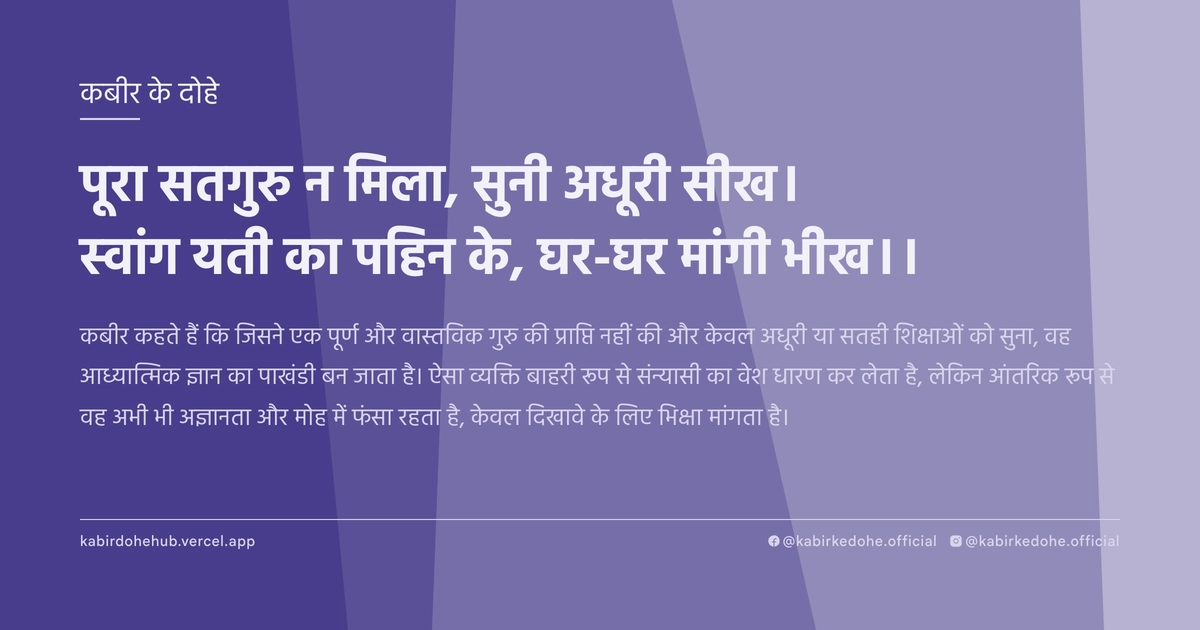
पूरा सतगुरु न मिला, सुनी अधूरी सीख।
स्वांग यती का पहिन के, घर-घर मांगी भीख।।
Poora satguru na mila, suni adhoori seekh. Swang yati ka pahin ke, ghar-ghar maangi bheekh.
इस पृष्ठ पर इस कबीर दोहे का अर्थ (meaning), हिंदी व्याख्या और अंग्रेज़ी अनुवाद, दार्शनिक विश्लेषण और व्यावहारिक जीवन सीख दी गई है। यह दोहा धार्मिक पाखंड (Religious Hypocrisy) विषय से जुड़ा है — Kabir doha meaning and explanation in Hindi and English.
अर्थ (Meaning):
कबीर कहते हैं कि जिसने एक पूर्ण और वास्तविक गुरु की प्राप्ति नहीं की और केवल अधूरी या सतही शिक्षाओं को सुना, वह आध्यात्मिक ज्ञान का पाखंडी बन जाता है। ऐसा व्यक्ति बाहरी रूप से संन्यासी का वेश धारण कर लेता है, लेकिन आंतरिक रूप से वह अभी भी अज्ञानता और मोह में फंसा रहता है, केवल दिखावे के लिए भिक्षा मांगता है।
Kabir asserts that one who fails to find a complete, realized Master and instead relies on fragmented or superficial teachings becomes a pretender of spirituality. Such a person adopts the external costume of an ascetic (Yati), wandering from door to door for alms, while remaining internally void of true liberation and trapped in the illusion of ego.
व्याख्या (Interpretation):
यह दोहा बाहरी आडंबर और आंतरिक शून्यता के बीच के विरोधाभास को दर्शाता है। 'पूरा सतगुरु' वह है जो साधक को माया के पर्दे से मुक्त कर ब्रह्म से मिला दे। जब शिक्षा अधूरी होती है, तो व्यक्ति केवल 'संन्यास' की नकल करना सीखता है, सत्य को नहीं। यहाँ 'भीख' केवल अन्न की नहीं, बल्कि सामाजिक मान्यता और प्रशंसा की भूख का प्रतीक है। यह निर्गुण भक्ति के उस सिद्धांत पर आधारित है जहाँ ईश्वर मंदिर या वेशभूषा में नहीं, बल्कि शुद्ध चेतना में मिलता है। अद्वैत वेदांत के अनुसार, जब तक अहंकार (माया) समाप्त नहीं होता, तब तक केवल वस्त्र बदलने से आत्मा का परमात्मा में विलय संभव नहीं है। यह स्थिति एक आध्यात्मिक त्रासदी है जहाँ व्यक्ति स्वयं को ज्ञानी मानकर और अधिक गहरे अज्ञान में गिर जाता है।
This couplet illuminates the stark paradox between external ornamentation and internal void. The 'Poora Satguru' represents a fully realized guide capable of stripping away the veil of Maya to reveal the Brahman. When teachings are fragmented, the seeker learns only the 'mimicry' of renunciation rather than the essence of liberation. The 'alms' mentioned here symbolize not just food, but a craving for social validation and the ego's hunger for recognition as 'holy.' Rooted in Nirgun Bhakti, it emphasizes that the Divine is found in pure consciousness, not in saffron robes. According to Advaita Vedanta, until the ego is annihilated, changing one's attire is a futile exercise in identity shifting. It depicts a spiritual tragedy where the practitioner mistakes the map for the territory, falling deeper into ignorance while wearing the mask of enlightenment.
दार्शनिक विश्लेषण (Philosophical Analysis):
कबीर का यह प्रहार उनके समय के उन धार्मिक पाखंडियों पर है जो केवल कर्मकांडों और बाहरी प्रतीकों को धर्म मानते थे। उन्होंने स्पष्ट किया कि धर्म कोई पोशाक नहीं है जिसे पहना जा सके, बल्कि यह एक आंतरिक रूपांतरण है। कबीर का दर्शन सूफीवाद के 'फना' (अहंकार का विनाश) और वेदांत के 'अहं ब्रह्मास्मि' के करीब है, जहाँ व्यक्ति को अपनी झूठी पहचान को मिटाना होता है।
ritualism (कर्मकांड) का विरोध करते हुए कबीर तर्क देते हैं कि यदि ज्ञान अधूरा है, तो वह केवल अहंकार को पुष्ट करता है। एक अधूरा ज्ञान व्यक्ति को यह विश्वास दिला देता है कि वह दूसरों से श्रेष्ठ है, जो कि आध्यात्मिक मार्ग की सबसे बड़ी बाधा है। यह 'अध्यात्मिक अहंकार' (Spiritual Ego) सामान्य अहंकार से अधिक खतरनाक है क्योंकि यह पवित्रता के मुखौटे के पीछे छिपा होता है।
ऐतिहासिक रूप से, कबीर ने देखा कि कैसे लोग तीर्थयात्राओं और कठिन तपस्याओं का ढोंग करते थे जबकि उनके भीतर क्रोध, लोभ और मोह यथावत थे। उन्होंने 'सहज मार्ग' का समर्थन किया, जहाँ सत्य का अनुभव दैनिक जीवन की सरलता में होता है, न कि जंगलों में भागने या भेष बदलने में।
सूफी परंपरा की तरह, कबीर भी 'इश्क' या प्रेम के माध्यम से ईश्वर की प्राप्ति की बात करते हैं। उनके लिए, एक पूर्ण गुरु वह है जो शिष्य के भीतर के 'मैं' को जला दे। यदि गुरु केवल शास्त्र पढ़ाता है और अनुभव नहीं कराता, तो वह केवल एक शिक्षक है, सतगुरु नहीं।
अंततः, यह विश्लेषण हमें यह समझने पर मजबूर करता है कि सत्य का मार्ग 'होने' (Being) का है, 'दिखने' (Appearing) का नहीं। जब तक साधक अपनी आंतरिक कुरूपता को स्वीकार नहीं करता, वह बाहरी सुंदरता या पवित्रता के पीछे छिपकर केवल स्वयं को धोखा देता है।
Kabir’s critique is aimed at the religious hypocrites of his era who equated spirituality with external symbols and rigid rituals. He posits that Dharma is not a garment to be worn, but an internal alchemy of transformation. His philosophy aligns closely with the Sufi concept of 'Fana' (annihilation of the self) and the Vedantic realization of 'Aham Brahmasmi,' where the false identity must be incinerated to reveal the Truth.
By rejecting ritualism, Kabir argues that fragmented knowledge does not liberate; rather, it reinforces the ego. Partial enlightenment creates a dangerous illusion of superiority, leading to 'Spiritual Ego'—a state far more perilous than worldly pride because it is shielded by a mask of sanctity and virtue.
Historically, Kabir witnessed a surge in performative asceticism, where pilgrims and pundits performed arduous penances while remaining enslaved to anger, greed, and lust. He advocated for the 'Sahaja Marg' (the Natural Path), suggesting that Truth is experienced in the simplicity of daily existence, not through the theatricality of renunciation or fleeing to forests.
Mirroring Sufi mysticism, Kabir emphasizes the role of divine love and the necessity of a guide who facilitates the death of the 'I'. A teacher may impart scriptures, but only a Satguru can ignite the fire of experiential realization. Without this, the student merely becomes a scholar of the void.
Ultimately, this analysis forces a confrontation with the reality that the path to Truth is about 'Being,' not 'Appearing.' As long as the seeker hides their internal shadows behind a facade of purity, they remain in a state of spiritual slumber, mistaking the costume of a saint for the state of a sage.
मूल संदेश (Core Message):
- बाहरी वेशभूषा आध्यात्मिक प्रगति का प्रमाण नहीं है।
- अधूरा ज्ञान अहंकार को बढ़ाता है, उसे मिटाता नहीं।
- सच्चा गुरु वह है जो आपके मुखौटों को नष्ट कर दे।
- दिखावे की भक्ति वास्तव में आत्म-धोखा है।
- विनम्रता ही वह द्वार है जिससे सत्य का प्रवेश होता है।
- आंतरिक रूपांतरण के बिना संन्यास केवल एक नाटक है।
- External attire is not evidence of spiritual evolution.
- Fragmented knowledge inflates the ego rather than dissolving it.
- A true Master is one who incinerates your masks.
- Performative devotion is essentially a form of self-deception.
- Humility is the only gateway through which Truth enters.
- Renunciation without internal alchemy is merely a theatrical act.
व्यावहारिक उदाहरण (Practical Example):
वाराणसी के घाटों पर रहने वाले एक वृद्ध विधवा, जानकी, की कहानी है। जानकी ने अपना पूरा जीवन धर्मग्रंथों के पाठ और कठोर नियमों के पालन में बिताया। वह शहर में सबसे 'पवित्र' मानी जाती थी क्योंकि वह केवल सादा भोजन करती थी और दिन भर माला जपती थी।
उसकी पहचान उसकी सफेद साड़ी और माथे की भस्म से थी। वह अन्य महिलाओं को उनके 'अशुद्ध' व्यवहार के लिए टोकती रहती थी, जिससे उसे एक नैतिक श्रेष्ठता का अनुभव होता था। वह मानती थी कि उसने मोक्ष का मार्ग पा लिया है क्योंकि उसने बाहरी दुनिया का त्याग कर दिया था।
एक दिन, उसकी मुलाकात एक साधारण से दिखने वाले बुनकर से हुई, जो कबीर की वाणी गा रहा था। उस बुनकर ने जानकी से पूछा, 'माँ, आपकी माला के मनके तो बहुत चमक रहे हैं, लेकिन क्या आपके भीतर का क्रोध शांत हुआ है?'
जानकी पहले तो क्रोधित हुई और उसे अपनी पवित्रता का हवाला दिया। लेकिन बुनकर ने मुस्कुराते हुए कहा, 'पवित्रता वस्त्रों में नहीं, उस करुणा में है जो दूसरों के दुख को अपना मान ले। आप माला तो जप रही हैं, लेकिन आपके शब्दों में दूसरों के लिए तिरस्कार है।'
यह बात जानकी के हृदय में एक तीर की तरह लगी। उसने महसूस किया कि उसने वर्षों तक केवल 'संन्यासी' होने का अभिनय किया था। उसने धर्म को एक ढाल बना लिया था जिससे वह अपनी कड़वाहट और अहंकार को छिपा सके।
उसने महसूस किया कि उसकी 'सीख' अधूरी थी; उसने केवल नियमों को सीखा था, प्रेम को नहीं। वह जिसे मोक्ष समझ रही थी, वह वास्तव में उसकी अपनी श्रेष्ठता का भ्रम था।
अगले कुछ महीनों में, जानकी ने अपनी कठोरता को त्याग दिया। उसने माला जपना बंद नहीं किया, लेकिन अब वह माला जपते समय दूसरों के प्रति क्षमा और प्रेम का भाव रखने लगी।
उसने पाया कि जब उसने 'पवित्र विधवा' का मुखौटा उतारा, तब उसे पहली बार वास्तविक शांति का अनुभव हुआ। अब वह दूसरों को सुधारने के बजाय, स्वयं के भीतर की गंदगी को साफ करने में जुट गई।
उसका जीवन अब दिखावे की भीख नहीं, बल्कि आंतरिक संतोष का उत्सव बन गया था। उसने सीखा कि असली गुरु वह अनुभव है जो आपको आपके अहंकार से रूबरू करा दे।
अंततः, जानकी ने समझा कि असली भक्ति वह है जो आपको विनम्र बनाए, न कि वह जो आपको दूसरों से ऊपर खड़ा करे।
In the ancient alleys of Varanasi lived Janaki, an elderly widow who had spent her entire existence adhering to the strictest interpretations of religious texts. She was regarded as the most 'pure' woman in her colony, known for her austere diet and incessant chanting of prayer beads.
Her identity was woven into her stark white saree and the ash on her forehead. She frequently corrected other women for their 'impure' behaviors, deriving a subtle sense of moral superiority from these interactions. She believed she had secured her path to Moksha simply by renouncing worldly luxuries.
One afternoon, she encountered a humble weaver who was singing the verses of Kabir. The weaver looked at her and asked softly, 'Mother, your prayer beads shine brightly, but has the anger within your heart been extinguished?'
Janaki was initially offended, citing her lifelong devotion and purity. But the weaver smiled and replied, 'Purity does not reside in the cloth you wear, but in the compassion that views another's pain as its own. You chant the names of the Divine, yet your words drip with contempt for others.'
These words pierced Janaki’s heart like a needle. For the first time, she realized she had spent decades merely 'acting' the part of a renunciant. She had used religion as a shield to hide her bitterness and an inflated sense of self.
She recognized that her 'learning' was incomplete; she had mastered the rules of the faith, but had completely missed the essence of Love. What she perceived as liberation was actually a sophisticated delusion of superiority.
Over the following months, Janaki consciously shed her rigidity. She did not stop her prayers, but she shifted her focus from the mechanical repetition of words to the cultivation of genuine forgiveness and empathy.
She discovered that only after she discarded the mask of the 'Holy Widow' did she experience true, unadulterated peace. She stopped trying to 'fix' others and began the grueling work of cleaning her own internal shadows.
Her life ceased to be a quest for the 'alms' of social validation and became a celebration of inner contentment. She realized that the true Guru is the experience that forces you to confront your own ego.
Ultimately, Janaki understood that authentic devotion is that which renders one humble, not that which elevates one above the rest of humanity.
अभ्यास मार्गदर्शन (Practice Guidance):
- दैनिक आत्म-निरीक्षण: प्रतिदिन 15 मिनट मौन बैठें और विचार करें कि आज आपने कितनी बार अपनी 'नैतिक श्रेष्ठता' का प्रदर्शन किया।
- अहंकार की पहचान: जब भी आप किसी दूसरे की गलती पर उसे सुधारने की इच्छा करें, रुकें और पूछें—'क्या मैं वास्तव में उसकी मदद करना चाहता हूँ या मैं खुद को श्रेष्ठ महसूस करना चाहता हूँ?'
- सेवा का अभ्यास: बिना किसी को बताए या बिना किसी पहचान के किसी की मदद करें, ताकि 'परोपकारी' होने का अहंकार विकसित न हो।
- डायरी लेखन: उन क्षणों को लिखें जब आपने अपनी छवि (Image) को बचाने के लिए झूठ बोला या दिखावा किया।
- निदान चेकलिस्ट: यदि आप दूसरों के प्रति निर्णय लेने (Judging) में तेजी महसूस करते हैं, तो समझ लें कि आप अभी भी 'अधूरी सीख' के प्रभाव में हैं।
- Daily Self-Inquiry: Spend 15 minutes in silence daily, reflecting on how many times you performed your 'moral superiority' today.
- Ego Detection: Whenever you feel the urge to correct someone else's mistake, pause and ask—'Do I truly wish to help them, or do I simply want to feel superior?'
- Anonymous Service: Perform acts of kindness without revealing your identity, ensuring that the ego of being a 'philanthropist' does not take root.
- Shadow Journaling: Document moments where you lied or pretended to be something you are not just to protect your public image.
- Diagnostic Checklist: If you find yourself judging others rapidly, recognize that you are still operating under the influence of 'fragmented learning'.
चिंतन प्रश्न (Reflection Questions):
- मेरे जीवन का वह कौन सा 'पवित्र मुखौटा' है जिसे मैं दुनिया के सामने पहनता हूँ?
- क्या मेरी धार्मिक या नैतिक मान्यताएं मुझे दूसरों के प्रति अधिक करुणामयी बनाती हैं या अधिक निर्णयकारी?
- यदि मेरी सारी उपाधियाँ और सामाजिक पहचान छीन ली जाएं, तो मेरे भीतर क्या बचेगा?
- मैं अपनी आध्यात्मिक यात्रा में 'सत्य' की खोज कर रहा हूँ या 'ज्ञानी' दिखने की इच्छा?
- मेरे जीवन में वह कौन सी 'अधूरी सीख' है जो मुझे वास्तव में आगे बढ़ने से रोक रही है?
- क्या मैं अपनी कमियों को स्वीकार करने का साहस रखता हूँ, या मैं उन्हें धर्म की आड़ में छिपाता हूँ?
- What is the 'holy mask' I wear in my life to present a sanitized version of myself to the world?
- Do my religious or moral beliefs make me more compassionate toward others, or more judgmental?
- If all my titles and social identities were stripped away, what would actually remain within me?
- Am I seeking the 'Truth' in my spiritual journey, or am I seeking the feeling of being 'enlightened'?
- What is the 'fragmented learning' in my life that is actually preventing me from true growth?
- Do I have the courage to confront my own shadows, or do I hide them behind the veil of spirituality?