
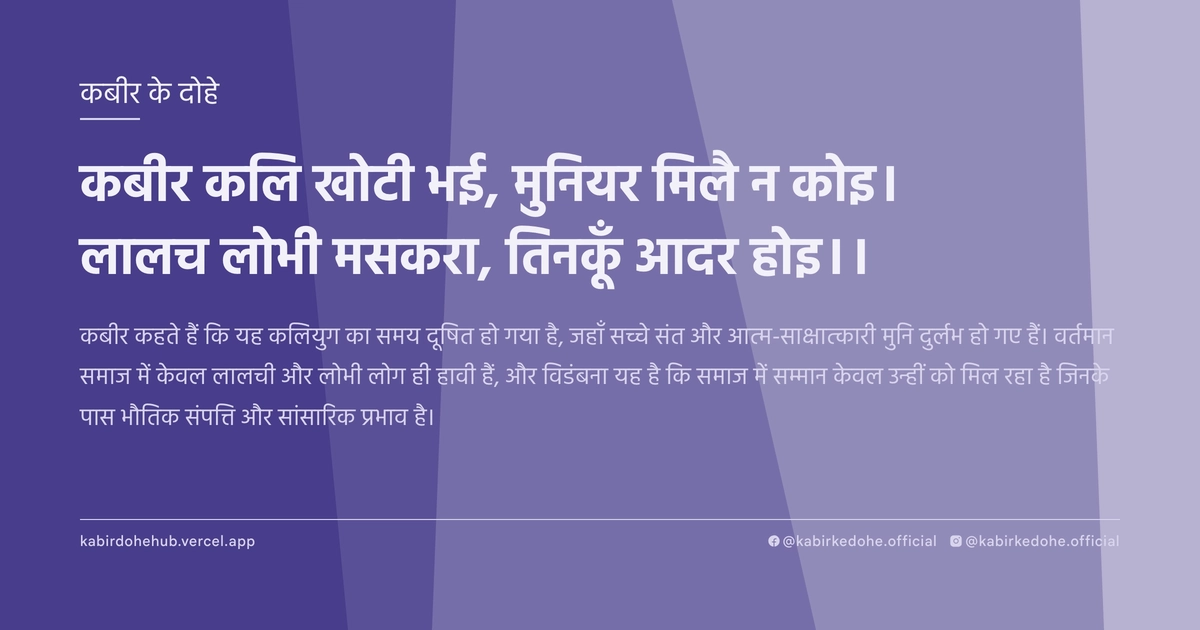
कबीर कलि खोटी भई, मुनियर मिलै न कोइ।
लालच लोभी मसकरा, तिनकूँ आदर होइ।।
Kabir kali khoti bhai, muniyar milai na koi. Laalach lobhi maskara, tinkun aadar hoye.
इस पृष्ठ पर इस कबीर दोहे का अर्थ (meaning), हिंदी व्याख्या और अंग्रेज़ी अनुवाद, दार्शनिक विश्लेषण और व्यावहारिक जीवन सीख दी गई है। यह दोहा धार्मिक पाखंड (Religious Hypocrisy) विषय से जुड़ा है — Kabir doha meaning and explanation in Hindi and English.
अर्थ (Meaning):
कबीर कहते हैं कि यह कलियुग का समय दूषित हो गया है, जहाँ सच्चे संत और आत्म-साक्षात्कारी मुनि दुर्लभ हो गए हैं। वर्तमान समाज में केवल लालची और लोभी लोग ही हावी हैं, और विडंबना यह है कि समाज में सम्मान केवल उन्हीं को मिल रहा है जिनके पास भौतिक संपत्ति और सांसारिक प्रभाव है।
Kabir observes that the current age (Kali Yuga) has become corrupted, making true saints and enlightened sages nearly impossible to find. In this inverted morality, those driven by greed and avarice dominate the social landscape, and ironically, respect is accorded only to those who possess material wealth and worldly influence.
व्याख्या (Interpretation):
इस दोहे का शाब्दिक अर्थ समाज में नैतिक पतन का वर्णन है, लेकिन इसका गहरा आध्यात्मिक अर्थ 'माया' के प्रभाव को दर्शाता है। 'खोटी कलि' केवल समय नहीं, बल्कि मानवीय चेतना की वह अवस्था है जहाँ सत्य और असत्य का भेद मिट गया है। यहाँ 'मुनियर' का अर्थ केवल बाहरी संन्यासियों से नहीं, बल्कि उस आंतरिक स्थिरता से है जो अहंकार से मुक्त है। कबीर इस विरोधाभास को उजागर करते हैं कि समाज उस व्यक्ति को पूजता है जो लोभी है, क्योंकि लोभ बाहरी चमक-धमक पैदा करता है। यह निर्गुण भक्ति का संकेत है कि ईश्वर किसी बाहरी आडंबर या धन में नहीं, बल्कि उस शून्य में है जहाँ लोभ का अंत होता है। यह आत्मा और ब्रह्म के बीच की दूरी को पाटने के बजाय, भौतिकता के पर्दे को और मोटा करने की प्रक्रिया है।
While the literal meaning describes social decay, the deeper spiritual interpretation addresses the veil of Maya. 'Khoti Kali' refers not just to a chronological era, but to a state of human consciousness where the distinction between truth and illusion has blurred. The 'Muniyar' (sages) represent not merely external ascetics, but the internal state of equanimity liberated from ego. Kabir highlights the paradox where society venerates the greedy because greed manifests as outward material splendor. This aligns with Nirgun Bhakti, suggesting that the Divine resides not in ritualistic displays or wealth, but in the void created when greed vanishes. It emphasizes how the obsession with the material world thickens the veil between the Atman and Brahman, trapping the soul in a cycle of false validations.
दार्शनिक विश्लेषण (Philosophical Analysis):
कबीर का यह दोहा उनके समय के सामाजिक और धार्मिक पाखंड पर एक तीखा प्रहार है। वे उस युग में लिख रहे थे जहाँ धर्म का व्यवसायीकरण हो चुका था और जातिगत श्रेष्ठता भौतिक संपत्ति से जुड़ी थी। कबीर का दृष्टिकोण अद्वैत वेदांत से प्रेरित है, जहाँ वे मानते हैं कि जब तक मनुष्य 'मैं' और 'मेरा' (अहंकार) के जाल में फंसा है, वह सत्य को नहीं देख सकता।
यहाँ 'लोभ' केवल धन की इच्छा नहीं है, बल्कि यह एक मनोवैज्ञानिक बंधन है जो आत्मा को उसकी वास्तविक प्रकृति से दूर ले जाता है। सूफी मत के 'नफ्स' (निचली इच्छाओं) के विचार की तरह, कबीर तर्क देते हैं कि जब तक निम्न प्रवृत्तियाँ हावी रहती हैं, उच्च आध्यात्मिक चेतना का उदय नहीं हो सकता। वे ritualism (कर्मकांड) का विरोध करते हैं क्योंकि वे देखते हैं कि लोग मंदिर और मस्जिद तो बनाते हैं, लेकिन अपने हृदय के भीतर के लालच को नहीं मिटाते।
दार्शनिक रूप से, कबीर यहाँ 'मूल्य परिवर्तन' की बात कर रहे हैं। समाज जिसे 'सफलता' या 'सम्मान' कहता है, कबीर उसे 'पतन' मानते हैं। उनके लिए असली सम्मान वह है जो आत्म-साक्षात्कार से आता है, न कि वह जो दूसरों की चापलूसी से प्राप्त होता है। यह विश्लेषण स्पष्ट करता है कि कबीर केवल समाज की आलोचना नहीं कर रहे, बल्कि साधक को चेतावनी दे रहे हैं कि वह भीड़ के पीछे न भागे।
अहंकार का विलोपन (Annihilation of Ego) ही वह एकमात्र मार्ग है जिससे 'खोटी कलि' के प्रभाव से बचा जा सकता है। जब व्यक्ति यह समझ लेता है कि बाहरी सम्मान एक भ्रम है, तब वह वास्तव में उस 'मुनि' की स्थिति प्राप्त करता है जिसकी तलाश कबीर कर रहे हैं। यह आंतरिक रूपांतरण ही वास्तविक मुक्ति है।
अंततः, यह दोहा हमें यह सोचने पर मजबूर करता है कि क्या हम वास्तव में सत्य की खोज कर रहे हैं या केवल उस सामाजिक स्वीकृति की, जो लोभ और दिखावे पर आधारित है। कबीर का संदेश सार्वभौमिक है: सत्य की खोज अकेलेपन और सादगी में होती है, शोर और विलासिता में नहीं।
This couplet is a piercing critique of the social and religious hypocrisy of Kabir's era. Writing during a time when religion had become commercialized and caste superiority was intertwined with material wealth, Kabir employs a lens inspired by Advaita Vedanta. He posits that as long as a human is trapped in the web of 'I' and 'Mine' (Ahamkara), the ultimate Truth remains obscured.
In this context, 'greed' is not merely a desire for money, but a psychological shackle that alienates the soul from its primordial nature. Mirroring the Sufi concept of 'Nafs' (the lower self), Kabir argues that spiritual awakening is impossible as long as these base instincts dominate the psyche. He vehemently rejects ritualism, observing that people build grand temples and mosques while neglecting to cleanse the greed within their own hearts.
Philosophically, Kabir is addressing a 'reversal of values.' What society labels as 'success' or 'honor,' Kabir identifies as 'spiritual decay.' For him, genuine honor is derived from self-realization, not from the sycophancy of others. This analysis reveals that Kabir is not merely criticizing society but warning the seeker against following the herd.
The annihilation of the ego is the only mechanism to escape the influence of the 'corrupt age.' When an individual realizes that external validation is a mirage, they attain the state of the 'Muni' (sage) that Kabir laments the loss of. This internal transmutation is the only path to true liberation.
Ultimately, the verse forces us to question whether we are pursuing Truth or merely seeking social acceptance based on greed and ostentation. Kabir's message is universal: Truth is found in solitude and simplicity, never in noise and luxury.
मूल संदेश (Core Message):
- बाहरी चमक अक्सर आंतरिक रिक्तता को छिपाने का मुखौटा होती है।
- सच्चा सम्मान गुणों से आता है, संचित संपत्ति से नहीं।
- लोभ आत्मा की दृष्टि को धुंधला कर देता है, जिससे सत्य ओझल हो जाता है।
- भीड़ का अनुसरण करना आध्यात्मिक पतन का सबसे सरल मार्ग है।
- अहंकार का विसर्जन ही वास्तविक मुनि होने की पहली शर्त है।
- शांति बाहरी दुनिया की स्वीकृति में नहीं, बल्कि आंतरिक संतोष में है।
- External brilliance is often a mask hiding internal emptiness.
- True honor is derived from virtue, not from accumulated wealth.
- Greed clouds the soul's vision, rendering the Truth invisible.
- Following the crowd is the easiest path toward spiritual decay.
- The dissolution of ego is the primary prerequisite to becoming a true sage.
- Peace resides in internal contentment, not in the validation of the world.
व्यावहारिक उदाहरण (Practical Example):
वाराणसी के घाटों पर रहने वाले एक वृद्ध विधवा, जानकी की कहानी है। जानकी के पास बहुत कम संसाधन थे, लेकिन वह अपनी छोटी सी कुटिया में शांति से रहती थी।
उसी मोहल्ले में एक धनी व्यापारी रहता था, जिसे पूरा शहर उसकी दानशीलता के कारण सम्मान देता था। वह हर उत्सव में बड़े-बड़े आयोजन करता और खुद को धर्म का रक्षक बताता था।
लोग व्यापारी के सामने झुकते थे, जबकि जानकी को अक्सर अनदेखा कर दिया जाता था। व्यापारी का सम्मान उसकी संपत्ति और प्रभाव पर टिका था, न कि उसकी करुणा पर।
एक दिन शहर में भीषण बाढ़ आई। व्यापारी का सारा वैभव, उसके गोदाम और उसकी संपत्ति पानी में बह गई। अचानक, वह सम्मान जो उसे मिलता था, गायब हो गया।
लोग अब उसकी मदद करने के बजाय उसकी विफलता पर चर्चा कर रहे थे। वह व्यक्ति जो 'सम्मान' का अभ्यस्त था, अब गहरे अवसाद और अकेलेपन में डूब गया।
दूसरी ओर, जानकी ने अपनी छोटी सी कुटिया के बचे हुए अनाज से उन लोगों को खिलाना शुरू किया जिनके पास कुछ नहीं बचा था। उसने बिना किसी दिखावे के लोगों की सेवा की।
धीरे-धीरे लोगों ने महसूस किया कि असली शांति और सहारा जानकी के पास है, न कि उस व्यापारी के पास जिसने केवल बाहरी चमक बिखेरी थी।
व्यापारी ने देखा कि जिस 'सम्मान' के लिए उसने जीवन भर लोभ किया, वह रेत की तरह ढह गया। उसने जानकी के चरणों में बैठकर पूछा कि यह शांति कहाँ से आती है।
जानकी ने मुस्कुराकर कहा, 'जब मैंने यह मान लिया कि मेरा कुछ नहीं है, तब मुझे वह मिल गया जो कभी खत्म नहीं होता।'
यह 'कबीर ट्विस्ट' था—व्यापारी का अहंकार टूट गया और उसने पहली बार भौतिकता से ऊपर उठकर निस्वार्थ सेवा के मार्ग को अपनाया।
Consider the story of Janaki, an elderly widow living on the ghats of Varanasi. Janaki possessed very few resources, living simply in a tiny hut with profound inner peace.
In the same neighborhood lived a wealthy merchant, revered by the entire city for his apparent philanthropy. He organized lavish festivals and presented himself as the guardian of faith.
People bowed before the merchant, while Janaki was often ignored or overlooked. The merchant's respect was anchored in his wealth and influence, not in genuine compassion.
One day, a devastating flood struck the city. The merchant's grandeur, his warehouses, and his riches were swept away by the currents. Suddenly, the respect he enjoyed vanished.
Instead of helping him, people began discussing his failure. The man who was accustomed to social validation plummeted into deep depression and isolation.
Meanwhile, Janaki began feeding the displaced people with the meager grains she had saved. She served others without any desire for recognition or reward.
Gradually, the community realized that true solace and strength resided with Janaki, not with the merchant who had only projected an outward shimmer.
The merchant observed that the 'honor' he had spent a lifetime chasing through greed had collapsed like a house of cards. He sat at Janaki's feet and asked where this peace came from.
Janaki smiled and replied, 'When I accepted that nothing belonged to me, I found that which can never be lost.'
This was the 'Kabir Twist'—the merchant's ego shattered, and for the first time, he abandoned materialism to embrace the path of selfless service.
अभ्यास मार्गदर्शन (Practice Guidance):
- दैनिक चिंतन: प्रतिदिन 15 मिनट मौन बैठें और विचार करें कि आपकी कौन सी इच्छाएं 'लोभ' से प्रेरित हैं और कौन सी 'आवश्यकता' से।
- आत्म-पूछताछ जर्नल: लिखें कि आप दूसरों से किस प्रकार के सम्मान की अपेक्षा करते हैं और क्या वह सम्मान आपके वास्तविक स्वरूप पर आधारित है या आपकी उपलब्धियों पर।
- व्यवहार परिवर्तन: सप्ताह में एक बार ऐसा कार्य करें जिससे किसी को लाभ हो, लेकिन इस शर्त पर कि आप उस कार्य का श्रेय किसी को न दें और न ही किसी को बताएं।
- डायग्नोस्टिक चेकलिस्ट: यदि आप किसी की प्रशंसा सुनकर उत्साहित होते हैं या आलोचना सुनकर विचलित होते हैं, तो समझें कि आप अभी भी बाहरी सम्मान (माया) के जाल में हैं।
- Daily Contemplation: Spend 15 minutes in silence daily, discerning which of your desires are driven by 'greed' and which are born of genuine 'necessity'.
- Self-Inquiry Journal: Document the types of respect you crave from others and analyze whether that desire is based on your authentic self or your external achievements.
- Behavioral Shift: Once a week, perform an act of service for another, with the strict condition that you take no credit and keep the act completely anonymous.
- Diagnostic Checklist: If you feel a surge of ego upon receiving praise or a dip in self-worth upon receiving criticism, recognize that you are still entangled in the web of external validation (Maya).
चिंतन प्रश्न (Reflection Questions):
- यदि आपकी सारी भौतिक उपलब्धियां और पद छीन लिए जाएं, तो आपकी पहचान का क्या बचेगा?
- क्या आप वास्तव में उन लोगों का सम्मान करते हैं जिन्हें समाज महान कहता है, या आप केवल उनकी शक्ति से प्रभावित हैं?
- आपके जीवन में 'सम्मान' की भूख किस छिपे हुए डर या कमी से पैदा होती है?
- क्या आपका डिजिटल व्यक्तित्व (सोशल मीडिया) आपके वास्तविक आंतरिक जीवन का प्रतिबिंब है या एक निर्मित भ्रम?
- आप अपनी नैतिकता को कहाँ रखते हैं—सत्य के साथ या सामाजिक स्वीकृति के साथ?
- वह कौन सा 'लोभ' है जिसे आप 'महत्वाकांक्षा' का नाम देकर सही ठहरा रहे हैं?
- If all your material achievements and titles were stripped away, what would remain of your identity?
- Do you truly respect the people society labels as 'great,' or are you merely intimidated by their power?
- From which hidden fear or deficiency does your hunger for 'respect' originate?
- Is your digital persona a reflection of your authentic inner life, or is it a carefully constructed illusion?
- Where do you anchor your morality—with the Truth, or with social acceptance?
- Which specific 'greed' in your life are you justifying by labeling it as 'ambition'?