
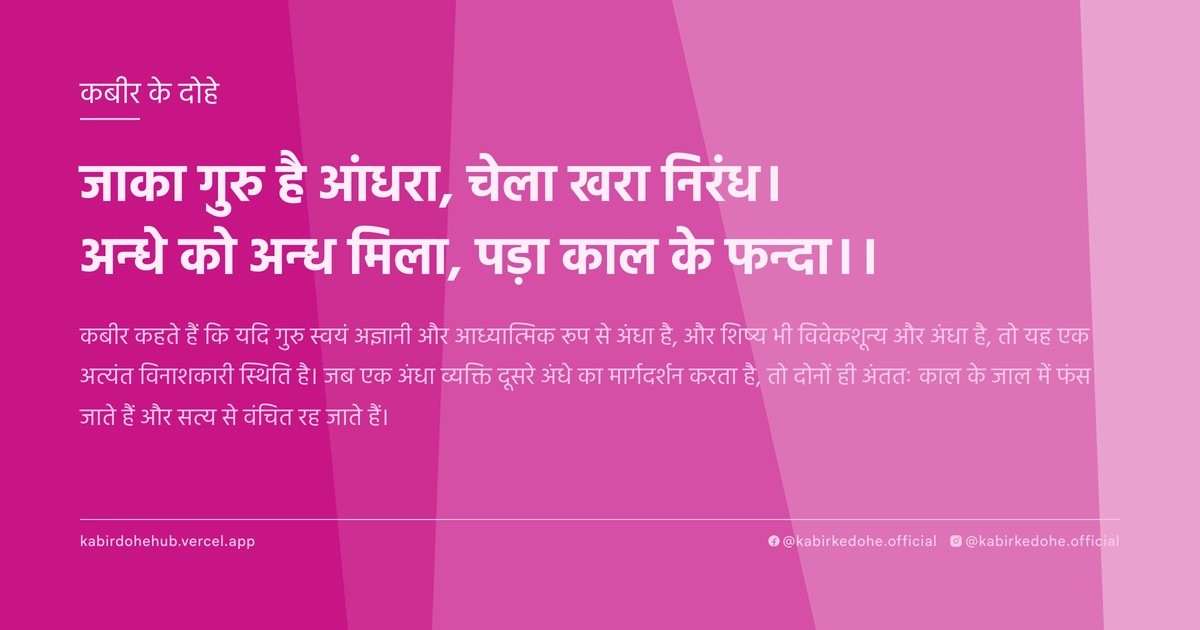
जाका गुरु है आंधरा, चेला खरा निरंध।
अन्धे को अन्ध मिला, पड़ा काल के फन्दा।।
Jaka guru hai andhara, chela khara nirandh. Andhe ko andh mila, pada kaal ke fanda.
इस पृष्ठ पर इस कबीर दोहे का अर्थ (meaning), हिंदी व्याख्या और अंग्रेज़ी अनुवाद, दार्शनिक विश्लेषण और व्यावहारिक जीवन सीख दी गई है। यह दोहा गुरु महत्व (The Guru's Importance) विषय से जुड़ा है — Kabir doha meaning and explanation in Hindi and English.
अर्थ (Meaning):
कबीर कहते हैं कि यदि गुरु स्वयं अज्ञानी और आध्यात्मिक रूप से अंधा है, और शिष्य भी विवेकशून्य और अंधा है, तो यह एक अत्यंत विनाशकारी स्थिति है। जब एक अंधा व्यक्ति दूसरे अंधे का मार्गदर्शन करता है, तो दोनों ही अंततः काल के जाल में फंस जाते हैं और सत्य से वंचित रह जाते हैं।
Kabir warns that when a spiritual guide is blinded by ignorance and the seeker is equally devoid of discernment, the result is catastrophic. When the blind lead the blind, both inevitably stumble into the traps of time and illusion, failing to ever reach the light of ultimate truth.
व्याख्या (Interpretation):
शाब्दिक अर्थ यह है कि अज्ञानी गुरु और शिष्य का मिलन पतन का कारण बनता है। रूपक के स्तर पर, 'अंधापन' यहाँ अहंकार, धार्मिक कट्टरता और माया के प्रभाव को दर्शाता है। निर्गुण भक्ति के संदर्भ में, यदि गुरु स्वयं ब्रह्म-साक्षात्कार से वंचित है, तो वह केवल बाहरी कर्मकांडों का बोझ बढ़ाएगा। यह अद्वैत वेदांत के उस सिद्धांत को पुष्ट करता है जहाँ बिना सही ज्ञान (ज्ञान-योग) के, केवल अंधश्रद्धा बंधन का कारण बनती है। यहाँ 'काल का फंदा' जन्म-मृत्यु के चक्र और अज्ञान की गहरी खाई का प्रतीक है, जहाँ आत्मा अपनी वास्तविक प्रकृति को भूलकर मिथ्या पहचान में उलझ जाती है।
Literally, the union of an ignorant teacher and disciple leads to downfall. Metaphorically, 'blindness' represents the veil of ego, religious bigotry, and the grip of Maya. In the context of Nirgun Bhakti, if the Guru has not realized the formless Brahman, they merely perpetuate the burden of external rituals. This aligns with Advaita Vedanta, suggesting that without true Gnosis (Jnana), blind faith only tightens the bonds of bondage. The 'trap of time' symbolizes the cycle of Samsara and the abyss of ignorance, where the Atman forgets its non-dual nature and remains entangled in a false, fragmented identity.
दार्शनिक विश्लेषण (Philosophical Analysis):
कबीर का यह दोहा मध्यकालीन भारत के उस सामाजिक-धार्मिक परिवेश पर प्रहार है जहाँ गुरु की पूजा बिना किसी तर्क या अनुभव के की जाती थी। कबीर ने देखा कि कैसे धर्म के नाम पर पाखंडी लोग आम जनता को गुमराह कर रहे थे। वे केवल पदवी या वेशभूषा को गुरुत्व का प्रमाण नहीं मानते थे, बल्कि आंतरिक अनुभव (अनुभूति) को प्राथमिकता देते थे।
यह विश्लेषण अद्वैत वेदांत के 'अविद्या' (अज्ञान) की अवधारणा से जुड़ता है। जब गुरु स्वयं माया के प्रभाव में होता है, तो वह सत्य के बजाय अपनी धारणाओं को थोपता है। सूफी मत में भी 'पीर' का मार्गदर्शन अनिवार्य है, लेकिन यदि पीर स्वयं 'नफ्स' (अहंकार) से मुक्त नहीं है, तो वह मुरीद को सत्य के बजाय भ्रम की ओर ले जाएगा।
कबीर यहाँ ritualism (कर्मकांड) और जातिगत श्रेष्ठता के दावों को खारिज करते हैं। वे तर्क देते हैं कि आध्यात्मिक योग्यता जन्म या कुल से नहीं, बल्कि आत्म-साक्षात्कार से आती है। एक ऐसा गुरु जो केवल शास्त्रों का रटंत ज्ञान रखता है लेकिन जिसने स्वयं के भीतर के अंधकार को नहीं मिटाया, वह वास्तव में 'अंधा' है।
मनोवैज्ञानिक स्तर पर, यह दोहा 'पुष्टि पूर्वाग्रह' (confirmation bias) की चेतावनी देता है। जब एक अज्ञानी शिष्य एक अज्ञानी गुरु को चुनता है, तो वे एक-दूसरे के भ्रमों की पुष्टि करते हैं, जिससे सत्य की खोज रुक जाती है और अहंकार और अधिक सुदृढ़ हो जाता है।
अंततः, कबीर यह संदेश देते हैं कि सत्य का मार्ग केवल उसी के द्वारा दिखाया जा सकता है जिसने स्वयं उस मार्ग को पार किया हो। बिना विवेक के समर्पण केवल मानसिक दासता है, जो आत्मा की मुक्ति के बजाय उसे और अधिक जटिल बंधनों में जकड़ लेती है।
This couplet strikes at the heart of the socio-religious climate of medieval India, where gurus were often venerated without any scrutiny of their actual realization. Kabir observed how charlatans used the guise of religion to mislead the masses. He rejected the notion that titles, attire, or lineage constituted spiritual authority, prioritizing direct experiential realization (Anubhuti) instead.
This analysis connects to the Advaita Vedanta concept of 'Avidya' (ignorance). When a teacher remains under the influence of Maya, they impose their personal delusions rather than revealing the Absolute Truth. Similarly, in Sufism, while the guidance of a 'Pir' is essential, if the Pir is not liberated from the 'Nafs' (ego), they lead the murid toward illusion rather than the Divine.
Kabir explicitly rejects ritualism and the claims of caste superiority. He argues that spiritual competence is not inherited by birth or clan but achieved through self-realization. A teacher who possesses only rote knowledge of scriptures but has not extinguished their own inner darkness is, in reality, 'blind'.
Psychologically, this verse warns against 'confirmation bias'. When an ignorant disciple chooses an ignorant master, they mutually validate each other's delusions, halting the search for truth and reinforcing the ego's stronghold.
Ultimately, Kabir asserts that the path to truth can only be shown by one who has already traversed it. Surrender without discernment is mere mental slavery, which, instead of liberating the soul, entangles it in even more complex webs of bondage.
मूल संदेश (Core Message):
- अंधश्रद्धा आध्यात्मिक प्रगति नहीं, बल्कि एक मानसिक कारागार है।
- सच्चा मार्गदर्शन वह है जो आपको स्वयं के भीतर के प्रकाश की ओर ले जाए।
- बिना विवेक के समर्पण केवल अहंकार का एक सूक्ष्म रूप है।
- बाहरी प्रतीकों और पदवियों से ऊपर उठकर आंतरिक अनुभव को खोजें।
- सत्य का मार्ग प्रश्न पूछने और आत्म-जागरूकता से शुरू होता है।
- अज्ञान का साथ अंततः विनाश और समय के चक्र में बंधन का कारण बनता है।
- Blind faith is not spiritual progress, but a psychological prison.
- True guidance is that which leads you toward your own inner light.
- Surrender without discernment is merely a subtle form of ego.
- Rise above external symbols and titles to seek internal realization.
- The path to truth begins with questioning and self-awareness.
- Association with ignorance inevitably leads to downfall and bondage in the cycle of time.
व्यावहारिक उदाहरण (Practical Example):
वाराणसी के एक पुराने घाट पर रामदीन नाम का एक वृद्ध बुनकर रहता था। रामदीन ने अपना पूरा जीवन एक ऐसे धर्मगुरु के चरणों में बिता दिया था जिसने उसे सिखाया था कि मोक्ष केवल कठिन उपवासों और महंगे अनुष्ठानों से ही संभव है। रामदीन ने अपनी सारी जमापूंजी उन अनुष्ठानों में लगा दी, जबकि उसका परिवार गरीबी में जी रहा था।
वह गुरु स्वयं लालची था और केवल अपनी विलासिता के लिए रामदीन जैसे सरल लोगों को डराता रहता था कि यदि उन्होंने दान नहीं दिया, तो वे नरक में जाएंगे। रामदीन पूरी तरह विश्वास करता था क्योंकि उसने कभी प्रश्न नहीं किया था। वह उस 'अंधे' गुरु का 'अंधा' शिष्य बन चुका था।
एक दिन, घाट पर एक फकीर आया जिसने रामदीन को देखा और पूछा, "तुम्हारी भक्ति में प्रेम है या केवल डर?" रामदीन ने उत्तर दिया, "गुरु जी ने कहा है कि डर ही मुझे बचाएगा।"
फकीर मुस्कुराया और बोला, "जो तुम्हें डराकर बांधता है, वह तुम्हें मुक्त कैसे कर सकता है? क्या तुमने कभी अपने भीतर उस ईश्वर को देखा है, या केवल गुरु की बातों में सुना है?"
रामदीन को पहली बार महसूस हुआ कि उसने कभी स्वयं के भीतर झांकने की कोशिश ही नहीं की। उसने महसूस किया कि वह एक ऐसे व्यक्ति के पीछे चल रहा था जिसे खुद रास्ता नहीं पता था।
उसने गुरु के पास जाकर उनसे पूछा कि क्या उन्होंने स्वयं उस शांति का अनुभव किया है जिसका वे वादा करते हैं। गुरु क्रोधित हो गए और उसे शाप देने लगे।
गुरु का वह क्रोध रामदीन के लिए 'जागृति का क्षण' बन गया। उसने देखा कि क्रोध और अहंकार सत्य के मार्ग में सबसे बड़ी बाधाएं हैं, और उसका गुरु इन्हीं से भरा हुआ था।
रामदीन ने उस दिन बाहरी अनुष्ठानों को त्याग दिया। उसने अपनी बची हुई ऊर्जा को सेवा और आत्म-चिंतन में लगाया।
उसने पाया कि असली शांति किसी के बताए अनुष्ठानों में नहीं, बल्कि अपने भीतर के अहंकार को मिटाने और सबके प्रति करुणा रखने में है।
इस प्रकार, रामदीन 'काल के फंदे' से निकलकर विवेक के प्रकाश में आ गया।
On an ancient ghat in Varanasi lived an elderly weaver named Ramdin. Ramdin had spent his entire life at the feet of a religious leader who taught him that salvation was possible only through rigorous fasting and expensive rituals. Ramdin spent all his savings on these ceremonies, while his family lived in dire poverty.
The guru was greedy and terrified simple people like Ramdin, claiming that without donations, they would descend into hell. Ramdin believed implicitly because he had never questioned anything. He had become the 'blind' disciple of a 'blind' master.
One day, a wandering dervish arrived at the ghat, saw Ramdin, and asked, "Is there love in your devotion, or only fear?" Ramdin replied, "My guru says fear is what will save me."
The dervish smiled and said, "He who binds you with fear, how can he liberate you? Have you ever seen that Divine within yourself, or have you only heard of it in your guru's words?"
For the first time, Ramdin realized he had never attempted to look within. He understood he was following someone who did not even know the way himself.
He approached his guru and asked if the teacher had personally experienced the peace he promised. The guru flew into a rage and began cursing him.
That rage became the 'moment of awakening' for Ramdin. He saw that anger and ego are the greatest obstacles to truth, and his guru was consumed by them.
Ramdin abandoned the external rituals that day. He channeled his remaining energy into selfless service and self-reflection.
He discovered that true peace lay not in the rituals prescribed by another, but in dissolving his own ego and cultivating compassion for all.
Thus, Ramdin escaped the 'trap of time' and stepped into the light of discernment.
अभ्यास मार्गदर्शन (Practice Guidance):
- विवेकपूर्ण विश्लेषण: किसी भी आध्यात्मिक गुरु या मार्गदर्शक के निर्देशों का पालन करने से पहले स्वयं से पूछें, 'क्या यह निर्देश मेरे भीतर करुणा और जागरूकता बढ़ा रहा है, या केवल भय और निर्भरता?'
- आत्म-निरीक्षण डायरी: प्रतिदिन उन क्षणों को लिखें जब आपने बिना सोचे-समझे किसी की बात मान ली। विश्लेषण करें कि क्या वह निर्णय आपके अपने विवेक पर आधारित था या बाहरी दबाव पर।
- मौन चिंतन: प्रतिदिन 20 मिनट पूर्ण मौन में बैठें। बाहरी आवाजों को शांत करें ताकि आप अपनी अंतरात्मा (Inner Guru) की आवाज सुन सकें, जो सत्य और असत्य के बीच भेद कर सकती है।
- निदान चेकलिस्ट: यदि आप निम्नलिखित अनुभव कर रहे हैं, तो आप 'अंधेपन' के फंदे में हो सकते हैं: 1. गुरु के प्रति बिना तर्क के पूर्ण समर्पण। 2. सत्य के बजाय परंपराओं को प्राथमिकता देना। 3. प्रश्न पूछने पर अपराधबोध महसूस करना। 4. आध्यात्मिक प्रगति को बाहरी प्रतीकों से मापना।
- Discernment Analysis: Before following the instructions of any spiritual guide, ask yourself, 'Is this guidance increasing my inner compassion and awareness, or is it merely fostering fear and dependency?'
- Self-Inquiry Journal: Daily, record moments where you followed someone blindly. Analyze whether that decision was based on your own discernment or external pressure.
- Silent Contemplation: Sit in absolute silence for 20 minutes daily. Quiet the external noise so you can hear the voice of the 'Inner Guru' (Atman), which can distinguish between truth and illusion.
- Diagnostic Checklist: You may be caught in the 'trap of blindness' if you experience: 1. Absolute surrender to a guru without any rational inquiry. 2. Prioritizing tradition over experiential truth. 3. Feeling guilt when asking questions. 4. Measuring spiritual progress by external symbols.
चिंतन प्रश्न (Reflection Questions):
- मेरे जीवन में ऐसे कौन से 'गुरु' या प्रभाव हैं जिन्हें मैं बिना किसी प्रश्न के मान रहा हूँ, और वे मुझे कहाँ ले जा रहे हैं?
- क्या मेरी आध्यात्मिक खोज वास्तव में सत्य की प्यास है, या यह केवल मेरी सामाजिक छवि को बेहतर बनाने का एक तरीका है?
- जब मैं किसी के विचारों से असहमत होता हूँ, तो क्या मैं तर्क का उपयोग करता हूँ या केवल अपनी पूर्वधारणाओं के आधार पर प्रतिक्रिया देता हूँ?
- क्या मैं अपनी आंतरिक शांति के लिए दूसरों पर निर्भर हूँ, और यदि वह सहारा छिन जाए, तो क्या मैं बिखर जाऊँगा?
- मेरे भीतर का वह कौन सा 'अंधापन' है जो मुझे अपनी गलतियों को देखने से रोकता है, भले ही वे स्पष्ट हों?
- क्या मैं सत्य को खोजने के लिए तैयार हूँ, या मैं केवल उन उत्तरों की तलाश में हूँ जो मेरे मौजूदा विश्वासों की पुष्टि करें?
- Who are the 'gurus' or influences in my life that I follow without question, and where are they leading me?
- Is my spiritual quest a genuine thirst for truth, or is it merely a way to enhance my social image?
- When I disagree with someone's views, do I employ discernment or simply react based on my preconceived notions?
- Am I dependent on others for my inner peace, and if that support were removed, would I crumble?
- What is the 'blindness' within me that prevents me from seeing my own mistakes, even when they are obvious?
- Am I truly ready to find the truth, or am I only searching for answers that confirm my existing beliefs?