
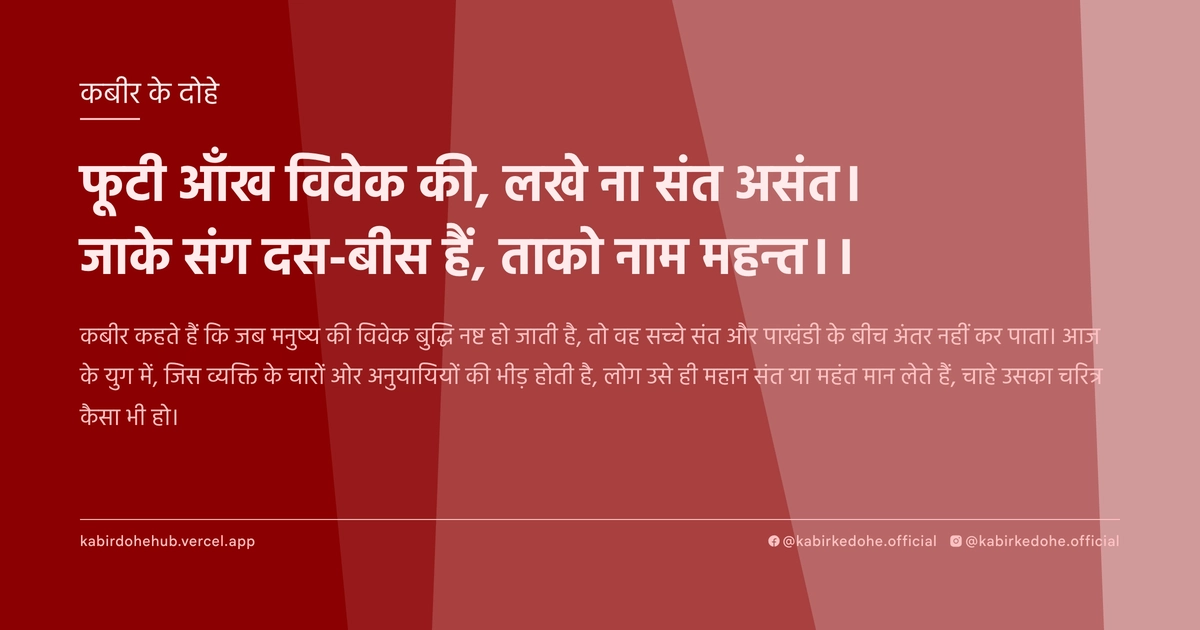
फूटी आँख विवेक की, लखे ना संत असंत।
जाके संग दस-बीस हैं, ताको नाम महन्त।।
Phooti aankh vivek ki, lakhe na sant asant. Jaake sang das-bees hain, taako naam mahant.
इस पृष्ठ पर इस कबीर दोहे का अर्थ (meaning), हिंदी व्याख्या और अंग्रेज़ी अनुवाद, दार्शनिक विश्लेषण और व्यावहारिक जीवन सीख दी गई है। यह दोहा धार्मिक पाखंड (Religious Hypocrisy) विषय से जुड़ा है — Kabir doha meaning and explanation in Hindi and English.
अर्थ (Meaning):
कबीर कहते हैं कि जब मनुष्य की विवेक बुद्धि नष्ट हो जाती है, तो वह सच्चे संत और पाखंडी के बीच अंतर नहीं कर पाता। आज के युग में, जिस व्यक्ति के चारों ओर अनुयायियों की भीड़ होती है, लोग उसे ही महान संत या महंत मान लेते हैं, चाहे उसका चरित्र कैसा भी हो।
Kabir asserts that when the eye of discernment is blinded, one loses the ability to distinguish between a true enlightened soul and a pretender. In a world driven by appearances, the person surrounded by a crowd of followers is erroneously labeled a great saint, regardless of their actual spiritual depth.
व्याख्या (Interpretation):
यह दोहा बाहरी आडंबर और आंतरिक सत्य के बीच के द्वंद्व को दर्शाता है। 'फूटी आँख' का अर्थ शारीरिक अंधता नहीं, बल्कि आध्यात्मिक अज्ञानता है। जब अहंकार और मोह हावी होते हैं, तो विवेक (Discernment) मर जाता है। निर्गुण भक्ति के अनुसार, ईश्वर किसी बाहरी चोले या भीड़ में नहीं, बल्कि अंतरात्मा की शुद्धि में है। यहाँ 'दस-बीस' लोग माया के उस भ्रम का प्रतीक हैं जो संख्या को सत्य मान लेते हैं। यह विरोधाभास है कि जिसे दुनिया 'महंत' मानती है, वह वास्तव में केवल एक सामाजिक मुखौटा हो सकता है, जबकि वास्तविक संत अक्सर एकांत और गुमनामी में रहते हैं।
This couplet highlights the conflict between external ostentation and internal truth. The 'blind eye' does not refer to physical sight, but to spiritual ignorance. When ego and attachment dominate, Viveka (discernment) perishes. According to Nirgun Bhakti, the Divine resides not in external robes or crowds, but in the purity of the inner soul. The 'ten or twenty' followers symbolize the illusion of Maya, where quantity is mistaken for quality. It presents a poignant paradox: the one the world hails as a 'Mahant' may be merely wearing a social mask, while the true sage often dwells in solitude and anonymity.
दार्शनिक विश्लेषण (Philosophical Analysis):
कबीर का यह प्रहार उनके समय के धार्मिक पाखंड और जातिगत श्रेष्ठता पर है। वे स्पष्ट करते हैं कि आध्यात्मिक योग्यता का पैमाना अनुयायियों की संख्या नहीं, बल्कि आत्म-साक्षात्कार है। अद्वैत वेदांत के परिप्रेक्ष्य में, जब तक 'मैं' और 'मेरा' का बोध रहता है, तब तक विवेक बाधित रहता है। कबीर यहाँ सूफी मत के 'इन्सान-ए-कामिल' की अवधारणा को छूते हैं, जहाँ सत्य बाहरी दिखावे से परे आंतरिक रूपांतरण में निहित है।
वे ritualism (कर्मकांड) का विरोध करते हुए बताते हैं कि धर्म केवल बाहरी प्रतीकों का खेल बन गया है। समाज की प्रवृत्ति है कि वह सत्ता और लोकप्रियता को पवित्रता मान लेता है। यह मनोवैज्ञानिक भ्रम है जहाँ सामूहिक स्वीकृति को सत्य का प्रमाण मान लिया जाता है।
कबीर का दर्शन यह है कि सत्य व्यक्तिपरक है, सामूहिक नहीं। यदि कोई व्यक्ति भीड़ को आकर्षित कर रहा है, तो वह संभवतः लोगों की वासनाओं और अपेक्षाओं को संतुष्ट कर रहा है, न कि उन्हें मुक्त कर रहा है। वास्तविक मुक्ति अहंकार के विसर्जन (annihilation of ego) से आती है, न कि प्रशंसा के संचय से।
ऐतिहासिक रूप से, कबीर ने उन धर्मगुरुओं को चुनौती दी जो केवल शास्त्र पढ़कर या तिलक लगाकर स्वयं को श्रेष्ठ मानते थे। उन्होंने सिखाया कि विवेक ही वह एकमात्र उपकरण है जो माया के पर्दे को हटा सकता है।
अंततः, यह दोहा हमें चेतावनी देता है कि हम अपनी चेतना को बाहरी शोर के हवाले न करें। जब हम दूसरों की प्रशंसा के आधार पर किसी को गुरु मानते हैं, तो हम वास्तव में अपनी आध्यात्मिक जिम्मेदारी से भाग रहे होते हैं।
Kabir's critique is a direct assault on the religious hypocrisy and caste-based superiority of his era. He clarifies that the metric of spiritual attainment is not the number of followers, but the realization of the Self. From the perspective of Advaita Vedanta, as long as the notion of 'I' and 'mine' persists, discernment remains obstructed. Kabir touches upon the Sufi concept of 'Al-Insan al-Kamil' (the Perfect Human), where truth lies in internal transformation rather than external display.
He opposes ritualism, arguing that religion has become a game of external symbols. Society tends to mistake power and popularity for purity. This is a psychological delusion where collective validation is accepted as proof of truth.
Kabir's philosophy posits that truth is subjective and internal, not collective. If a person attracts a crowd, they may simply be catering to the desires and expectations of the masses rather than liberating them. True liberation comes from the annihilation of the ego, not the accumulation of praise.
Historically, Kabir challenged the clergy who claimed superiority merely through scriptural rote learning or wearing religious marks. He taught that Viveka is the only tool capable of piercing the veil of Maya.
Ultimately, this couplet warns us not to surrender our consciousness to external noise. When we designate someone as a guru based on the praise of others, we are essentially evading our own spiritual responsibility.
मूल संदेश (Core Message):
- लोकप्रियता सत्य का प्रमाण नहीं है।
- भीड़ अक्सर भ्रम का विस्तार होती है।
- विवेक ही माया के पर्दे को हटाता है।
- सच्चा ज्ञान एकांत और शुद्धि में मिलता है।
- बाहरी आडंबर आंतरिक रिक्तता को छुपाते हैं।
- आत्मा की पुकार भीड़ के शोर से ऊपर है।
- Popularity is not a certificate of truth.
- Crowds are often extensions of collective illusion.
- Discernment is the only tool to pierce Maya.
- True wisdom is found in solitude and purity.
- External pomp masks internal emptiness.
- The soul's call transcends the noise of the masses.
व्यावहारिक उदाहरण (Practical Example):
एक समय की बात है, वाराणसी के घाटों पर रामदीन नाम का एक वृद्ध बुनकर रहता था। वह अत्यंत सरल था और दिन भर सूत कातता था। उसी शहर में एक प्रसिद्ध ओझा था, जिसके पास हर शाम सैकड़ों लोग आशीर्वाद लेने आते थे। ओझा रेशमी वस्त्र पहनता था और ऊँचे स्वर में उपदेश देता था।
रामदीन उस ओझा के पास गया, यह सोचकर कि शायद यहाँ उसे शांति मिले। उसने देखा कि भीड़ ओझा के चरणों में गिर रही थी, लेकिन ओझा का ध्यान इस बात पर था कि कौन उसे कितना दान दे रहा है।
रामदीन ने गौर किया कि ओझा की बातें केवल अहंकार को संतुष्ट कर रही थीं, उनमें सत्य की कोई तड़प नहीं थी। वह चुपचाप वहाँ से उठ गया।
तभी उसकी नज़र एक कोने में बैठे एक फकीर पर पड़ी, जो चुपचाप अपनी माला जप रहा था और जिसकी आँखों में एक गहरी करुणा थी।
रामदीन ने उस फकीर से एक सरल प्रश्न पूछा, 'जीवन का सार क्या है?' फकीर ने बिना किसी आडंबर के उत्तर दिया, 'अपने भीतर के शोर को शांत करो, सत्य वहीं मिलेगा।'
रामदीन को महसूस हुआ कि जिस ओझा के पास भीड़ थी, वह वास्तव में अंधा था, और यह गुमनाम फकीर वास्तव में जागृत था।
उस दिन रामदीन ने सीखा कि भीड़ सत्य की पहचान नहीं होती।
उसने ओझा के प्रति अपना मोह त्याग दिया और स्वयं के भीतर विवेक को जगाने का प्रयास किया।
अब वह किसी बाहरी चमत्कार की तलाश नहीं करता था, बल्कि अपने काम को ही पूजा मानने लगा।
उसका जीवन बदल गया; वह अब भीड़ का हिस्सा नहीं, बल्कि अपनी आत्मा का साक्षी बन गया था।
Once, on the ghats of Varanasi, lived an elderly weaver named Ramdin. He was a man of extreme simplicity, spending his days spinning thread. In the same city, there was a famous occultist (Ojha) who attracted hundreds of people every evening seeking blessings. The Ojha wore shimmering silk robes and preached in a booming, authoritative voice.
Ramdin visited the Ojha, hoping to find spiritual peace. He observed the crowd falling at the Ojha's feet, but noticed that the Ojha's attention was focused on how much donation each person was offering.
Ramdin realized that the Ojha's words were merely catering to the ego of the listeners; there was no genuine longing for truth in them.
He quietly stood up to leave. In a secluded corner, his eyes fell upon a wandering dervish (Fakir), who sat in silence, chanting, with a gaze filled with profound compassion.
Ramdin asked the Fakir a simple question: 'What is the essence of life?' Without any pretense, the Fakir replied, 'Silence the noise within you; that is where the truth resides.'
Ramdin felt that the Ojha, despite his crowd, was spiritually blind, while this anonymous Fakir was truly awakened.
That day, Ramdin learned that a crowd is not a certificate of truth.
He relinquished his attraction to the Ojha and strove to awaken the discernment within himself.
He stopped searching for external miracles and began treating his daily labor as a form of worship.
His life transformed; he was no longer a part of the herd, but a witness to his own soul.
अभ्यास मार्गदर्शन (Practice Guidance):
- प्रतिदिन 20 मिनट मौन साधना करें और यह देखें कि आपके विचार किस प्रकार बाहरी प्रशंसा की इच्छा से प्रेरित हैं।
- एक 'विवेक जर्नल' बनाएँ: जब भी आप किसी प्रभावशाली व्यक्ति से प्रेरित हों, लिखें कि आप उनकी योग्यता से प्रभावित हैं या उनकी लोकप्रियता से।
- व्यवहार परिवर्तन: किसी भी व्यक्ति की बातों को केवल इसलिए न मानें क्योंकि वह 'प्रसिद्ध' है; उनके शब्दों को अपने अनुभव की कसौटी पर कसें।
- डायग्नोस्टिक चेकलिस्ट: क्या मैं किसी की राय बदलने के लिए भीड़ का सहारा लेता हूँ? क्या मैं किसी की योग्यता को उसके पद या अनुयायियों से मापता हूँ? यदि हाँ, तो विवेक की आँख अभी बंद है।
- Practice 20 minutes of silent meditation daily to observe how your thoughts are driven by a desire for external validation.
- Maintain a 'Discernment Journal': Whenever you feel inspired by an influential figure, note whether you are attracted to their actual virtue or their popularity.
- Behavioral Change: Stop accepting the words of someone simply because they are 'famous'; test their insights against your own lived experience.
- Diagnostic Checklist: Do I rely on crowd consensus to validate my beliefs? Do I measure a person's worth by their status or followers? If yes, the eye of discernment is still closed.
चिंतन प्रश्न (Reflection Questions):
- मेरे जीवन में ऐसे कौन से 'महंत' हैं जिन्हें मैं केवल उनकी लोकप्रियता के कारण पूजता हूँ?
- यदि मेरी सामाजिक पहचान और प्रशंसा छीन ली जाए, तो क्या मेरे पास कोई आंतरिक सत्य बचेगा?
- मैं अपनी डिजिटल पहचान (सोशल मीडिया) के माध्यम से कितनी 'भीड़' इकट्ठा करने की कोशिश कर रहा हूँ, और यह मेरे विवेक को कैसे अंधा कर रहा है?
- क्या मैं वास्तव में सत्य की खोज में हूँ, या मैं केवल एक ऐसे समूह का हिस्सा बनना चाहता हूँ जो खुद को 'सत्यवादी' कहता है?
- मेरे भीतर का वह कौन सा डर है जो मुझे भीड़ से अलग होकर अकेले सत्य का सामना करने से रोकता है?
- Who are the 'Mahants' in my life whom I revere solely because of their popularity?
- If my social identity and accolades were stripped away, would any internal truth remain?
- How much of my digital ego is focused on gathering a 'crowd,' and how is this blinding my discernment?
- Am I truly seeking the truth, or do I simply want to belong to a group that claims to be 'truthful'?
- What is the fear within me that prevents me from stepping away from the crowd to face the truth alone?