
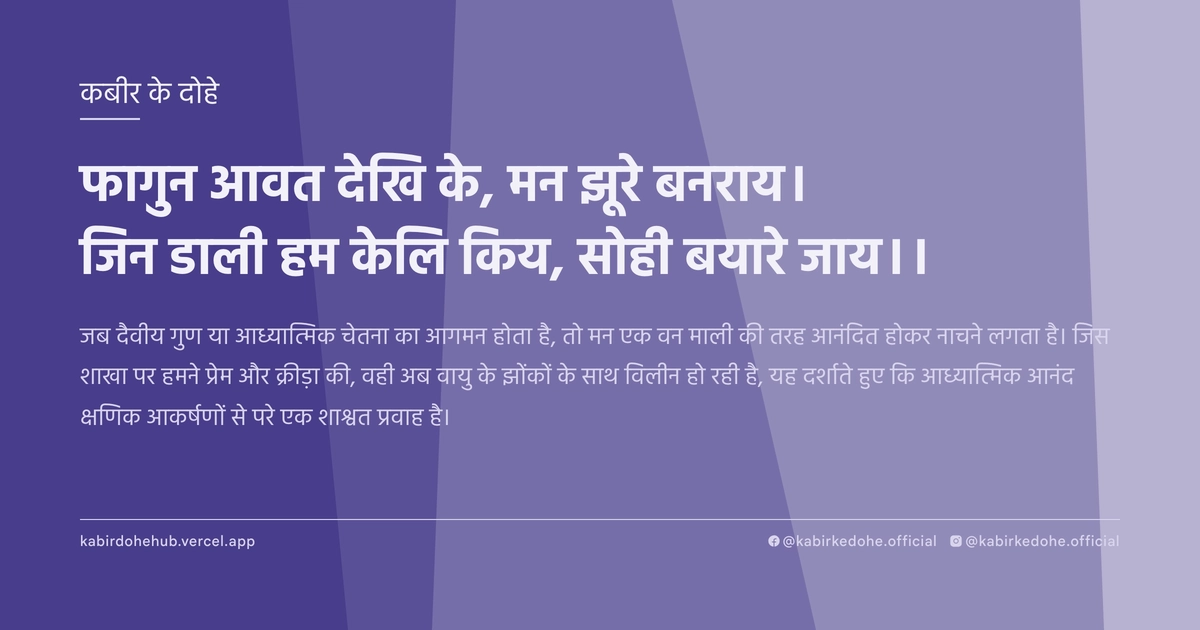
फागुन आवत देखि के, मन झूरे बनराय।
जिन डाली हम केलि किय, सोही बयारे जाय।।
Phagun aavat dekhi ke, man jhoore banray. Jin daali hum keli kiya, sohi bayare jaaye.
इस पृष्ठ पर इस कबीर दोहे का अर्थ (meaning), हिंदी व्याख्या और अंग्रेज़ी अनुवाद, दार्शनिक विश्लेषण और व्यावहारिक जीवन सीख दी गई है। यह दोहा अनित्य (Impermanence) विषय से जुड़ा है — Kabir doha meaning and explanation in Hindi and English.
अर्थ (Meaning):
जब दैवीय गुण या आध्यात्मिक चेतना का आगमन होता है, तो मन एक वन माली की तरह आनंदित होकर नाचने लगता है। जिस शाखा पर हमने प्रेम और क्रीड़ा की, वही अब वायु के झोंकों के साथ विलीन हो रही है, यह दर्शाते हुए कि आध्यात्मिक आनंद क्षणिक आकर्षणों से परे एक शाश्वत प्रवाह है।
When divine virtues or spiritual consciousness descend, the mind dances with joy like a forest gardener. The very branches where we once played and lingered in worldly attachment are now being swept away by the wind, signifying that true spiritual bliss transcends temporary attachments and flows toward the infinite.
व्याख्या (Interpretation):
शाब्दिक अर्थ यह है कि वसंत के आने पर माली खुश होता है, लेकिन यहाँ 'गुन' का अर्थ ईश्वरीय गुणों से है। यह दोहा निर्गुण भक्ति के उस क्षण को दर्शाता है जहाँ साधक माया के मोह को छोड़कर आत्मा के वास्तविक स्वरूप से मिलता है। 'केलि' या क्रीड़ा सांसारिक आसक्तियों का प्रतीक है, जबकि 'बयारे' उस आध्यात्मिक वेग को कहते हैं जो अहंकार को मिटा देता है। अद्वैत वेदांत के अनुसार, जब जीव को यह बोध होता है कि वह और ब्रह्म एक ही हैं, तब पुराने संकोच और पहचान की शाखाएं गिर जाती हैं। यह विरोधाभास है कि जिसे हम अपना आधार समझते थे, वही अंततः विलीन हो जाता है ताकि हम शून्य में पूर्ण हो सकें।
Literally, it describes a gardener's joy at the arrival of spring, but 'Gun' here refers to divine attributes. This couplet captures the moment in Nirgun Bhakti where the seeker sheds the illusions of Maya to encounter the true Self. 'Keli' or play symbolizes worldly attachments, while 'Bayare' represents the spiritual wind that annihilates the ego. According to Advaita Vedanta, when the soul realizes its non-duality with Brahman, the branches of old identities and attachments fall away. It presents the paradox that the very foundations we cling to must be swept away for us to become complete in the void of absolute consciousness.
दार्शनिक विश्लेषण (Philosophical Analysis):
कबीर का यह दोहा उस कालखंड का है जब समाज कर्मकांडों और बाहरी आडंबरों में जकड़ा हुआ था। कबीर ने यहाँ 'गुणों' की बात कर यह स्पष्ट किया कि ईश्वर मंदिर या मस्जिद में नहीं, बल्कि आंतरिक गुणों के जागरण में है। यह सूफी मत के 'फना' (अहंकार का विनाश) के करीब है, जहाँ प्रेमी अपने अस्तित्व को ईश्वर में विलीन कर देता है।
यहाँ ritualism का खंडन है क्योंकि मोक्ष किसी बाहरी क्रिया से नहीं, बल्कि आंतरिक रूपांतरण से आता है। कबीर यह समझाते हैं कि हम जिन रिश्तों और उपलब्धियों की 'शाखाओं' पर गर्व करते हैं, वे केवल माया के जाल हैं। जब वास्तविक ज्ञान (Gyan) आता है, तो ये सभी कृत्रिम पहचानें स्वतः ही गिर जाती हैं।
अद्वैत वेदांत के परिप्रेक्ष्य में, यह 'माया' से 'सत्य' की ओर संक्रमण है। साधक पहले द्वैत (दो होने का भाव) में खेलता है, लेकिन अंततः उसे यह बोध होता है कि वह स्वयं वह पवन है जो सब कुछ बहा ले जाती है। यह मनोवैज्ञानिक स्तर पर एक गहरे विरेचन (catharsis) की प्रक्रिया है।
कबीर यहाँ यह चेतावनी देते हैं कि आध्यात्मिक मार्ग पर चलने वाले को अपनी पुरानी पहचान के खोने का शोक नहीं मनाना चाहिए। जैसे पतझड़ के बिना नए पत्ते नहीं आते, वैसे ही पुराने अहंकार के विनाश के बिना दिव्य गुणों का उदय असंभव है।
अंततः, यह दोहा हमें सिखाता है कि मुक्ति का अर्थ कुछ प्राप्त करना नहीं, बल्कि उन सब चीजों को छोड़ देना है जो हम वास्तव में नहीं हैं। यह 'अहं' से 'सोऽहम्' की यात्रा है, जहाँ व्यक्तिगत सीमितता सार्वभौमिक अनंतता में बदल जाती है।
Kabir's couplet emerges from an era gripped by rigid ritualism and external piety. By speaking of 'Gun' (divine attributes), he clarifies that the Divine resides not in temples or mosques, but in the awakening of internal virtues. This aligns closely with the Sufi concept of 'Fana' (annihilation of the self), where the lover dissolves their existence into the Beloved.
There is a sharp rejection of ritualism here; salvation is not achieved through external rites but through internal transformation. Kabir explains that the 'branches' of relationships and achievements we pride ourselves on are merely webs of Maya. When true Knowledge (Gyan) arrives, these artificial identities naturally wither away.
From the lens of Advaita Vedanta, this is the transition from 'Maya' (illusion) to 'Satya' (Truth). The seeker initially plays in the realm of duality, but eventually realizes that they are the very wind that sweeps everything away. Psychologically, this represents a profound process of catharsis and ego-death.
Kabir warns that the spiritual aspirant should not mourn the loss of their old identity. Just as new leaves cannot grow without the autumn shed, the emergence of divine virtues is impossible without the destruction of the old ego.
Ultimately, this doha teaches that liberation is not about acquiring something new, but about letting go of everything that we are not. It is the journey from 'Aham' (I-ness) to 'So-ham' (I am That), where personal limitation transforms into universal infinity.
मूल संदेश (Core Message):
- अहंकार की शाखाएं गिरेंगी, तभी आत्मा का वसंत आएगा।
- बाहरी पहचान एक भ्रम है; आंतरिक गुण ही वास्तविक सत्य हैं।
- मोह का त्याग ही आध्यात्मिक आनंद का एकमात्र द्वार है।
- जब 'मैं' मिटता है, तब 'वह' (ब्रह्म) प्रकट होता है।
- जीवन का उद्देश्य संचय नहीं, बल्कि पूर्ण विसर्जन है।
- The branches of ego must fall for the spring of the soul to arrive.
- External identity is an illusion; internal virtues are the only truth.
- Renunciation of attachment is the sole gateway to spiritual bliss.
- When the 'I' vanishes, the 'That' (Brahman) manifests.
- The purpose of life is not accumulation, but total dissolution.
व्यावहारिक उदाहरण (Practical Example):
एक समय की बात है, वाराणसी के घाटों पर रामदीन नाम का एक वृद्ध बुनकर रहता था। रामदीन ने अपना पूरा जीवन बेहतरीन रेशमी वस्त्र बनाने में बिताया था। उसे अपनी कला पर बहुत गर्व था और वह मानता था कि उसकी पहचान उसके द्वारा बनाए गए वस्त्रों की बारीकी से है। वह अपनी श्रेष्ठता के अहंकार में डूबा रहता था और अन्य बुनकरों को तुच्छ समझता था।
एक दिन, उसकी मुलाकात एक घुमक्कड़ फकीर से हुई जिसने रामदीन के सबसे महंगे वस्त्र को देखा और मुस्कुराकर कहा, 'यह सुंदर है, लेकिन क्या तुम जानते हो कि जिसे तुम पहन रहे हो, वह केवल एक पर्दा है?' रामदीन को यह बात चुभी, लेकिन फकीर की आँखों में एक अजीब सी शांति थी।
फकीर ने उसे एक प्रयोग करने को कहा: 'अगले सात दिनों तक, हर सुबह उठकर यह सोचो कि तुम बुनकर नहीं हो, बल्कि वह धागा हो जिसे बुना जा रहा है।' रामदीन ने इसे एक खेल की तरह लिया। पहले तीन दिन उसे बहुत बेचैनी हुई क्योंकि उसकी 'बुनकर' वाली पहचान उसे सुरक्षा देती थी।
चौथे दिन, उसने महसूस किया कि उसका गर्व वास्तव में एक बोझ था। वह जिस 'शाखा' (अपनी कला और प्रतिष्ठा) को पकड़कर बैठा था, वह उसे वास्तव में कैद किए हुए थी। उसे एहसास हुआ कि वह अपनी कला का स्वामी नहीं, बल्कि उसका माध्यम मात्र है।
पाँचवें दिन, जब वह करघे पर बैठा, तो उसे एक अद्भुत आनंद की अनुभूति हुई। उसने महसूस किया कि वह और उसका काम अलग नहीं हैं। उसका अहंकार धीरे-धीरे उस हवा की तरह बहने लगा जिसने उसके पुराने घमंड को उड़ा दिया।
छठे दिन, उसने अपने उन साथियों की मदद करना शुरू किया जिन्हें वह पहले नीचा दिखाता था। उसने पाया कि दूसरों की सेवा में जो सुख है, वह उसकी सबसे महंगी साड़ी की प्रशंसा में भी नहीं था।
सातवें दिन, रामदीन पूरी तरह बदल चुका था। उसने अपनी सबसे महंगी साड़ी एक गरीब को दान कर दी। जब उसके पड़ोसियों ने पूछा कि उसने अपनी पहचान क्यों खो दी, तो वह मुस्कुराया और बोला, 'मैंने पहचान खोई नहीं, बल्कि उस बंधन से मुक्त हुआ हूँ जिसने मुझे असली मैं से मिलने नहीं दिया था।'
रामदीन अब भी बुनता था, लेकिन अब वह प्रशंसा के लिए नहीं, बल्कि समर्पण के लिए बुनता था। उसकी कला में अब एक दिव्य चमक थी क्योंकि वह अब 'बुनकर' नहीं, बल्कि उस 'दिव्य गुण' का हिस्सा बन चुका था।
Once in the ghats of Varanasi, there lived an elderly weaver named Ramdeen. He had spent his entire life crafting the finest silk garments. He was immensely proud of his skill, believing his identity was defined by the intricacy of his weaves. He lived in the bubble of his own superiority, looking down upon other weavers.
One day, he met a wandering fakir who looked at Ramdeen's most expensive garment and smiled, saying, 'This is beautiful, but do you know that what you wear is merely a veil?' Ramdeen felt insulted, yet there was an unsettling peace in the fakir's eyes.
The fakir challenged him with an experiment: 'For the next seven days, wake up every morning and tell yourself that you are not the weaver, but the thread being woven.' Ramdeen took this as a game. For the first three days, he felt extreme restlessness because his identity as a 'master weaver' provided him a sense of security.
On the fourth day, he realized that his pride was actually a burden. The 'branch' (his art and reputation) he had been clinging to was actually a cage. He understood that he was not the master of his art, but merely its medium.
On the fifth day, as he sat at the loom, he experienced a strange, overwhelming joy. He felt that he and his work were not separate entities. His ego began to drift away like a wind, sweeping clean the dust of his arrogance.
On the sixth day, he began helping the fellow weavers he had previously belittled. He discovered that the joy found in serving others far exceeded the pleasure of receiving praise for his most expensive sarees.
By the seventh day, Ramdeen was completely transformed. He donated his most expensive silk garment to a poor man. When his neighbors asked why he had discarded his identity, he smiled and replied, 'I haven't lost my identity; I have been liberated from the bond that prevented me from meeting my true self.'
Ramdeen continued to weave, but no longer for praise, but for surrender. His art now possessed a divine radiance because he was no longer just a 'weaver,' but a vessel for the divine attributes.
अभ्यास मार्गदर्शन (Practice Guidance):
- प्रतिदिन 20 मिनट मौन ध्यान करें, जहाँ आप अपनी सभी सामाजिक भूमिकाओं (पुत्र, पिता, कर्मचारी) को एक पुराने वस्त्र की तरह उतार कर रख दें।
- स्व-पूछताछ जर्नल: लिखें कि 'यदि मेरी उपलब्धियां और मेरी प्रतिष्ठा आज छीन ली जाए, तो मेरे भीतर क्या शेष बचेगा?'
- व्यवहार परिवर्तन: दिन में कम से कम एक बार किसी ऐसे व्यक्ति की निस्वार्थ मदद करें जिससे आपका कोई निजी लाभ न जुड़ा हो, ताकि अहंकार का विसर्जन हो सके।
- निदान चेकलिस्ट: क्या मैं अपनी प्रशंसा सुनकर उत्साहित होता हूँ? क्या मैं दूसरों की सफलता से असुरक्षित महसूस करता हूँ? यदि हाँ, तो आप अभी भी 'शाखाओं' से चिपके हुए हैं।
- Practice 20 minutes of silent meditation daily, imagining yourself stripping away all social roles (son, father, employee) like old garments.
- Self-Inquiry Journaling: Write a response to the prompt: 'If my achievements and reputation were stripped away today, what would remain within me?'
- Behavioral Shift: Perform one selfless act of service daily for someone from whom you gain nothing, specifically to dismantle the ego's need for reward.
- Diagnostic Checklist: Do I feel an adrenaline rush from praise? Do I feel insecure during others' success? If yes, you are still clinging to the 'branches' of identity.
चिंतन प्रश्न (Reflection Questions):
- आपकी वह कौन सी 'शाखा' है जिसे आप सबसे मजबूती से पकड़े हुए हैं और जिसके खोने के डर से आप डरते हैं?
- क्या आपकी डिजिटल पहचान (सोशल मीडिया) आपके वास्तविक आंतरिक गुणों को ढकने वाला एक पर्दा बन गई है?
- जब आप अकेले होते हैं, तब आप कौन होते हैं, और जब दुनिया आपको देखती है, तब आप कौन होने का अभिनय करते हैं?
- क्या आप वास्तव में स्वतंत्र हैं, या आप अपनी उपलब्धियों के गुलाम बन चुके हैं?
- यदि आपका पूरा जीवन एक सपना है, तो उस सपने के जागने पर आप क्या बचाना चाहेंगे?
- Which 'branch' of your identity are you clinging to most tightly, and what is the fear associated with letting it go?
- Has your digital persona become a veil that hides your authentic internal virtues?
- Who are you when you are completely alone, and who do you pretend to be when the world is watching?
- Are you truly free, or have you become a slave to your own achievements?
- If your entire life were a dream, what part of your essence would you want to remain after waking up?