
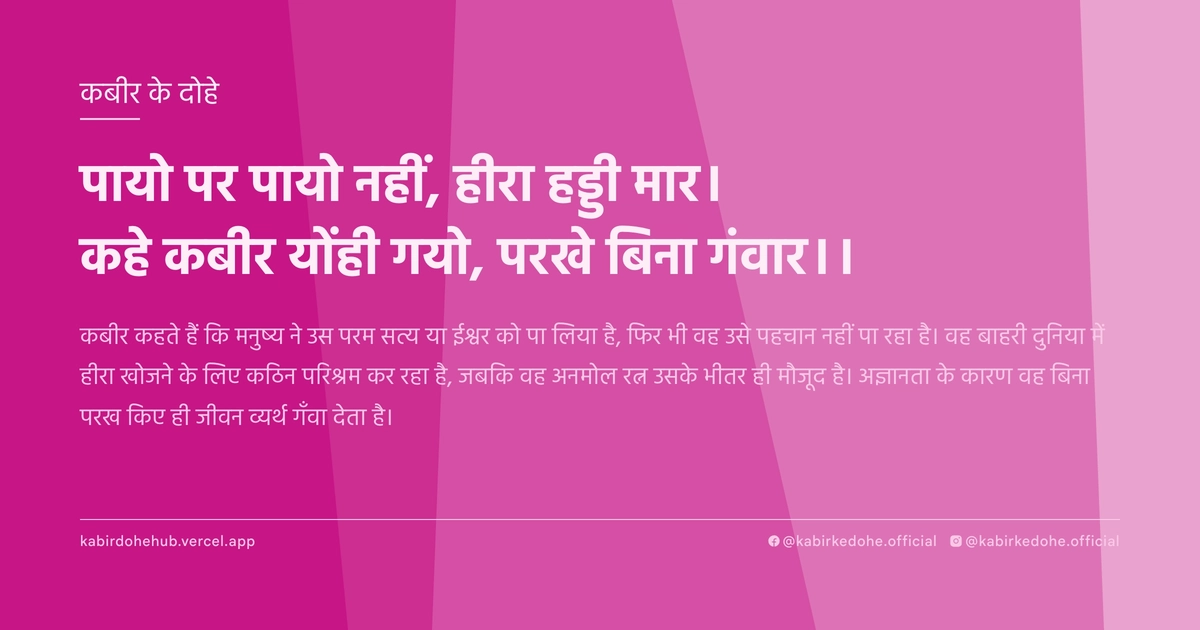
पायो पर पायो नहीं, हीरा हड्डी मार।
कहे कबीर योंही गयो, परखे बिना गंवार।।
Payo par payo nahin, heera haddi maar. Kahe kabir yonhi gayo, parkhe bina ganvar.
इस पृष्ठ पर इस कबीर दोहे का अर्थ (meaning), हिंदी व्याख्या और अंग्रेज़ी अनुवाद, दार्शनिक विश्लेषण और व्यावहारिक जीवन सीख दी गई है। यह दोहा जागृति (The Wake-up Call) विषय से जुड़ा है — Kabir doha meaning and explanation in Hindi and English.
अर्थ (Meaning):
कबीर कहते हैं कि मनुष्य ने उस परम सत्य या ईश्वर को पा लिया है, फिर भी वह उसे पहचान नहीं पा रहा है। वह बाहरी दुनिया में हीरा खोजने के लिए कठिन परिश्रम कर रहा है, जबकि वह अनमोल रत्न उसके भीतर ही मौजूद है। अज्ञानता के कारण वह बिना परख किए ही जीवन व्यर्थ गँवा देता है।
Kabir asserts that although the human soul has already attained the Divine, it remains oblivious to this realization. Like someone scrubbing bones in search of a diamond, the seeker exhausts themselves in external pursuits. Due to a lack of spiritual discernment, the ignorant person lets life slip away without ever recognizing the treasure within.
व्याख्या (Interpretation):
इस दोहे का शाब्दिक अर्थ है कि हीरा हाथ में होते हुए भी व्यक्ति उसे पहचान नहीं पाता। रूपकात्मक रूप से, 'हीरा' आत्मा या ब्रह्म का प्रतीक है और 'हड्डी' भौतिक शरीर और सांसारिक मोह-माया का। यह निर्गुण भक्ति का सार है, जहाँ ईश्वर किसी मंदिर या मस्जिद में नहीं, बल्कि स्वयं के भीतर स्थित है। माया एक पर्दे की तरह है जो हमें यह विश्वास दिलाती है कि सत्य कहीं बाहर है। जब तक साधक 'परख' यानी आत्म-साक्षात्कार नहीं करता, वह अद्वैत वेदांत के उस सत्य से वंचित रहता है कि आत्मा और परमात्मा एक ही हैं। यह विरोधाभास है कि हम जिसे खोजने पूरी दुनिया छान मारते हैं, वह खोजकर्ता स्वयं ही वह खोजा जाने वाला तत्व है।
Literally, the verse speaks of missing a diamond while holding it. Metaphorically, the 'diamond' represents the Atman or Brahman, while 'bone' symbolizes the physical body and the illusions of the material world. This is the essence of Nirgun Bhakti, where the Divine is not found in external shrines but within the self. Maya acts as a veil, convincing the seeker that Truth resides elsewhere. Until the seeker employs 'parakh' (spiritual discernment), they remain blind to the Advaita Vedanta truth of non-duality. The central paradox is that the seeker is, in fact, the very thing being sought; the search is a distraction from the inherent presence.
दार्शनिक विश्लेषण (Philosophical Analysis):
कबीर का यह दोहा उनके युग के धार्मिक पाखंड और कर्मकांडों पर एक तीखा प्रहार है। उस समय लोग तीर्थयात्राओं और कठिन बाहरी अनुष्ठानों में लीन थे, जिसे कबीर 'हड्डी मारना' कहते हैं। वे स्पष्ट करते हैं कि मोक्ष किसी बाहरी क्रिया से नहीं, बल्कि आंतरिक जागरूकता से मिलता है।
यह विचार अद्वैत वेदांत के 'तत्वमसि' (तुम वही हो) के सिद्धांत से मेल खाता है। कबीर का तर्क है कि यदि ईश्वर सर्वव्यापी है, तो वह मनुष्य के भीतर भी होना चाहिए। बाहरी खोज वास्तव में अहंकार का विस्तार है, क्योंकि अहंकार चाहता है कि वह कुछ 'प्राप्त' करे, जबकि सत्य केवल 'पहचानने' की बात है।
सूफी मत के 'अनल हक़' (मैं सत्य हूँ) के करीब यह दर्शन बताता है कि आत्मा का परमात्मा से मिलन कोई भविष्य की घटना नहीं, बल्कि वर्तमान की वास्तविकता है। कबीर यहाँ 'गंवार' शब्द का प्रयोग सामाजिक स्तर के लिए नहीं, बल्कि आध्यात्मिक चेतना की कमी के लिए करते हैं।
मनोवैज्ञानिक स्तर पर, यह दोहा संज्ञानात्मक विसंगति को दर्शाता है। हम अपनी पहचान को शरीर और नाम से जोड़ लेते हैं, जिससे हम अपनी वास्तविक दैवीय प्रकृति को भूल जाते हैं। यह 'अहं' का वह भ्रम है जो हमें सत्य के करीब ले जाकर भी उसे देखने नहीं देता।
अंततः, कबीर यह संदेश देते हैं कि बिना विवेक और आत्म-विश्लेषण के, जीवन केवल एक यांत्रिक प्रक्रिया बनकर रह जाता है। ritualism (कर्मकांड) केवल एक बाहरी आवरण है; वास्तविक धर्म वह है जो मनुष्य को उसके आंतरिक प्रकाश से परिचित कराए।
Kabir's couplet is a sharp critique of the religious hypocrisy and ritualism prevalent in his era. During his time, people were obsessed with pilgrimages and grueling external penances, which Kabir dismisses as 'scrubbing bones'—effort spent on the lifeless and irrelevant. He clarifies that liberation is not a product of external action but of internal awakening.
This aligns profoundly with the Advaita Vedanta principle of 'Tat Tvam Asi' (Thou Art That). Kabir argues that if the Divine is omnipresent, it must necessarily reside within the human. The external search is actually an extension of the ego, as the ego desires to 'acquire' something, whereas Truth is simply a matter of 'recognition'.
Closely mirroring the Sufi concept of 'Ana al-Haqq' (I am the Truth), this philosophy suggests that the union of the soul with the Divine is not a future event but a present reality. Kabir uses the term 'ganvaar' (ignorant) not to denote social status, but to describe a lack of spiritual consciousness.
On a psychological level, the verse highlights a cognitive dissonance. By identifying ourselves with the body and the social persona, we obscure our innate divine nature. This is the illusion of the 'I' that keeps us blind even when we are standing in the light of Truth.
Ultimately, Kabir suggests that without viveka (discernment) and self-analysis, life remains a mere mechanical process. Ritualism is but a hollow shell; true religion is that which introduces the human being to their own internal luminosity.
मूल संदेश (Core Message):
- सत्य बाहर नहीं, स्वयं के भीतर स्थित है।
- बाहरी कर्मकांड अक्सर आंतरिक जागृति के अवरोध बन जाते हैं।
- अहंकार की खोज ही वास्तविक खोज में सबसे बड़ी बाधा है।
- विवेक के बिना आध्यात्मिक प्रयास केवल शारीरिक श्रम है।
- आप वह नहीं हैं जिसे आप खोज रहे हैं, आप वही हैं।
- मौन ही वह भाषा है जिसमें हीरा प्रकट होता है।
- Truth resides not without, but within the self.
- External rituals often become obstacles to internal awakening.
- The ego's quest is the greatest barrier to actual discovery.
- Spiritual effort without discernment is merely physical labor.
- You are not the seeker; you are the sought.
- Silence is the only language in which the diamond reveals itself.
व्यावहारिक उदाहरण (Practical Example):
वाराणसी के घाटों पर रहने वाले एक वृद्ध विधवा, जानकी, का जीवन केवल मंदिर की सीढ़ियों पर बैठकर भिक्षा माँगने और घंटों माला जपने में बीत रहा था। वह मानती थीं कि मोक्ष केवल कठिन तप और बाहरी सेवा से मिलेगा।
वह हर दिन मीलों पैदल चलकर अलग-अलग मंदिरों में जातीं, इस उम्मीद में कि कोई चमत्कार होगा जो उन्हें ईश्वर के दर्शन कराएगा। उनके पैर थक चुके थे, लेकिन उनकी प्यास नहीं बुझी थी।
एक दिन उनकी मुलाकात एक घुमक्कड़ फकीर से हुई, जिसने उनसे पूछा, "माई, तुम किसे ढूँढ रही हो?"
जानकी ने रोते हुए कहा, "मैं उस परमात्मा को ढूँढ रही हूँ, जो मुझे इस दुखी संसार से मुक्त कर दे। मैंने अपना पूरा जीवन खोज में लगा दिया।"
फकीर ने मुस्कुराते हुए कहा, "तुम उस कुएँ की तलाश में भटक रही हो, जिसके पानी में तुम खुद खड़ी हो। तुम्हारी माला के मनके तो गिन लिए, पर क्या कभी उस हृदय को सुना जिसने यह माला पकड़ी है?"
जानकी को पहले यह बात समझ नहीं आई, लेकिन फकीर के शब्दों ने उनके भीतर एक हलचल पैदा कर दी। उन्होंने अगले कुछ दिन बाहरी यात्राएं बंद कर दीं और केवल मौन रहकर अपने भीतर की सांसों को देखना शुरू किया।
धीरे-धीरे उन्हें अहसास हुआ कि जिस शांति और प्रेम की तलाश में वह मंदिरों के चक्कर लगा रही थीं, वह शांति उनके अपने भीतर के मौन में बसी थी।
उन्हें समझ आया कि उनकी अब तक की सारी भागदौड़ 'हड्डी मारना' थी—एक बाहरी प्रयास जो आंतरिक सत्य को ढंक रहा था।
जानकी का व्यवहार बदल गया। अब वह केवल माला नहीं जपती थीं, बल्कि हर जीव में उसी आंतरिक प्रकाश को देखने लगीं।
उनका चेहरा अब थकान से नहीं, बल्कि एक ऐसी चमक से भरा था जो किसी मंदिर की यात्रा से नहीं, बल्कि स्वयं के भीतर की यात्रा से आई थी।
Janaki, an elderly widow living on the ghats of Varanasi, spent her days begging on temple steps and chanting beads for hours. She believed that liberation could only be achieved through rigorous penance and external service.
Every day, she walked miles to different temples, hoping for a miracle that would grant her a vision of the Divine. Her feet were worn out, but her spiritual thirst remained unquenched.
One day, she encountered a wandering fakir who asked her, "Mother, whom are you searching for?"
Janaki replied tearfully, "I am searching for the Almighty, who will liberate me from this world of sorrow. I have spent my entire life in this quest."
The fakir smiled and said, "You are wandering in search of the well, while you are already standing in its water. You have counted the beads of your rosary, but have you ever listened to the heart that holds the beads?"
Janaki did not understand at first, but the fakir's words stirred something deep within her. For the next few days, she ceased her external journeys and began to simply sit in silence, observing her own breath.
Slowly, she realized that the peace and love she had been seeking in the circuits of temples were already residing in the silence of her own being.
She understood that all her previous striving was 'scrubbing bones'—an external effort that only served to obscure the internal truth.
Janaki's behavior transformed. She no longer just chanted beads; she began to see that same internal light in every living being she encountered.
Her face was no longer marked by exhaustion, but by a radiance that came not from a pilgrimage to a temple, but from a pilgrimage into herself.
अभ्यास मार्गदर्शन (Practice Guidance):
- प्रतिदिन 20 मिनट 'साक्षी भाव' का अभ्यास करें: अपने विचारों को बिना किसी निर्णय के देखें, जैसे आप किसी और को देख रहे हों।
- आत्म-पूछताछ जर्नल: प्रतिदिन एक प्रश्न लिखें—"यदि मैं अपना नाम, पेशा और संबंध हटा दूँ, तो मैं वास्तव में कौन हूँ?"
- बाहरी शोर का त्याग: सप्ताह में एक दिन 'मौन व्रत' रखें ताकि आंतरिक ध्वनि स्पष्ट हो सके।
- निदान चेकलिस्ट: क्या मैं शांति को किसी परिस्थिति या व्यक्ति में ढूँढ रहा हूँ? (यदि हाँ, तो आप अभी भी 'हड्डी मार' रहे हैं)। क्या मैं वर्तमान क्षण में पूर्णता महसूस करता हूँ? (यदि हाँ, तो आप 'हीरे' को पहचान रहे हैं)।
- Practice 'Witness Consciousness' for 20 minutes daily: Observe your thoughts without judgment, as if you are watching a stranger.
- Self-Inquiry Journal: Write one daily prompt—"If I strip away my name, profession, and relationships, who is the 'I' that remains?"
- Shedding External Noise: Observe a day of 'Mauna' (silence) once a week to allow the internal resonance to become audible.
- Diagnostic Checklist: Am I seeking peace in a specific condition or person? (If yes, you are still 'scrubbing bones'). Do I feel a sense of wholeness in the present moment? (If yes, you are recognizing the 'diamond').
चिंतन प्रश्न (Reflection Questions):
- मैं अपनी पहचान बनाने के लिए किन बाहरी मुखौटों का उपयोग कर रहा हूँ?
- क्या मेरी आध्यात्मिक साधना वास्तव में मुझे मुक्त कर रही है, या यह मेरे अहंकार को संतुष्ट करने का एक नया तरीका है?
- वह कौन सा डर है जो मुझे यह मानने से रोकता है कि मैं पहले से ही पूर्ण हूँ?
- मैं अपनी 'डिजिटल पहचान' को कितना महत्व देता हूँ और यह मेरे वास्तविक स्वरूप को कैसे ढकता है?
- क्या मैं सत्य को खोजने के प्रयास में सत्य से ही दूर भाग रहा हूँ?
- मेरे जीवन का वह कौन सा हिस्सा है जहाँ मैं अभी भी 'हड्डी मार' रहा हूँ?
- What external masks am I using to construct my identity?
- Is my spiritual practice truly liberating me, or is it just a new way to feed the ego?
- What is the fear that prevents me from accepting that I am already complete?
- How much value do I place on my 'digital identity,' and how does it obscure my true nature?
- Am I running away from the Truth in the very act of trying to find it?
- In which area of my life am I still 'scrubbing bones' instead of recognizing the diamond?