
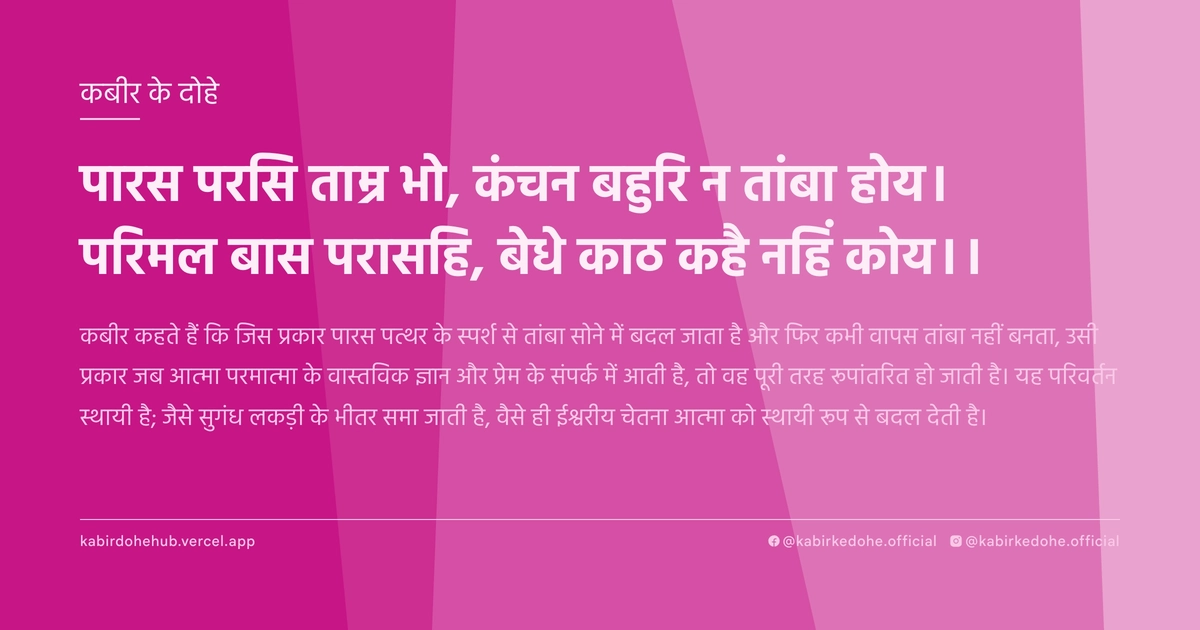
पारस परसि ताम्र भो, कंचन बहुरि न तांबा होय।
परिमल बास परासहि, बेधे काठ कहै नहिं कोय।।
Paras parasi tamra bho, kanchan bahuri na tamba hoye. Parimal bas parasahi, bedhe kath kahe nahi koye.
इस पृष्ठ पर इस कबीर दोहे का अर्थ (meaning), हिंदी व्याख्या और अंग्रेज़ी अनुवाद, दार्शनिक विश्लेषण और व्यावहारिक जीवन सीख दी गई है। यह दोहा सत्य (Truth) विषय से जुड़ा है — Kabir doha meaning and explanation in Hindi and English.
अर्थ (Meaning):
कबीर कहते हैं कि जिस प्रकार पारस पत्थर के स्पर्श से तांबा सोने में बदल जाता है और फिर कभी वापस तांबा नहीं बनता, उसी प्रकार जब आत्मा परमात्मा के वास्तविक ज्ञान और प्रेम के संपर्क में आती है, तो वह पूरी तरह रूपांतरित हो जाती है। यह परिवर्तन स्थायी है; जैसे सुगंध लकड़ी के भीतर समा जाती है, वैसे ही ईश्वरीय चेतना आत्मा को स्थायी रूप से बदल देती है।
Kabir explains that just as copper turns into gold upon touching the mythical Paras stone and never reverts to copper, the soul undergoes a permanent transformation when it encounters the true knowledge and love of the Divine. This change is absolute and irreversible; just as fragrance permeates wood, the divine consciousness saturates the soul, altering its very nature forever.
व्याख्या (Interpretation):
इस दोहे का शाब्दिक अर्थ पारस और तांबे के परिवर्तन से शुरू होता है, लेकिन यह एक गहरा आध्यात्मिक रूपक है। यहाँ 'तांबा' अज्ञानता और अहंकार से ग्रस्त मानव आत्मा का प्रतीक है, जबकि 'पारस' उस सद्गुरु या आत्म-ज्ञान का प्रतीक है जो अज्ञान को मिटाता है। 'कंचन' या सोना उस शुद्ध चेतना (शुद्ध सत्व) को दर्शाता है जो आत्म-साक्षात्कार के बाद प्राप्त होती है। कबीर यह स्पष्ट करते हैं कि वास्तविक आध्यात्मिक जागृति कोई अस्थायी मानसिक अवस्था नहीं है, बल्कि एक तात्विक परिवर्तन है। यह अद्वैत वेदांत के उस सिद्धांत से मेल खाता है जहाँ जीव को यह बोध होता है कि वह वास्तव में ब्रह्म ही है, और एक बार यह सत्य अनुभव हो जाने पर, माया का भ्रम दोबारा प्रभावी नहीं होता। सुगंध और लकड़ी का उदाहरण यह दर्शाता है कि परमात्मा का गुण आत्मा में इस तरह घुल मिल जाता है कि उन्हें अलग करना असंभव हो जाता है, जो कि निर्गुण भक्ति की पराकाष्ठा है।
The literal meaning begins with the alchemy of copper and the Paras stone, but it serves as a profound spiritual metaphor. Here, 'copper' symbolizes the human soul burdened by ignorance and ego, while 'Paras' represents the Satguru or the awakening of self-knowledge that eradicates darkness. 'Gold' signifies the pure consciousness (Sattva) attained after self-realization. Kabir emphasizes that true spiritual awakening is not a fleeting emotional state but an ontological transformation. This aligns with Advaita Vedanta, where the Jiva realizes its identity as Brahman; once this truth is experienced, the illusion of Maya cannot regain its hold. The analogy of fragrance and wood illustrates that the divine attribute permeates the soul so completely that they become indivisible, representing the pinnacle of Nirgun Bhakti where the devotee merges into the formless Absolute.
दार्शनिक विश्लेषण (Philosophical Analysis):
कबीर का यह दोहा उस युग में लिखा गया था जब समाज कर्मकांडों और बाहरी आडंबरों में उलझा था। कबीर ने इस अलकेमी (कीमिया) के माध्यम से यह संदेश दिया कि धर्म केवल पूजा-पाठ नहीं, बल्कि आंतरिक रूपांतरण है। उन्होंने जाति और वर्ग के भेदों को नकारते हुए कहा कि ईश्वर का स्पर्श किसी विशेष जाति के लिए आरक्षित नहीं है, बल्कि वह हर उस व्यक्ति के लिए उपलब्ध है जो अहंकार का त्याग कर सत्य की खोज करता है।
दार्शनिक स्तर पर, यह 'अद्वैत' की स्थिति है। जब साधक 'मैं' और 'तू' के द्वैत से ऊपर उठकर एकत्व का अनुभव करता है, तो वह तांबे से सोने में बदल जाता है। यह परिवर्तन मनोवैज्ञानिक रूप से 'अहं' के विसर्जन और 'सर्व' के उदय की प्रक्रिया है। सूफी मत के 'फना' (अहंकार का विनाश) के समान, यहाँ भी पुराने व्यक्तित्व का अंत होता है ताकि एक दिव्य व्यक्तित्व का जन्म हो सके।
कबीर यहाँ यह चेतावनी भी देते हैं कि कई लोग केवल बाहरी दिखावे को ज्ञान समझ लेते हैं। लेकिन वास्तविक ज्ञान वह है जो व्यक्ति के व्यवहार, वाणी और दृष्टि को पूरी तरह बदल दे। यदि कोई कहता है कि वह ज्ञानी है, लेकिन उसके भीतर क्रोध और लोभ अभी भी तांबे की तरह मौजूद हैं, तो उसने अभी तक 'पारस' का स्पर्श नहीं किया है।
यह विश्लेषण हमें बताता है कि आध्यात्मिक प्रगति रैखिक नहीं, बल्कि क्रांतिकारी होती है। यह धीरे-धीरे सुधार करने की प्रक्रिया नहीं है, बल्कि एक क्षणिक बोध है जो पूरे जीवन की दिशा बदल देता है। जैसे सुगंध लकड़ी के रेशों में समा जाती है, वैसे ही करुणा और प्रेम साधक के स्वभाव का हिस्सा बन जाते हैं।
अंततः, यह दोहा ritualism (कर्मकांड) के विरुद्ध एक सशक्त प्रहार है। कबीर का तर्क है कि मंदिर या मस्जिद जाने से कोई सोना नहीं बनता; सोना बनने के लिए उस आंतरिक पारस (विवेक और प्रेम) की आवश्यकता है जो केवल आत्म-अनुशासन और समर्पण से प्राप्त होता है।
This couplet was composed in an era where society was deeply entrenched in ritualism and external displays of piety. Through the metaphor of alchemy, Kabir asserts that religion is not about rote performance of rituals, but about internal transformation. He rejects caste and class distinctions, suggesting that the divine touch is not reserved for a privileged few but is accessible to anyone who renounces the ego in search of Truth.
Philosophically, this represents the state of 'Advaita' (non-duality). When the seeker transcends the duality of 'I' and 'Thou' to experience oneness, they are transformed from copper to gold. Psychologically, this is the process of the dissolution of the 'Aham' (ego) and the emergence of the 'Sarvam' (Universal Self). Similar to the Sufi concept of 'Fana' (annihilation of the self), the old identity must perish for the divine identity to be born.
Kabir warns against mistaking external scholarship or religious attire for true knowledge. Genuine wisdom is that which fundamentally alters one's behavior, speech, and perception. If a person claims enlightenment yet harbors anger and greed—the 'copper' traits—they have not yet encountered the 'Paras'.
This analysis reveals that spiritual progress is not linear but revolutionary. It is not a gradual improvement of the personality, but a sudden shift in consciousness that reorients one's entire existence. Just as fragrance permeates the fibers of wood, compassion and love become the very fabric of the seeker's nature.
Ultimately, the doha is a powerful critique of ritualism. Kabir argues that visiting temples or mosques does not turn one into gold; such transformation requires the internal Paras of discernment (Viveka) and unconditional love, attainable only through self-discipline and total surrender.
मूल संदेश (Core Message):
- अहंकार अज्ञानता का तांबा है, जो आत्मा की चमक को ढकता है।
- सद्गुरु या आत्म-ज्ञान वह पारस है जो व्यक्तित्व को बदल देता है।
- वास्तविक आध्यात्मिक परिवर्तन अस्थायी नहीं, बल्कि स्थायी होता है।
- बाहरी कर्मकांड व्यर्थ हैं यदि आंतरिक रूपांतरण न हुआ हो।
- प्रेम और करुणा आत्मा की वह सुगंध है जिसे मिटाया नहीं जा सकता।
- स्वयं को मिटाकर ही सार्वभौमिक सत्य का अनुभव संभव है।
- Ego is the copper of ignorance that obscures the soul's brilliance.
- The Satguru or self-knowledge is the Paras that transmutes the personality.
- Genuine spiritual transformation is permanent, not a fleeting state.
- External rituals are futile if internal transmutation has not occurred.
- Love and compassion are the soul's fragrance that cannot be erased.
- The experience of universal truth is possible only through the annihilation of the self.
व्यावहारिक उदाहरण (Practical Example):
राजस्थान के एक छोटे से गाँव में माधव नाम का एक अहंकारी जमींदार रहता था। वह अपनी संपत्ति और ऊँचे कुल के कारण ग्रामीणों को तुच्छ समझता था। उसका हृदय तांबे की तरह कठोर और काला था, जिसमें केवल सत्ता का मोह था।
एक दिन गाँव में एक फकीर आया, जिसके पास कोई संपत्ति नहीं थी, लेकिन उसकी आँखों में एक असीम शांति थी। माधव ने उसे अपनी अमीरी दिखाकर नीचा दिखाने की कोशिश की, लेकिन फकीर ने केवल मुस्कुराकर कहा, 'सोना वह नहीं जो तिजोरी में हो, सोना वह है जो हृदय में हो।'
माधव को यह बात चुभी, लेकिन उसने फकीर के साथ समय बिताना शुरू किया। फकीर ने उसे कभी उपदेश नहीं दिया, बल्कि उसे केवल यह देखना सिखाया कि कैसे एक चींटी भी अपने वजन से दस गुना बोझ उठाती है और कैसे एक बूढ़ा पेड़ बिना किसी स्वार्थ के छाया देता है।
धीरे-धीरे, फकीर के निस्वार्थ प्रेम और सहज ज्ञान के 'स्पर्श' ने माधव के भीतर के अहंकार को पिघलाना शुरू किया। उसे एहसास हुआ कि उसकी सारी संपत्ति उसके अकेलेपन को नहीं भर पाई थी।
एक समय ऐसा आया जब माधव ने अपनी आधी जमीन उन मजदूरों के नाम कर दी जिनके बच्चों को शिक्षा की आवश्यकता थी। गाँव वाले हैरान थे; जो व्यक्ति कभी किसी को पानी नहीं पिलाता था, वह अब सबकी सेवा में लगा रहता था।
यह बदलाव अचानक नहीं था, लेकिन एक बार जब उसे 'करुणा' का स्वाद मिल गया, तो वह वापस अपने पुराने क्रूर स्वभाव में नहीं लौट सका। उसका हृदय अब तांबा नहीं, बल्कि सोने जैसा शुद्ध हो चुका था।
माधव अब अपनी पहचान जमींदार के रूप में नहीं, बल्कि एक सेवक के रूप में देखता था। उसने पाया कि दूसरों के दुख को अपना समझना ही वास्तविक अमीरी है।
उसकी यह नई पहचान इतनी गहरी थी कि मृत्यु तक वह कभी वापस उस अहंकारी व्यक्ति में नहीं बदला। फकीर का प्रभाव उसकी आत्मा में सुगंध की तरह बस गया था।
गाँव के लोग अब उसे 'सोने का इंसान' कहने लगे। माधव ने सीखा कि जब आत्मा का मिलन सत्य से होता है, तो परिवर्तन स्थायी और अपरिहार्य होता है।
यह कहानी दर्शाती है कि कैसे एक सही मार्गदर्शक (पारस) के संपर्क में आकर एक कठोर व्यक्तित्व पूरी तरह रूपांतरित हो सकता है।
In a small village in Rajasthan lived a proud landlord named Madhav. Due to his immense wealth and high lineage, he looked down upon the villagers. His heart was like copper—hard, dark, and consumed only by the desire for power.
One day, a wandering dervish arrived in the village. He possessed no material wealth, but his eyes held an infinite peace. Madhav tried to belittle him by flaunting his riches, but the dervish simply smiled and said, 'Gold is not that which sits in a vault, but that which resides in the heart.'
This remark stung Madhav, yet he found himself drawn to the dervish and began spending time with him. The dervish never gave him formal sermons; instead, he taught Madhav to observe how a tiny ant carries ten times its weight and how an old tree provides shade without any expectation of reward.
Gradually, the 'touch' of the dervish's selfless love and effortless wisdom began to melt the ego within Madhav. He realized that all his wealth had failed to fill the void of his loneliness.
There came a moment when Madhav transferred half his land to the laborers whose children needed education. The villagers were astonished; the man who once refused to give a cup of water was now devoted to the service of all.
This change was not instantaneous, but once he tasted the essence of 'compassion,' he could never revert to his old, cruel nature. His heart was no longer copper; it had become pure gold.
Madhav no longer identified as a landlord, but as a servant. He discovered that the true richness lay in feeling the pain of others as his own.
This new identity was so profound that he never returned to his arrogant self until the day he died. The dervish's influence had permeated his soul like a lasting fragrance.
The villagers began calling him 'the golden man.' Madhav learned that when the soul encounters Truth, the transformation is permanent and inevitable.
This story illustrates how a rigid personality can be completely transformed through the contact of a true guide (the Paras).
अभ्यास मार्गदर्शन (Practice Guidance):
- दैनिक चिंतन: प्रतिदिन 20 मिनट मौन बैठें और विचार करें कि आपके कौन से व्यवहार 'तांबे' (अहंकार, क्रोध, ईर्ष्या) की तरह हैं और उन्हें 'सोने' (प्रेम, क्षमा, शांति) में कैसे बदला जा सकता है।
- आत्म-पूछताछ जर्नल: एक डायरी लिखें जिसमें आप उन क्षणों को दर्ज करें जब आपने अपनी ईगो को त्यागकर किसी की निस्वार्थ मदद की। पूछें: 'क्या इस कार्य ने मुझे बदला?'
- व्यवहारिक परिवर्तन: प्रतिदिन एक ऐसा कार्य करें जो आपके स्वभाव के विपरीत हो (जैसे किसी ऐसे व्यक्ति की मदद करना जिसे आप नापसंद करते हैं) ताकि पुराने व्यक्तित्व का क्षय हो।
- निदान चेकलिस्ट: क्या आप अभी भी दूसरों में कमियां ढूंढ रहे हैं? क्या आपकी खुशी दूसरों की स्थिति पर निर्भर है? यदि हाँ, तो आप अभी भी 'तांबा' हैं। यदि आप दूसरों के दुख में स्वयं को देखते हैं, तो रूपांतरण शुरू हो चुका है।
- Daily Contemplation: Sit in silence for 20 minutes daily and reflect on which of your behaviors are like 'copper' (ego, anger, jealousy) and how they can be transmuted into 'gold' (love, forgiveness, peace).
- Self-Inquiry Journal: Maintain a diary recording moments where you surrendered your ego to help someone selflessly. Ask yourself: 'Did this act change me internally?'
- Behavioral Shift: Perform one act daily that is contrary to your habitual ego (e.g., helping someone you dislike) to erode the old personality structure.
- Diagnostic Checklist: Are you still searching for flaws in others? Is your happiness dependent on others' status? If yes, you are still 'copper'. If you see yourself in the suffering of others, the transformation has begun.
चिंतन प्रश्न (Reflection Questions):
- वह कौन सा 'तांबे' जैसा गुण है जिसे आप दुनिया के सामने 'सोना' बताकर पेश करते हैं?
- क्या आपकी धार्मिक पहचान वास्तव में आपके स्वभाव को बदल रही है, या यह केवल एक नया मुखौटा है?
- यदि आपका सामाजिक पद, धन और प्रतिष्ठा छीन ली जाए, तो आपके भीतर क्या बचेगा?
- आपकी डिजिटल पहचान (सोशल मीडिया) आपके वास्तविक आंतरिक रूपांतरण में सहायक है या बाधक?
- क्या आप वास्तव में बदलने के लिए तैयार हैं, या आप केवल 'बदलाव का अहसास' चाहते हैं?
- वह कौन सा डर है जो आपको पूरी तरह से 'सोना' बनने से रोक रहा है?
- Which 'copper-like' trait do you present to the world as 'gold'?
- Is your religious identity actually transforming your nature, or is it merely a new mask?
- If your social status, wealth, and reputation were stripped away, what would remain within you?
- Is your digital identity (social media) aiding or hindering your actual internal transformation?
- Are you truly ready to change, or do you merely desire the 'feeling' of changing?
- What is the specific fear that prevents you from becoming completely 'gold'?