
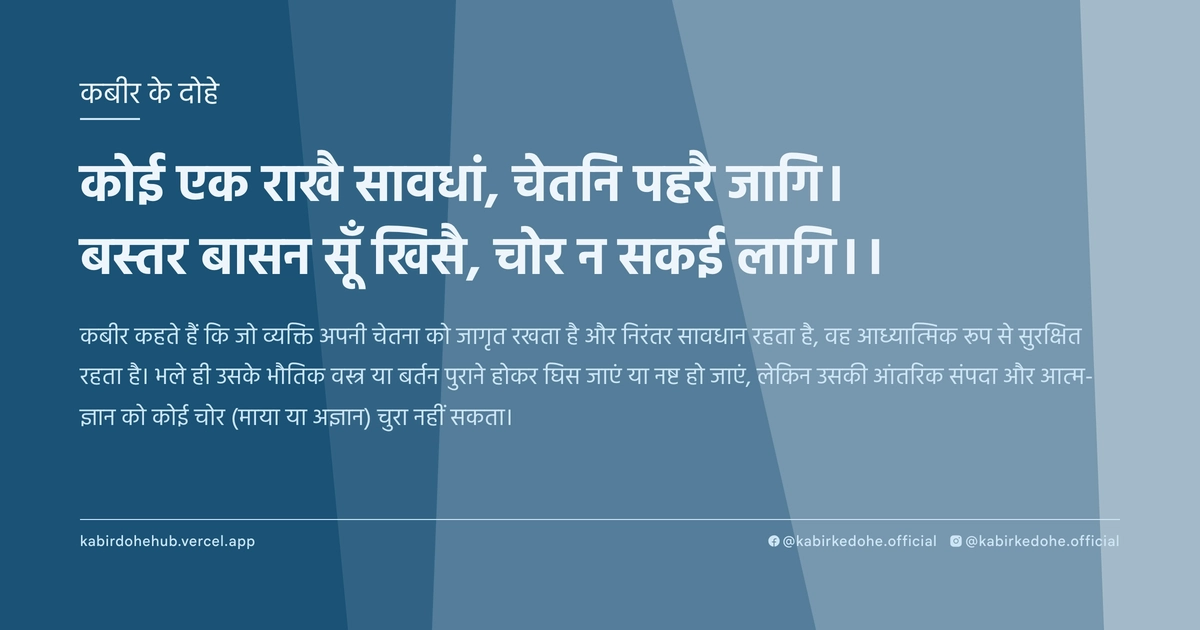
कोई एक राखै सावधां, चेतनि पहरै जागि।
बस्तर बासन सूँ खिसै, चोर न सकई लागि।।
Koi ek rakhai savdhaan, chetani pahrai jaagi. Bastar baasan sun khisai, chor na sakai laagi.
इस पृष्ठ पर इस कबीर दोहे का अर्थ (meaning), हिंदी व्याख्या और अंग्रेज़ी अनुवाद, दार्शनिक विश्लेषण और व्यावहारिक जीवन सीख दी गई है। यह दोहा मन नियंत्रण (Mind Control) विषय से जुड़ा है — Kabir doha meaning and explanation in Hindi and English.
अर्थ (Meaning):
कबीर कहते हैं कि जो व्यक्ति अपनी चेतना को जागृत रखता है और निरंतर सावधान रहता है, वह आध्यात्मिक रूप से सुरक्षित रहता है। भले ही उसके भौतिक वस्त्र या बर्तन पुराने होकर घिस जाएं या नष्ट हो जाएं, लेकिन उसकी आंतरिक संपदा और आत्म-ज्ञान को कोई चोर (माया या अज्ञान) चुरा नहीं सकता।
Kabir asserts that one who maintains constant vigilance and remains awakened in consciousness attains spiritual security. While material possessions, such as clothes or utensils, may wear out or be destroyed over time, the internal treasure of self-realization remains untouched and cannot be stolen by the thief of illusion or ignorance.
व्याख्या (Interpretation):
यह दोहा भौतिक और आध्यात्मिक सुरक्षा के बीच के अंतर को स्पष्ट करता है। 'सावधान' रहने का अर्थ है साक्षी भाव (Witness Consciousness) में स्थित होना। यहाँ 'बस्तर' (कपड़े) और 'बासन' (बर्तन) संसार की नश्वरता और माया के बाहरी आवरणों का प्रतीक हैं। कबीर समझाते हैं कि बाहरी दुनिया में हानि होना स्वाभाविक है, क्योंकि सब कुछ क्षणभंगुर है। लेकिन जब साधक अपनी चेतना को जागृत करता है, तो वह उस 'अविनाशी' तत्व से जुड़ जाता है जिसे कोई बाहरी शक्ति नष्ट नहीं कर सकती। यह निर्गुण भक्ति का सार है, जहाँ ईश्वर किसी मूर्ति में नहीं बल्कि स्वयं की जागृत चेतना में पाया जाता है। यह अद्वैत वेदांत के उस सत्य की ओर संकेत है जहाँ आत्मा और ब्रह्म एक हैं, और यह एकता ही एकमात्र वास्तविक सुरक्षा है।
This couplet elucidates the profound distinction between material security and spiritual fortitude. To remain 'vigilant' signifies abiding in the state of Sakshi-Bhava, or Witness Consciousness. Here, 'clothes' and 'utensils' symbolize the transient nature of the world and the external layers of Maya. Kabir explains that loss in the external realm is inevitable because everything material is ephemeral. However, when a seeker awakens their consciousness, they align with the 'Indestructible' element that no external force can diminish. This is the essence of Nirgun Bhakti, where the Divine is not found in idols but within one's own awakened awareness. It points toward the Advaita Vedanta truth of the non-duality of Atman and Brahman, suggesting that this unity is the only authentic sanctuary.
दार्शनिक विश्लेषण (Philosophical Analysis):
कबीर का यह दर्शन उनके समय के कर्मकांडीय आडंबरों और बाहरी दिखावे के विरुद्ध एक सशक्त प्रहार है। उन्होंने देखा कि लोग तीर्थों, वस्त्रों और धार्मिक प्रतीकों में सुरक्षा खोज रहे थे, जबकि वास्तविक सुरक्षा आंतरिक रूपांतरण में निहित थी। यह दृष्टिकोण सूफी मत के 'फना' (अहंकार का विनाश) और वेदांत के 'माया' सिद्धांत का एक सुंदर संगम है। कबीर तर्क देते हैं कि जब तक मनुष्य अपनी पहचान बाहरी वस्तुओं से जोड़ता है, वह भय और असुरक्षा के अधीन रहता है।
ऐतिहासिक रूप से, कबीर ने जाति व्यवस्था और सामाजिक पदानुक्रम को चुनौती दी, क्योंकि ये सभी 'बाहरी वस्त्रों' की तरह थे जो मनुष्य को उसकी वास्तविक प्रकृति से अलग करते थे। उनके लिए, आध्यात्मिक जागृति का अर्थ है उस 'चोर' को पहचानना जो सूक्ष्म रूप से हमारे ध्यान को भटकाता है—वह चोर है हमारा अहंकार और अज्ञान। जब चेतना जागती है, तो द्वैत (मैं और तू) समाप्त हो जाता है और केवल शुद्ध अस्तित्व शेष रहता है।
मनोवैज्ञानिक स्तर पर, यह दोहा 'अटैचमेंट' (मोह) और 'अवेयरनेस' (जागरूकता) के बीच के संघर्ष को दर्शाता है। अधिकांश लोग अपनी खुशी को बाहरी वस्तुओं की स्थिति से जोड़ते हैं, जिससे वे मानसिक तनाव का शिकार होते हैं। कबीर एक ऐसी मानसिक स्थिति का प्रस्ताव देते हैं जहाँ व्यक्ति संसार में रहते हुए भी उससे अप्रभावित रहता है।
यह शिक्षण हमें सिखाता है कि वास्तविक 'चोरी' भौतिक वस्तुओं का खोना नहीं है, बल्कि जीवन के उद्देश्य को भूल जाना है। जब हम अपनी आंतरिक ज्योति को प्रज्वलित करते हैं, तो हम उस शून्य में प्रवेश करते हैं जहाँ न कुछ पाने की इच्छा होती है और न कुछ खोने का डर।
अंततः, यह दोहा हमें भौतिक अभावों के प्रति तटस्थ रहने और आंतरिक प्रचुरता को विकसित करने के लिए प्रेरित करता है। यह एक क्रांतिकारी विचार है जो व्यक्ति को बाहरी परिस्थितियों का दास बनने के बजाय अपनी चेतना का स्वामी बनाता है।
Kabir's philosophy here serves as a potent critique of the ritualistic pomps and external displays prevalent during his era. He observed people seeking security in pilgrimages, specific attire, and religious symbols, whereas true sanctuary lay in internal transformation. This perspective is a sublime synthesis of the Sufi concept of 'Fana' (annihilation of the ego) and the Vedantic theory of 'Maya' (illusion).
Historically, Kabir challenged the caste system and social hierarchies, viewing them as 'external garments' that distanced humans from their true nature. For him, spiritual awakening meant identifying the 'thief' that subtly diverts our attention—that thief is the ego and primordial ignorance. Once consciousness awakens, duality (the sense of 'I' and 'Other') dissolves, leaving only pure existence.
On a psychological level, this couplet illustrates the conflict between attachment and awareness. Most individuals tether their happiness to the state of external objects, rendering them susceptible to anxiety and fear. Kabir proposes a mental state where one exists within the world but remains untouched by its turbulence.
This teaching suggests that the real 'theft' is not the loss of material possessions, but the loss of one's life purpose and spiritual essence. When we ignite the inner light, we enter a void where there is neither the desire to acquire nor the fear of losing.
Ultimately, the couplet urges us to remain neutral toward material scarcity and cultivate internal abundance. It is a revolutionary thought that empowers the individual to become the master of their consciousness rather than a slave to external circumstances.
मूल संदेश (Core Message):
- बाहरी सुरक्षा एक भ्रम है, आंतरिक जागृति ही एकमात्र सत्य है।
- माया वस्तुओं के माध्यम से आती है; जागरूकता के माध्यम से वह नष्ट होती है।
- अहंकार वह चोर है जो आपकी आध्यात्मिक शांति को चुराता है।
- नश्वरता को स्वीकार करना ही वास्तविक स्वतंत्रता की पहली सीढ़ी है।
- आत्मा की संपत्ति अविनाशी है, इसे न कोई छीन सकता है न कोई दे सकता है।
- External security is an illusion; internal awakening is the only truth.
- Maya enters through objects; it is dissolved through awareness.
- The ego is the thief that steals your spiritual tranquility.
- Accepting impermanence is the first step toward true liberation.
- The wealth of the soul is indestructible; it can neither be taken nor given.
व्यावहारिक उदाहरण (Practical Example):
वाराणसी के घाटों पर रहने वाले एक वृद्ध विधवा, जानकी, का जीवन अत्यंत अभावों में बीता। उनके पास केवल एक पुरानी सूती साड़ी और कुछ पीतल के बर्तन थे, जो समय के साथ घिसकर काले पड़ चुके थे। मोहल्ले के लोग अक्सर उनकी गरीबी का मजाक उड़ाते थे और उन्हें असहाय समझते थे।
जानकी का दिन भोर की प्रार्थना और गंगा के किनारे मौन बैठने में बीतता था। उन्होंने वर्षों तक कबीर के शब्दों का चिंतन किया था, विशेषकर इस विचार का कि बाहरी दुनिया की हानि वास्तव में कोई हानि नहीं है।
एक रात, उनके छोटे से कमरे में चोरी हुई। चोर ने उनके एकमात्र कीमती बर्तन और कुछ बचे हुए पैसे चुरा लिए। जब सुबह पड़ोसियों को यह पता चला, तो वे सहानुभूति जताने आए, यह सोचकर कि अब जानकी पूरी तरह टूट चुकी होंगी।
लेकिन जब वे जानकी के पास पहुँचे, तो उन्होंने उन्हें एक गहरी शांति और मंद मुस्कान के साथ बैठे पाया। उनके चेहरे पर दुख का कोई निशान नहीं था, बल्कि एक अद्भुत तेज था।
पड़ोसियों ने आश्चर्य से पूछा, "माता, आपका सब कुछ लुट गया, फिर भी आप इतनी शांत कैसे हैं?"
जानकी ने धीमे स्वर में उत्तर दिया, "बेटा, चोर ने केवल वह लिया जो पहले से ही मेरा नहीं था। वह बर्तन और कपड़े तो मिट्टी के थे, मिट्टी में ही मिलने थे। लेकिन उसने मेरी शांति, मेरी जागरूकता और मेरे भीतर के राम को नहीं चुराया।"
इस उत्तर ने वहां मौजूद सभी लोगों को स्तब्ध कर दिया। उन्हें एहसास हुआ कि वे अपनी महंगी वस्तुओं की सुरक्षा के लिए ताले लगाते हैं, लेकिन उनके मन में डर और चिंता का वास है।
जानकी की इस 'जागृति' ने मोहल्ले के लोगों के सोचने का तरीका बदल दिया। उन्होंने सीखा कि असली संपत्ति वह है जिसे कोई चोर नहीं छीन सकता—वह है संतोष और आत्म-बोध।
जानकी का जीवन एक जीवित उदाहरण बन गया कि कैसे बाहरी अभावों के बीच भी एक व्यक्ति आंतरिक रूप से सम्राट हो सकता है, यदि वह अपनी चेतना को जागृत रखे।
Janaki, an elderly widow living on the ghats of Varanasi, spent her life in extreme scarcity. Her only possessions were a worn-out cotton saree and a few brass utensils that had blackened and eroded over time. The neighbors often mocked her poverty, perceiving her as helpless.
Janaki's days were spent in dawn prayers and sitting in silence by the Ganges. For years, she had contemplated Kabir's words, specifically the idea that loss in the external world is not a true loss.
One night, a theft occurred in her tiny room. The thief stole her only valuable vessel and the few coins she had saved. When the neighbors found out the next morning, they came to offer sympathy, assuming Janaki would be utterly devastated.
However, upon reaching her, they found her sitting with a profound sense of peace and a gentle smile. There was no trace of grief on her face, only a strange, luminous radiance.
Surprised, the neighbors asked, "Mother, everything you owned has been stolen, yet how are you so calm?"
Janaki replied softly, "My child, the thief only took that which was never truly mine. Those vessels and clothes were made of earth, and to earth they must return. But he could not steal my peace, my awareness, or the Ram within me."
This response stunned everyone present. They realized that while they locked their expensive belongings behind heavy doors, their minds were plagued by fear and anxiety.
Janaki's 'awakening' transformed the perspective of the entire neighborhood. They learned that the only true wealth is that which no thief can snatch—contentment and self-realization.
Janaki's life became a living testament to how a person can be an internal emperor despite external deprivation, provided they keep their consciousness awake.
अभ्यास मार्गदर्शन (Practice Guidance):
- दैनिक साक्षी अभ्यास: दिन में तीन बार 10 मिनट के लिए रुकें और केवल यह देखें कि आपके विचार कैसे आ रहे हैं और जा रहे हैं, बिना उनमें उलझे।
- अनासक्ति जर्नल: उन तीन चीजों की सूची बनाएं जिनसे आप सबसे अधिक भावनात्मक रूप से जुड़े हैं, और विचार करें कि यदि वे कल गायब हो जाएं, तो आपके अस्तित्व का कौन सा हिस्सा अभी भी सुरक्षित रहेगा।
- चेतना का परीक्षण: जब भी क्रोध या भय महसूस हो, स्वयं से पूछें—'क्या यह चोर (अज्ञान) मेरी शांति चुरा रहा है, या मैं इसे चुराने दे रहा हूँ?'
- निदान चेकलिस्ट: आप इस ज्ञान को जी रहे हैं यदि: (1) भौतिक हानि पर आपका विलाप क्षणिक है, (2) आप दूसरों की संपत्ति से ईर्ष्या नहीं करते, (3) आप अकेलेपन में भी पूर्ण महसूस करते हैं।
- Daily Witness Practice: Three times a day, pause for 10 minutes to simply observe your thoughts arising and dissolving, without becoming entangled in them.
- Non-Attachment Journaling: List three things you are most emotionally attached to, and contemplate which part of your existence would remain intact if they vanished tomorrow.
- Consciousness Audit: Whenever you feel anger or fear, ask yourself—'Is this thief (ignorance) stealing my peace, or am I allowing it to happen?'
- Diagnostic Checklist: You are living this wisdom if: (1) Your grief over material loss is transient, (2) You feel no envy toward others' possessions, (3) You feel complete even in solitude.
चिंतन प्रश्न (Reflection Questions):
- यदि आज आपकी सारी सामाजिक प्रतिष्ठा और भौतिक संपत्ति छीन ली जाए, तो आपके पास 'स्वयं' के रूप में क्या बचेगा?
- आपकी डिजिटल पहचान (सोशल मीडिया इमेज) किस हद तक एक 'बाहरी वस्त्र' है जिसे आप अपनी वास्तविक पहचान मान बैठे हैं?
- वह कौन सा सूक्ष्म 'चोर' है जो आपके वर्तमान क्षण की शांति को भविष्य की चिंताओं में बदल देता है?
- क्या आपकी भक्ति केवल बाहरी प्रतीकों तक सीमित है, या वह आपके व्यवहार में गहराई तक उतरी है?
- आप अपनी सुरक्षा के लिए किन मानसिक दीवारों का निर्माण करते हैं, और क्या वे दीवारें आपको कैद कर रही हैं?
- If all your social status and material wealth were stripped away today, what would remain of 'you' as a self?
- To what extent is your digital identity a 'mere garment' that you have mistaken for your true self?
- Who is the subtle 'thief' that transforms your present peace into future anxieties?
- Is your devotion limited to external symbols, or has it permeated the depths of your behavior?
- What mental walls do you build for security, and are those very walls becoming your prison?