
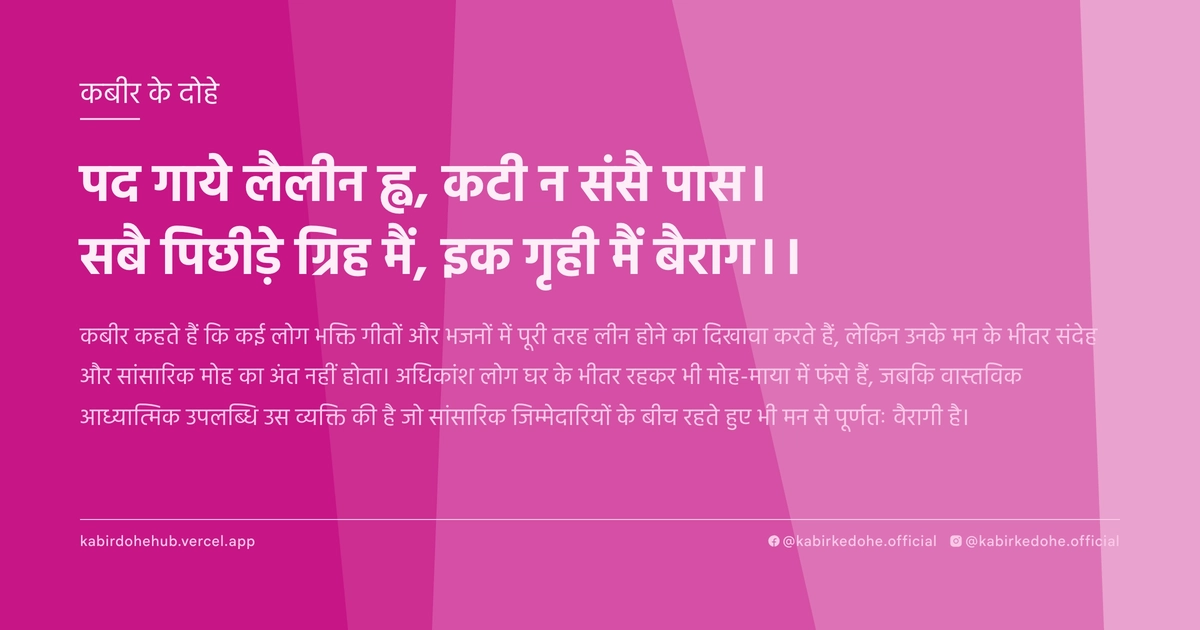
पद गाये लैलीन ह्व, कटी न संसै पास।
सबै पिछीड़े ग्रिह मैं, इक गृही मैं बैराग।।
Pad gaaye laileen hva, kati na sansai paas. Sabai pichhide grih main, ik grihi main bairag.
इस पृष्ठ पर इस कबीर दोहे का अर्थ (meaning), हिंदी व्याख्या और अंग्रेज़ी अनुवाद, दार्शनिक विश्लेषण और व्यावहारिक जीवन सीख दी गई है। यह दोहा वैराग्य (Detachment) विषय से जुड़ा है — Kabir doha meaning and explanation in Hindi and English.
अर्थ (Meaning):
कबीर कहते हैं कि कई लोग भक्ति गीतों और भजनों में पूरी तरह लीन होने का दिखावा करते हैं, लेकिन उनके मन के भीतर संदेह और सांसारिक मोह का अंत नहीं होता। अधिकांश लोग घर के भीतर रहकर भी मोह-माया में फंसे हैं, जबकि वास्तविक आध्यात्मिक उपलब्धि उस व्यक्ति की है जो सांसारिक जिम्मेदारियों के बीच रहते हुए भी मन से पूर्णतः वैरागी है।
Kabir observes that many immerse themselves in the singing of devotional hymns, yet the shackles of doubt and worldly attachment remain unbroken. While most people are trapped by the illusions of the household, the true seeker is the one who maintains the spirit of a renunciant while living amidst the duties of a householder.
व्याख्या (Interpretation):
यहाँ कबीर बाहरी कर्मकांड और आंतरिक रूपांतरण के बीच के अंतर को स्पष्ट करते हैं। 'पद गाये' का अर्थ केवल संगीत नहीं, बल्कि धर्म का प्रदर्शन है। वह बताते हैं कि जब तक 'संशय' (संदेह और द्वैत) नहीं कटता, तब तक कोई भी बाहरी क्रिया व्यर्थ है। यह निर्गुण भक्ति का सार है जहाँ ईश्वर मंदिर या भजन में नहीं, बल्कि अहंकार के विसर्जन में मिलता है। 'गृही मैं बैराग' एक महान विरोधाभास है—यह अद्वैत वेदांत के उस सिद्धांत को दर्शाता है जहाँ व्यक्ति संसार में रहते हुए भी उससे अलिप्त रहता है। माया का प्रभाव तब समाप्त होता है जब हम वस्तुओं का उपयोग तो करते हैं, लेकिन उनसे चिपके नहीं रहते।
Kabir distinguishes between external ritualism and internal transformation. 'Singing hymns' symbolizes the performance of religion, which remains futile if 'Sansai' (doubt and duality) persists. This aligns with Nirgun Bhakti, where the Divine is found not in hymns, but in the dissolution of the ego. The phrase 'Grihi main Bairag' (renunciation within the household) presents a profound paradox rooted in Advaita Vedanta: achieving detachment while remaining engaged in worldly duties. It suggests that Maya's grip is broken not by fleeing the world, but by changing one's relationship with it—utilizing the world without being possessed by it.
दार्शनिक विश्लेषण (Philosophical Analysis):
कबीर का यह दोहा उनके समय के उस सामाजिक परिवेश पर प्रहार है जहाँ धर्म केवल बाहरी दिखावे और रटंत विद्या तक सीमित था। वे उन पाखंडियों की आलोचना करते हैं जो घंटों भजन गाते हैं लेकिन उनके व्यवहार में करुणा और सत्य का अभाव होता है। यह दृष्टिकोण सूफीवाद के 'फना' (अहंकार का विनाश) और वेदांत के 'साक्षी भाव' का संगम है।
यहाँ 'संशय' का अर्थ केवल संदेह नहीं, बल्कि वह द्वैत है जो मनुष्य को स्वयं को परमात्मा से अलग मानता है। जब तक यह 'मैं' और 'तू' का भाव रहता है, तब तक कोई भी पूजा पूर्ण नहीं होती। कबीर का तर्क है कि वास्तविक वैराग्य जंगल जाने में नहीं, बल्कि मोह के केंद्र (घर) में रहकर भी उससे मुक्त रहने में है।
यह विश्लेषण हमें बताता है कि कर्मकांड अक्सर एक मानसिक ढाल बन जाते हैं जिससे हम अपनी वास्तविक आंतरिक रिक्तता को छुपाते हैं। लोग 'भक्ति' को एक सामाजिक पहचान बना लेते हैं, जबकि भक्ति वास्तव में एक आंतरिक अग्नि है जो अहंकार को जला देती है।
कबीर का 'गृही' (householder) होना यह सिद्ध करता है कि आध्यात्मिकता किसी विशेष वर्ग या संन्यासी के लिए नहीं है। यह हर उस व्यक्ति के लिए है जो अपनी चेतना को जाग्रत कर सके। यह जाति और वर्ण के बंधनों को तोड़कर आत्मा की शुद्धता पर बल देता है।
अंततः, यह दोहा मनोवैज्ञानिक रूपांतरण की बात करता है। यह सिखाता है कि बाहरी शांति (मौन या एकांत) आसान है, लेकिन शोर और जिम्मेदारियों के बीच आंतरिक स्थिरता प्राप्त करना ही वास्तविक सिद्धि है। यह द्वैत से अद्वैत की ओर बढ़ने का मार्ग है।
This couplet is a sharp critique of the socio-religious climate of Kabir's era, where spirituality was often reduced to performative rituals and rote chanting. He targets those who use devotional music as a mask, while their inner lives remain cluttered with attachment and doubt. This perspective merges the Sufi concept of 'Fana' (annihilation of the self) with the Vedantic 'Sakshi Bhava' (witness consciousness).
'Sansai' here refers not just to doubt, but to the fundamental duality—the illusion that the individual self is separate from the Universal Consciousness. As long as this sense of 'I' and 'Thou' persists, no amount of ritualistic singing can lead to liberation. Kabir argues that true Vairagya (renunciation) is not found in the forest, but in the heart of the household, where one remains untouched by attachment.
Philosophically, rituals often become psychological defense mechanisms, allowing individuals to hide their internal void behind a facade of piety. People transform 'Bhakti' into a social identity, whereas true devotion is an internal fire that incinerates the ego.
By championing the 'Grihi' (householder), Kabir democratizes spirituality. He asserts that enlightenment is not the exclusive domain of ascetics or a specific caste, but is accessible to anyone capable of awakening their consciousness. This dismantles the hierarchy of spiritual attainment based on external lifestyle.
Ultimately, the poem focuses on psychological alchemy. It teaches that while finding peace in isolation is simple, maintaining an unshakeable inner stillness amidst the chaos of domesticity is the true mark of a realized soul. It is the transition from the fragmented self to the non-dual Whole.
मूल संदेश (Core Message):
- बाहरी अनुष्ठान तब तक व्यर्थ हैं जब तक आंतरिक अहंकार जीवित है।
- सच्ची भक्ति प्रदर्शन में नहीं, बल्कि स्वभाव के रूपांतरण में है।
- वैराग्य का अर्थ संसार का त्याग नहीं, बल्कि आसक्ति का त्याग है।
- द्वैत और संदेह ही आध्यात्मिक प्रगति के सबसे बड़े अवरोध हैं।
- घर के भीतर रहकर भी अनासक्त रहना ही सर्वोच्च सिद्धि है।
- External rituals are futile as long as the internal ego survives.
- True devotion lies in the transformation of nature, not in performance.
- Renunciation is not the abandonment of the world, but the abandonment of attachment.
- Duality and doubt are the greatest obstacles to spiritual evolution.
- Remaining unattached while living in the world is the highest attainment.
व्यावहारिक उदाहरण (Practical Example):
वाराणसी की तंग गलियों में माधव नाम का एक पुराना बुनकर रहता था। वह दिन भर करघे पर सूत कातता और शाम को मंदिर में बैठकर घंटों भजन गाता था। शहर के लोग उसे बहुत बड़ा भक्त मानते थे क्योंकि उसकी आवाज़ में दर्द और समर्पण था।
लेकिन माधव के भीतर एक गहरा द्वंद्व था। वह अपने बेटों के बीच संपत्ति को लेकर हमेशा चिंतित रहता और छोटी-छोटी बातों पर क्रोधित हो जाता। उसकी भक्ति केवल मंदिर की देहरी तक सीमित थी; घर लौटते ही वह वही पुराना लोभी और क्रोधी माधव बन जाता।
एक दिन उसने एक फकीर को देखा जो बाजार के शोर-शराबे के बीच शांत बैठा था। फकीर ने माधव की व्याकुलता को पहचान लिया और उससे कहा, "माधव, तुम मंदिर में ईश्वर को खोज रहे हो, लेकिन अपने घर में उसे क्रोध और मोह के नीचे दबा रहे हो।"
माधव ने पूछा, "क्या मुझे यह सब छोड़कर वन चले जाना चाहिए?"
फकीर हँसा और बोला, "वन जाना आसान है, असली चुनौती तो इस घर में रहकर वैरागी बनना है। जिस दिन तुम्हारा करघा तुम्हारी पूजा बन जाए और तुम्हारा परिवार तुम्हारा मंदिर, उस दिन तुम्हारा संशय मिट जाएगा।"
माधव को अपनी गलती समझ आई। उसने महसूस किया कि वह भजनों का उपयोग अपनी ईगो को संतुष्ट करने के लिए कर रहा था, न कि स्वयं को मिटाने के लिए।
अगले कुछ महीनों में माधव ने अपना व्यवहार बदला। अब वह भजन केवल मंदिर में नहीं गाता था, बल्कि काम करते समय भी उसी लय में रहता था। उसने संपत्ति का मोह छोड़ दिया और अपने बेटों के साथ प्रेम से रहना शुरू किया।
अब वह घर के काम करते हुए भी मानसिक रूप से शांत रहता। लोग हैरान थे कि माधव अब पहले से अधिक खुश और स्थिर था, भले ही उसकी आर्थिक स्थिति वैसी ही थी।
माधव ने जान लिया था कि वास्तविक वैराग्य घर छोड़ना नहीं, बल्कि घर के भीतर रहते हुए मोह को छोड़ना है। वह अब एक 'गृही' था, लेकिन उसके भीतर एक 'वैरागी' जाग चुका था।
In the narrow lanes of Varanasi lived an old weaver named Madhav. He spent his days at the loom and his evenings in the temple, singing devotional hymns for hours. The townspeople revered him as a great devotee because of the raw emotion and surrender in his voice.
However, inside Madhav, there was a deep conflict. He was perpetually anxious about property disputes among his sons and would erupt in anger over trivial matters. His devotion was confined to the temple steps; the moment he returned home, he reverted to the greedy and irritable Madhav.
One day, he encountered a wandering fakir sitting in absolute stillness amidst the cacophony of the marketplace. The fakir sensed Madhav's inner turmoil and said, "Madhav, you seek God in the temple, yet you bury Him under anger and attachment in your own home."
Madhav asked, "Should I abandon everything and flee to the forest?"
The fakir laughed and replied, "Fleeing to the forest is easy. The real challenge is to become a renunciant while living in this house. The day your loom becomes your prayer and your family becomes your temple, your doubts will vanish."
Madhav realized his error. He understood that he had been using hymns to feed his ego's image of being 'spiritual,' rather than using them to dissolve the ego itself.
Over the next few months, Madhav transformed his behavior. He no longer sang hymns only in the temple; he maintained that same rhythmic devotion while working. He let go of his obsession with property and began treating his sons with genuine love.
He remained mentally poised even while performing mundane chores. People were amazed that Madhav was now far happier and more stable, despite his financial circumstances remaining unchanged.
Madhav had learned that true Vairagya is not the abandonment of the home, but the abandonment of attachment within the home. He was now a 'Grihi' (householder) in form, but a 'Bairagi' (renunciant) in spirit.
अभ्यास मार्गदर्शन (Practice Guidance):
- दैनिक अभ्यास: दिन में तीन बार 10 मिनट के लिए 'साक्षी भाव' का अभ्यास करें। यह देखें कि आप अपनी भूमिकाओं (पिता, पुत्र, कर्मचारी) को निभा रहे हैं, लेकिन आप उनसे अलग एक शुद्ध चेतना हैं।
- आत्म-पूछताछ जर्नल: हर रात लिखें कि आज किस क्षण में आपने 'दिखावे की भक्ति' की और कहाँ आपने वास्तव में निस्वार्थ भाव से कार्य किया।
- व्यवहार परिवर्तन: किसी ऐसे व्यक्ति की मदद करें जिससे आप नफरत करते हैं, बिना यह सोचे कि आपको इसके बदले में क्या मिलेगा।
- डायग्नोस्टिक चेकलिस्ट: क्या मैं शांति के लिए एकांत खोजता हूँ? (यदि हाँ, तो वैराग्य अभी अधूरा है)। क्या मैं शोर और तनाव के बीच भी आंतरिक मुस्कान बनाए रख सकता हूँ? (यदि हाँ, तो आप 'गृही वैराग' की ओर बढ़ रहे हैं)।
- Daily Practice: Practice 'Witness Consciousness' (Sakshi Bhava) for 10 minutes three times a day. Observe yourself performing your roles (parent, child, employee) while realizing you are the pure consciousness distinct from these roles.
- Self-Inquiry Journal: Every night, record moments where you engaged in 'performative spirituality' versus moments of genuine, selfless action.
- Behavioral Shift: Perform an act of service for someone you dislike, without expecting any recognition or return.
- Diagnostic Checklist: Do I seek solitude to find peace? (If yes, renunciation is incomplete). Can I maintain an inner smile amidst noise and stress? (If yes, you are progressing toward 'Renunciation within the Household').
चिंतन प्रश्न (Reflection Questions):
- क्या मेरी आध्यात्मिक पहचान केवल दूसरों की नजरों में है, या यह मेरे एकांत के अंधेरे में भी उतनी ही सच्ची है?
- मैं किन सामाजिक मुखौटों के पीछे अपनी आंतरिक अशांति को छुपाता हूँ?
- यदि मेरी सारी धार्मिक पहचान (जाति, संप्रदाय, पद) छीन ली जाए, तो क्या मेरे पास कुछ बचेगा?
- क्या मैं वास्तव में प्रेम करता हूँ, या मैं केवल उस 'प्रेम करने वाले' होने के अहसास से प्रेम करता हूँ?
- मेरे जीवन का वह कौन सा 'घर' (मोह) है जिसे मैं छोड़ने का साहस नहीं जुटा पा रहा हूँ?
- Is my spiritual identity merely for others to see, or is it equally true in the darkness of my solitude?
- Which social masks do I use to hide my internal turbulence?
- If all my religious identities (caste, sect, titles) were stripped away, what would remain of me?
- Do I truly love others, or am I merely in love with the feeling of 'being a loving person'?
- What is the specific 'household' (attachment) in my life that I lack the courage to relinquish?