
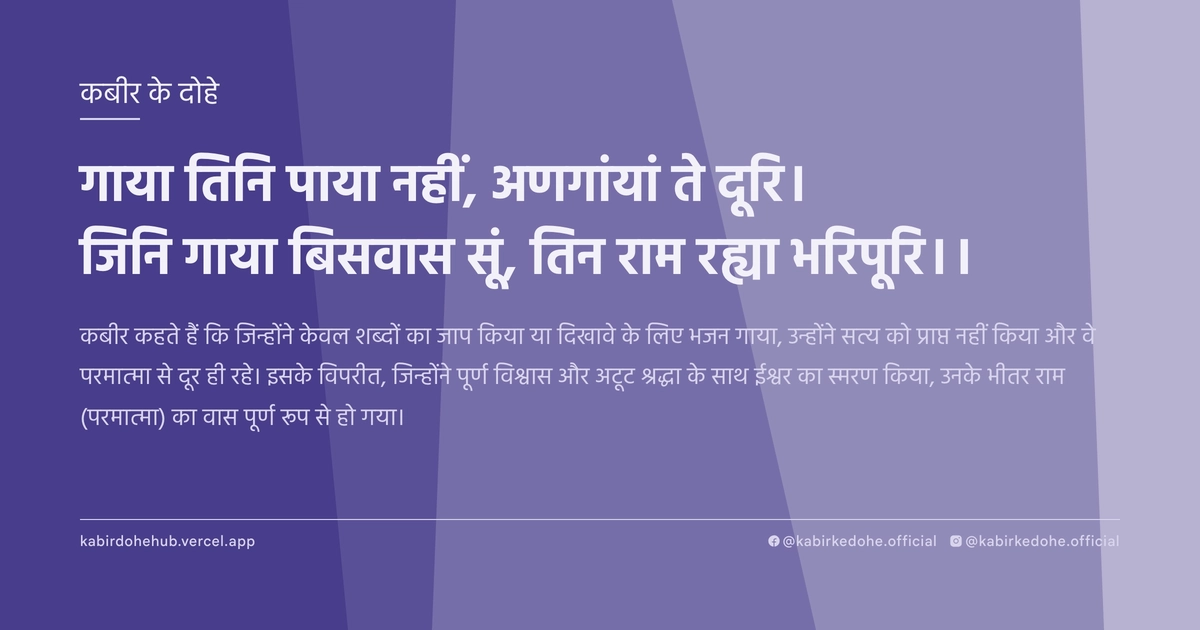
गाया तिनि पाया नहीं, अणगांयां ते दूरि।
जिनि गाया बिसवास सूं, तिन राम रह्या भरिपूरि।।
Gaaya tini paaya nahi, angaayan te doori. Jini gaaya biswaas soon, tin ram rahya bharipoori.
इस पृष्ठ पर इस कबीर दोहे का अर्थ (meaning), हिंदी व्याख्या और अंग्रेज़ी अनुवाद, दार्शनिक विश्लेषण और व्यावहारिक जीवन सीख दी गई है। यह दोहा भक्ति (Bhakti) विषय से जुड़ा है — Kabir doha meaning and explanation in Hindi and English.
अर्थ (Meaning):
कबीर कहते हैं कि जिन्होंने केवल शब्दों का जाप किया या दिखावे के लिए भजन गाया, उन्होंने सत्य को प्राप्त नहीं किया और वे परमात्मा से दूर ही रहे। इसके विपरीत, जिन्होंने पूर्ण विश्वास और अटूट श्रद्धा के साथ ईश्वर का स्मरण किया, उनके भीतर राम (परमात्मा) का वास पूर्ण रूप से हो गया।
Kabir asserts that those who merely chanted words or sang hymns for outward show failed to attain the Truth and remained distant from the Divine. Conversely, those who sang with absolute faith and unwavering devotion found the Divine Presence filling every fiber of their being.
व्याख्या (Interpretation):
इस दोहे का शाब्दिक अर्थ है कि यांत्रिक प्रार्थना फलहीन है। यहाँ "गाना" केवल होंठों की हलचल का प्रतीक है, जबकि "बिसवास" हृदय की गहराई का। कबीर निर्गुण भक्ति की बात करते हैं जहाँ ईश्वर किसी बाहरी मूर्ति में नहीं, बल्कि आंतरिक विश्वास में बसता है। यह माया के उस भ्रम को तोड़ता है जहाँ मनुष्य कर्मकांड को ही मोक्ष मान लेता है। जब अहंकार मिटता है और केवल विश्वास बचता है, तब आत्मा और परमात्मा का अद्वैत (non-duality) घटित होता है। यह विरोधाभास है कि जो खोजने निकलता है वह खो जाता है, और जो समर्पित हो जाता है वह पा लेता है।
Literally, the verse suggests that mechanical prayer is fruitless. Here, "singing" symbolizes the mere movement of lips, while "faith" represents the depths of the heart. Kabir speaks of Nirgun Bhakti, where the Divine resides not in external idols but in internal conviction. This shatters the illusion of Maya, where humans mistake ritualism for liberation. When the ego dissolves and only faith remains, the non-duality of Atman and Brahman is realized. It is the central paradox: he who seeks through effort often misses, while he who surrenders in faith finds the All.
दार्शनिक विश्लेषण (Philosophical Analysis):
कबीर का यह विचार उनके समय के धार्मिक पाखंड पर एक तीखा प्रहार था। उन्होंने देखा कि पंडित और मौलवी केवल ग्रंथों के रटने और बाहरी आडंबरों में लीन थे, जबकि वास्तविक आध्यात्मिक अनुभव से कोसों दूर थे। यह दृष्टिकोण अद्वैत वेदांत के उस सिद्धांत से मेल खाता है जहाँ 'अहं ब्रह्मास्मि' का अनुभव केवल बौद्धिक विमर्श से नहीं, बल्कि गहन अनुभव से होता है।
सूफी मत के 'फना' (अहंकार का विनाश) के समान, कबीर यहाँ यह समझा रहे हैं कि जब तक 'मैं' (कर्ता का भाव) मौजूद है, तब तक 'राम' (परमात्मा) का पूर्ण अनुभव संभव नहीं है। विश्वास यहाँ अंधविश्वास नहीं, बल्कि एक ऐसी मानसिक स्थिति है जहाँ संदेह का पूर्ण अभाव होता है।
ritualism (कर्मकांड) का विरोध करते हुए कबीर यह स्पष्ट करते हैं कि ईश्वर किसी विशेष भाषा, मंत्र या विधि का मोहताज नहीं है। वह केवल प्रेम और विश्वास की भाषा समझता है। यह मनोवैज्ञानिक रूपांतरण की प्रक्रिया है जहाँ व्यक्ति बाहरी शोर से हटकर आंतरिक मौन की ओर बढ़ता है।
अक्सर लोग इस दोहे को केवल धार्मिक आस्था के रूप में देखते हैं, लेकिन वास्तव में यह चेतना के स्तर को बदलने का आह्वान है। यह सिखाता है कि सत्य का मार्ग 'जानने' से नहीं, बल्कि 'होने' से प्रशस्त होता है।
अंततः, कबीर यह स्थापित करते हैं कि भक्ति का अर्थ है स्वयं को परमात्मा में विलीन कर देना। जब भक्त और भगवान के बीच का पर्दा (माया) हट जाता है, तब केवल पूर्णता शेष रहती है, जिसे उन्होंने "भरिपूरि" कहा है।
Kabir's insight is a sharp critique of the religious hypocrisy of his era. He observed that the clergy were immersed in rote memorization of scriptures and outward displays of piety, while remaining miles away from actual spiritual realization. This aligns with the Advaita Vedanta principle that the realization of 'Aham Brahmasmi' (I am Brahman) cannot be achieved through intellectual discourse alone, but through direct experience.
Similar to the Sufi concept of 'Fana' (annihilation of the self), Kabir explains that as long as the 'I' (the sense of doership) exists, the full experience of 'Ram' (the Divine) is impossible. Faith here is not blind belief, but a psychological state where all doubt is extinguished.
By rejecting ritualism, Kabir clarifies that the Divine is not bound by a specific language, mantra, or method. The Divine responds only to the language of love and trust. This is a process of psychological transformation where the individual moves from external noise toward internal silence.
Common literalist misconceptions often frame this as a religious exhortation, but it is actually a call to shift levels of consciousness. It teaches that the path to Truth is not paved by 'knowing' but by 'becoming'.
Ultimately, Kabir establishes that devotion means dissolving oneself into the Divine. When the veil of Maya between the devotee and the Godhead is lifted, only wholeness remains, which he describes as "Bharipuri" or being completely filled.
मूल संदेश (Core Message):
- बाहरी आडंबर केवल भ्रम पैदा करते हैं, सत्य नहीं।
- शब्द केवल संकेत हैं, गंतव्य नहीं; विश्वास ही वास्तविक सेतु है।
- अहंकार युक्त प्रार्थना ईश्वर से दूर ले जाती है।
- पूर्ण समर्पण ही आत्मा और परमात्मा का मिलन है।
- सच्ची भक्ति वह है जो मनुष्य को विनम्र और प्रेमपूर्ण बनाए।
- परमात्मा को बाहर खोजना एक अंतहीन और व्यर्थ प्रयास है।
- External rituals create only illusions, never the Truth.
- Words are mere signposts, not the destination; faith is the actual bridge.
- Prayer laced with ego only increases the distance from the Divine.
- Total surrender is the only union between the Soul and the Absolute.
- True devotion is that which renders a human humble and loving.
- Seeking the Divine externally is an endless and futile endeavor.
व्यावहारिक उदाहरण (Practical Example):
वाराणसी के एक पुराने घाट पर रहने वाली एक वृद्ध विधवा, जानकी, का जीवन केवल मंदिर जाने और घंटों माला जपने में बीत रहा था। वह मानती थी कि यदि वह प्रतिदिन हजार बार नाम जपेगी, तो उसे मोक्ष मिल जाएगा। उसके चेहरे पर एक कठोर अनुशासन था, लेकिन हृदय में एक अनजाना खालीपन और दूसरों के प्रति निर्णय लेने की प्रवृत्ति थी।
एक दिन उसने एक साधारण से व्यक्ति को देखा जो घाट की सीढ़ियों पर चुपचाप बैठा था। वह न तो माला फेर रहा था और न ही कोई मंत्र पढ़ रहा था, लेकिन उसके चेहरे पर एक ऐसी शांति थी जिसे जानकी ने कभी महसूस नहीं किया था।
जिज्ञासावश जानकी ने उससे पूछा, "तुम इतनी देर से यहाँ बैठे हो, पर कोई प्रार्थना नहीं कर रहे? क्या तुम्हें डर नहीं कि तुम ईश्वर से दूर हो जाओगे?"
उस व्यक्ति ने मुस्कुराकर जवाब दिया, "माँ, मैं प्रार्थना नहीं कर रहा, मैं बस उनके साथ हूँ। जब मैं शब्दों में उलझता था, तो मैं केवल शब्दों को पाता था। जब मैंने शब्दों को छोड़ा और केवल विश्वास को पकड़ा, तो मुझे पता चला कि जिसे मैं बाहर ढूँढ रहा था, वह तो मेरे भीतर ही सांस ले रहा है।"
यह शब्द जानकी के लिए एक बिजली की तरह थे। उसे एहसास हुआ कि उसकी माला केवल एक गिनती थी, एक सौदा था—कि "मैं इतना जप करूँगा तो ईश्वर मुझे यह देंगे।"
उस रात जानकी ने माला को एक तरफ रख दिया। उसने पहली बार अपनी आँखें बंद कीं और बिना किसी शब्द के, केवल इस विश्वास के साथ बैठ गई कि वह परमात्मा का ही एक अंश है।
शुरुआत में उसे बेचैनी हुई, क्योंकि उसका मन शब्दों का भूखा था। लेकिन धीरे-धीरे, वह मौन गहरा होता गया। उसने महसूस किया कि अब तक वह ईश्वर को एक बाहरी सत्ता मानकर उसे रिझाने की कोशिश कर रही थी।
जैसे ही उसने 'पाने' की इच्छा छोड़ी और 'होने' के विश्वास को अपनाया, उसके भीतर एक असीम प्रेम उमड़ पड़ा। अब वह मंदिर केवल दिखावे के लिए नहीं, बल्कि उस आंतरिक आनंद को साझा करने के लिए जाने लगी।
उसका व्यवहार बदल गया। अब वह दूसरों की गलतियाँ नहीं निकालती थी, क्योंकि उसे हर इंसान में वही 'राम' दिखने लगा था जिसे वह अब तक केवल मंत्रों में खोज रही थी।
जानकी की यह यात्रा शब्दों के शोर से विश्वास के मौन तक की यात्रा थी, जिसने उसे वास्तव में पूर्ण कर दिया।
In the ancient ghats of Varanasi lived an elderly widow named Janaki, whose life revolved around visiting temples and chanting beads for hours. She believed that if she recited the Divine Name a thousand times daily, she would secure liberation. Her face bore a mask of rigid discipline, yet her heart held a strange emptiness and a tendency to judge others.
One day, she noticed a simple man sitting silently on the stone steps. He was neither counting beads nor reciting mantras, yet his face radiated a peace that Janaki had never experienced in her years of ritual.
Driven by curiosity, Janaki asked, "You have been sitting here so long, yet you offer no prayer. Do you not fear drifting away from God?"
The man smiled and replied, "Mother, I am not praying; I am simply being with Him. When I was entangled in words, I found only words. When I let go of the words and held onto faith, I discovered that the One I sought outside was breathing within me all along."
These words struck Janaki like a bolt of lightning. She realized her prayer beads had become a mere counting exercise, a transaction—"I will chant this much, and in return, God will give me this."
That night, Janaki set aside her beads. For the first time, she closed her eyes and sat in absolute silence, holding only the conviction that she was a fragment of the Divine.
Initially, she felt restlessness, as her mind craved the familiar structure of words. But gradually, the silence deepened. She realized she had been treating God as an external entity to be appeased.
As soon as she abandoned the desire to 'attain' and embraced the faith of 'being', an infinite love welled up within her. She continued to visit the temple, but no longer for show; she went to share the internal bliss she had found.
Her behavior transformed. She stopped criticizing others, for she began to see the same 'Ram' in every human being that she had previously sought only in mantras.
Janaki's journey was a transition from the noise of words to the silence of faith, which finally made her whole.
अभ्यास मार्गदर्शन (Practice Guidance):
- दैनिक मौन अभ्यास: प्रतिदिन 20 मिनट बिना किसी मंत्र या विचार के बैठें। केवल इस भाव पर ध्यान केंद्रित करें कि 'मैं पूर्ण हूँ' और 'ईश्वर मेरे भीतर है'।
- आत्म-पूछताछ जर्नलिंग: लिखें कि आपकी कौन सी धार्मिक या आध्यात्मिक आदतें केवल सामाजिक दबाव या डर के कारण हैं, न कि आंतरिक प्रेम के कारण।
- व्यवहार परिवर्तन: किसी भी कार्य को करते समय 'कर्ता' होने के अहंकार को छोड़कर, उसे परमात्मा की इच्छा मानकर समर्पित करने का प्रयास करें।
- डायग्नोस्टिक चेकलिस्ट: क्या मैं प्रार्थना के बाद भी क्रोधित या ईर्ष्यालु महसूस करता हूँ? क्या मेरा आध्यात्मिक अभ्यास मुझे दूसरों से श्रेष्ठ महसूस कराता है? यदि हाँ, तो आप अभी भी 'शब्दों' में हैं, 'विश्वास' में नहीं।
- Daily Silence Practice: Sit for 20 minutes daily without any mantra or thought. Focus solely on the feeling that 'I am complete' and 'The Divine is within me'.
- Self-Inquiry Journaling: Document which of your religious or spiritual habits are driven by social pressure or fear rather than internal love.
- Behavioral Shift: While performing any task, try to let go of the ego of the 'doer' and surrender the action as the will of the Divine.
- Diagnostic Checklist: Do I still feel anger or jealousy after my prayers? Does my spiritual practice make me feel superior to others? If yes, you are still in the realm of 'words', not 'faith'.
चिंतन प्रश्न (Reflection Questions):
- क्या मेरी प्रार्थनाएं ईश्वर को बदलने की कोशिश हैं या स्वयं को बदलने की?
- यदि मुझसे मेरे सभी धार्मिक प्रतीक (माला, तिलक, वस्त्र) छीन लिए जाएं, तो क्या मेरा विश्वास बचेगा?
- मैं अपनी आध्यात्मिक पहचान का उपयोग दूसरों को नीचा दिखाने के लिए किस तरह करता हूँ?
- मेरे जीवन का वह कौन सा क्षेत्र है जहाँ मैं 'विश्वास' के बजाय 'डर' से संचालित होता हूँ?
- क्या मैं सत्य को जानने की इच्छा रखता हूँ, या केवल सत्य जैसा दिखने की?
- मेरे भीतर का 'राम' तब कहाँ होता है जब मैं अपने सबसे गहरे अंधेरे या क्रोध में होता हूँ?
- Are my prayers an attempt to change God, or an attempt to change myself?
- If all my religious symbols (beads, markings, attire) were stripped away, would my faith survive?
- In what ways do I use my spiritual identity to subtly belittle others?
- Which area of my life is driven by 'fear' rather than 'faith'?
- Do I truly desire to know the Truth, or do I only desire to appear truthful?
- Where is the 'Ram' within me when I am in my deepest darkness or rage?