
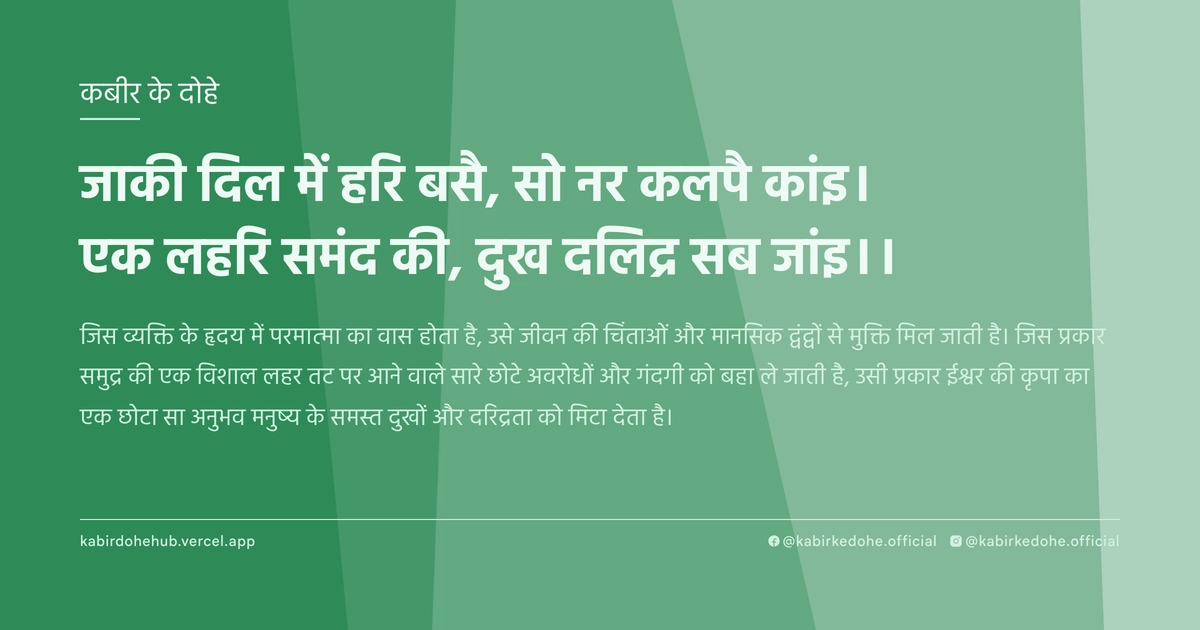
जाकी दिल में हरि बसै, सो नर कलपै कांइ।
एक लहरि समंद की, दुख दलिद्र सब जांइ।।
Jaaki dil me hari basai, so nar kalpai kaai. Ek lahari samand ki, dukh dalidra sab jaai.
इस पृष्ठ पर इस कबीर दोहे का अर्थ (meaning), हिंदी व्याख्या और अंग्रेज़ी अनुवाद, दार्शनिक विश्लेषण और व्यावहारिक जीवन सीख दी गई है। यह दोहा भक्ति (Bhakti) विषय से जुड़ा है — Kabir doha meaning and explanation in Hindi and English.
अर्थ (Meaning):
जिस व्यक्ति के हृदय में परमात्मा का वास होता है, उसे जीवन की चिंताओं और मानसिक द्वंद्वों से मुक्ति मिल जाती है। जिस प्रकार समुद्र की एक विशाल लहर तट पर आने वाले सारे छोटे अवरोधों और गंदगी को बहा ले जाती है, उसी प्रकार ईश्वर की कृपा का एक छोटा सा अनुभव मनुष्य के समस्त दुखों और दरिद्रता को मिटा देता है।
He whose heart is the abode of the Divine remains untouched by the anxieties and tribulations of the world. Just as a single powerful wave of the ocean sweeps away all debris and remnants from the shore, a single surge of spiritual realization obliterates all suffering and inner poverty from a seeker's life.
व्याख्या (Interpretation):
इस दोहे का शाब्दिक अर्थ है कि ईश्वर भक्ति से दुख दूर होते हैं, परंतु इसका गहरा आध्यात्मिक अर्थ 'अद्वैत' की स्थिति है। यहाँ 'हरि' केवल एक बाहरी देवता नहीं, बल्कि वह अंतर्निहित चेतना है जो हर जीव में व्याप्त है। जब साधक को यह अनुभव होता है कि वह स्वयं ब्रह्म है, तो 'मैं' और 'मेरा' का भ्रम टूट जाता है। यह 'माया' के आवरण का हटना है। 'लहर' यहाँ उस क्षणिक बोध (Satori) का प्रतीक है जो अज्ञानता की सदियों पुरानी परतों को एक पल में नष्ट कर देता है। यह निर्गुण भक्ति का सार है जहाँ भक्त और भगवान के बीच का द्वैत समाप्त हो जाता है और केवल अनंत शांति शेष रहती है।
While the literal meaning suggests that devotion removes sorrow, the deeper metaphysical layer points toward the state of Non-duality (Advaita). Here, 'Hari' is not an external deity but the immanent consciousness residing within every being. When the seeker realizes their identity as the Universal Self, the illusion of 'I' and 'mine' dissolves. This represents the piercing of 'Maya' (the cosmic illusion). The 'wave' symbolizes the sudden surge of spiritual awakening (Satori) that erases centuries of accumulated ignorance in a single instant. This is the essence of Nirgun Bhakti, where the duality between the devotee and the Divine vanishes, leaving only an infinite, undisturbed peace.
दार्शनिक विश्लेषण (Philosophical Analysis):
कबीर का यह विचार उनके युग के कर्मकांडीय आडंबरों पर एक प्रहार है। उन्होंने यह स्पष्ट किया कि मोक्ष किसी तीर्थ या मंदिर में नहीं, बल्कि हृदय की शुद्धि में है। यह दर्शन सूफीवाद के 'फना' (अहंकार का विनाश) और वेदांत के 'अहं ब्रह्मास्मि' का संगम है। कबीर तर्क देते हैं कि दुख का मूल कारण बाहरी अभाव नहीं, बल्कि आंतरिक अलगाव है। जब हम स्वयं को शरीर या सामाजिक पहचान (जाति, धर्म) से जोड़ते हैं, तो हम दरिद्र हो जाते हैं।
ऐतिहासिक रूप से, कबीर ने उस समय के समाज को चुनौती दी जहाँ मोक्ष केवल उच्च जातियों के लिए आरक्षित माना जाता था। उन्होंने घोषणा की कि ईश्वर का वास किसी विशेष स्थान पर नहीं, बल्कि उस हृदय में है जो प्रेम और सत्य से भरा है। यह एक क्रांतिकारी मनोवैज्ञानिक परिवर्तन था, जिसने व्यक्ति को बाहरी सत्ता के अधीन करने के बजाय उसे अपनी आंतरिक शक्ति से जोड़ा।
दार्शनिक स्तर पर, 'दुख दलिद्र' केवल भौतिक गरीबी नहीं है, बल्कि आध्यात्मिक रिक्तता है। यह वह अवस्था है जहाँ मनुष्य स्वयं को पूर्णता से अलग महसूस करता है। कबीर के अनुसार, यह रिक्तता तब भरती है जब व्यक्ति अपनी सीमित पहचान को त्यागकर उस विराट सत्ता में विलीन हो जाता है।
यहाँ 'हरि' का अर्थ है वह जो 'हर' ले जाए—अर्थात जो हमारे अहंकार और दुखों को हर ले। यह प्रक्रिया किसी बाहरी अनुष्ठान से नहीं, बल्कि निरंतर आत्म-निरीक्षण और समर्पण से संभव है। यह मार्ग कठिन है क्योंकि यह हमसे हमारी सबसे प्रिय वस्तु—हमारे अहंकार—को माँगता है।
अंततः, यह दोहा यह स्थापित करता है कि आध्यात्मिक समृद्धि ही वास्तविक समृद्धि है। जब चेतना का विस्तार होता है, तो दुनिया की समस्याएँ छोटी हो जाती हैं। यह एक ऐसी मानसिक स्थिति है जहाँ व्यक्ति संसार में रहते हुए भी संसार से ऊपर उठ जाता है, ठीक वैसे ही जैसे कमल का पत्ता पानी में रहकर भी उससे भीगता नहीं है।
Kabir's thought here is a direct critique of the ritualistic pomposity of his era. He clarifies that liberation is not found in pilgrimages or temples, but in the purification of the heart. This philosophy is a confluence of the Sufi concept of 'Fana' (annihilation of the ego) and the Vedantic realization of 'Aham Brahmasmi' (I am Brahman). Kabir argues that the root of suffering is not external lack, but internal alienation.
Historically, Kabir challenged a society where salvation was deemed the exclusive preserve of higher castes. He proclaimed that the Divine resides not in a specific location, but in the heart filled with love and truth. This was a revolutionary psychological shift, empowering the individual to connect with their inner strength rather than remaining subservient to external authorities.
On a philosophical level, 'dukh dalidra' (suffering and poverty) does not merely refer to material deprivation, but to spiritual void. It is the state where a human feels severed from the Totality. According to Kabir, this void is filled only when the individual transcends their limited identity and merges into the Infinite.
Here, 'Hari' signifies the one who 'removes'—the one who takes away our ego and sorrows. This process is not achieved through external rituals but through constant self-inquiry and surrender. This path is arduous because it demands the sacrifice of our most cherished possession: the ego.
Ultimately, this couplet establishes that spiritual abundance is the only true wealth. When consciousness expands, the problems of the world shrink in significance. It is a state of being where one lives in the world but remains untouched by it, much like a lotus leaf that rests on water yet never gets wet.
मूल संदेश (Core Message):
- बाहरी अभाव केवल एक मानसिक भ्रम है।
- आंतरिक परमात्मा का बोध ही वास्तविक संपदा है।
- अहंकार का विसर्जन ही दुखों का अंत है।
- समर्पण में ही सबसे बड़ी शक्ति निहित है।
- आत्मा और परमात्मा का मिलन ही परम शांति है।
- External lack is merely a mental illusion.
- Realization of the Inner Divine is the only true wealth.
- The dissolution of ego is the end of all suffering.
- The greatest power lies in total surrender.
- The union of Atman and Brahman is ultimate peace.
व्यावहारिक उदाहरण (Practical Example):
वाराणसी के घाटों पर रहने वाले एक वृद्ध बुनकर थे, जिनका नाम माधव था। माधव ने अपना पूरा जीवन रेशमी साड़ियाँ बुनने में बिताया, लेकिन उनका मन हमेशा इस बात से व्यथित रहता था कि उनके पास पर्याप्त धन नहीं है और उनके बच्चे उन्हें छोड़कर शहर चले गए हैं। वह हर समय इस चिंता में रहते थे कि बुढ़ापे में उनका क्या होगा।
माधव अक्सर मंदिर जाते और घंटों प्रार्थना करते, लेकिन उनकी प्रार्थनाओं में केवल माँग थी, समर्पण नहीं। वह ईश्वर से अपनी दरिद्रता दूर करने की भीख माँगते थे, पर उनके भीतर का क्रोध और अकेलापन उन्हें शांति नहीं लेने देता था।
एक दिन, घाट पर एक फकीर बैठा था जो बस मुस्कुरा रहा था। माधव ने उससे पूछा, "बाबा, आप इतने शांत कैसे हैं? क्या आपके पास कोई संपत्ति है?" फकीर ने हँसकर कहा, "मेरे पास वह है जिसे पाने के बाद सब कुछ छोटा लगने लगता है। मैं अपनी आत्मा में उस मालिक को देख चुका हूँ, अब मुझे बाहर क्या ढूँढना?"
माधव को यह बात समझ नहीं आई, लेकिन फकीर ने उन्हें एक अभ्यास दिया: "अगले एक महीने तक, जब भी तुम करघे पर धागा पिरोओ, यह मत सोचो कि तुम कपड़ा बना रहे हो, बल्कि यह सोचो कि तुम ईश्वर की इच्छा को बुन रहे हो। अपनी हर सांस को उस परमात्मा का उपहार मानो।"
शुरुआत में माधव को यह मूर्खता लगी। लेकिन धीरे-धीरे, उन्होंने महसूस किया कि जब वे अपना ध्यान 'लाभ' से हटाकर 'प्रक्रिया' और 'परमात्मा' पर लगाते हैं, तो उनका तनाव कम होने लगता है। उन्हें एहसास हुआ कि उनकी असली गरीबी पैसों की नहीं, बल्कि संतोष की कमी थी।
एक शाम, जब वे एक विशेष बनारसी साड़ी का काम पूरा कर रहे थे, उन्हें अचानक एक तीव्र अनुभूति हुई। उन्हें लगा कि वह धागा, वह करघा, वह हवा और वह स्वयं—सब एक ही दिव्य ऊर्जा का हिस्सा हैं। उस क्षण उनका अहंकार पूरी तरह टूट गया।
अब माधव को इस बात का दुख नहीं था कि उनके बच्चे नहीं आते। उन्हें महसूस हुआ कि पूरा ब्रह्मांड ही उनका परिवार है। उनकी आँखों में एक ऐसी चमक आ गई जो पहले कभी नहीं थी।
उनकी इस आंतरिक शांति का प्रभाव उनके काम पर भी पड़ा। उनकी साड़ियों में एक ऐसी दिव्यता और बारीकी आने लगी कि लोग दूर-दूर से उनके पास आने लगे। अब उनके पास धन भी था, लेकिन अब वह धन उनके लिए मायने नहीं रखता था।
माधव अब एक दरिद्र बुनकर नहीं, बल्कि एक समृद्ध आत्मा बन चुके थे। उन्होंने जान लिया था कि जब हृदय में 'हरि' बसते हैं, तो बाहरी अभाव केवल एक भ्रम बन जाते हैं।
In the ghats of Varanasi lived an elderly weaver named Madhav. Madhav had spent his entire life weaving silk sarees, yet his mind was perpetually tormented by the fact that he lacked wealth and his children had abandoned him for the city. He lived in constant anxiety about his old age.
Madhav visited the temple daily and prayed for hours, but his prayers were filled with demands, not surrender. He begged God to remove his poverty, yet the anger and loneliness within him prevented any peace from taking root.
One day, he encountered a fakir sitting on the ghats, smiling serenely. Madhav asked, "Baba, how are you so peaceful? Do you possess some great wealth?" The fakir laughed and replied, "I possess that which makes everything else seem small. I have seen the Master within my own soul; what is there left to seek outside?"
Madhav did not understand, but the fakir gave him a practice: "For the next month, whenever you thread your loom, do not think you are making a cloth, but think you are weaving the will of the Divine. Treat every breath as a gift from the Eternal."
Initially, Madhav found this absurd. However, gradually, he noticed that when he shifted his focus from 'profit' to 'process' and 'Presence', his stress began to dissolve. He realized his true poverty was not a lack of money, but a lack of contentment.
One evening, while completing a complex Banarasi saree, he experienced a sudden, intense realization. He felt that the thread, the loom, the air, and he himself were all parts of a single divine energy. In that moment, his ego completely shattered.
Now, Madhav no longer grieved the absence of his children. He felt that the entire universe was his family. A radiance appeared in his eyes that had never been there before.
This inner peace reflected in his craft. His sarees acquired a divinity and precision that attracted people from far and wide. He now had wealth, but that wealth no longer held any power over him.
Madhav was no longer a poor weaver, but a wealthy soul. He had learned that when 'Hari' resides in the heart, external lack becomes nothing more than a fading illusion.
अभ्यास मार्गदर्शन (Practice Guidance):
- प्रतिदिन 20 मिनट मौन ध्यान करें, जहाँ आप केवल अपनी सांसों को देखें और यह अनुभव करें कि प्रत्येक सांस परमात्मा का एक उपहार है।
- एक 'कृतज्ञता जर्नल' (Gratitude Journal) बनाएँ। प्रतिदिन तीन ऐसी चीज़ें लिखें जो भौतिक नहीं हैं, लेकिन आपको आंतरिक शांति देती हैं।
- जब भी चिंता या भय का अनुभव हो, तो स्वयं से पूछें: "क्या यह डर मेरी सीमित पहचान (अहंकार) का है, या मेरी वास्तविक आत्मा का?"
- डायग्नोस्टिक चेकलिस्ट: क्या मैं दूसरों की सफलता से ईर्ष्या करता हूँ? क्या मैं अपनी खुशी को बाहरी परिस्थितियों पर निर्भर मानता हूँ? यदि हाँ, तो इसका अर्थ है कि 'हरि' का वास अभी हृदय में पूर्णतः स्थापित नहीं हुआ है।
- Practice 20 minutes of silent meditation daily, observing your breath and experiencing each inhalation as a gift from the Divine.
- Maintain a 'Gratitude Journal'. Every day, list three non-material things that bring you profound inner peace.
- Whenever you experience anxiety or fear, ask yourself: "Is this fear born from my limited identity (ego), or from my true Soul?"
- Diagnostic Checklist: Do I feel envy toward others' success? Do I depend on external circumstances for my happiness? If yes, it indicates that the Divine presence has not yet been fully realized within the heart.
चिंतन प्रश्न (Reflection Questions):
- मेरी वह कौन सी 'मानसिक दरिद्रता' है जिसे मैं भौतिक सुखों से भरने की कोशिश कर रहा हूँ?
- यदि मेरी सारी सामाजिक पहचान (पद, नाम, रिश्ता) छीन ली जाए, तो मेरे भीतर क्या बचेगा?
- क्या मैं वास्तव में ईश्वर की खोज कर रहा हूँ, या केवल अपनी इच्छाओं की पूर्ति का साधन ढूँढ रहा हूँ?
- मेरे जीवन की वह कौन सी 'लहर' है जिसने मुझे पूरी तरह बदल दिया, या मैं किस लहर की प्रतीक्षा कर रहा हूँ?
- मैं अपनी डिजिटल पहचान (Social Media Ego) को अपनी वास्तविक शांति के बीच कैसे आने देता हूँ?
- What is that 'mental poverty' within me that I am trying to fill with material pleasures?
- If all my social identities (status, name, relationships) were stripped away, what would remain within me?
- Am I truly seeking the Divine, or am I merely searching for a means to fulfill my desires?
- What was the 'wave' in my life that completely transformed me, or which wave am I waiting for?
- How do I allow my digital identity (Social Media Ego) to obstruct my authentic inner peace?