
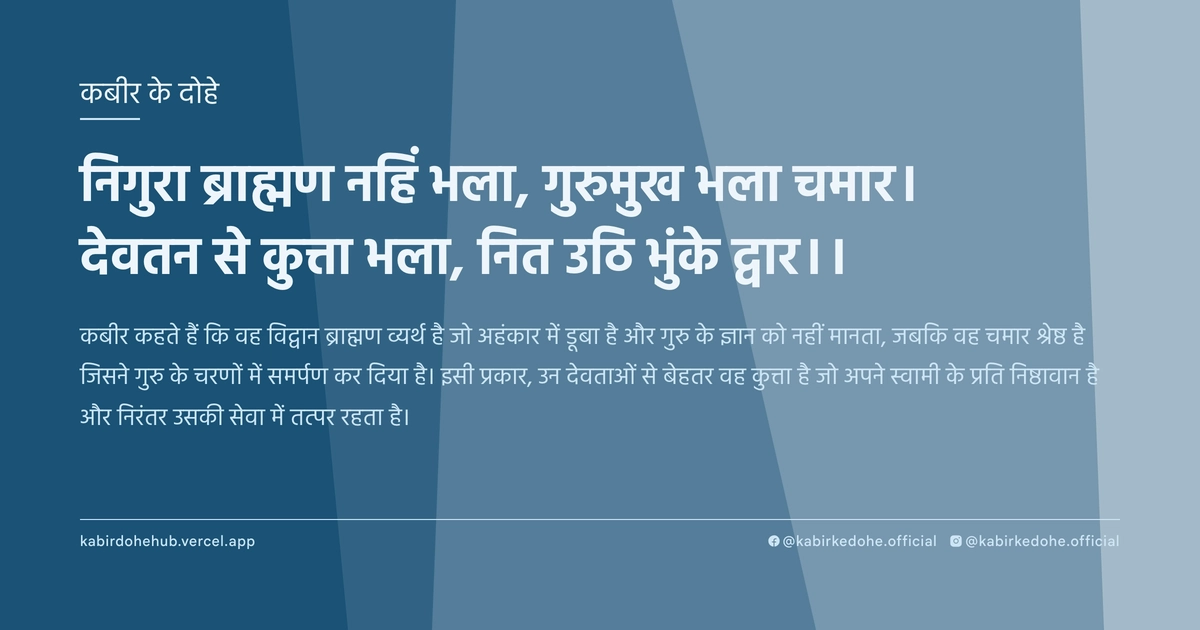
निगुरा ब्राह्मण नहिं भला, गुरुमुख भला चमार।
देवतन से कुत्ता भला, नित उठि भुंके द्वार।।
Nigura brahaman nahin bhala, gurumukh bhala chamaar. Devtan se kutta bhala, nit uthi bhunke dwaar.
इस पृष्ठ पर इस कबीर दोहे का अर्थ (meaning), हिंदी व्याख्या और अंग्रेज़ी अनुवाद, दार्शनिक विश्लेषण और व्यावहारिक जीवन सीख दी गई है। यह दोहा जाति विरोध (Anti-casteism) विषय से जुड़ा है — Kabir doha meaning and explanation in Hindi and English.
अर्थ (Meaning):
कबीर कहते हैं कि वह विद्वान ब्राह्मण व्यर्थ है जो अहंकार में डूबा है और गुरु के ज्ञान को नहीं मानता, जबकि वह चमार श्रेष्ठ है जिसने गुरु के चरणों में समर्पण कर दिया है। इसी प्रकार, उन देवताओं से बेहतर वह कुत्ता है जो अपने स्वामी के प्रति निष्ठावान है और निरंतर उसकी सेवा में तत्पर रहता है।
Kabir asserts that a learned Brahmin is useless if he is blinded by arrogance and ignores the Guru's wisdom, whereas a leather-worker (Chamar) is superior if he has surrendered to the Guru's guidance. Similarly, a loyal dog that wakes its master with devotion is better than distant deities who remain indifferent to the seeker's struggle.
व्याख्या (Interpretation):
यह दोहा बाहरी पहचान और आंतरिक पात्रता के बीच के विरोधाभास को दर्शाता है। यहाँ 'ब्राह्मण' केवल एक जाति नहीं, बल्कि उस बौद्धिक अहंकार का प्रतीक है जो स्वयं को श्रेष्ठ मानता है। 'चमार' उस विनम्रता का प्रतीक है जो सामाजिक तिरस्कार के बावजूद सत्य की खोज में समर्पित है। यह निरगुण भक्ति का सार है, जहाँ ईश्वर किसी विशेष कुल या शास्त्र में नहीं, बल्कि समर्पण और प्रेम में बसता है। माया यहाँ सामाजिक प्रतिष्ठा के रूप में कार्य करती है, जो मनुष्य को वास्तविक आत्म-ज्ञान से दूर रखती है। कबीर यह स्पष्ट करते हैं कि अद्वैत वेदांत के अनुसार आत्मा की कोई जाति नहीं होती; केवल अहंकार ही है जो विभाजन पैदा करता है। अंततः, यह दोहा सिखाता है कि सच्ची भक्ति कर्मकांडों से नहीं, बल्कि पूर्ण समर्पण (Prapatti) से प्राप्त होती है।
This couplet highlights the paradox between external identity and internal spiritual eligibility. Here, the 'Brahmin' is not merely a caste but a symbol of intellectual arrogance that perceives itself as superior. The 'Chamar' represents the humility that, despite social marginalization, remains devoted to the pursuit of Truth. This is the essence of Nirgun Bhakti, where the Divine resides not in a specific lineage or scripture, but in surrender and love. Maya operates here as social prestige, blinding the individual to the reality of the Atman. Drawing from Advaita Vedanta, Kabir emphasizes that the soul possesses no caste; only the ego creates divisions. Ultimately, the verse teaches that true liberation is achieved not through ritualistic purity, but through total surrender (Prapatti) and the annihilation of the false self.
दार्शनिक विश्लेषण (Philosophical Analysis):
कबीर का यह दोहा उनके युग के गहरे सामाजिक और धार्मिक संघर्षों की उपज है। उन्होंने उस समय की कट्टरता पर प्रहार किया जहाँ जन्म को ज्ञान का पैमाना माना जाता था। कबीर का दर्शन 'सहज मार्ग' है, जो किसी भी बाहरी आडंबर को नकारता है। वे ब्राह्मणवाद के उस रूप का विरोध करते हैं जो ज्ञान को सत्ता और विशेषाधिकार का साधन बनाता है।
दार्शनिक स्तर पर, यह सूफी मत के 'फना' (अहंकार का विलोपन) और अद्वैत वेदांत के 'अहं ब्रह्मास्मि' के करीब है। जब तक व्यक्ति अपनी सामाजिक पहचान (जैसे ब्राह्मण या चमार) को अपनी वास्तविक पहचान मानता रहता है, वह माया के जाल में फंसा रहता है। कबीर कहते हैं कि एक 'गुरुमुख' (गुरु के निर्देशों का पालन करने वाला) व्यक्ति, चाहे वह किसी भी सामाजिक स्तर का हो, उस व्यक्ति से कहीं अधिक उन्नत है जो शास्त्रों का ज्ञाता तो है पर हृदय से रिक्त है।
यहाँ कुत्ते का उदाहरण एक गहरा रूपक है। कुत्ता अपनी निष्ठा और निरंतरता के लिए जाना जाता है। कबीर संकेत देते हैं कि ईश्वर की प्राप्ति के लिए जटिल अनुष्ठानों की आवश्यकता नहीं है, बल्कि एक कुत्ते जैसी सरल, निस्वार्थ और निरंतर भक्ति की आवश्यकता है। यह उन लोगों पर कटाक्ष है जो देवताओं की पूजा तो करते हैं लेकिन अपने व्यवहार में मानवीय करुणा और निष्ठा का अभाव रखते हैं।
यह विश्लेषण हमें मनोवैज्ञानिक रूपांतरण की ओर ले जाता है। अहंकार (Ego) वह पर्दा है जो आत्मा और परमात्मा के मिलन को रोकता है। जब एक व्यक्ति अपनी सामाजिक श्रेष्ठता के भ्रम को त्याग देता है, तभी वह वास्तविक ज्ञान के लिए खुला होता है। कबीर का उद्देश्य किसी जाति को नीचा दिखाना नहीं, बल्कि 'श्रेष्ठता' की परिभाषा को बदलना था।
अंततः, यह दोहा भक्ति आंदोलन के उस क्रांतिकारी स्वर को दर्शाता है जिसने धर्म को मंदिर और पुरोहितों के चंगुल से निकालकर आम आदमी के हृदय तक पहुँचाया। यह संदेश देता है कि आध्यात्मिक पात्रता का आधार जन्म नहीं, बल्कि चरित्र और समर्पण है।
Kabir's couplet is a product of the profound social and religious conflicts of his era. He attacked the orthodoxy of his time, where birth was mistakenly equated with spiritual knowledge. Kabir's philosophy is the 'Sahaj Marg' (the Natural Path), which rejects all external pomposity and ritualistic facades.
On a philosophical level, this aligns with the Sufi concept of 'Fana' (annihilation of the ego) and the Advaita Vedanta realization of 'Aham Brahmasmi'. As long as an individual identifies with their social label—be it a Brahmin or a Chamar—they remain trapped in the web of Maya. Kabir argues that a 'Gurumukh' (one who faces the Guru), regardless of social standing, is far more evolved than a scholar who possesses textual knowledge but lacks heart-centered realization.
The metaphor of the dog is particularly poignant. A dog is defined by its loyalty and consistency. Kabir suggests that attaining the Divine does not require complex rituals, but rather a simple, selfless, and persistent devotion akin to that of a dog. This is a critique of those who perform elaborate worship of deities while lacking basic human compassion and loyalty in their daily lives.
This analysis leads us toward psychological transformation. The Ego is the veil that prevents the union of the Atman and Brahman. Only when a person discards the illusion of social superiority does the door to true gnosis open. Kabir's intent was not to demean any caste, but to redefine the very concept of 'superiority'.
Ultimately, this verse represents the revolutionary voice of the Bhakti movement, which liberated spirituality from the clutches of temples and priests, bringing it to the heart of the common man. It asserts that spiritual eligibility is rooted in character and surrender, not in the accident of birth.
मूल संदेश (Core Message):
- अहंकार ज्ञान का सबसे बड़ा शत्रु है।
- समर्पण ही वास्तविक आध्यात्मिक पात्रता है।
- बाहरी पहचान आत्मा की सच्चाई को नहीं बदलती।
- विनम्रता के बिना शास्त्र केवल बोझ हैं।
- सत्य जाति और कुल के बंधनों से परे है।
- ईश्वर प्रेम और निष्ठा का भूखा है, अनुष्ठानों का नहीं।
- Ego is the greatest enemy of true knowledge.
- Surrender is the only real spiritual eligibility.
- External identity does not alter the soul's truth.
- Without humility, scriptures are merely a burden.
- Truth transcends the boundaries of caste and lineage.
- The Divine craves love and loyalty, not rituals.
व्यावहारिक उदाहरण (Practical Example):
वाराणसी के एक पुराने घाट पर माधव नाम का एक वृद्ध बुनकर रहता था। वह सादा जीवन जीता था और कबीर के पदों को गुनगुनाता था। उसी शहर में पंडित शिवदत्त रहते थे, जिन्हें अपनी विद्वत्ता और कुल का बहुत गर्व था। शिवदत्त अक्सर माधव का उपहास करते थे कि एक साधारण बुनकर कैसे मोक्ष की बातें कर सकता है।
एक दिन शहर में एक महान संत आए। शिवदत्त ने अपनी सारी पोथियाँ और ज्ञान उनके सामने रखा, यह दिखाने के लिए कि वह कितने योग्य हैं। लेकिन संत ने उनकी बातों में केवल अहंकार देखा, सत्य नहीं। शिवदत्त की बातें शब्दों में तो महान थीं, पर उनमें प्रेम की कमी थी।
वहीं माधव, जो चुपचाप संत के चरणों में बैठा था, केवल एक बार उनके सामने झुका और अपनी आँखों में आँसू लेकर कहा, 'प्रभु, मुझे बस आपकी शरण चाहिए।' माधव के पास दिखाने के लिए कोई शास्त्र नहीं थे, केवल एक शुद्ध हृदय था।
संत ने सबके सामने घोषणा की, 'इस शहर का सबसे बड़ा ज्ञानी यह बुनकर है, क्योंकि इसने अपने 'मैं' को मार दिया है, जबकि वह विद्वान अभी भी अपने नाम के बोझ तले दबा है।'
शिवदत्त को यह सुनकर बहुत क्रोध आया, लेकिन तभी उन्होंने देखा कि माधव के चेहरे पर एक ऐसी शांति थी जो उन्होंने अपनी सारी किताबों में नहीं पाई थी। उन्हें अहसास हुआ कि वे केवल शब्दों के संग्रहकर्ता थे, जबकि माधव सत्य के अनुभवकर्ता थे।
शिवदत्त ने महसूस किया कि उनका 'ब्राह्मण' होना उनके लिए एक दीवार बन गया था। उन्होंने अपनी श्रेष्ठता का मुखौटा उतार फेंका और माधव के पास जाकर पूछा कि यह समर्पण कैसे आता है।
माधव ने मुस्कुराकर कहा, 'जब तक आप खुद को बड़ा मानेंगे, आप छोटे ही रहेंगे। जिस दिन आप खुद को शून्य मान लेंगे, पूरा ब्रह्मांड आपमें समा जाएगा।'
उस दिन शिवदत्त ने पहली बार अपनी पोथियों को किनारे रखा और एक शिष्य की तरह जीना सीखा। उनका अहंकार टूट गया और उन्होंने पाया कि सच्ची भक्ति किसी पद या जाति में नहीं, बल्कि पूर्ण समर्पण में है।
On an old ghat in Varanasi lived an elderly weaver named Madhav. He led a simple life, often humming the verses of Kabir. In the same city lived Pandit Shivdutt, a man consumed by pride in his scholarship and lineage. Shivdutt often mocked Madhav, questioning how a mere weaver could possibly speak of liberation.
One day, a renowned saint visited the city. Shivdutt presented all his scriptures and knowledge before the saint, attempting to prove his spiritual eligibility. However, the saint saw only arrogance in his words, not truth. Shivdutt's discourse was grand in vocabulary but void of love.
Meanwhile, Madhav sat silently at the saint's feet. He bowed once, with tears in his eyes, and simply said, 'Lord, I only seek your refuge.' Madhav had no scriptures to showcase, only a pure and open heart.
The saint declared before the crowd, 'The greatest sage in this city is this weaver, for he has slain his ego, while that scholar remains crushed under the weight of his own name.'
Shivdutt was initially enraged, but then he noticed a profound peace on Madhav's face—a serenity he had never encountered in all his books. He realized that while he was a collector of words, Madhav was an experiencer of Truth.
Shivdutt understood that his identity as a 'Brahmin' had become a wall between him and the Divine. He cast aside the mask of superiority and approached Madhav, asking how such surrender is achieved.
Madhav smiled and replied, 'As long as you consider yourself great, you will remain small. The day you become zero, the entire universe will reside within you.'
That day, Shivdutt set aside his manuscripts and learned to live as a true seeker. His ego shattered, and he discovered that true devotion lies not in rank or caste, but in absolute surrender.
अभ्यास मार्गदर्शन (Practice Guidance):
- प्रतिदिन 15 मिनट मौन बैठें और विचार करें कि आपकी कौन सी सामाजिक या पेशेवर पहचान आपके अहंकार को पोषण दे रही है।
- एक 'अहंकार डायरी' लिखें: उन क्षणों को दर्ज करें जब आपने किसी को खुद से कमतर महसूस कराया या अपनी श्रेष्ठता सिद्ध करने की कोशिश की।
- सेवा का अभ्यास: किसी ऐसे व्यक्ति की निस्वार्थ सेवा करें जिसे समाज 'निम्न' मानता है, और यह महसूस करें कि आप उनसे कुछ सीख रहे हैं।
- निदान चेकलिस्ट: क्या आप दूसरों की राय से विचलित होते हैं? क्या आप अपनी उपलब्धियों का बखान करते हैं? यदि हाँ, तो आप अभी भी 'निगुरा' (अहंकारी) अवस्था में हैं।
- Sit in silence for 15 minutes daily and contemplate which social or professional identity is feeding your ego.
- Maintain an 'Ego Journal': Record moments where you felt superior to others or attempted to prove your status.
- Practice selfless service: Serve someone whom society marginalizes, and consciously seek to learn a spiritual lesson from them.
- Diagnostic Checklist: Do you get easily offended by others' opinions? Do you frequently boast of your achievements? If yes, you are still in the state of 'Nigura' (arrogance).
चिंतन प्रश्न (Reflection Questions):
- यदि आपकी सारी डिग्रियां, पद और सामाजिक प्रतिष्ठा छीन ली जाए, तो आपके पास क्या बचेगा?
- आप अपनी श्रेष्ठता सिद्ध करने के लिए किन सूक्ष्म तरीकों का उपयोग करते हैं?
- क्या आप वास्तव में किसी ऐसे व्यक्ति का सम्मान कर सकते हैं जिसे समाज तुच्छ मानता है, बिना किसी दया भाव के?
- आपकी 'डिजिटल पहचान' (सोशल मीडिया प्रोफाइल) आपके वास्तविक आंतरिक स्वरूप को कितना ढक रही है?
- क्या आपका धर्म आपको दूसरों से जोड़ने का माध्यम है या खुद को अलग दिखाने का तरीका?
- वह कौन सा डर है जो आपको पूर्ण समर्पण करने से रोकता है?
- If all your degrees, titles, and social prestige were stripped away, what would remain of you?
- What subtle methods do you use to assert your superiority over others?
- Can you truly respect someone marginalized by society without feeling a sense of pity?
- How much does your 'digital identity' (social media profile) obscure your authentic internal self?
- Is your religion a bridge to connect with others or a tool to distinguish yourself?
- What is the specific fear that prevents you from practicing total surrender?