
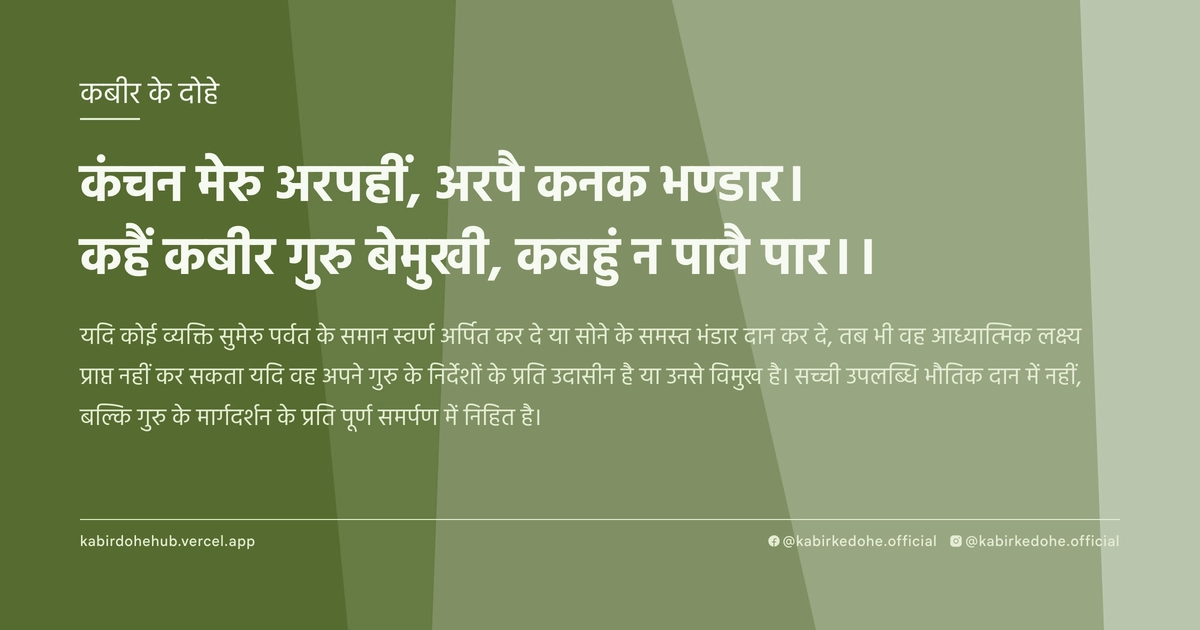
कंचन मेरु अरपहीं, अरपै कनक भण्डार।
कहैं कबीर गुरु बेमुखी, कबहुं न पावै पार।।
Kanchan meru araphin, arapai kanak bhandaar. Kahen kabir guru bemukhi, kabhun na paavai paar.
इस पृष्ठ पर इस कबीर दोहे का अर्थ (meaning), हिंदी व्याख्या और अंग्रेज़ी अनुवाद, दार्शनिक विश्लेषण और व्यावहारिक जीवन सीख दी गई है। यह दोहा गुरु महत्व (The Guru's Importance) विषय से जुड़ा है — Kabir doha meaning and explanation in Hindi and English.
अर्थ (Meaning):
यदि कोई व्यक्ति सुमेरु पर्वत के समान स्वर्ण अर्पित कर दे या सोने के समस्त भंडार दान कर दे, तब भी वह आध्यात्मिक लक्ष्य प्राप्त नहीं कर सकता यदि वह अपने गुरु के निर्देशों के प्रति उदासीन है या उनसे विमुख है। सच्ची उपलब्धि भौतिक दान में नहीं, बल्कि गुरु के मार्गदर्शन के प्रति पूर्ण समर्पण में निहित है।
Even if one offers a mountain of gold like Mount Meru or donates entire treasuries of wealth, they will never reach the ultimate spiritual shore if they remain indifferent or turned away from the guidance of the Guru. True liberation is not found in material sacrifice, but in absolute surrender to the spiritual teacher's wisdom.
व्याख्या (Interpretation):
यह दोहा भौतिक त्याग और आध्यात्मिक समर्पण के बीच के मूलभूत अंतर को स्पष्ट करता है। 'कंचन मेरु' और 'कनक भंडार' माया के उच्चतम प्रतीकों को दर्शाते हैं, जो यह बताते हैं कि बाहरी दुनिया की कोई भी संपत्ति मोक्ष का साधन नहीं बन सकती। यहाँ 'गुरु' केवल एक व्यक्ति नहीं, बल्कि वह दिव्य प्रकाश है जो अज्ञान के अंधकार को मिटाता है। 'बेमुखी' होने का अर्थ है अहंकार के कारण गुरु के ज्ञान को अस्वीकार करना। यह निरगुण भक्ति के उस सिद्धांत को पुष्ट करता है जहाँ आंतरिक रूपांतरण बाहरी कर्मकांडों से ऊपर है। जब तक साधक अपनी अहम्-वृत्ति को गुरु के चरणों में विलीन नहीं करता, वह संसार के चक्र में फंसा रहता है। अंततः, यह अद्वैत वेदांत की उस स्थिति की ओर संकेत करता है जहाँ केवल ज्ञान (Gnosis) ही बंधन से मुक्ति दिला सकता है।
This couplet elucidates the fundamental distinction between material renunciation and spiritual surrender. 'Kanchan Meru' and 'Kanak Bhandaar' serve as supreme symbols of Maya, illustrating that no amount of worldly wealth can purchase liberation. Here, the 'Guru' is not merely a person, but the divine light that dissipates the darkness of ignorance. To be 'Bemukhi' means to reject the teacher's wisdom due to the persistence of the ego. This reinforces the principle of Nirgun Bhakti, where internal transformation transcends external rituals. Until the seeker dissolves their ego at the feet of the guide, they remain trapped in the cycle of Samsara. Ultimately, it points toward the Advaita Vedanta realization that only experiential knowledge (Gnosis) can break the chains of duality.
दार्शनिक विश्लेषण (Philosophical Analysis):
कबीर का यह कथन उनके युग के उस सामाजिक-धार्मिक परिवेश की प्रतिक्रिया है जहाँ धर्म को दान-पुण्य और बाहरी आडंबरों से जोड़ा गया था। उस समय यह धारणा प्रचलित थी कि भारी मात्रा में स्वर्ण दान करने या मंदिरों-मस्जिदों में संपत्ति अर्पित करने से मोक्ष मिल जाता है। कबीर इस धारणा का खंडन करते हुए यह तर्क देते हैं कि मोक्ष कोई वस्तु नहीं है जिसे खरीदा जा सके, बल्कि यह चेतना का एक स्तर है जिसे केवल अनुशासन और मार्गदर्शन से प्राप्त किया जा सकता है।
दार्शनिक स्तर पर, यह दोहा सूफी मत के 'मुर्शिद' (मार्गदर्शक) और वेदांत के 'गुरु' की अवधारणा का संगम है। सूफीवाद में बिना मुर्शिद के आध्यात्मिक यात्रा असंभव मानी गई है, क्योंकि अहंकार व्यक्ति को स्वयं को धोखा देने के लिए प्रेरित करता है। कबीर यहाँ चेतावनी देते हैं कि भौतिक दान अक्सर अहंकार को और अधिक पुष्ट करता है ('मैं महान दानवीर हूँ'), जो कि आध्यात्मिक प्रगति में सबसे बड़ी बाधा है।
यह विश्लेषण हमें यह समझने में मदद करता है कि 'गुरु' वास्तव में वह दर्पण है जो साधक को उसके वास्तविक स्वरूप (आत्मा) से परिचित कराता है। जब साधक 'बेमुखी' होता है, तो वह वास्तव में अपने स्वयं के आंतरिक सत्य से विमुख होता है। यह विमुखता ही वह पर्दा है जिसे माया कहा जाता है।
कबीर का विरोध केवल धन के प्रति नहीं, बल्कि उस मानसिकता के प्रति है जो आध्यात्मिक सत्य को लेन-देन के सौदे के रूप में देखती है। वे स्पष्ट करते हैं कि निर्वाण या मोक्ष का मार्ग 'अहं' के विसर्जन से होकर गुजरता है, न कि 'अहं' के प्रदर्शन से।
अंततः, यह दोहा इस सत्य को स्थापित करता है कि ज्ञान की प्राप्ति के लिए पात्रता (Eligibility) आवश्यक है, और वह पात्रता केवल विनम्रता और गुरु के प्रति पूर्ण विश्वास से आती है। बिना समर्पण के, समस्त भौतिक संपत्तियां केवल बोझ हैं जो आत्मा को और अधिक भारी बनाती हैं।
Kabir's statement is a direct response to the socio-religious climate of his era, where spirituality was often conflated with philanthropy and external ostentation. The prevailing belief was that donating vast sums of gold or gifting wealth to temples and mosques could secure salvation. Kabir dismantles this notion, arguing that liberation is not a commodity to be purchased, but a state of consciousness attainable only through discipline and guidance.
Philosophically, this doha merges the Sufi concept of the 'Murshid' (spiritual guide) with the Vedantic 'Guru'. In Sufism, the spiritual journey is considered impossible without a guide because the ego constantly tempts the seeker into self-delusion. Kabir warns that material charity often reinforces the ego ('I am a great philanthropist'), which becomes the primary obstacle to spiritual ascent.
This analysis reveals that the 'Guru' is essentially a mirror reflecting the seeker's true nature (Atman). When a seeker is 'Bemukhi' (turned away), they are in reality estranged from their own inner truth. This estrangement is the veil known as Maya, which obscures the non-dual reality of existence.
Kabir's critique is not merely against wealth, but against the mindset that views spiritual truth as a transactional exchange. He clarifies that the path to Nirvana or Moksha passes through the dissolution of the 'I', not through the exhibition of the 'I'.
Ultimately, the doha establishes that eligibility for knowledge requires humility and absolute trust in the guide. Without surrender, all material possessions are merely burdens that weigh down the soul, preventing it from ascending toward the formless Divine.
मूल संदेश (Core Message):
- बाहरी आडंबर आध्यात्मिक शून्यता को नहीं भर सकते।
- अहंकार का त्याग ही वास्तविक स्वर्ण दान है।
- गुरु का मार्गदर्शन केवल निर्देश नहीं, बल्कि एक दर्पण है।
- समर्पण वह कुंजी है जो मोक्ष के द्वार खोलती है।
- सत्य बाहरी संपदा में नहीं, आंतरिक शुद्धि में है।
- External rituals cannot fill a spiritual void.
- The sacrifice of the ego is the only true gold.
- The Guru's guidance is not a command, but a mirror.
- Surrender is the key that unlocks the gates of liberation.
- Truth resides in inner purity, not in outer possessions.
व्यावहारिक उदाहरण (Practical Example):
वाराणसी के एक पुराने घाट पर माधव नाम का एक वृद्ध बुनकर रहता था। माधव अपनी कला में निपुण था और उसने जीवन भर बहुत धन कमाया था। वह शहर के सबसे बड़े मंदिरों में स्वर्ण पात्र और कीमती वस्त्र दान करता था, इस विश्वास में कि उसकी यह उदारता उसे मृत्यु के बाद स्वर्ग ले जाएगी। वह स्वयं को एक महान धर्मपरायण व्यक्ति मानता था।
एक दिन उसकी मुलाकात एक फकीर से हुई, जिसने माधव को बताया कि उसका दान केवल उसके अहंकार को पोषण दे रहा है, उसकी आत्मा को नहीं। फकीर ने उसे चुनौती दी कि वह एक महीने तक बिना किसी बाहरी प्रदर्शन के केवल अपने भीतर के क्रोध और अहंकार पर काम करे। माधव ने शुरू में इसे अहंकारपूर्ण माना और फकीर की बातों को अनसुना कर दिया।
कुछ समय बाद, माधव के जीवन में एक संकट आया। उसके परिवार में कलह बढ़ गई और उसकी व्यावसायिक प्रतिष्ठा गिरने लगी। उसने और अधिक दान करना शुरू किया, यह सोचकर कि शायद वह पर्याप्त पुण्य नहीं कमा रहा है। लेकिन शांति उसके जीवन से और दूर होती गई।
तब उसे फकीर की बात याद आई। वह फकीर के पास गया और अपनी हार स्वीकार की। उसने महसूस किया कि वह अब तक केवल 'दाता' की छवि से प्यार कर रहा था, न कि वास्तव में ईश्वर या सत्य से। उसने फकीर को अपना गुरु मान लिया और उनके निर्देशों के अनुसार मौन और आत्म-निरीक्षण का अभ्यास शुरू किया।
गुरु ने उसे सिखाया कि असली दान वह नहीं है जो तिजोरी से निकलता है, बल्कि वह है जो अहंकार की वेदी पर चढ़ाया जाता है। माधव ने अब स्वर्ण देना बंद कर दिया और दूसरों के प्रति करुणा और विनम्रता का अभ्यास करना शुरू किया।
उसने पाया कि जब उसने अपनी 'दाता' वाली पहचान छोड़ी, तो उसे वह शांति मिली जो लाखों स्वर्ण मुद्राओं से नहीं खरीदी जा सकती थी। उसके भीतर का द्वंद्व समाप्त हो गया और वह अपने परिवार के साथ सामंजस्य में रहने लगा।
माधव ने अनुभव किया कि वह अब तक एक अंधेरी सुरंग में सोने की दीवारें बना रहा था, जबकि गुरु ने उसे सुरंग से बाहर निकलने का रास्ता दिखाया।
अंत में, माधव एक ऐसा व्यक्ति बन गया जो बिना किसी दिखावे के सेवा करता था। उसकी आँखों में अब वह अहंकार नहीं था, बल्कि एक गहरी स्थिरता थी। उसने जान लिया कि गुरु की एक बात पर चलना, दुनिया की सारी दौलत लुटाने से कहीं अधिक मूल्यवान है।
On an ancient ghat in Varanasi lived an elderly weaver named Madhav. Madhav was a master of his craft and had accumulated significant wealth over his lifetime. He donated golden vessels and precious fabrics to the city's largest temples, believing that this generosity would secure his place in heaven after death. He viewed himself as a paragon of piety.
One day, he encountered a wandering dervish who told Madhav that his charity was merely feeding his ego, not his soul. The dervish challenged him to spend one month working on his inner anger and pride without any external display of piety. Initially, Madhav found this offensive and ignored the dervish's words.
Some time later, a crisis struck Madhav's life. Conflict grew within his family, and his professional reputation began to decline. He increased his donations, thinking perhaps he hadn't earned enough merit. However, peace drifted even further away from his life.
He then remembered the dervish's words. He approached the dervish and admitted his defeat. He realized that he had been in love with the image of being a 'donor' rather than loving the Truth or the Divine. He accepted the dervish as his Guru and began practicing silence and self-introspection as instructed.
The Guru taught him that true charity is not what leaves the treasury, but what is sacrificed on the altar of the ego. Madhav stopped the ostentatious gifting of gold and began practicing genuine compassion and humility toward others.
He discovered that once he relinquished his identity as a 'benefactor', he found a peace that millions of gold coins could never purchase. The internal conflict ceased, and he began living in harmony with his family.
Madhav realized that he had been building golden walls inside a dark tunnel, while the Guru had shown him the way out of the tunnel entirely.
Eventually, Madhav became a man who served others without any need for recognition. The arrogance in his eyes was replaced by a profound stillness. He understood that following one instruction of the Guru is more valuable than squandering all the wealth in the world.
अभ्यास मार्गदर्शन (Practice Guidance):
- प्रतिदिन 20 मिनट के लिए 'साक्षी भाव' का अभ्यास करें, जहाँ आप अपने विचारों को बिना किसी निर्णय के केवल देखें, जैसे कि आप एक बाहरी दर्शक हों।
- एक डायरी लिखें जिसमें आप उन क्षणों को दर्ज करें जब आपने 'सही' दिखने के लिए कोई कार्य किया हो। विश्लेषण करें कि उस कार्य के पीछे की प्रेरणा सेवा थी या अहंकार।
- व्यवहार परिवर्तन: अगले 30 दिनों तक कोई भी ऐसा दान या मदद न करें जिसका उल्लेख आप किसी अन्य व्यक्ति के सामने करें। इसे पूर्णतः गुप्त रखें।
- निदान चेकलिस्ट: क्या आप मार्गदर्शन मिलने पर रक्षात्मक (defensive) महसूस करते हैं? क्या आप अपनी उपलब्धियों का श्रेय स्वयं लेते हैं? यदि हाँ, तो आप अभी भी 'बेमुखी' अवस्था में हैं।
- Practice 'Witness Consciousness' (Sakshi Bhava) for 20 minutes daily, observing your thoughts without judgment, as if you were an external observer.
- Maintain a journal recording moments where you acted to 'appear' virtuous. Analyze whether the motivation was genuine service or a desire for validation.
- Behavioral Shift: For the next 30 days, perform acts of charity or help without mentioning them to anyone. Keep them entirely secret to starve the ego.
- Diagnostic Checklist: Do you feel defensive when receiving guidance? Do you instinctively take credit for your achievements? If yes, you are still in the 'Bemukhi' state.
चिंतन प्रश्न (Reflection Questions):
- क्या मेरा धर्म और आध्यात्मिकता वास्तव में मुझे विनम्र बना रहे हैं, या वे मेरे अहंकार को एक 'धार्मिक' मुखौटा दे रहे हैं?
- यदि मेरी सारी सामाजिक प्रतिष्ठा और संपत्ति छीन ली जाए, तो क्या मेरे पास ईश्वर के साथ जुड़ने का कोई वास्तविक माध्यम बचेगा?
- मैं किन लोगों को अपना 'गुरु' मानता हूँ, और क्या मैं उनके निर्देशों का पालन केवल तब करता हूँ जब वे मेरी मान्यताओं के अनुकूल होते हैं?
- मेरे जीवन में 'बेमुखी' होने का सबसे बड़ा कारण क्या है—डर, क्रोध या मेरी अपनी बौद्धिक श्रेष्ठता का भ्रम?
- क्या मैं सत्य की खोज कर रहा हूँ, या मैं केवल उस सत्य की पुष्टि चाहता हूँ जिसे मैं पहले से सही मानता हूँ?
- Is my religion and spirituality actually making me humble, or are they providing a 'pious' mask for my ego?
- If all my social status and wealth were stripped away, would I have any authentic means of connecting with the Divine?
- Who do I consider my 'Gurus', and do I follow their guidance only when it aligns with my pre-existing beliefs?
- What is the primary cause of my 'Bemukhi' (estrangement)—fear, anger, or the illusion of my own intellectual superiority?
- Am I seeking the Truth, or am I merely seeking confirmation of the truth I already believe to be correct?